

 CC-BY 4.0
Introduction
Aims of the study
In bioarcheology, the study of childhood through isotopic sequence or dataset allowing a longitudinal life tracking of an individual (frequently referred as “isobiography”) is a valuable source of information. However, such approaches face a number of limitations resulting from the methods used to align data with numerical ages. In this study, we propose to explore the effects of several methodological decisions regarding realignment: the choice of a dental maturation standard and the modelling method. We will discuss the consequences of these choices using the example of Neolithic individuals.
Childhood in prehistory
Since the late 1980s (Lillehammer, 1989), children and childhood have gradually become a subject of study in their own right in archaeology (Mays et al., 2017). Recent research has shown the importance of considering this part of the population in order to understand past societies holistically (e.g. Murphy, 2017; Crawford et al., 2018; Le Roy, 2022). Indeed, children are the members of society who ensure the perpetuation of culture and the survival of the populations to which they belong. Defining the different stages leading to adulthood is therefore essential for a better understanding of the society under study. These stages are determined not only by biology (e.g. puberty) but also by context, whether environmental (e.g. growth) or cultural (e.g. weaning). Moreover, it is the latter that informs social age classes marked by "rites de passage" (Van Gennep, 1901), which allow us to assess the social consideration (as well as its evolution) of children within the population (Le Roy, 2015). To date, few studies have focused on this aspect of ancient societies, with the few available focusing mainly on burial practices (e.g. Tillier, 1995; Dedet, 2008; Murphy & Le Roy, 2017; Le Roy, 2022), diet, especially around the weaning age (e.g. Herrscher & Séguy, 2019), or childhood diseases (e.g. Lewis, 2018). However, children are an integral part of all daily activities and social behaviours in the communities studied. In Gurgy Les Noisats (Yonne, France) during the Middle Neolithic, female children were no longer present in the local group after the age of seven, and women who gave birth were all from outside the local group (Rivollat et al., 2023). The variations in isotopes observed during adolescence are due to a combination of hormonal factors (Kurle et al., 2014; Feuillâtre et al., 2022), changes in physiological needs (Das et al., 2017), diet (Griffith et al., 2025) and status that are frequent at these ages (Lew-Levy et al., 2017). In the case of Gurgy, patrilocality seems to be the most important factor in explaining the constant difference between girls and boys in adolescence. It is therefore reasonable to assume that young girls move to other contemporary groups around the age of puberty in order to diversify the gene pool. Similarly, isotopic analyses of this population have revealed a change in diet at certain ages during childhood (between 7 and 8 years, then around 13 years, Rey et al., 2021). These pivotal ages are identical to those at which changes in burial practices are observed (Le Roy et al., 2018).
Characterising life-history variation using isobiography
The combination of longitudinal isotope data sequences, biological, osteobiographical and archaeological data (isobiography; ie. isotopic sequence or dataset allowing a longitudinal life tracking of an individual) offers the possibility of tracing the different events in an individual's life. While the study of sequential isotopic compositions on tooth enamel is well known in palaeoanthropological (review in Smith, 2013) and bioarchaeological (e.g. Zazzo et al., 2010) research, the use of dentine sequences has only recently been invested in anthropology. Recently developed tracking changes in the isotopic composition of carbon (δ13C) and nitrogen (δ15N) values contained in the collagen of dental tissue (dentine, e.g. Eerkens et al., 2011; Beaumont et al., 2013), whose age of formation can be estimated, provides a unique insight into the life history of individuals. This intra-individual longitudinal tracking allows (with greater precision than bone; Beaumont et al., 2018) physiological, economic and cultural changes, such as estimating the duration of breastfeeding, weaning (e.g. Eerkens et al., 2011) or feeding during childhood and adolescence. This high-resolution monitoring has documented physiological stress with a temporality useful for palaeosocial interpretations, such as the effects of famine in Ireland (Beaumont & Montgomery, 2016) or environmental changes between boys and girls during prehistoric adolescence (Rey et al., 2021). Technical advances in the sensitivity of isotope ratio mass spectrometers in recent years have greatly facilitated the use of this type of study, despite its invasive nature and impact on heritage. For example, it is possible to reduce sample sizes to increase the resolution of isotopic tracing, or to perform other analyses, such as measuring the isotopic composition of sulfur (δ34S), on the same sample (Sayle et al., 2019). The integration of δ34S values makes it possible to differentiate the influence of mobilities in relation to, for example, physiological responses to stress, growth or starvation (Goude et al., 2020a). Longitudinal monitoring of the three isotopic compositions mentioned allowing us a follow-up with a different interpretative perspective with regards to the consumption of protein resources (e.g. breast milk and weaning food), in relation to the supply environment (e.g. dietary changes during life, Beaumont & Montgomery, 2016; differences in resources produced, Goude et al., 2020b) and physiological responses (growth peaks, stress and changes in protein catabolism and gluconeogenesis; e.g. Hobson et al., 1993; Mekota et al., 2006; Neuberger et al., 2013). Also, as mentioned by Eerkens et al. (2011), secondary dentine, which is present in smaller amounts, can now be used to extend the individual longitudinal record. For example, Bernardini et al. (2023) have constructed an isobiography of a medieval woman in central Italy from which it is possible to trace the duration of weaning, mobility during infancy, care during deteriorating health and dietary status until death at around age 50.
The construction of an isobiography requires two main parameters: the ability to take successive and numerous samples along the tooth to obtain sufficient resolution of information, and the ability to provide an age estimate with the smallest possible margin of error for each section of dentine sampled. Czermak et al. (2020) propose to combine a reduced sample size (by biopsy punch) with an age adjustment that follows a specific growth rate for each part of the tooth (crown, crown-root junction - CRJ, root, apex). Other authors, such as Scharlotta et al. (2018), include a reflection on the reference frames to be used depending on the origin of the archaeological populations studied. By comparing different age alignment methods and tracing the isotopic sequences of three permanent molars with partially overlapping and successive growth (first molar - M1, second molar - M2 and third molar - M3), the authors show that there are dental growth discrepancies between Siberian Neolithic children and modern populations, and that a growth reference made from populations whose genetic heritage is closest to the archaeological individuals can partially mitigate age estimation errors. Furthermore, it has been shown that the rhythmicity of dental growth in humans is influenced by environmental variables that affect life history (life history variables; Ramirez Rozzi, 2016). Furthermore, the choice of dental maturation standards has an impact on the social inferences made: each standard will produce a different result for estimating the age of formation of dentine sections. The use of different standards makes it impossible to make inter-data comparisons. Therefore, it is crucial to find the right criteria when choosing an age estimation method by taking into account both the constraints linked to the material and to the use and comparison of previously obtained data.
This problem may be exacerbated in a context where many efforts are being made to provide (1) databases accessible to all (such as Amalthea, accessible in the Pandora consortium; Cocozza & Fernandes, 2021) and (2) statistical or machine learning tools to identify chronologies of behavioural change (e.g. estimation of age at weaning with the WEAN software, (Ganiatsou et al., 2023a; Ganiatsou et al., 2023b). Finally, this finding also raises questions about the preservation of bioarchaeological remains and the assessment of the risk/reward trade-off between sampling, heritage impact and scientific contributions. Nevertheless, isotopic and biomolecular sequence data from human remains are a unique source of information and have made a major contribution to understanding the geographical and historical variability of behaviours that raise questions about our present and future societies. In the context of such studies, it is necessary to establish a methodology for estimating age at death that is as reliable and accurate as possible in order to monitor the ages at which social change occurs.
Estimating age from tooth development
Teeth develop from a proliferation of epithelial cells that form a germ. Around the germ, ameloblasts deposit a matrix that mineralises to form enamel (Hillson, 2005, pp. 207–211). Odontoblasts deposit a dentine matrix to support dentine mineralisation. These two tissues, enamel and dentine, develop in successive layers following a relatively short chronology that is consistent between individuals. Observation of a stage of dental development is therefore a reliable method of determining an individual's age (Smith, 1991). Longitudinal biochemical analyses of dentinal sections are based on these growth rhythms and propose a correspondence between the location of the sections analysed and the stages of dental development. Numerous references have been published on the stages of mineralisation. They are mainly based on radiographic observations of current populations (Table 1).
Table 1 - Dental maturation benchmarks and eruption atlases commonly used to estimate ages at death in biological anthropology. Data compilation 1: the Atlas established by Gustafson and Koch (1974) is a compilation of data obtained by (Röse, 1909; Logan & Kronfeld, 1933; Klein et al., 1937; Cohen, 1940; Schour et al., 1941; Robinow et al., 1942; Kranz, 1946; Dahlberg & Bernhard Maunsbach, 1948; Stones et al., 1951; Clements et al., 1953; Gödény, 1955; Orban, 1957; Tegzes, 1959; Nolla, 1960; Fanning, 1961; Sjöberg, 1961; Carr, 1962; Moyers, 1963; Lysell et al., 1964; Haavikko, 1970); Data compilation 2: the Atlas established by Ubelaker (1978) is a compilation of data obtained by (Robinow et al., 1942; Steggerda & Hill, 1942; Meredith, 1946; Hurme, 1948; Demisch & Wartmann, 1956; Dahlberg & Menegaz-Bock, 1958; Kraus, 1959; Nolla, 1960; Moorrees et al., 1963a; Moorrees, et al., 1963b; Gilster et al., 1964; Moorrees, 1965; Christensen & Kraus, 1965; Coughlin & Christensen, 1966; Banerjee & Mukherjee, 1967; Lunt & Law, 1974; Anderson et al., 1976) NS1 According to (Schour et al., 1941), around 1000 teeth.
|
Type |
Reference |
Country |
N Boys |
N Girls |
N unknown sex |
Age range (years) |
|---|---|---|---|---|---|---|
|
Referential maturation |
Canada |
121 |
111 |
0 |
[3.5-18] |
|
|
Referential maturation |
Canada |
1446 |
1482 |
0 |
[2-20] |
|
|
Referential maturation |
Canada |
2705 |
1732 |
0 |
[2-19] |
|
|
Referential maturation |
Finland |
615 |
547 |
0 |
[2-21] |
|
|
Referential maturation |
Sweden |
122 |
90 |
0 |
[0-18] |
|
|
Referential maturation |
United Kingdom |
263 |
258 |
0 |
[4-9] |
|
|
Referential maturation |
United States of America |
136 |
110 |
0 |
[0-15] |
|
|
Referential maturation |
United States of America |
48 |
51 |
0 |
[0-25] |
|
|
Referential maturation |
United States of America |
25 |
25 |
0 |
[2-23] |
|
|
Referential maturation |
Poolsanguan mentioned in (Liversidge, 2003) |
United Kingdom |
279 |
255 |
0 |
[5-15] |
|
Referential maturation |
United States of America |
152 |
151 |
0 |
[2.2-18] |
|
|
Referential maturation |
Belgium |
1460 |
1418 |
0 |
[2-18] |
|
|
Referential maturation |
China |
465 |
438 |
0 |
[3-16] |
|
|
Atlas |
United Kingdom, Bangladesh |
336 |
355 |
13 |
[-0,25-24] |
|
|
Atlas |
data compilation 1 |
data compilation 1 |
data compilation 1 |
data compilation 1 |
[2-16] |
|
|
Atlas |
Germany |
535 |
458 |
0 |
[5-24] |
|
|
Atlas |
United States of America |
NS1 |
NS1 |
NS1 |
[-0,42-35] |
|
|
Atlas |
data compilation 2 |
data compilation 2 |
data compilation 2 |
data compilation 2 |
[-0,42-35] |
Another approach commonly used to estimate an individual's age from dental maturation is the use of atlases (Schour et al., 1941; Gustafson & Koch, 1974; Ubelaker, 1978; Kahl & Schwarze, 1988; AlQahtani et al., 2010). These graphically depict the development of the dentition by age class. Although commonly used, these atlases are difficult to apply to archaeological material as they require exhaustive observation of the dentition and do not allow for a per-tooth estimate (Cunningham et al., 2016). Furthermore, they do not estimate a numerical age, but propose an age class, which limits the statistical analysis of the results. Nevertheless, these atlases are favoured for the study of large series due to their ease of use (Arumugam & Doggalli, 2020).
Methodological challenges and new data on the French Neolithic
One of the objectives of the international WomenSOFar project (ANR-21-CE03-0008) is to identify the variability of parental and alloparental care behaviours within early Neolithic agropastoral societies (5th-4th millennium BC), by tracking breastfeeding and weaning periods. These data are then be compared with the geographical origins of human groups and sampling choices (e.g. maxillary versus mandibular) to understand the possible impact of environmental differences on these life trajectories and potentially on health status and growth. We propose first to evaluate the statistical processing of our sequential isotopic data on a limited number of individuals from the same geographical area, and then to open the debate on the methodological orientations to be favoured when interpreting data from individuals with different genetic and ecological origins.
Material and Methods
Archaeological context
The site of Le Brézet is located on the western edge of the Limagne Tertiary collapse trough in the Clermont-Ferrand basin (Puy-de-Dôme, France). The geological substratum, which consists of detrital lacustrine deposits and then carbonates, is overlain by marshy levels dating to around 11460 BP, which in turn are overlain by volcanic fallout. The latter disrupted hydrographic networks and contributed to the formation of marshy areas that persisted into modern times. It is in this environment that human societies have inhabited the area since the early Neolithic period. Apart from traces of intensive deforestation and the presence of layers of pottery, lithics and fauna found in these silty-sandy layers, with some objects suggesting deliberate deposition, this occupation did not reveal any settlement structures. The Neolithic burials can be divided into two groups (Blaizot, 2005). The first consists of 11 grouped individual burials dated by two radiocarbon dates to the Early Middle Neolithic (two radiocarbon dates: 4455-4334 BCE and 4539-4359 BCE, details available in Blaizot, 2005). These burials form part of a large area dedicated to the burial of the deceased, including those at Pontcharaud, 250 m S-E of Le Brézet (Loison et al., 1991). Individuals were laid on their right or left side, with the limbs bent, without any relation to sex or age at death. The swampy nature of the site had an impact on the taphonomy of the skeletons, with small pieces of bone dispersed by the movement of the water table. The second group consists of a child burial in a silo-like pit, from which the head bones were removed and then replaced in an upper sequence of the pit fill by the craniofacial blocks of two other immature individuals (Blaizot & Vernet, 2004). A recent revision of the deposit allows us to date this assemblage to 2550-2450 BCE (Letterlé, 2021, pp. 24–25).
Samples and isotope analysis
The material studied for this exploratory work consists of four molars from four different individuals from Le Brézet site dating to the Middle Neolithic. Their ages at death were estimated using methods based on dental (Schour et al., 1941; Moorrees et al., 1963a; Moorrees et al., 1963b) and skeletal maturation (Sundick, 1978; Birkner, 1980) and senescence (Masset, 1982; Lovejoy, 1985; Brooks & Suchey, 1990; Schmitt, 2005). Their sexes were estimated using methods based on pelvic sexual dimorphism (Brůžek, 1991, 1996; Murail et al., 2005). Three definitive second molars (left and right mandibular M2 and right maxillary M2) and one first molar (right maxillary M1) were documented (photographs, 3D reconstruction using an Artec Spider surface scanner), sampled and prepared in the laboratory for isotopic analysis of carbon (δ13C), nitrogen (δ15N) and sulfur (δ34S) along the tooth from the top of the crown to the end of the root (cf. example of technical protocol in Goude et al., 2020a; Figure 1, Table 2 and SI).
Teeth were selected in order to respect the best preservation conditions of Le Brezet osteological collection (unworn, without visible taphonomic damages or pathology). The three second molar (M2) have a growth period allowing to address different periods of life that are comparable between individuals and that can cover changes in life history, also known as social ages (cf. Rey et al. 2021). The first molar (M1) provides an initial glimpse into a life history more closely linked to the maternal-infant nexus. A sagittal section of each tooth was performed with a precision saw in order to obtain a complete section from the cusp to root (Figure 1). The section is smoothly abraded with aluminum oxide by a sandblaster in order to remove the external surface of the enamel and the root. The section is then demineralized in HCl (0.05M) at 4°C for several days and rinsed with distilled water after demineralization was completed. The section is then soaked in NaOH (0.125M) for 1h to remove potential remaining contaminants and rinsed. Transverse sections of dentine were realized with a sterilized scalpel, with a thickness of one millimeter when possible, or more when dentine was too fragile to allow for a thinner section. Each section is frozen and freeze-dried for 24h and then weight in tin caps (0.8 to 1.5 mg) for the IRMS analyses.

Figure 1 - Example of archiving and sampling protocol 3D surface scanner (Artec Spider; file available in SI), digital microscope photo (Hirox) of targeted second molar, before and after demineralization photo of analyzed tooth section.
Table 2 - Individual biological data and descriptions of sampled teeth
|
Tooth |
Individual ID |
Total length of the tooth dentine |
Tooth growth stage |
Nb of dentine section |
Age at death (est. from bone study) |
Sex |
Complementary information |
|---|---|---|---|---|---|---|---|
|
M2 mandibular left |
Brézet C324 9/1 |
19 mm |
Apex open |
15 |
15-19 yrs old |
F |
|
|
M2 mandibular Right |
Brézet C314 Sep 8 |
17.35 mm |
Apex closed |
10 |
Aged adult |
F |
|
|
M2 maxillar Right |
Brézet C313 sep 4 |
20 mm |
Apex closed |
14 |
15-19 yrs old |
M? |
Infectious disease |
|
M1 maxillar Right |
Brézet sep 2 |
19 mm |
R3/4 - Rc |
14 |
5-10 yrs old |
Undet |
Stable carbon (δ13C), nitrogen (δ15N), and sulfur (δ34S) isotopic compositions were determined on a Delta V Advantage continuous-flow isotope ratio mass spectrometer coupled via a ConfloIV to an IsoLink elemental analyser (Thermo Scientific, Bremen) at SUERC, East Kilbride as described in (Sayle et al., 2019).
Samples were combusted in the presence of oxygen in a single reactor containing tungstic oxide and copper wires at 1020°C to produce N2, CO2 and SO2. A magnesium perchlorate trap was used to eliminate water produced during the combustion process, and the gases were separated in a GC column heated between 70°C and 240°C. Helium was used as a carrier gas throughout the procedure. N2, CO2, and SO2 entered the mass spectrometer via an open split arrangement within the ConfloIV and were analysed against their corresponding reference gases.
The International Atomic Energy Agency (IAEA) reference materials USGS40 (L-glutamic acid, δ13CVPDB = –26.39 ± 0.04‰, δ15NAIR = –4.52 ± 0.06‰) and USGS41a (L-glutamic acid, δ13CVPDB = 36.55 ± 0.08‰, δ15NAIR = 47.55 ± 0.15‰) were used to normalise δ13C and δ15N values. An in-house standard (5-SAAG, δ34SVCTD = –12.86 ± 0.20‰) that is calibrated to the International Atomic Energy Agency (IAEA) reference materials IAEA-S-2 (silver sulfide, δ34SVCTD = 22.62 ± 0.08‰) and IAEA-S-3 (silver sulfide, δ34SVCTD = –32.49 ± 0.08‰) and the marine collagen USGS88 (δ34SVCTD = 17.10 ± 0.44‰) were used to normalise δ34S values. Results are reported as per mil (‰) relative to the internationally accepted standards VPDB, AIR and VCDT.
Normalisation was checked using the Elemental Microanalysis standards B2219 (Coldwater fish gelatin: δ13CVPDB = –16.33 ± 0.10‰, δ15NAIR = 14.71 ± 0.14‰, and δ34SVCTD = 17.05 ± 0.07‰), B2222 (Bovine gelatin: δ13CVPDB = –11.11 ± 0.091‰, δ15NAIR = 7.54 ± 0.12‰, and δ34SVCTD = 6.79 ± 0.08‰) and B2215 (fish gelatin: δ13CVPDB = –22.92 ± 0.10‰, δ15NAIR = 4.26 ± 0.12‰, and δ34SVCTD = 1.21 ± 0.24‰).
On the basis of the check and calibration standards, measurement precision (the pooled standard deviation of the check and calibration standards) was ±0.08‰ for δ13C (df=41), ±0.49‰ for δ15N (df=41), and ±0.32‰ for δ34S (df=29).
Measurement precision specific to duplicate samples (the pooled standard deviation of all samples analysed in duplicate) was ±0.03‰ for δ13C and ±0.26‰ for δ15N (df=12).
Precision (u(Rw)) was determined to be ±0.09‰ for δ13C and ±0.52‰ for δ15N on the basis of repeated measurements of calibration standards, check standards, and sample replicates.
Measurement accuracy or systematic error (u(bias)) was evaluated by comparing the known and measured δ13C, δ15N and δ34S values for B2219, B2222, and B2215, and was determined to be ±0.14‰ for δ13C, ±0.25‰ for δ15N, and ±0.55‰ for δ34S.
Choice of dental maturity reference systems
The two reference systems proposed by Coenraad F. A. Moorrees and colleagues (Moorrees et al., 1963a; Moorrees et al., 1963b) are among the most widely used for dental age estimation in archaeology (Cunningham et al., 2016, p. 165) due to their reliability (Buckberry, 2018, p. 59) and because this is one of the few longitudinal studies conducted. The raw data were published by (Harris, 2018; Harris & Buck, 2018), which facilitated their statistical processing. These references were established for three decidual teeth (lower C, M1 and M2) from longitudinal radiographs of 136 boys and 110 girls stored at the Fels Research Institute (Yellow Springs, Ohio, USA). For permanent teeth, radiographs of the entire mandibular dentition and maxillary incisors of 51 girls and 48 boys from Boston (Massachusetts, USA) were used as a reference. The atlas developed by Sakher J. AlQahtani and colleagues (AlQahtani et al., 2010) is the most commonly used reference for longitudinal isotopic studies (e.g. Beaumont & Montgomery, 2015; Fernández-Crespo et al., 2018; Van Der Haas et al., 2018; Scharlotta et al., 2018; Crowder et al., 2019; Czermak et al., 2020) due to its reliability and the fact that it documents the entire dentition over a large number of mineralisation stages (García-Mancuso & Salceda, 2014). This atlas was compiled from the skeletal remains of 91 boys, 72 girls and 12 individuals of undetermined sex, and the radiographs of 264 girls and 264 boys. For our study, we developed a statistical processing protocol to automate the alignment of dentine sections to these two reference frames. We used raw data from (Moorrees et al., 1963a; Moorrees et al., 1963b) formatted in (Harris, 2018; Harris & Buck, 2018) and (AlQahtani et al., 2010). These references are hereafter referred to as 'Moorrees et al.' and 'AlQahtani et al.'.
Modelling tooth growth and estimating the age of formation of dentine sections
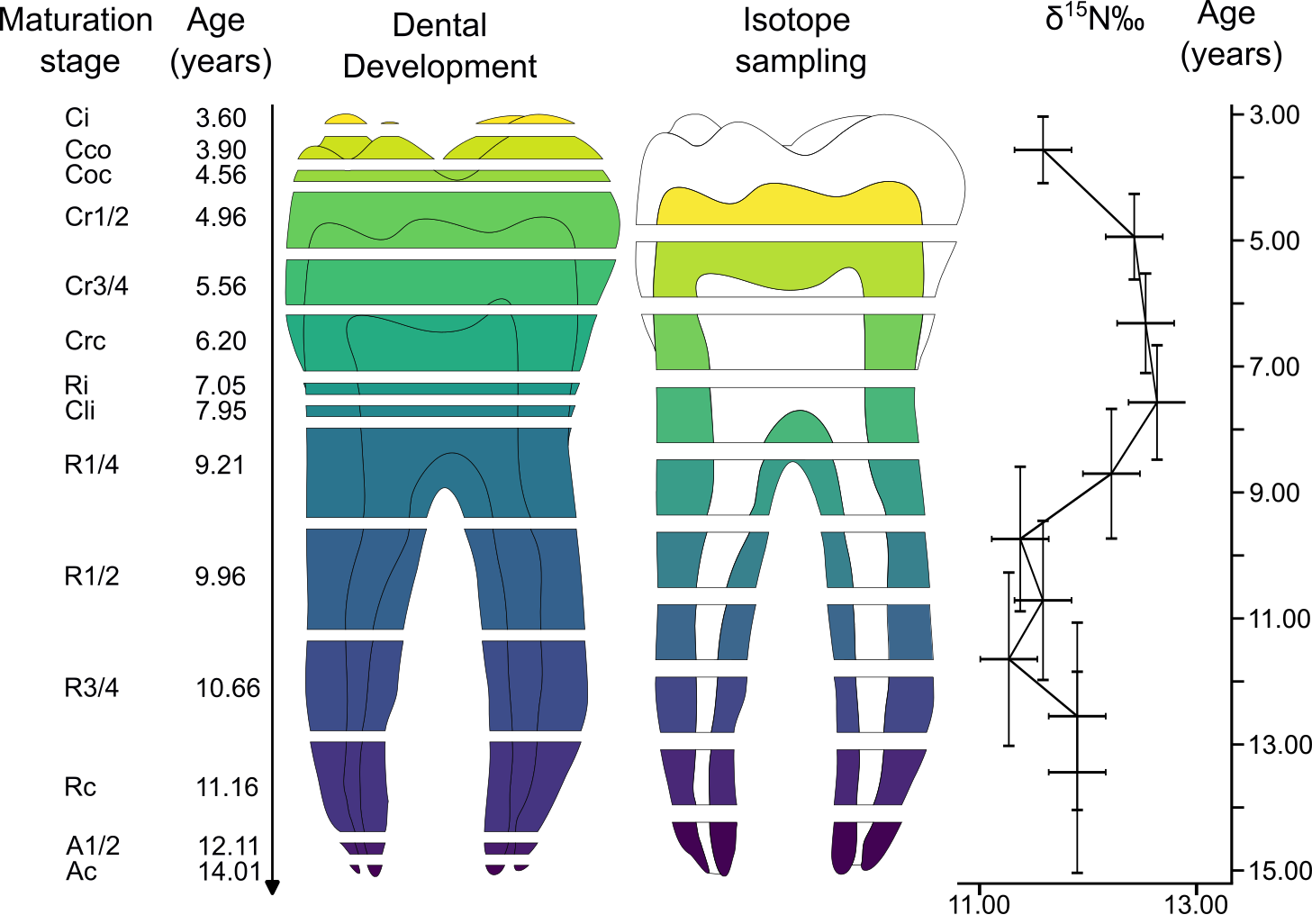
Data processing involved three main stages: alignment of the individual's sections to the reference frame, modelling of the dental maturation curve on the reference frame, and imputation of age values corresponding to the sections of the individual studied. All these operations were carried out using R software, version 4.3.0 (R core Team, 2024), and the complete script is available in SI. The sections are transformed into numerical sequences ranging from 0 to 1 by normalising their length in relation to the total tooth size. On the reference frame, the stage of maturation reached is used to assign the value 1, and the other stages are calculated in relation to the tooth lengths. Two modelling methods were used: a linear model (LM) and a generalised additive model (GAM, Hastie & Tibshirani, 1986). Based on the observations of Comte Philibert Guéneau de Montbelliard, Comte Georges-Louis Leclerc Buffon noted in 1777 that growth and maturation processes are not linear. There are variations in the rhythms of growth and maturation due to hormonal, nutritional, environmental and metabolic factors (Falkner and Tanner, 1978). These age-dependent variations in rhythm and amplitude are reflected in tooth formation processes (Cameron, 1978; Buckberry, 2018). We therefore chose to model tooth maturation as a function of age by implementing a GAM (Wood, 2017) using the mgcv package (Wood, 2011). We also applied linear modelling as LMs are good descriptive tools for measuring the effect of most auxological parameters (Cheung, 2013, p. 73). As such, they provide a simple and robust means of proposing an age class based on tooth maturation (Hillson, 2005; Reid & Dean, 2006). They are suitable for working with small-amplitude age classes where the processes are linear (Buckberry, 2018, p. 64). They are therefore particularly useful for aligning sections made on teeth still forming, where the LM is sufficient and the data size makes it difficult to establish reliable GAMs. We created these models using the lm() function in the stats package (R core Team, 2024). The final step is to invert the model to predict ages according to maturation stages and, more specifically, to predict ages according to the sections of the tooth under study (Figure 2).

Figure 2 - Principle of the alignment of isotope sampling to the dental maturation referential in order to calculate the age at formation of each section and create the isobiography. The example uses the data obtained for the M2 of the individual 8, the Moorrees et al. referential and a GAM model.
Results
The raw data per tooth includes the following information: Section ID, anatomical region to which it belongs, its length, and δ¹³C, δ¹⁵N, and δ³⁴S values (Table 3). The protocol for estimating the formation age of dentine sections calculates minimum, mean and maximum ages per section. Estimates for individual 8 (C314 Sep 8) are shown in Figure 3. All results are presented in SI.
Discussion
Modelling dental development reliably
To compare LMs and GAMs, we modelled them for all data from both tooth development references and then calculated adjusted coefficients of determination (R²adj), which measure the ratio of variance explained by the model to total variance (Dodge, 2007). Adjusted coefficients of determination are indicators of model quality and can have values between 0 and 1. If the values are close to 1, the variance explained is very close to the total variance and the model is considered satisfactory. We also compared the Akaike Information Criteria (AIC) of the LMs and GAMs to determine which model was best at describing the correlations. The AIC (Akaike, 1973) is a measure of the quality of a model by estimating the loss of information caused by its use. In our case, the model with the lowest AIC is considered to best describe the tooth mineralisation process.
The results for the Moorrees et al. referential are shown in Table 4 and those for the AlQahtani et al. referential are shown in Table 5.

Figure 3 - Comparison of modelisations of age of mineralisation for the tooth M2 inferior of individual 8 using both references (Moorrees et al., 1963a; Moorrees et al., 1963b; AlQahtani et al., 2010) and both mathematical models (Linear Model and Generalised Additive Model). The black line represents the mean age and the grey areas the min and max ages.
Table 3 - Input and output data for the individual 8 using AlQahtani et al. and Moorrees et al. references and LM and GAM model. Input: Sections length and anatomical position (C = crown; RC = crown-root junction; R = root; A = apex) with elemental and stable isotope compositions of carbon, nitrogen and sulfur and elemental ratios. Output: minimal, mean and maximal age estimation for each section by refrerences and model. Low elemental compositions are not reported in the tables and isotopic composition of bad preserved sections are removed (= failed). Preservation criteria follows international recommendations (DeNiro, 1985; Ambrose & Norr, 1993; van Klinken, 1999; Nehlich, 2015)
|
Brézet C314 Sep 8 |
Section length (mm) |
δ¹³C (%) |
δ¹⁵N (%) |
δ³⁴S (%) |
%C |
%N |
%S |
C:N Ratio |
C:S Ratio |
N:S Ratio |
AlQahtani et al. GAM age min (years) |
AlQahtani et al. GAM age med (years) |
AlQahtani et al. GAM age max (years) |
AlQahtani et al. LM age min (years) |
AlQahtani et al. LM age med (years) |
AlQahtani et al. LM age max (years) |
Moorrees et al. GAM age min (years) |
Moorrees et al. GAM age med (years) |
Moorrees et al. GAM age max (years) |
Moorrees et al. LM age min (years) |
Moorrees et al. LM age med (years) |
Moorrees et al. LM age max (years) |
|---|---|---|---|---|---|---|---|---|---|---|---|---|---|---|---|---|---|---|---|---|---|---|
|
C10 |
2.65 |
-20.5 |
11.6 |
4.5 |
44.1 |
15.6 |
0.17 |
3.3 |
677 |
206 |
2.50 |
2.50 |
2.50 |
3.31 |
3.91 |
5.17 |
3.09 |
3.61 |
4.12 |
3.44 |
4.01 |
4.57 |
|
C9 |
1.65 |
-20.4 |
12.4 |
4.7 |
43.8 |
15.7 |
0.19 |
3.3 |
601 |
184 |
4.39 |
5.26 |
7.23 |
4.56 |
5.34 |
6.65 |
4.29 |
4.95 |
5.61 |
4.40 |
5.08 |
5.75 |
|
R8 |
1.65 |
-20.6 |
12.5 |
4.3 |
43.1 |
15.7 |
0.2 |
3.2 |
576 |
180 |
6.06 |
7.50 |
9.53 |
5.81 |
6.76 |
8.13 |
5.52 |
6.29 |
7.06 |
5.36 |
6.15 |
6.93 |
|
R7 |
1.65 |
-20.4 |
12.6 |
5.6 |
44 |
15.5 |
0.19 |
3.3 |
607 |
184 |
7.53 |
9.14 |
11.00 |
7.07 |
8.19 |
9.61 |
6.63 |
7.51 |
8.40 |
6.32 |
7.22 |
8.11 |
|
R6 |
1.65 |
-20.3 |
12.2 |
5.5 |
44.9 |
15.9 |
0.21 |
3.3 |
566 |
171 |
8.81 |
10.45 |
12.15 |
8.32 |
9.61 |
11.08 |
7.61 |
8.62 |
9.62 |
7.29 |
8.29 |
9.29 |
|
R5 |
1.65 |
-20 |
11.4 |
4.7 |
41.8 |
15.5 |
0.16 |
3.1 |
719 |
229 |
9.95 |
11.60 |
13.15 |
9.57 |
11.03 |
12.56 |
8.51 |
9.63 |
10.75 |
8.25 |
9.36 |
10.47 |
|
R4 |
1.65 |
-20.1 |
11.6 |
5.1 |
42.2 |
15.8 |
0.16 |
3.1 |
706 |
227 |
11.02 |
12.66 |
14.07 |
10.83 |
12.46 |
14.04 |
9.35 |
10.58 |
11.81 |
9.21 |
10.43 |
11.65 |
|
R3 |
1.65 |
-20.5 |
11.3 |
3.1 |
42.2 |
14.9 |
0.18 |
3.3 |
637 |
193 |
12.04 |
13.67 |
14.94 |
12.08 |
13.88 |
15.50 |
10.15 |
11.49 |
12.83 |
10.17 |
11.5 |
12.82 |
|
R2 |
1.65 |
-20.4 |
11.9 |
2.8 |
43.2 |
15.2 |
0.17 |
3.3 |
699 |
211 |
13.03 |
14.64 |
15.78 |
13.33 |
15.31 |
15.50 |
10.92 |
12.37 |
13.82 |
11.13 |
12.57 |
14.00 |
|
A1 |
1.65 |
-20.7 |
11.9 |
2.2 |
43.6 |
14.1 |
0.15 |
3.6 |
757 |
210 |
14.00 |
15.50 |
16.50 |
14.50 |
15.50 |
15.50 |
11.68 |
13.24 |
14.79 |
12.10 |
13.64 |
14.02 |
Table 4 - R² and AIC of different models using Moorrees et al. reference (Moorrees et al., 1963a; Moorrees et al., 1963b).
|
Moorrees et al. NA |
Moorrees et al. F |
Moorrees et al. M |
|||||||||||||
|---|---|---|---|---|---|---|---|---|---|---|---|---|---|---|---|
|
GAM |
LM |
GAM VS LM |
GAM |
LM |
GAM VS LM |
GAM |
LM |
GAM VS LM |
|||||||
|
Tooth |
AIC |
R²adj |
AIC |
R²adj |
Lowest AIC |
AIC |
R²adj |
AIC |
R²adj |
Lowest AIC |
AIC |
R²adj |
AIC |
R²adj |
Lowest AIC |
|
cinfmin |
11.412 |
0.995 |
39.909 |
0.936 |
GAM |
18.461 |
0.991 |
38.142 |
0.945 |
GAM |
63.078 |
0.473 |
63.078 |
0.473 |
Equivalent |
|
cinfmed |
9.178 |
0.996 |
39.895 |
0.936 |
GAM |
16.879 |
0.993 |
38.195 |
0.945 |
GAM |
61.456 |
0.546 |
61.456 |
0.546 |
Equivalent |
|
cinfmax |
13.786 |
0.994 |
40.095 |
0.935 |
GAM |
15.526 |
0.993 |
38.253 |
0.945 |
GAM |
59.126 |
0.645 |
59.914 |
0.605 |
GAM |
|
m1infmin |
26.616 |
0.974 |
30.999 |
0.957 |
GAM |
27.370 |
0.972 |
31.147 |
0.956 |
GAM |
20.475 |
0.986 |
35.855 |
0.930 |
GAM |
|
m1infmed |
20.617 |
0.986 |
32.541 |
0.950 |
GAM |
25.857 |
0.976 |
30.964 |
0.957 |
GAM |
21.454 |
0.985 |
35.591 |
0.932 |
GAM |
|
m1infmax |
22.249 |
0.983 |
35.383 |
0.933 |
GAM |
24.675 |
0.979 |
30.868 |
0.958 |
GAM |
22.249 |
0.983 |
35.383 |
0.933 |
GAM |
|
m2infmin |
18.292 |
0.989 |
22.447 |
0.982 |
GAM |
18.650 |
0.988 |
22.530 |
0.982 |
GAM |
29.044 |
0.967 |
32.751 |
0.949 |
GAM |
|
m2infmed |
23.641 |
0.981 |
28.435 |
0.967 |
GAM |
18.390 |
0.989 |
22.733 |
0.981 |
GAM |
28.346 |
0.969 |
32.645 |
0.949 |
GAM |
|
m2infmax |
27.923 |
0.970 |
32.735 |
0.949 |
GAM |
18.211 |
0.989 |
22.929 |
0.981 |
GAM |
27.923 |
0.970 |
32.735 |
0.949 |
GAM |
|
I1supmin |
-0.876 |
0.998 |
13.176 |
0.975 |
GAM |
-0.876 |
0.998 |
13.176 |
0.975 |
GAM |
3.120 |
0.995 |
11.527 |
0.971 |
GAM |
|
I1supmed |
1.707 |
0.996 |
11.278 |
0.982 |
GAM |
0.120 |
0.997 |
13.031 |
0.975 |
GAM |
2.847 |
0.995 |
11.541 |
0.971 |
GAM |
|
I1supmax |
7.118 |
0.991 |
11.572 |
0.981 |
GAM |
0.885 |
0.997 |
12.916 |
0.976 |
GAM |
2.616 |
0.995 |
11.553 |
0.971 |
GAM |
|
I2supmin |
3.473 |
0.995 |
16.123 |
0.959 |
GAM |
3.215 |
0.995 |
16.249 |
0.958 |
GAM |
-8.300 |
0.999 |
13.757 |
0.955 |
GAM |
|
I2supmed |
7.060 |
0.991 |
14.772 |
0.967 |
GAM |
3.569 |
0.995 |
16.277 |
0.958 |
GAM |
-5.103 |
0.999 |
13.890 |
0.954 |
GAM |
|
I2supmax |
10.785 |
0.984 |
14.919 |
0.966 |
GAM |
3.863 |
0.995 |
16.301 |
0.957 |
GAM |
-3.052 |
0.998 |
14.004 |
0.953 |
GAM |
|
I1infmin |
1.454 |
0.993 |
9.586 |
0.966 |
GAM |
1.454 |
0.993 |
9.586 |
0.966 |
GAM |
-184.236 |
1.000 |
-205.044 |
1.000 |
Equivalent |
|
I1infmed |
1.051 |
0.994 |
9.536 |
0.966 |
GAM |
1.051 |
0.994 |
9.536 |
0.966 |
GAM |
-184.236 |
1.000 |
-205.044 |
1.000 |
Equivalent |
|
I1infmax |
0.722 |
0.994 |
9.499 |
0.966 |
GAM |
0.722 |
0.994 |
9.499 |
0.966 |
GAM |
-184.236 |
1.000 |
-205.044 |
1.000 |
Equivalent |
|
I2infmin |
4.940 |
0.986 |
4.940 |
0.986 |
Equivalent |
4.940 |
0.986 |
4.940 |
0.986 |
Equivalent |
-16.995 |
1.000 |
-16.553 |
1.000 |
GAM |
|
I2infmed |
-2.647 |
0.997 |
-1.007 |
0.996 |
GAM |
4.966 |
0.986 |
4.966 |
0.986 |
Equivalent |
-184.236 |
1.000 |
-205.044 |
1.000 |
Equivalent |
|
I2infmax |
-1.806 |
0.997 |
-0.970 |
0.996 |
GAM |
4.999 |
0.986 |
4.999 |
0.986 |
Equivalent |
-31.899 |
1.000 |
-17.613 |
1.000 |
GAM |
|
Cinfmin |
5.824 |
0.984 |
5.824 |
0.984 |
Equivalent |
5.824 |
0.984 |
5.824 |
0.984 |
Equivalent |
-14.779 |
1.000 |
-4.888 |
0.998 |
GAM |
|
Cinfmed |
5.661 |
0.984 |
5.661 |
0.984 |
Equivalent |
5.614 |
0.984 |
5.614 |
0.984 |
Equivalent |
-19.248 |
1.000 |
-4.802 |
0.998 |
GAM |
|
Cinfmax |
5.606 |
0.984 |
5.606 |
0.984 |
Equivalent |
5.443 |
0.985 |
5.443 |
0.985 |
Equivalent |
-7.032 |
0.999 |
-4.731 |
0.998 |
GAM |
|
Pm1infmin |
11.324 |
0.951 |
11.324 |
0.951 |
GAM |
11.324 |
0.951 |
11.324 |
0.951 |
GAM |
-55.625 |
1.000 |
3.428 |
0.968 |
GAM |
|
Pm1infmed |
10.783 |
0.956 |
10.783 |
0.956 |
GAM |
10.783 |
0.956 |
10.783 |
0.956 |
GAM |
-68.196 |
1.000 |
3.116 |
0.971 |
GAM |
|
Pm1infmax |
10.335 |
0.960 |
10.335 |
0.960 |
GAM |
10.335 |
0.960 |
10.335 |
0.960 |
GAM |
1.116 |
0.982 |
2.847 |
0.974 |
GAM |
|
P2infmin |
1.480 |
0.993 |
9.816 |
0.964 |
GAM |
1.480 |
0.993 |
9.816 |
0.964 |
GAM |
-18.006 |
1.000 |
-17.372 |
1.000 |
GAM |
|
Pm2infmed |
2.221 |
0.992 |
6.173 |
0.983 |
GAM |
1.294 |
0.993 |
9.505 |
0.966 |
GAM |
-173.113 |
1.000 |
-194.294 |
1.000 |
Equivalent |
|
P2infmax |
2.012 |
0.993 |
2.607 |
0.991 |
GAM |
1.138 |
0.994 |
9.244 |
0.968 |
GAM |
-18.887 |
1.000 |
-18.626 |
1.000 |
GAM |
|
M1infmin |
8.577 |
0.972 |
15.461 |
0.888 |
GAM |
2.616 |
0.991 |
12.083 |
0.943 |
GAM |
-67.273 |
1.000 |
8.339 |
0.836 |
GAM |
|
M1infmed |
3.717 |
0.989 |
17.027 |
0.847 |
GAM |
3.350 |
0.990 |
12.553 |
0.938 |
GAM |
4.487 |
0.932 |
7.962 |
0.855 |
GAM |
|
M1infmax |
-2.554 |
0.997 |
18.052 |
0.813 |
GAM |
3.945 |
0.989 |
12.932 |
0.933 |
GAM |
6.325 |
0.904 |
7.632 |
0.870 |
GAM |
|
M2infmin |
-0.285 |
0.995 |
12.857 |
0.934 |
GAM |
-0.285 |
0.995 |
12.857 |
0.934 |
GAM |
0.566 |
0.985 |
2.294 |
0.978 |
GAM |
|
M2infmed |
1.008 |
0.994 |
11.796 |
0.946 |
GAM |
-1.841 |
0.996 |
12.937 |
0.933 |
GAM |
-4.529 |
0.995 |
1.656 |
0.982 |
GAM |
|
M2infmax |
1.795 |
0.993 |
10.826 |
0.956 |
GAM |
-3.275 |
0.997 |
13.008 |
0.932 |
GAM |
1.031 |
0.986 |
1.079 |
0.985 |
GAM |
|
M3infmin |
-0.020 |
0.995 |
16.338 |
0.867 |
GAM |
6.764 |
0.981 |
12.321 |
0.940 |
GAM |
-14.106 |
1.000 |
-13.994 |
1.000 |
GAM |
|
M3infmed |
0.666 |
0.994 |
14.270 |
0.912 |
GAM |
7.196 |
0.979 |
12.490 |
0.938 |
GAM |
-192.547 |
1.000 |
-190.135 |
1.000 |
GAM |
|
M3infmax |
7.556 |
0.977 |
12.635 |
0.937 |
GAM |
7.556 |
0.977 |
12.635 |
0.937 |
GAM |
-77.896 |
1.000 |
-15.285 |
1.000 |
GAM |
Table 5 - R² and AIC of differents models using AlQahtani et al. reference (AlQahtani et al., 2010).
|
AlQahtani et al. |
|||||
|---|---|---|---|---|---|
|
GAM |
LM |
GAM VS LM |
|||
|
Tooth |
AIC |
R²adj |
AIC |
R²adj |
Lowest AIC |
|
i1supmin |
53.242 |
0.920 |
62.019 |
0.834 |
GAM |
|
i1supmed |
40.072 |
0.971 |
56.752 |
0.889 |
GAM |
|
i1supmax |
47.710 |
0.946 |
48.218 |
0.943 |
GAM |
|
i2supmin |
48.976 |
0.942 |
57.826 |
0.880 |
GAM |
|
i2supmed |
42.662 |
0.964 |
49.233 |
0.938 |
GAM |
|
i2supmax |
53.116 |
0.916 |
53.116 |
0.916 |
Equivalent |
|
csupmin |
34.275 |
0.981 |
45.994 |
0.952 |
GAM |
|
csupmed |
39.515 |
0.972 |
41.969 |
0.964 |
GAM |
|
csupmax |
44.124 |
0.958 |
44.156 |
0.958 |
GAM |
|
m1supmin |
34.539 |
0.981 |
58.197 |
0.876 |
GAM |
|
m1supmed |
39.681 |
0.971 |
40.768 |
0.968 |
GAM |
|
m1supmax |
39.726 |
0.971 |
41.435 |
0.966 |
GAM |
|
m2supmin |
40.253 |
0.970 |
44.067 |
0.958 |
GAM |
|
m2supmed |
43.464 |
0.960 |
43.464 |
0.960 |
Equivalent |
|
m2supmax |
40.379 |
0.962 |
40.379 |
0.962 |
Equivalent |
|
i1infmin |
49.115 |
0.927 |
59.628 |
0.813 |
GAM |
|
i1infmed |
41.913 |
0.960 |
57.386 |
0.845 |
GAM |
|
i1infmax |
37.742 |
0.972 |
47.133 |
0.934 |
GAM |
|
i2infmin |
50.853 |
0.915 |
55.995 |
0.862 |
GAM |
|
i2infmed |
42.050 |
0.959 |
51.620 |
0.904 |
GAM |
|
i2infmax |
38.584 |
0.969 |
47.158 |
0.934 |
GAM |
|
cinfmin |
42.795 |
0.954 |
42.795 |
0.954 |
Equivalent |
|
cinfmed |
34.146 |
0.979 |
37.924 |
0.969 |
GAM |
|
cinfmax |
43.530 |
0.951 |
43.530 |
0.951 |
Equivalent |
|
m1infmin |
41.307 |
0.960 |
41.684 |
0.958 |
GAM |
|
m1infmed |
37.500 |
0.970 |
37.503 |
0.970 |
GAM |
|
m1infmax |
43.481 |
0.953 |
44.817 |
0.946 |
GAM |
|
m2infmin |
35.314 |
0.977 |
43.241 |
0.952 |
GAM |
|
m2infmed |
42.051 |
0.957 |
42.051 |
0.957 |
Equivalent |
|
m2infmax |
41.445 |
0.959 |
41.445 |
0.959 |
Equivalent |
|
I1supmin |
39.338 |
0.967 |
40.223 |
0.963 |
GAM |
|
I1supmed |
38.834 |
0.967 |
38.834 |
0.967 |
Equivalent |
|
I1supmax |
35.389 |
0.975 |
35.389 |
0.975 |
Equivalent |
|
I2supmin |
46.048 |
0.942 |
47.221 |
0.934 |
GAM |
|
I2supmed |
37.977 |
0.969 |
37.977 |
0.969 |
Equivalent |
|
I2supmax |
35.083 |
0.976 |
35.083 |
0.976 |
Equivalent |
|
Csupmin |
27.176 |
0.988 |
42.298 |
0.956 |
GAM |
|
Csupmed |
28.125 |
0.987 |
29.867 |
0.984 |
GAM |
|
Csupmax |
24.341 |
0.990 |
24.341 |
0.990 |
Equivalent |
|
Pm1supmin |
26.212 |
0.988 |
26.212 |
0.988 |
Equivalent |
|
Pm1supmed |
18.568 |
0.994 |
18.568 |
0.994 |
Equivalent |
|
Pm1supmax |
35.913 |
0.974 |
35.913 |
0.974 |
GAM |
|
Pm2supmin |
36.748 |
0.972 |
36.748 |
0.972 |
GAM |
|
Pm2supmed |
19.451 |
0.993 |
19.451 |
0.993 |
Equivalent |
|
Pm2supmax |
33.213 |
0.979 |
33.213 |
0.979 |
Equivalent |
|
M1supmin |
32.048 |
0.982 |
32.598 |
0.980 |
GAM |
|
M1supmed |
25.084 |
0.989 |
25.084 |
0.989 |
Equivalent |
|
M1supmax |
39.515 |
0.965 |
39.515 |
0.965 |
Equivalent |
|
M2supmin |
30.392 |
0.985 |
40.179 |
0.963 |
GAM |
|
M2supmed |
15.542 |
0.995 |
15.542 |
0.995 |
Equivalent |
|
M2supmax |
38.999 |
0.967 |
38.999 |
0.967 |
Equivalent |
|
M3supmin |
31.033 |
0.984 |
42.483 |
0.955 |
GAM |
|
M3supmed |
21.497 |
0.992 |
21.497 |
0.992 |
Equivalent |
|
M3supmax |
43.366 |
0.954 |
45.064 |
0.944 |
GAM |
|
I1infmin |
42.355 |
0.957 |
43.684 |
0.951 |
GAM |
|
I1infmed |
30.467 |
0.984 |
32.025 |
0.981 |
GAM |
|
I1infmax |
33.543 |
0.979 |
33.543 |
0.979 |
Equivalent |
|
I2infmin |
41.603 |
0.958 |
41.603 |
0.958 |
Equivalent |
|
I2infmed |
28.630 |
0.986 |
29.377 |
0.985 |
GAM |
|
I2infmax |
36.404 |
0.973 |
36.404 |
0.973 |
Equivalent |
|
Cinfmin |
38.735 |
0.969 |
40.098 |
0.963 |
GAM |
|
Cinfmed |
23.579 |
0.991 |
27.186 |
0.987 |
GAM |
|
Cinfmax |
20.341 |
0.993 |
23.109 |
0.991 |
GAM |
|
Pm1infmin |
32.267 |
0.982 |
33.866 |
0.978 |
GAM |
|
Pm1infmed |
15.060 |
0.995 |
15.060 |
0.995 |
Equivalent |
|
Pm1infmax |
34.868 |
0.976 |
34.868 |
0.976 |
Equivalent |
|
Pm2infmin |
33.180 |
0.980 |
34.562 |
0.977 |
GAM |
|
Pm2infmed |
29.324 |
0.986 |
31.563 |
0.982 |
GAM |
|
Pm2infmax |
33.504 |
0.979 |
33.504 |
0.979 |
Equivalent |
|
M1infmin |
24.514 |
0.991 |
31.658 |
0.982 |
GAM |
|
M1infmed |
28.385 |
0.987 |
29.960 |
0.984 |
GAM |
|
M1infmax |
41.856 |
0.959 |
43.333 |
0.952 |
GAM |
|
M2infmin |
24.511 |
0.991 |
29.798 |
0.984 |
GAM |
|
M2infmed |
15.542 |
0.995 |
15.542 |
0.995 |
Equivalent |
|
M2infmax |
29.205 |
0.986 |
37.364 |
0.971 |
GAM |
|
M3infmin |
45.423 |
0.946 |
50.611 |
0.912 |
GAM |
|
M3infmed |
34.298 |
0.977 |
34.298 |
0.977 |
Equivalent |
|
M3infmax |
38.353 |
0.968 |
38.353 |
0.968 |
Equivalent |
The results show that the various models are satisfactory, with the exception of those for lower deciduous canines on the Moorrees et al. male reference frame, for which the adjusted R²s of LM and GAM do not exceed 0.65. Our analysis protocol is therefore unsuitable for working on decidual canines using the Moorrees et al. reference for boys. For all teeth, the GAMs have lower or equal AICs than the LMs. GAMs are therefore best suited to describe tooth mineralisation processes. However, when tooth maturation is incomplete, GAMs have fewer reference points, which reduces their reliability. If only the crown or root is being studied, an LM is preferable.
Impact of accounting standards chosen on interpretations
Substantial differences in age estimates are found depending on the choice of statistical model and frame of reference. For the same frame of reference, a difference in model can lead to a difference of 2.67 years, and for the same model, a difference in frame of reference can lead to a difference of 3.39 years. The choice of reference frame can introduce a bias in the interpretation of the results obtained. Over- or underestimation of age can further complicate data analysis. Social changes are often, although not systematically, inferred from biological transformations such as puberty and/or growth, which allow individuals to access new functions due to their physical or biological development (Bocquentin, 2003; Barbot & Hunter, 2012). Thus, an error in age estimation may hinder the identification of the initial cause of the observed change and, consequently, the interpretation of the results. AlQahtani et al. is based on the observation of the presence of maturation stages for a given age in a set of individuals, whereas Moorrees et al. notes the age of appearance of the stages in longitudinal data and distinguishes between the sexes. In this way, Moorrees et al. standards records variations in the rate of mineralisation as a function of age, a phenomenon that is less apparent in AlQahtani et al. data. This essential point makes the Moorrees et al. reference the preferred choice where applicable, as it is closer to the physiological reality of the dental mineralisation process. Secular variations in pubertal age (Parent et al., 2003) appear to be due to a combination of socio-economic factors (Huen et al., 1997; Krstevska-Konstantinova et al., 2001; Teilmann et al., 2006), nutritional factors (Stark et al., 1989; Wang, 2002; Sloboda et al., 2007; Lee et al., 2007), genetic factors (Guo et al., 2006; Rothenbuhler et al., 2006; Zhou et al., 2007) and stresses experienced during growth and development (Theintz et al., 1989; Georgopoulos et al., 1999). In addition, the social responses associated with biological changes are fundamental to understanding the populations studied. For example, the accuracy of age estimation in relation to sex is crucial in studies of gender and differences between boys and girls. These elements can inform us about the social organisation of societies (patrilocality vs. matrilocality, inequality vs. cooperation between the sexes, intersectionality in the definition of gender), where differences may emerge as early as childhood. For this reason, the use of the Moorrees et al. reference, which differentiates dental development according to sex, is preferable. Furthermore, the age of weaning in Palaeolithic hunter-gatherer societies, for example, is an essential element in understanding these populations (Ellison, 1995). In a nomadic society, the dependence of the young child on the group, and in particular on the nursing mother (who may be a woman other than the biological mother), affects the whole community. Travelling, migration and group size are partly determined by this practice (Waters-Rist, 2019). Overestimating or underestimating the age of weaning can therefore distort our interpretations in an archaeological context. Finally, with regard to the social age classes that we seek to identify using this method, any error in age estimation can also affect the definition of age pivots, thus distorting the intervals that mark social transitions and, consequently, our understanding of group functioning.
On the basis of the figures proposed in SI, we discuss below the comparison of the two frames of reference (Figure 4) in the context of a bioanthropological and archaeological interpretation. Individual 8 (C314 Sep 8) with the GAM model is chosen as the first example. Firstly, we can see that changes in the isotopic profiles for each of the elements are recorded at different ages depending on the reference frame. In the case of carbon, the variation in isotopic composition throughout childhood is limited to between -20.5 and -20.0‰, which is consistent with the local environment and the isotopic values recorded on bone collagen (cf. SI). Here, the time lag of about 2 years observed between the two reference frames (cf. vertical lines) is not controversial, as an environmental change is not clearly supported by the δ13C value. On the other hand, for the δ15N value, we observe a decrease of 1.3‰, which is observed at approx. 9.5 years using AlQhatani et al. and at ca. 7.5 years according to Moorrees et al., which is accompanied by a decrease in δ34S value of 3.4‰ at ca. 10 years (AlQhatani et al) or ca. 8 years (Moorrees et al.). These roughly related changes for these two isotopic compositions show a move away for S and a move closer for N compared to the values recorded on bone. These changes could indicate a change in dietary protein sources and/or mobility in an environment with little variation in δ13C for about two years. At 11.5 years according to AlQhatani et al. and ca. 9.5 years using Moorrees et al., the δ15N value of the dentine increases slightly, but for sulfur the δ34S recorded value continues to decrease and deviate from the variability recorded on the adult bones of Le Brézet and other Neolithic individuals from the area. If we rely primarily on δ34S value to discuss a change during the life of the individual (in this case, mobility), we find that the two pivotal ages according to the chosen frame of reference are close to what has been observed in other Neolithic groups, notably at Gurgy (Yonne, France) (first proposed changes around age 8 using AlQahtani et al. frame of reference, Rey et al. 2021). Consequently, if we wish to establish a precise age for large-scale statistical comparisons, the difference of two years between the two models is unacceptable. However, in the case of a broader age estimate (e.g. infancy, childhood, pre-adolescence, adolescence), which would only allow us to identify a moment in life or a moment of "maturity", the observed age gap allows for empirical reflection, which must then be confronted on a case-by-case basis with other archaeological (e.g. grave goods, body position, cf. Le Roy 2015) and biological data. In the case of Le Brézet, the hypothesis of an environmental or dietary change around the age of 8 is not observed for other M2s (cf. SI), for which other isotopic variations occur well before this age range, for example for individual 4.
As the intra-individual comparative approach shows, the choice of reference frame for dental maturation can strongly modify the interpretation of the data. These results reflect two findings already observed in studies of the reliability of such reference frames: AlQahtani et al. tends to overestimate age in many populations (Sousa et al., 2020; Alkandiri et al., 2021; Vila-Blanco et al., 2023), while Moorrees et al. tends to underestimate age (Liversidge et al., 2010; Tony L. et al., 2016; Alkandiri et al., 2021; AlOtaibi & AlQahtani, 2023; Vila-Blanco et al., 2023). These phenomena, which are difficult to quantify in prehistoric populations, must be considered when interpreting results, especially when inferences of social age based on dental age are proposed (Rey et al., 2021).
Impact of choice of statistical model on interpretations
In the second example chosen, Individual 2 (Sep 2) presents only isotopic profiles of M1 dentine from the AlQhatani et al. reference data (GAM and LM shown in Figure 5). Based on bone maturation, the child's age at death is estimated to be between 5.5 and 10 years. The tooth examined was not complete at the time of death, so the last section of dentine recorded the very last moments of life. The isotopic profiles of the dentine are consistent for carbon and nitrogen, whatever the model for this Individual. A first 'break' can be seen at around 3 years of age, which may mark the complete end of the child's weaning period. For these two elements, a second "break" can be suggested at around 7.5 to 8 years of age. In contrast to Brézet's other individual, who died later in adulthood, Individual 2 may have been exposed to unfavourable physiological and sanitation conditions, which may have led to an early death. The very last section of dentine shows a decrease in δ13C value and an increase in δ15N value. This type of pattern is regularly observed in archaeology for the dentine of immatures (e.g. tuberculosis cases, Goude et al., 2020a) and may be related to metabolic disturbances, including remobilisation of body proteins and lipid reserves in cases of malnutrition, as shown by several studies in medical settings (Mekota et al., 2006; Neuberger et al., 2013) and during starvation episodes (Beaumont & Montgomery, 2016). In contrast to the example described above, here the estimation of age at death may have a greater impact on archaeological interpretations. The end of lactation and weaning are crucial moments in an individual's life, and accurately estimating this transition to solid food incorporates the many discourses in the literature about female fertility and childcare, indicators of population survival. On a growing tooth, the estimation of the age at death, especially for an individual marked by a possible indicator of poor nutritional status, allows the refinement of an age that is sometimes too broad, based on bone measurements. Estimates of the age of formation of dentine sections are subject to a variable margin of uncertainty, depending on the model used. A discrepancy of 1, 2 or even more years is therefore unacceptable for these scientific purposes.

Figure 4 - Isotopic compositions of dentine sections from Individual Brézet 8 (M2, female) as a function of an age estimate based on the GAM model and according to the reference (AlQahtani et al., 2010) (purple) and (Moorrees et al., 1963a; Moorrees et al., 1963b) (green). Variations in bone isotope compositions recorded for Brézet (blue, this study, N = 3) and for another Neolithic series from Clermont Ferrand (Goude et al., 2013, 2025, N Carbon and Nitrogen = 38, N Sulfur = 37) are reported. The standard deviation on the isotopic measurement is reported for each element (between ± 0.25‰ and ±0.14‰). Coloured vertical lines indicate a discussed breakpoint for each curve.

Figure 5 - Isotopic compositions of dentine sections from Individual Brézet 2 (M1) as a function of an age estimate based on the GAM and LM models and according to the AlQhatani et al. reference. Variations in bone isotopic compositions recorded for Brézet (blue, this study, N = 3) and for another Neolithic series from Clermont Ferrand (Goude et al., 2013, 2025, N Carbon and Nitrogen = 38, N Sulfur = 37) are reported. The standard deviation on the isotopic measurement is reported for each element (between ± 0.25‰ and ±0.14‰). Arrows indicate a discussed breakpoint for each curve.
Conclusion
The life histories of ancient populations and the possibilities of longitudinal analysis are topics that are increasingly being incorporated into archaeological studies, encouraging new ways of thinking about the mutability of people's statuses over the course of their lives. This approach allows us to move away from fixed, 'binary' interpretations and to shed new light on intra- and inter-, individual- and population-level variability. When applied to the Neolithic, the concept of 'social ages', which combines archaeological and biological data, changes our understanding of population dynamics. These 'social ages' can be partially identified by isobiography, making it an increasingly popular approach to the study of ancient populations. However, the interest of this method is accompanied by limitations related, on the one hand, to the biology of growth and, on the other, to the application of current references to past populations. In this context, the ANR WomenSOFar project, which aims to understand the variability of social status between men and women over the course of their lives, has studied the isobiography of several Neolithic individuals in France and the Mediterranean. Among these individuals, those from the site of Le Brézet provide the first keys to understanding a chronocultural context that is already well documented from both archaeological and anthropological points of view: the French Middle Neolithic (4500-3500 BCE).
In order to study the variations in δ13C, δ15N and δ34S isotopic values along dental sections, we propose a statistical analysis protocol to estimate the formation age of the different sections according to the choices specific to each researcher. We used the two dental maturation reference frames most widely used in the international biological anthropology community (Moorrees et al., 1963a; Moorrees et al., 1963b; AlQahtani et al., 2010) and tested two types of modelling: linear models (LM) and generalised additive models (GAM). Our results show that GAMs are best suited to describe the non-linear process of tooth mineralisation. However, LMs remain reliable and adequate, particularly when it comes to studying teeth in the process of formation or resorption. The data provided by the Moorrees et al. studies are preferable for modelling because (1) they are longitudinal, (2) mineralisation rates can be differentiated by sex, and (3) the measurements correspond to numerical ages rather than age classes. However, AlQahtani et al. covers the entire deciduous and permanent dentition, whereas Moorrees et al. is based on the observation of three deciduous teeth (lower c, m1 and m2) and ten permanent teeth (maxillary I and all mandibular teeth). The choice of teeth therefore determines the frame of reference to be used. Both reference frames are also subject to age overestimation and underestimation biases, the effects of which on prehistoric populations are poorly understood.
Although exploratory, this work demonstrates that an isobiographical study based on dentinal sections must first take into account the preservation and availability of dental material. This inventory defines the potential for analysis and interpretation and can be used as a decision-making tool to optimise data collection in relation to the invasive impact on the sample. We therefore recommend anticipating and projecting the type of data expected, as well as considering potential and already identified interpretative biases, before requests to collect archaeological material are proposed and/or granted. If a single individual is being studied, we recommend that all models be run, and the different results taken into account when making inferences about biological age. If a series is being studied or several individuals are being compared, it is preferable to use a single model and a single frame of reference to make the data comparable, while recognising the inherent limitations of mathematical models and frames of reference.
Formatted versions of the referentials and an annotated version of the R script are provided in SI. The script is optimised for formatted data in the same way as the input data in Table 3.
Acknowledgements
The authors thank the SRA Auvergne Rhône Alpes for the sampling authorisation, Muriel Gandelin and Christelle Gaudelet from INRAP and Patrice Courtaud (PACEA) for the management of the collection. We would also like to thank Anaïs Baima-Rughet (Aix-Marseille University) for technical assistance during her master's thesis and Guy André (UMR 7269 LAMPEA) for his help with tooth cutting.
Preprint version 2 of this article has been peer-reviewed and recommended by Peer Community In Archaeology (https://doi.org/10.24072/pci.archaeo.100609; Leggett, 2025).
Fundings
This work was funded by the French National Research Agency (ANR WomenSOFar 21-CE03-0008) https://womensofar.hypotheses.org/.
Conflict of interest disclosure
The authors declare that they have no known competing financial interests or personal relationships that could potentially influence the work reported in this paper. Gwenaëlle Goude is recommender for the PCI Archaeology.
Data, script, code and supplementary Information availability
All supplementary informations are available at https://doi.org/10.5281/zenodo.15124498 (Bédécarrats et al., 2025).