
Section: Ecology
Topic:
Ecology,
Population biology,
Statistics
Disentangling different sources of variation in functional responses: between-individual variability, measurement error and inherent stochasticity of the prey-predator interaction process

Corresponding author(s): Billiard, Sylvain (sylvain.billiard@univ-lille.fr)
10.24072/pcjournal.729 - Peer Community Journal, Volume 6 (2026), article no. e53
Get full text PDF Peer reviewed and recommended by PCI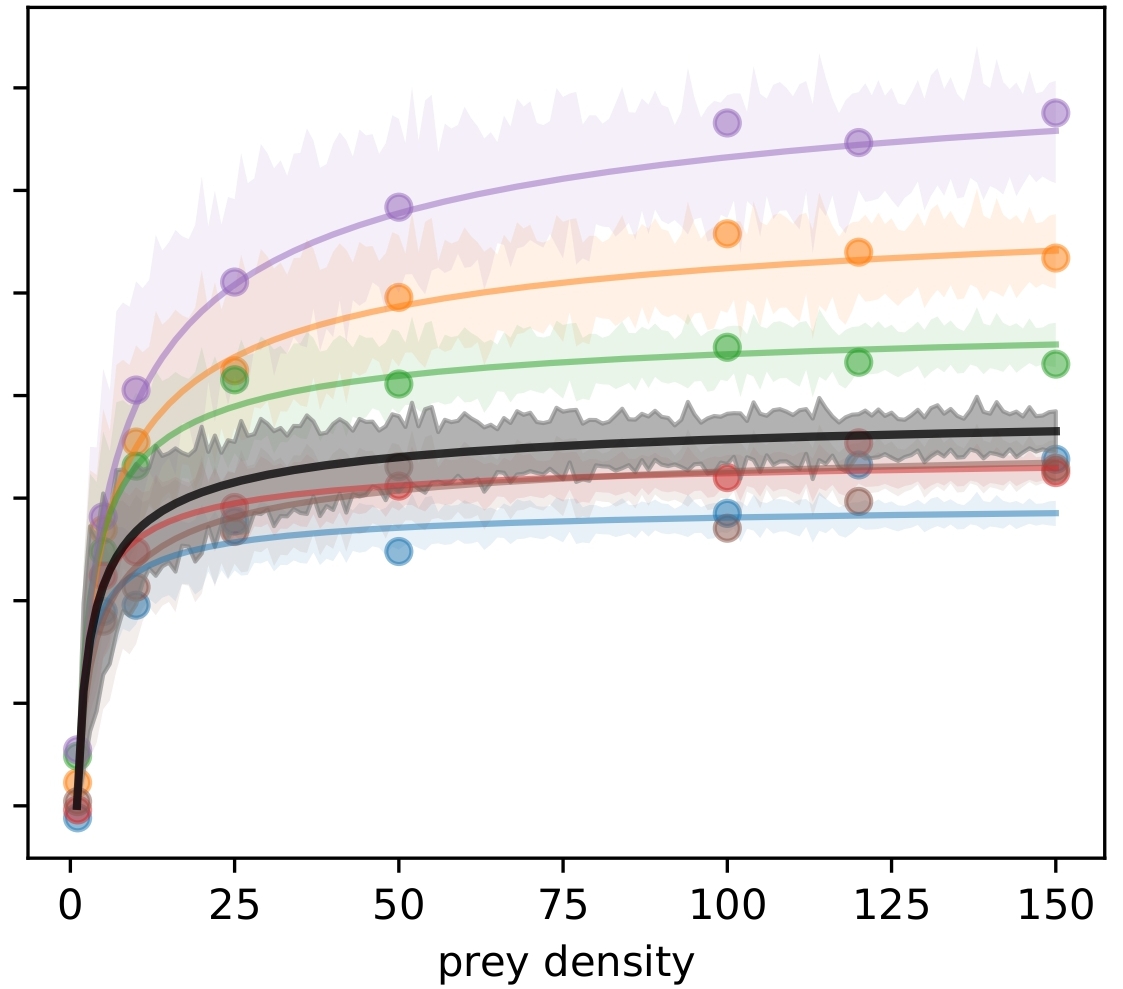
The consumption rate of prey by predators, or functional responses, are known to be highly variable even within a single population. Identifying and estimating the different sources of variation of functional responses is a long-standing challenge. We develop here a statistical framework derived from a mechanistic stochastic process model that explicitly accounts for different sources of variation. We apply it to disentangle and estimate in particular 1) residual variance due to measurement errors and model misspecification, 2) between-predator variability, and 3) the interaction stochasticity, i.e. the intrinsic and mechanistic variability due to interactions processes between prey and predators. We show that it is possible to estimate these sources of variation under realistic experimental conditions. Our results also show that model fitting can compensate by overestimating residual source of variation, leading to biased parameter estimates when interaction stochasticity is misspecified. Applied to empirical data, the model reveals that standard assumptions, such as prey renewal and lack of spatial structure, fail to capture observed variability. We also show how experimental design affects parameter identifiability, highlighting the trade-off between the number of individuals and repeated observations.
Type: Research article
Keywords: foraging, population ecology, community ecology, stochastic process, non-linear mixed models, stochastic gradient descent
Baey, Charlotte 1 ; Billiard, Sylvain 2 ; Delattre, Maud 3
 CC-BY 4.0
Baey, C.; Billiard, S.; Delattre, M. Disentangling different sources of variation in functional responses: between-individual variability, measurement error and inherent stochasticity of the prey-predator interaction process. Peer Community Journal, Volume 6 (2026), article no. e53. https://doi.org/10.24072/pcjournal.729
@article{10_24072_pcjournal_729,
     author = {Baey, Charlotte and Billiard, Sylvain and Delattre, Maud},
     title = {Disentangling different sources of variation in functional responses: between-individual variability, measurement error and inherent stochasticity of the prey-predator interaction process
},
     journal = {Peer Community Journal},
     eid = {e53},
     year = {2026},
     publisher = {Peer Community In},
     volume = {6},
     doi = {10.24072/pcjournal.729},
     language = {en},
     url = {https://peercommunityjournal.org/articles/10.24072/pcjournal.729/}
}
TY  - JOUR
AU  - Baey, Charlotte
AU  - Billiard, Sylvain
AU  - Delattre, Maud
TI  - Disentangling different sources of variation in functional responses: between-individual variability, measurement error and inherent stochasticity of the prey-predator interaction process

JO  - Peer Community Journal
PY  - 2026
VL  - 6
PB  - Peer Community In
UR  - https://peercommunityjournal.org/articles/10.24072/pcjournal.729/
DO  - 10.24072/pcjournal.729
LA  - en
ID  - 10_24072_pcjournal_729
ER  -
%0 Journal Article
%A Baey, Charlotte
%A Billiard, Sylvain
%A Delattre, Maud
%T Disentangling different sources of variation in functional responses: between-individual variability, measurement error and inherent stochasticity of the prey-predator interaction process

%J Peer Community Journal
%] e53
%D 2026
%V 6
%I Peer Community In
%U https://peercommunityjournal.org/articles/10.24072/pcjournal.729/
%R 10.24072/pcjournal.729
%G en
%F 10_24072_pcjournal_729
PCI peer reviews and recommendation, and links to data, scripts, code and supplementary information: 10.24072/pci.ecology.100808
Conflict of interest of the recommender and peer reviewers:
The recommender in charge of the evaluation of the article and the reviewers declared that they have no conflict of interest (as defined in the code of conduct of PCI) with the authors or with the content of the article.
[1] Scripts and codes, zenodo (2025) | DOI
[2] Efficient preconditioned stochastic gradient descent for estimation in latent variable models, International Conference on Machine Learning, PMLR, 2023, pp. 1430-1453 (https://dl.acm.org/doi/10.5555/3618408.3618468)
[3] varTestnlme: An R Package for Variance Components Testing in Linear and Nonlinear Mixed-Effects Models, Journal of Statistical Software, Volume 107 (2023) no. 6, pp. 1-32 | DOI
[4] Vigilance and the functional response of granivorous foragers, Functional Ecology, Volume 24 (2010), pp. 1281-1290 | DOI
[5] Stochastic foraging paths primarily drives within-species variations of prey consumption rates, bioRxiv (2024) | DOI
[6] A mechanistic model of functional response provides new insights into indirect interactions among arctic tundra prey, Ecology, Volume 103 (2022) no. 8 | DOI
[7] Rejuvenating functional responses with renewal theory, Journal of The Royal Society Interface, Volume 15 (2018) no. 146 | DOI
[8] Statistical analysis of functional response experiments, Biocontrol Science and Technology, Volume 4 (1994) no. 2, pp. 133-145 | DOI
[9] Improving the assessment of predator functional responses by considering alternate prey and predator interactions, Ecology, Volume 98 (2017) no. 7, pp. 1787-1796 | DOI
[10] Parameter estimation in nonlinear mixed effect models using saemix, an R implementation of the SAEM algorithm, Journal of Statistical Software, Volume 80 (2017), pp. 1-41 | DOI
[11] Predator ecology: Evolutionary ecology of the functional response, Oxford University Press, 2021
[12] A note on BIC in mixed-effects models, Electronic Journal of Statistics, Volume 8 (2014), pp. 456-475 | DOI
[13] An iterative algorithm for joint covariate and random effect selection in mixed effects models, The international journal of biostatistics, Volume 16 (2020) no. 2 | DOI
[14] Convergence of a stochastic approximation version of the EM algorithm, Annals of statistics, Volume 27 (1999) no. 1, pp. 94-128 | DOI
[15] Modelling predation in functional response, Ecological modelling, Volume 198 (2006) no. 1, pp. 154-162 | DOI
[16] Some characteristics of simple types of predation and parasitism, Canadian Entomologist, Volume 91 (1959), pp. 385-398 | DOI
[17] Predator functional responses: Discriminating between handling and digesting prey, Ecological Monographs, Volume 72 (2002), pp. 95-112 | DOI
[18] Identifying predator–prey processes from time-series, Theoretical population biology, Volume 57 (2000) no. 4, pp. 325-337 | DOI
[19] Data from Schröder, Kalinkat and Arlinghaus (2016), FigShare (2025) (10.6084/m9.figshare.24665880) | DOI
[20] Maximum likelihood estimation in nonlinear mixed effects models, Computational statistics & data analysis, Volume 49 (2005) no. 4, pp. 1020-1038 | DOI
[21] Mixed effects models for the population approach: models, tasks, methods and tools, CRC press, 2014
[22] Towards a mechanistic understanding of individual-level functional responses: Invasive crayfish as model organisms, Freshwater Biology, Volume 65 (2020) no. 4, pp. 657-673 | DOI
[23] Sources of variation in predation rates at high prey densities: an analytic model and a mite example, Experimental & applied acarology, Volume 5 (1988), pp. 187-205 | DOI
[24] Disentangling the nonlinear effects of habitat complexity on functional responses, Journal of Animal Ecology, Volume 90 (2021) no. 6, pp. 1525-1537 | DOI
[25] Neural Networks: Tricks of the Trade, Lecture Notes in Computer Science, Springer Berlin Heidelberg, 2012
[26] Climate, season, and social status modulate the functional response of an efficient stalking predator: the Eurasian lynx, Journal of Animal Ecology, Volume 78 (2009) no. 4, pp. 741-751 | DOI
[27] Systematic bias in studies of consumer functional responses, Ecology Letters, Volume 24 (2021) no. 3, pp. 580-593 | DOI
[28] Functional responses of coyotes and lynx to the snowshoe hare cycle, Ecology, Volume 79 (1998) no. 4, pp. 1193-1208 | DOI
[29] Predator-prey responses in an acarine system, Population Ecology, Volume 22 (1980) no. 2, pp. 301-322 | DOI
[30] Mixed-effects models in S and S-PLUS, Springer science & business media, 2006
[31] Universal temperature and body-mass scaling of feeding rates, Philosophical Transactions of the Royal Society B: Biological Sciences, Volume 367 (2012) no. 1605, pp. 2923-2934 | DOI
[32] What’s all that noise? Modeling multiple sources of variation improves estimates of feeding rates, Peer Community in Ecology (2026) | DOI
[33] Towards understanding interactions in a complex world: Design and analysis of multi-species functional response experiments, Methods in Ecology and Evolution, Volume 15 (2024) no. 9, pp. 1704-1719 | DOI
[34] Fitting functional responses: Direct parameter estimation by simulating differential equations, Methods in Ecology and Evolution, Volume 9 (2018) no. 10, pp. 2076-2090 | DOI
[35] Predation of beech seed by mice: effects of numerical and functional responses, Journal of Animal Ecology, Volume 74 (2005) no. 6, pp. 1005-1019 | DOI
[36] Individual variation in functional response parameters is explained by body size but not by behavioural types in a poeciliid fish, Oecologia, Volume 182 (2016) no. 4, pp. 1129-1140 | DOI
[37] Functional responses with predator interference: viable alternatives to the Holling Type II model, Ecology, Volume 82 (2001), pp. 3083-3092 | DOI
[38] Comparison of methods for general nonlinear mixed-effects models, Modelling Longitudinal and Spatially Correlated Data, Springer, 1997, pp. 135-146 | DOI
[39] Herbivore functional response in heterogeneous environments: a contest among models, Ecology, Volume 84 (2003) no. 3, pp. 666-681 | DOI
[40] How can the functional reponse best be determined?, Oecologia, Volume 76 (1988), pp. 206-214 | DOI
[41] Multiple factors, including arena size, shape the functional responses of ladybird beetles, Journal of Applied Ecology, Volume 55 (2018) no. 5, pp. 2429-2438 | DOI
[42] Functional responses are maximized at intermediate temperatures, Ecology, Volume 101 (2020) no. 4 | DOI
[43] FoRAGE database: A compilation of functional responses for consumers and parasitoids, Ecology, Volume 103 (2022) no. 7 | DOI
[44] Evaluating pharmacokinetic/pharmacodynamic models using the posterior predictive check, Journal of pharmacokinetics and pharmacodynamics, Volume 28 (2001), pp. 171-192 | DOI
Cited by Sources: