

 CC-BY 4.0
Introduction
Archaeological sites and heritage buildings globally face different and continuous challenges with regard to vulnerability. Natural threat events, erosion, vegetation and human intervention like excavation devoid of preservation, pollution and unlimited urbanization bring about presentation and preservation problems (Fatorić & Seekamp, 2017; Hamilton et al., 2009; Lemos, 2007). There is an everyday need for preventative measures towards monuments’ preservation. Condition monitoring and temporal change detection of the monuments can be carried out by means of multifaceted approaches from the literature (Abate, 2018; Moropoulou et al., 2013; Wallace et al., 2017). In the past two decades, photogrammetric 3D modeling of archaeological sites has become ordinary whilst methods of extracting data from archival materials to create 3D models have been developed (Falkingham et al., 2014; Discamps et al., 2016; Peppa et al., 2018; Wallace, 2017). Retrospective photogrammetry permits to take a new look at the past condition of archaeological sites as in the time of first excavation. The current paper treats the issue of using retrospective models in comparison to contemporary models for assessing deterioration relative to time, preservation, and natural processes.
Two 3D models of the site called Omega house, a luxurious residential complex of the Roman period in the Athenian Agora, serve for case study (Camp 1989; Camp 2010). The retrospective model is as it was when excavated in 1972, and the contemporary is of the site after 45 years in 2017 (Wallace et al., 2017; Wallace, 2017). Omega house was selected for the retrospective aspect of this project due to the scrupulousness of documentation during its excavation.
In this paper, we compare the two models utilizing Constructive Solid Geometry (CSG) operations (Bernstein & Fussell, 2009; Campen & Kobbelt, 2010; Chen et al., 2021; de Araújo et al., 2015; Nehring-Winxel et al., 2021; Trettner & Kobbelt, 2021) for performing Boolean operations on the Omega house models. Also, distance and volume calculations are carried out. The 3D photogrammetric models of the site dated in 1972 and 2017 enable the examination and measurement of the site’s aspects. This work is organized into four sections. The Methodology is presented in the second section and the Results are given in the third section. Conclusions are drawn in the last section.
Scope and Methodology
The principal aim of this paper is to check the accuracy of the retrospective (1972) model, by comparing it with the contemporary one (2017) of measured accuracy ±1cm and to assess how much the site has changed between the time of its first excavation in 1972 and its current state.
The initial version of the retrospective model 1972 and of the contemporary model 2017 have been obtained from the source (Wallace et al., 2017; Wallace, 2017).
Both the 1972 and 2017 models are georeferenced, allowing them to be compared with real-world coordinates. Drawing accuracy of these models is is not a straightforward task because the accuracy of the 1972 model is unknown. However, by treating drawings and plans of 3D modeling as though they were photographs, the geometry within a digital model can be seamlessly integrated, resulting in an improved accuracy. To compare the two models the model of 2017 was used as a reference to find out the relative accuracy of the old one.
More specifically, the analysis includes 20 checkpoints selected for the Omega House model, where the differences in Easting, Northing, and Elevation between the 1972 model and the 2017 model have been calculated. The root mean square error (RMSE) for these checkpoints is calculated. According to the Geospatial Positioning Accuracy Standards (Federal Geographic Data Committee, 1998) using 20 well-distributed points is sufficient for reliably assessing the relative positional accuracy of the retrospective model in comparison to the contemporary one (Panagiotopoulou et al., 2023). The RMSE values derived from this analysis provide a quantitative measure of how closely the historical 1972 model aligns with the 2017 reference model. Specifically, the RMSE for the easting residuals is 0.339 meters, for the northing residuals is 0.344 meters, and for the elevation residuals is 1.795 meters. These values indicate that while the horizontal accuracy (easting and northing) of the 1972 model is quite high, with sub-half-meter discrepancies, the vertical component (elevation) shows a larger deviation.
The 3D photogrammetric models were processed using CloudCompare (CloudCompare Development Team, 2022), a software for 3D point cloud analysis and visualization. This step is crucial for identifying and measuring temporal changes in the Omega House models over the decades. The historical 1972 model and the contemporary 2017 model were thoroughly compared. This approach allows the precise identification of areas with significant geometric modifications, offering valuable insights into the structural evolution and changes of the Omega House.
In the present study, Constructive Solid Geometry (CSG) techniques are applied to the Omega House models (Chen et al., 2021; CloudCompare Development Team, 2022; de Araújo et al., 2015; Nehring-Winxel et al., 2021; Trettner & Kobbelt, 2021) to perform Boolean operations, specifically the difference and intersection calculations. These operations are essential tools for conducting precise comparative analyses of the 3D geometries of the historical (1972) and contemporary (2017) models.
The Boolean difference operation enables the identification and quantification of changes that have occurred between the two models. By subtracting the retrospective model from the contemporary one, this operation highlights the areas where modifications, additions, or losses have taken place over the decades. As a result, it provides critical insights into the degree and nature of structural alterations, offering a comprehensive understanding of how the Omega House has evolved or been restored over time.

Figure 1 - Camera Overlap Map for the 1972 Modeling of the Omega House (Panagiotopoulou et al., 2023).
The Boolean intersection operation, on the other hand, identifies the common volume shared by both the historical and contemporary models. This shared geometry represents the parts of the monument that have remained unchanged for the past 45 years, thereby providing valuable information on the enduring structural integrity of the Omega House. These areas highlight the parts of the building that have survived without any changes, showing how strong and well-built the original construction was.
For the calculation of distances between the 1972 and 2017 models of the Omega House, the distance computation algorithm known as Iterative Closest Point (ICP) was applied. This method enables accurate alignment of the two point clouds by iteratively minimizing the distance between corresponding points (Cignoni et al., 1998; Girardeau-Montaut et al., 2005). Once the models are aligned, the octree structure and Cloud-to-Mesh (C2M) distance calculations help efficiently measure and analyze the spatial differences between the two aligned models at a fine resolution. The octree structure offers several advantages when processing large 3D point clouds. By dividing the dataset into hierarchical cubic cells (voxels), it dramatically speeds up data searches and distance calculations, making it more efficient to analyze even complex or dense models.

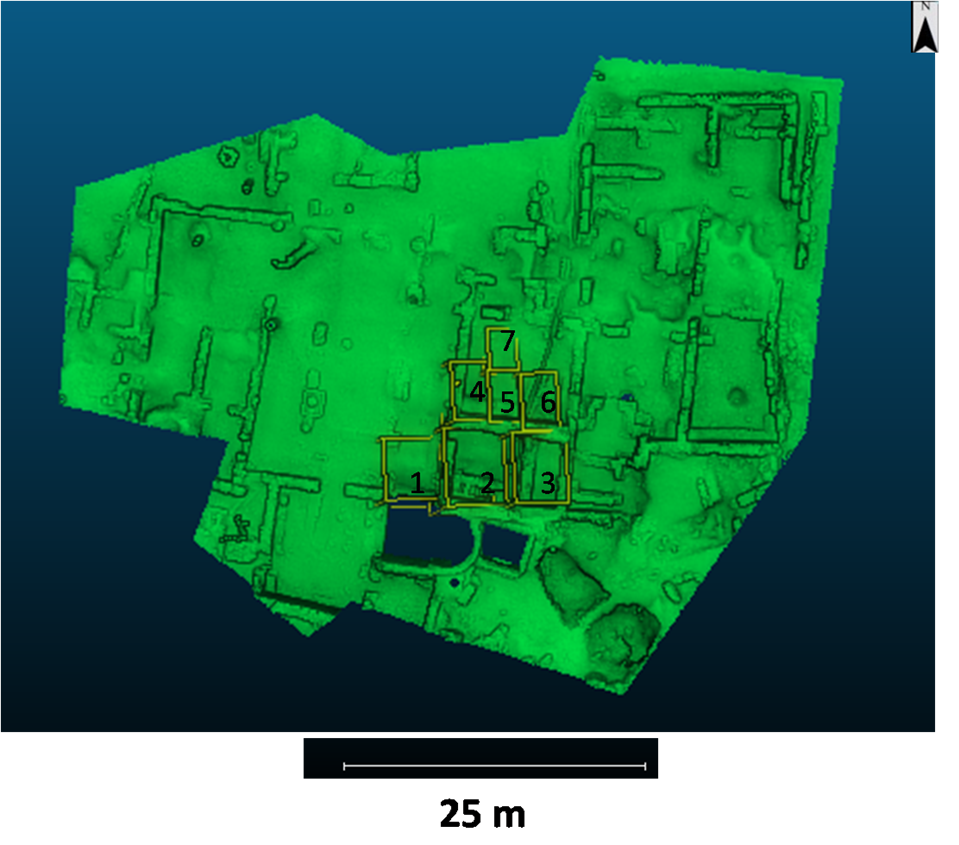
Figure 2 - Selection of specific areas within the Omega House for detailed investigation and analysis (Sections 1-7).
Moreover, the octree’s hierarchical organization ensures more precise control over spatial resolution, improving the accuracy of comparisons and measurements while also reducing computational load. Cloud-to-Mesh (C2M) distance calculations offer a robust method for measuring variations between 3D models by calculating the distance from each point in a point cloud to the nearest surface of a mesh. This approach ensures highly accurate and continuous distance measurements, as it accounts for the smooth surfaces of the mesh rather than relying solely on point-to-point comparisons. This workflow ensures that distance measurements are precise, computationally efficient, and meaningful in understanding how the Omega House has changed over time.
Additionally, volumetric calculations were conducted to quantify any changes in material presence or loss between the two models of the Omega House. By comparing the volumetric data from the 1972 and 2017 models, it was possible to identify and measure areas where material had decayed, eroded, or otherwise been lost over the 45-year span. These volume comparisons are critical for understanding the long-term structural health and preservation of the Omega House, highlighting areas where material degradation may have compromised the building’s integrity or historical features.
The present work builds upon a previously published study by Panagiotopoulou et al. (2023), expanding the scope of analysis and introducing new experimental findings. The motivation for these new experiments comes from a detailed map, shown in Figure 1, which illustrates the spatial distribution and overlap of historical photographs from the 1972 archival data. This map highlights that the central south portions of the Omega House have the highest density of overlapping photographic coverage, suggesting a lower level of geometric disparity between the 1972 and 2017 models in these areas. Consequently, the central south sections of the Omega House are the focus of the current investigation. By focusing on this region, which shows the smallest differences between the old and new models, we aim to perform a more detailed and accurate analysis of structural changes and stability. The east and northeast parts have the least overlap in historical photographs and result in a greater disparity in measurements between the two sets of models. The central south portions of Omega house which have been selected for investigation in the current study are demonstrated in Figure 2.
Results
The selected parts of the monument, alongside the computed C2M signed distances expressed in centimeters, are presented, with the 2017 model being used as the reference dataset. In this analysis, three out of the seven parts—specifically parts 3, and 4, —are highlighted in Figure 3 and Figure 4. These parts were selected as representative examples, rather since we are not presenting all the parts here. The other five parts underwent the same analytical process. Additionally, the Boolean operations of Difference (1972–2017) and Intersection (1972 ∩ 2017) were performed and are displayed within the respective figures for each part where these calculations were feasible. This comprehensive approach facilitates a detailed comparative assessment of the monument’s morphological changes between the two chronological datasets, offering insights into the preservation state and transformation patterns over time.
Table 1 shows the minimum and maximum C2M (cloud-to-mesh) signed distances calculated for the seven parts of the Omega House monument. Parts 2 and 6 stand out with the biggest distance ranges, from 0.630 to -1.324 cm and from 1.040 to -0.895 cm, respectively. So, the range is 1.954 cm for Part 2 and 1.935 cm for Part 6 (marked in red in Table 1). On the other hand, Parts 3, 4, and 7 have the smallest ranges, suggesting smaller deviations (highlighted in green in Table 1). Specifically, Part 7’s distances go from 0.611 to -0.825 cm, Part 4 from 0.772 to -0.732 cm, and Part 3 from 0.892 to -0.681 cm. Parts 1 and 5 fall somewhere in between, with distance ranges of 1.782 cm and 1.759 cm, respectively (marked in orange in Table 1).
The calculated values for the volumes and surfaces of the monument’s selected parts are presented in Table 2. The absolute and percentage differences in volume and surface area calculations between the 1972 and 2017 models for the seven selected parts of Omega House is presented in Table 3. Notably, part 1 in the 2017 model exhibits a substantial decrease in volume, amounting to 42.60% compared to the 1972 model. Similarly, parts 2 and 3 demonstrate decreased volumes of 12.25% and 5.89%, respectively, in the 2017 model relative to the earlier model. In contrast, parts 4, 5, 6, and 7 show an increase in volume in the 2017 model compared to the 1972 one. Specifically, parts 5 and 6 experienced the most significant increases, with volume increases of 26.87% and 28.55%, respectively. Meanwhile, parts 4 and 7 show only marginal volume increases of 2.02% and 2.99%, respectively.

Figure 3 - a) Selected part 3 of Omega House b) The Boolean operations on the models Difference 1972-2017 and Intersection 1972∩2017 c) C2M signed distances in cm with reference the model 2017.

Figure 4 - a) Selected part 4 of Omega House b) The Boolean operations on the models Difference 1972-2017 and Intersection 1972∩2017 c) C2M signed distances in cm with reference the model 2017.
Table 1 - C2M signed distances in cm with reference the model 2017. The maximum and minimum values are given regarding each one of the seven selected parts of Omega House.
|
Omega House Part |
Minimum Distance (cm) |
Maximum Distance (cm) |
Range (cm) |
|---|---|---|---|
|
Part 1 |
-1.006 |
0.776 |
1.782 |
|
Part 2 |
-1.324 |
0.630 |
1.954 |
|
Part 3 |
-0.681 |
0.892 |
1.573 |
|
Part 4 |
-0.732 |
0.772 |
1.504 |
|
Part 5 |
-0.713 |
1.046 |
1.759 |
|
Part 6 |
-0.895 |
1.040 |
1.935 |
|
Part 7 |
-0.825 |
0.611 |
1.436 |
Table 2 -Volume and surface calculation values for the 1972 and 2017 models, regarding the seven selected parts of Omega House.
|
Omega House Part |
Volume (m3) 1972 |
Volume (m3) 2017 |
Surface (m2) 1972 |
Surface (m2) 2017 |
|---|---|---|---|---|
|
Part 1 |
25.492 |
14.635 |
18 |
16 |
|
Part 2 |
61.272 |
53.767 |
20 |
20 |
|
Part 3 |
76.055 |
71.574 |
18 |
18 |
|
Part 4 |
43.901 |
44.786 |
12 |
12 |
|
Part 5 |
41.898 |
53.164 |
10 |
12 |
|
Part 6 |
47.115 |
60.565 |
10 |
12 |
|
Part 7 |
38.196 |
39.341 |
8 |
8 |
Table 3 - The absolute and percentage differences in volume and surface area calculations between the 1972 and 2017 models for the seven selected parts of Omega House.
|
Omega House Part |
Δ Volume (m3) |
%Volume Change |
Δ Surface (m2) |
%Surface Change |
|---|---|---|---|---|
|
Part 1 |
-10.857 |
-42.6% |
-2 |
- 11.11% |
|
Part 2 |
-7.505 |
-12.25% |
0 |
0% |
|
Part 3 |
-4.481 |
-5.89% |
0 |
0% |
|
Part 4 |
0.885 |
2.02% |
0 |
0% |
|
Part 5 |
11.266 |
26.88% |
2 |
20% |
|
Part 6 |
13.45 |
28.55% |
2 |
20% |
|
Part 7 |
1.145 |
2.99% |
0 |
0% |
Regarding the surface area calculations, the data show that parts 2, 3, 4, and 7 remained largely unchanged in both the 1972 and 2017 models, suggesting their external geometry didn’t change much. On the other hand, parts 5 and 6 in the 2017 model have about 20% larger surface areas compared to 1972, which could point to modifications or restoration work. Interestingly, the surface area of part 1 decreased by 11.11% in 2017 compared to 1972. Overall, these results show how some parts of the monument changed more than others, offering clues about structural transformations and possible conservation efforts over time
The scatter plot in Figure 5 illustrates the percentage changes in volume and surface area for the seven selected parts of the Omega House monument between the 1972 and 2017 models. The blue markers indicate the percentage change in volume, while the orange markers represent the percentage change in surface area.

Figure 5 - Correlation Between Volume Change and Surface Change for the Seven Selected Parts of Omega House.
A clear trend can be seen from the data:
-
Parts 5 and 6 show significant increases in both volume and surface area, suggesting notable restoration work or the addition of material during the intervening years.
-
In contrast, part 1 exhibits a pronounced decrease in volume (approximately -50%) along with a slight decrease in surface area, indicating substantial material loss, likely due to erosion or natural decay.
-
Parts 3, 4, and 7 show only minor changes in both volume and surface area, suggesting relative stability in these areas.
-
Notably, the data points do not align along a perfect diagonal, indicating that while volume and surface area are generally correlated, some discrepancies arise due to the complex geometry and irregular shapes of the monument’s parts.
Overall, this comparative analysis underscores the heterogeneous nature of structural changes in the Omega House over the 45-year period and highlights the need for targeted conservation efforts in the areas showing significant deterioration.
This comparative analysis sheds light on the nature and extent of deterioration that may have occurred over the 45-year period due to natural processes. From an archaeological perspective, these changes likely result from a mix of factors, including material weathering and decay, as well as shifts in the surrounding terrain and debris accumulation throughout the years.
In addition, regular maintenance activities — such as cleaning and removing built-up dirt or debris — may have played a role in some of the structural changes seen in the models. Some walls, in particular, have experienced substantial material loss, highlighting areas that are especially vulnerable. Overall, these findings underscore the importance of ongoing monitoring and careful documentation, which can inform conservation strategies and improve our understanding of the monument’s evolving condition within its environment and historical context.
Conclusions
The comparative analysis of the 1972 and 2017 3D models of the Omega House provides valuable insights into the monument’s preservation status and the broader implications of long-term monitoring with digital heritage tools.
To start, the results—both visual (Figures 3–4) and numerical (Tables 1–3, Figure 5)—show that although there are considerable geometric differences between the 1972 and 2017 models, these differences aren’t evenly spread across the monument. Parts 1 and 2, for example, show large volume reductions (up to 42.6% for part 1), suggesting significant material loss due to erosion, weathering, or possibly incomplete data capture in the older photogrammetry. In contrast, parts 5 and 6 have seen notable volume increases (around 26.88% and 28.55%, respectively) and about 20% more surface area. These increases likely indicate restoration work or the build-up of material (such as repairs or debris infill) since 1972.
Meanwhile, parts 3, 4, and 7 show only minimal changes, highlighting areas of relative structural stability over the 45-year period. This is supported by the Boolean intersection operations (Figures 3–4), which show shared geometry between the models, as well as the consistent surface area measurements for parts 2, 3, 4, and 7 (Table 3). Altogether, these results suggest that, despite localized material losses or changes, much of the Omega House remains well-preserved.
The overall good preservation condition is also reflected in the relatively low RMSE values for horizontal positioning: 0.339 m for easting and 0.344 m for northing. This suggests that the 1972 model largely aligns with the 2017 survey data, except for some vertical deviations (RMSE 1.795 m). It seems that vertical measurements may have been less precise in 1972, but the overall horizontal footprint of the monument has not significantly shifted or deformed.
The differences between the 1972 and 2017 models can be explained by several factors. The 1972 photogrammetric data likely faced limitations in photographic coverage, especially in the east and northeast areas, as well as the accuracy of historical methods and potential data loss over time. Focusing on the central south areas (highlighted in Figure 2), where there was the highest photographic overlap, allows for more confident assessments and minimizes uncertainty from less reliable data.
While natural deterioration (like weathering and vegetation growth) and human activities (such as cleaning, excavations, or minor reconstructions) likely account for much of the observed changes in volume and surface area, there may be other explanations that weren’t explored in this study. For example, undocumented restoration work or new interpretations of historical site plans might have contributed to the observed geometric changes. These aspects weren’t fully examined here due to the lack of detailed historical documentation, highlighting the importance of future archival research.
The implications of this research extend beyond the Omega House itself. The use of 3D Boolean operations, C2M distance calculations, and robust volume/surface comparisons provides a methodological framework that can be adapted to other cultural heritage sites. Such techniques enable precise, quantitative assessments of structural changes and conservation states, aiding archaeologists, conservationists, and heritage managers in identifying vulnerable areas, planning targeted interventions, and documenting ongoing preservation efforts.
Future work should aim to refine the vertical accuracy of the retrospective models, integrate historical maintenance records, and expand the analysis to less-documented areas of the Omega House. Moreover, applying this workflow to other sites can build a comparative dataset of how different monuments respond to environmental and human-induced changes over time.
In conclusion, this study underscores the importance of long-term digital documentation and comparative 3D analysis in heritage conservation. Despite the geometric differences observed, the Omega House retains significant portions of its original structure, reflecting the effectiveness of preservation practices and the enduring resilience of its historical architecture.
Acknowledgements
Preprint version 2 of this article has been peer-reviewed and recommended by Peer Community in (https://doi.org/10.24072/pci.archaeo.100344, Allison & Schmidt 2025).
Conflict of interest disclosure
The authors declare that they comply with the PCI rule of having no financial conflicts of interest in relation to the content of the article.
Funding
This research received no external funding.
Data, scripts and code
The data, scripts, and code used in this study are subject to copyright held by the Hellenic Ministry of Culture and, as such, cannot be made publicly available.