

 CC-BY 4.0
“Écrire à n, n-1, écrire par slogans : Faites rhizome et pas racine, ne plantez jamais ! Ne semez pas, piquez ! Ne soyez pas un ni multiple, soyez des multiplicités ! Faites la ligne et jamais le point ! La vitesse transforme le point en ligne ! Soyez rapide, même sur place ! Ligne de chance, ligne de hanche, ligne de fuite. Ne suscitez pas un Général en vous ! Pas des idées justes, juste une idée (Godard). Ayez des idées courtes. Faites des cartes, et pas des photos ni des dessins. Soyez la Panthère rose, et que vos amours encore soient comme la guêpe et l’orchidée, le chat et le babouin. […] Un rhizome ne commence et n’aboutit pas, il est toujours au milieu, entre les choses, inter-être, intermezzo. L’arbre est filiation, mais le rhizome est alliance, uniquement d’alliance. L’arbre impose le verbe « être », mais le rhizome a pour tissu la conjonction « et… et… et…». Il y a dans cette conjonction assez de force pour secouer et déraciner le verbe être.”
Gilles Deleuze & Félix Guattari, Milles Plateaux.
Introduction
Collaborations among organizations intensify, in number, size, nature and form. Such collaborations constitutes an important contemporary phenomenon that translates into a flourishing and heteroclite literature on inter-organizational arrangements (Cropper et al., 2008; Lumineau & Oliveira, 2018). Is there a way to account for this diversity?
There are many reasons for organizations to collaborate with other organizations, and these collaborations take many forms. Alliances, policy networks, and meta-organizations are some of the many concepts developed to analyse how inter-organizational arrangements enable or structure collaborations among organizations. These inter-organizational arrangements are extremely diverse: they vary in terms of level of action, membership composition, objectives, duration, spatiality, among other dimensions. And yet they are also similar in that they constitute groupings that rely on recurring, structured connections at the level of organizations. In that sense, these arrangements all contribute to enrich the picture of pluralistic and fluid forms of organizing (Barin Cruz et al., 2017; Brès et al., 2018; Lumineau & Oliveira, 2018; Hussenot, 2021; Clegg, 2024; Brankovic, 2025). However, we lack a common tool or concept to look at these diverse pluralistic forms of inter-organizational collaborations, especially when concepts may overlap or be used incoherently within communities (see for instance Coulombel & Berkowitz, 2025 on the uses of “meta-organization”). Which dimensions could be used to understand these collaborations among organizations, beyond the various categories, and to accommodate the study of pluralistic and fluid forms of organizing?
In this paper, we aim to develop a more comprehensive and fluid approach of similarities and differences among inter-organizational arrangements and their interrelations. In so doing, we contribute to the growing literature on pluralistic and heterogeneous organizations. Our objective is to move beyond existing categories, because categories reduce the complexity of life and impose certain assumptions within certain scientific regimes of knowledge (Verran, 2002). First, our study highlights the pluralistic relations organizations have with other organizations, and the different forms these relational arrangements may take. Collaborations among multiple organizations are not solely having a dyadic, transactional nature (Das & Teng, 2002) expected in dominant perspectives on organizations. As such these arrangements provide insight into some of the pluralist relations and forms that may exist beyond the conventional and dominant forms of organizing (Glynn et al., 2000; Denis et al., 2001; Brès et al., 2018; Lumineau & Oliveira, 2018; Svejenova, 2019). As organizational and everyday life is complex, it “warrants a variety of interpretations, as well as rich frameworks for understanding and acknowledging plurality and differences” (Glynn et al., 2000, p. 728). Second, the paper contributes specifically to the discussion on pluralist inter-organizational relations (Lumineau & Oliveira, 2018; Franke & Koch, 2023) by providing some useful alternative dimensions for understanding pluralism in these relations.
We make a central assumption that inter-organizational arrangements facilitating collaborations are fundamentally comparable and that comparing and contrasting them can yield valuable insights. In that sense, we draw on the expanding body of research that argues that what exists beyond organizations’ traditional boundaries is also organized (Bauman, 2000; Ahrne & Brunsson, 2011; Ahrne et al., 2016b; Apelt et al., 2017; Hussenot, 2021; Clegg, 2024). Our approach is informed by the innovative and original work of Deleuze and Guattari (1987), whose concepts have been fruitfully applied in organization studies to enable a more fluid, dynamic and creative exploration of various social phenomena (Wood & Ferlie, 2003; Lawley, 2005; Linstead & Thanem, 2007; Deroy & Clegg, 2011; Daskalaki & Mould, 2013; Pick, 2017; Charret & Chankseliani, 2023).
Specifically, we engage with the concept of rhizome, which Deleuze and Guattari draw from biology. A rhizome is a type of root, which can grow from any point and may create new shoots and connections and does not have a clear hierarchy. Deleuze and Guattari describe six guiding principles for the rhizome (cf Charret & Chankseliani, 2023), which we use to structure our analysis and framework: connections, heterogeneity, multiplicity, asignificant rupture, cartography, and decalcomania. We operationalize these principles to study inter-organizational arrangements.
This rhizome concept has been fruitfully used in organization studies (e.g. Lawley, 2005; Kuronen & Huhtinen, 2017; Pick, 2017). However, despite its potential, the rhizome remains underutilized in the analysis of collaborations among organizations (Charret & Chankseliani, 2023). In this paper, we develop a rhizomatic framework. The framework enables us to think creatively of inter-organizational arrangements as fluid acts of collaboration, characterized by ongoing adaptations and movements, potential ruptures and reconnections.
By developing a rhizomatic framework and weaving together insights from varied disciplines, we outline possible avenues for exploring, understanding and contrasting the complex phenomena of collaborations among organizations. We designed this approach to highlight the need for bridges across different fields of study, but also the need for more fluid understandings of inter-organizational arrangements and their proliferation in all spheres of society.
The paper is organized as follows. We first present a general state of the art inter-organizational arrangement literatures on 1) the pluralism and heterogeneity of the inter-organizational phenomena but also 2) the possibility to recognize overlaps and how they may help in understanding these phenomena, beyond the tendency to use different terms for similar phenomena across different disciplines and theoretical developments. We then develop our rhizomatic approach and methodology which aims to help identify and assist in comparison work across inter-organizational collaborations and support the consolidation and use of theory across disciplines. Next we apply our framework to the different inter-organizational arrangements as identified in our state of the art to illustrate the use of the framework. Finally, we discuss our proposal of an inter-organizational web approach that connects multiple organizations and inter-organizational arrangements across levels, fields, sectors, etc. and our contributions to the understanding of the pluralist view on organizations in general and on collaborations among organizations in particular.
Pluralist organizing among organizations
There is a growing literature that focuses on inter-organizational arrangements, which we define here as the association or linkage of three or more organizational actors. As shown in figure 1, while some of these concepts have been already studied longer, there has been an explosive growth since the beginning of 2000. We intentionally set aside studies focusing on dyadic relations among organizations, aiming instead to explore broader collaborative configurations. Our intention is to provide tools for understanding and mapping various concepts developed to analyse different forms of inter-organizational arrangements, drawing from a variety of disciplines. The diversity in both concepts and forms of inter-organizational arrangements highlights the pluralism and heterogeneity not only of organizations made of individuals (Brès et al., 2018) but also of forms of organizing among organizations.
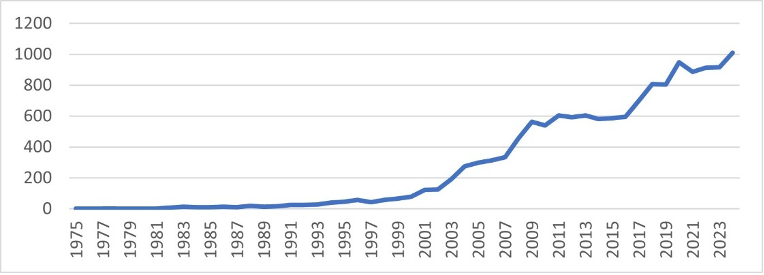
Figure 1 - Number of publications on inter-organizational arrangements1
As detailed hereafter, we engage with different literatures from management, focusing on concepts of alliance networks (e.g. Dyer & Singh, 1998) and alliance constellations (e.g. Corbo & Shi, 2015); from marketing and logistics, with an emphasis on supply networks (e.g. Harland et al., 2001); from economic geography, looking at industrial districts (e.g. Becattini et al., 2009); from public administration and political science, engaging with policy networks (e.g. Dahan et al., 2006), and from organization studies, with a focus on meta-organizations (Ahrne & Brunsson, 2005; Ahrne & Brunsson, 2008). Our work is, however, not a systematic review and does not claim to be exhaustive. We are well aware of the vast diversity present in the literatures addressing inter-organizational arrangements and of the inherent challenges in capturing this diversity in a single paper. We, however, aim to provide space for enough diversity to show the possibilities opened by the methodological tool we develop.
Inter-organizational arrangements: A variety of concepts across literatures
Inter-organizational arrangements are discussed in a large variety of disciplines from (strategic) management, entrepreneurship, logistics, marketing, political science, administrative science, organization studies and organizational sociology. Some key concepts from these literatures are shortly introduced below, and we highlight which of the arrangements we decided to assess in detail in this paper.
In (strategic) management there exists a large literature on alliances between firms. There are, at least, three different concepts of inter-organizational arrangements this literature uses and studies. First, the alliance network (e.g. Dyer & Singh, 1998) which consists of all the alliances one particular firm has. The focus is hereby on how the firm may manage its alliance network and improve its relationships and relationship network, but also how learning in one part of the network may impact another part of the network through the interaction and learning that takes place in the central focal firm. More recently, the related concept of platform organization, discussed below as part of marketing and logistics, is utilized as well. Second, the alliance constellation (e.g. Phelps, 2010) which is a network formed of dyadic alliances. While the study of these constellations often focuses on similar type of alliances (e.g. in terms of goal), or alliances in one specific industry, this is not necessary. And third, the multi-partner alliance (e.g. Lavie et al., 2007), which is an alliance organization created by multiple firms. The multiple partners create the organization by drawing up a single contract among the members of the alliance. In our analysis, we have decided to include the first two arrangements, the alliance network and the alliance constellation. The multi-partner alliance was excluded as this has been identified as being similar to meta-organizations (Berkowitz & Bor, 2018), a concept developed in organization studies and organizational sociology.
In marketing and logistics, we also identified, at least, three concepts of inter-organizational arrangements. First, the business network (e.g. Håkansson & Snehota, 1995) is considered a network of relations between businesses, similar to the alliance constellation idea, though the relations between the firms do not need to be formalized into an alliance, as is the case in the alliance constellation. Second, the concept of platform organization which refers to an organization running and controlling an technological platform and contracts companies who can promote themselves on the platform to their (potential) customers (think of organizations such as Amazon) (e.g. Ritala et al., 2014). Due to its focus on the relations with those who wish to promote themselves, this concept has similarities to the alliance network concept And finally, we identify the supply network, which concerns the “chains through which goods and services flow from original supply sources to end customers” (Harland et al., 2001, p. 22). From this literature, we decided to only include supply network in our analysis. The two other concepts were excluded as a similar concept (alliance constellation, alliance network) was already included.
In economic geography, we identified industrial district (e.g. Pyke et al., 1990) as key concept for inter-organizational arrangements. Industrial districts are geographically concentrated clustering of firms which produce something similar (such as textile, or high-tech). Often there is a high concentration of new, innovative, small-sized firms in these industrial districts. In entrepreneurship literature a similar concept was introduced, termed entrepreneurial ecosystem, which restricts to a geographical area, though does not restrict to just one or very few interrelated industries. Both, however, highlight the role of the public sector in promoting and supporting the growth of businesses in their geographical area. We selected industrial district as inter-organizational arrangement for our analysis.
In political and administrative sciences, we identified several concepts. The whole or goal-directed network (e.g. Provan et al., 2007) describing networks of organizations which may include organizations from either public, private, or third sectors or a combination of them and address a common problem or dealing with a common issue. This concept, however, is general, including phenomena close to alliance networks, phenomena close to multi-party alliances as well as phenomena close to policy networks, making it difficult to use this concept for analysis. Cross-sector partnership (e.g. Selsky & Parker, 2005) includes both dyadic and multi-partner arrangements often focused on addressing social or environmental issues. While dyadic arrangements are outside our scope, the multi-partner arrangements seem to be phenomena close to meta-organizations, as discussed below. In this discipline, we also identified the concept of policy network (e.g. Dahan et al., 2006) which is a network of both informal and formal institutional links resulting in a self-organizing group of diverse actors working together to formulate and implement public policies. We decided to only include policy network in our analysis, as the other concepts were covering a variety of arrangements which are included separately as they have significant differences.
Finally, in organization studies and organizational sociology, many already mentioned concepts are or have been used. One concept, that of meta-organization (Ahrne & Brunsson, 2005; Ahrne & Brunsson, 2008) is worth mentioning separately. This concept refers to organizations which have other organizations as their members, whereby these organizational members remain (largely) autonomous and govern the meta-organization. We decided to include this inter-organizational arrangement in our analysis.
Attempts have been made to bring coherence to this diverse landscape of inter-organizational arrangements (Grandori & Soda, 1995; Schmitter & Streeck, 1999). However, existing classifications remain bounded to certain domains and have not sufficiently clarified the literatures, making it challenging to identify commonalities across different studies and establish solid grounds for joint theory building. Here we take stock of this diversity, pluralism and heterogeneity of organized collaborations among organizations, and rather focus on developing a conceptual tool to examine this pluralism.
Methodological approach: A rhizomatic analysis of inter-organizational arrangements
We draw inspiration from previous studies that have fruitfully used Deleuze and Guattari’s work (Lawley, 2005; Linstead & Thanem, 2007; Daskalaki & Mould, 2013; Pick, 2017; Charret & Chankseliani, 2023). We adopted the concept of rhizome as a foundation for our framework to understand inter-organizational arrangements for its creative and original potential but also for the more fluid approach of social relations it entails. Our methodology involves a two-step approach: we started by exploring the rhizome concept and its philosophical underpinnings and implications. This examination set the stage for the subsequent development of our framework, which implied transposing the principles of the rhizome to the analysis of inter-organizational arrangements and developing a grading assessment, i.e. evaluating the extent to which selected inter-organizational arrangements embody these principles.
The rhizome concept
Several studies have used Deleuze’s work in organization studies, demonstrating its conceptual power (Wood & Ferlie, 2003; Lawley, 2005; Linstead & Thanem, 2007; Deroy & Clegg, 2011; Pick, 2017; Charret & Chankseliani, 2023). In Deleuze’s vision, the world no longer is something continuous and harmonious, pre-established (Deleuze, 1988). On the contrary, the world is made of discords and dissonances, where there is a diversity of orders and organizations (Linstead & Thanem, 2007; Adkins, 2015). Deleuze and Guattari (1987) develop the concept of rhizome (horizontal, emergent, unique) in opposition to tree-approaches of a the world (ascendant, hierarchical, repetitive). “We’re tired of trees,” they write “We should stop believing in trees, roots, and radicles” (Deleuze & Guattari, 1987, p. 15). Further, “in contrast to centered (even polycentric) systems with hierarchical modes of communication and preestablished paths, the rhizome is an acentered, nonhierarchical, nonsignifying system” (Deleuze & Guattari, 1987, p. 21). In addition, “arboreal, root-tree structures grow and multiply in relation to a central guiding and anchoring structure” (Lawley, 2005, p. 36), while the rhizome grows and expands freely by randomly connecting any point to another (See also Picture 1 and Music 1 below, as well as later on Music 2).

Picture 1 - Bamboo rhizome (Source: https://commons.wikimedia.org/wiki/File: Bamboo_with _rhizome_1.JPG, XIIIfromTOKYO Creative Commons Attribution-Share Alike 3.0)


Music 1 - Luke Abbott ‘Rhizome’ (Source: https://www.mixcloud.com/okini/rhizome-by-luke-abbott/)2
To help understand the rhizome, Deleuze and Guattari (1987) use six principles: connection, heterogeneity, multiplicity, asignifying rupture, cartography, and decalcomania. By examining these principles, we lay the groundwork for applying them beyond their philosophical origins. This foundational understanding is crucial for appreciating the rhizome’s potential to offer new insights into the dynamic and complex nature of inter-organizational arrangements.
The principle of connection posits that in a rhizome any point can be connected to any other (and should be). This principle thus emphasizes an open-ended connectivity between different points.
The principle of connection is complemented by the principle of heterogeneity, which posits that connections can be made between heterogeneous elements. The elements within a rhizome fundamentally differ from one another, they are not uniform or reducible to a single type or category but heterogeneous (Funke, 2014). And in a rhizomatic structure, any point can connect to any other point, regardless of their nature. Thus, organizations with different people, backgrounds, positions, ideas, goals, technologies, knowledges and so forth can come together and form connections without needing to conform to or being limited by a given, pre-determined order or identity.
The principle of multiplicity further elaborates on this. A multiplicity is a complex structure, though not of a prior unity, i.e. “multiplicities are not parts of a greater whole that have been fragmented, and they cannot be considered manifold expressions of a single concept or transcendent unity” (Roffe in Parr, 2010, p. 181). Within the rhizome, multiplicity proliferates autonomously through the lines that are created, devoid of a central subject or object that would be bounding it or giving it direction (Deleuze & Guattari, 1987). And when a rhizome is divided up it changes its nature, there is no essence that remains unchanged. Multiplicity is also important in avoiding dualism, as the opposing parts of a dualism become a multiplicity, independently of the number of parts (Parr, 2010).
The principle of asignifying rupture, then, acknowledges the lack of hierarchical order within the rhizome, the absence of predetermined order, allowing for breaks or interruptions to happen anywhere in the rhizome. The rhizome thus contrasts with the tree or the root (Lawley, 2005), where cutting the trunk can be fatal, the rhizome is resilient, and in the event of a break, it will always resume its growth. The rupture is thus not significant for the whole, connections exist, and more connections can be made. This principle emphasizes the rhizome’s non-linear, flexible nature, where ruptures do not prevent continuity but rather encourage further development and connection.
The principle of cartography highlights that a rhizome “pertains to a map that must be produced, constructed, a map that is always detachable, connectable, reversible, modifiable, and has multiple entryways and exits and its own lines of flight” (Deleuze & Guattari, 1987, p. 21). It thus consists in mapping and remapping constantly something new, which does not follow a structural model. There is no “deep structure” or “genetic axis” on which things build up hierarchically, which corresponds to the tree or root model (Deleuze & Guattari, 1987; Lawley, 2005). A rhizome is therefore like a shifting map rather than the perfect replication of a model, whereby cartography describes the adaptive and decentralized process that creates and recreates it.
The decalcomania principle, as explored through the lens of a transfer process through a medium, exemplifies the potential for tracing and swings of meanings. Decalcomania is like pressing a pattern onto a surface and serves to illustrate the risks of replication without adaptation, imitation and control within inter-organizational arrangements. In Deleuze and Guattari’s terms, decalcomania reflects the impulse to trace rather than map.
Yet decalcomania is not purely oppositional to cartography and exist rather in relation to it. While we can understand cartography as open-ended and generative of new structures, decalcomania introduces a dimension of codification, stabilization and reduction of difference. Cartography and decalcomania act in symbiotic relations: even within cartography, there are tendencies towards replicating (decalcomania), and similarly a traced structure may unexpectedly evolve into different directions (cartography).
The rhizomatic framework
We develop a rhizomatic framework by transposing the above presented principles to the analysis of inter-organizational arrangements. Inter-organizational arrangements represent a variety of phenomena where various organizations interact with one another. We define the inter-organizational arrangement as any form of relation among three or more organizations. We thus exclude dyadic inter-organizational relations, as these dyadic relations do not include the complexity created by multiple partners, which we are interested in.
An overview of this synthesis is presented in Table 1. Our aim here is to provide an original analytical framework to build new understanding of collaboration among organizations, resonating with recent works like Charret and Chankseliani (2023).
Table 1 - Rhizome’s principles and their implications for inter-organizational arrangements
Principles | Rhizome definition | Possible operationalisation for inter-organizational arrangements |
|---|---|---|
Connection | Any point can be connected to any other | Extent to which decisions are made to limit who can connect (membership decisions, including about types of members, geography of members and the number of members). |
Heterogeneity | Non-patterned links between heterogeneous elements | Extent to which structures exist limiting or patterning the travel of ideas, knowledges, technologies, people, habits, and so forth between the participating organizations and their heterogeneous parts. |
Multiplicity | Autonomous proliferation of a complex system | Extent to which a decided order exists demanding unity and limiting activity or actions. |
Asignifying rupture | No effect of a break in the connection | Extent to which an exit of a member, participant, or lack of physical presence affects the arrangement. |
Cartography | Process of endless mapping of an interaction system | Extent to which there is change in the patterns (pre-set paths or structures) of interaction (lack of repetition, lack of preset paths or structures of interaction). |
Decalcomania | Process of transferring knowledge through a medium | Extent to which the modes of transfer are changing what is transferred (i.e. level of standardization). |
Connection captures the fact that in a rhizome any point can be connected, which means in inter-organizational arrangements that there is no decision made about who may connect and become part of the arrangement. In some inter-organizational arrangements, the connection may indeed be possible without interference, in others however a decision may be needed to be made to accept such connection. When decisions are made, boundaries are created around the inter-organizational arrangements limiting the connections with those outside the arrangement. The more members are accepted, and the more diverse they are, reduces the limitations on the possible connections created by such boundary. Thus, the question we ask is to what extend can organizations connect with others (they want to connect with) through the arrangement. We therefore assess the extent to which a decision is needed to interact with others. A very high level of connection concerns a situation when any point can connect to any other when they so wish, making connections among any two points possible. A low level arises from a situation when a decision is needed to be able to connect with other points, meaning that only certain points may connect to one another. The more diverse the membership and the higher the number of members and more diverse members will increase the level of connection.
Heterogeneity is defined as the principle by which links can emerge among heterogeneous elements – e.g. actors, discourses, practices, techniques – without any order. In the context of inter-organizational arrangements, this means that diverse organizations (e.g. different identities, values, sizes or sectors) and diverse elements of these organizations (personnel, technologies, etc) can relate to one another across levels, domains, issues or topics. We operationalize this by asking whether the arrangements allow for such interactions, whether decisions are made that limit the content or possibility of the interaction among the members of or participants in the arrangement. Does it enable participation and connection regardless of status, type of organization, hierarchical position? The more a planned structure or hierarchy exists, the more decisions are made about who may or may not participate in the different parts of the structure and who may connect with whom about what, the lower the heterogeneity. In contrast, if organizations are able to collaborate across roles and topics, without prior authorizations or legal frameworks, the principle of heterogeneity can be considered as high. We thus assess heterogeneity by analysing the pre-existence of a given order which may limit or not interactions. If interaction can happen without interference of order or hierarchy, the principle of heterogeneity is very high. When structures, such as workgroups, or hierarchies are created and no connections other than those in the structure or hierarchy are possible, heterogeneity is low.
Multiplicity is the principle whereby the organization of multiple elements has no need for unity and the elements can proliferate autonomously. For inter-organizational arrangements, this implies to look at the extent to which there is a demand for unity, that restricts the proliferation in terms of diversity of activity or action participants may choose to engage in with others within the inter-organizational arrangement. For the multiplicity principle, we assess the degree of emergent/decided order. When the emergent order may proliferate autonomously, without assuming unity (of goals for instance) the multiplicity principle is very high. When a decided order, with a central unit of decision-making exists which decides which activities and actions may be organized, what may be done and how within the inter-organizational arrangement, the multiplicity is low.

Music 2 - Rhizomatic Composition tool by Mute State (Source: https://www.mutestate.com/itu/rhizomatic_composition_tool/)3
Asignifying rupture, i.e. the principle that states that a break in the rhizome does not affect the rhizome as it will find new ways of connecting, implies to study the impacts of a member’s exit on the inter-organizational arrangement. Also, the effect of conflict among members can be studied as well as possible rupture or disturbance caused by the lack of physical presence. For the asignifying rupture principle, we assess the impacts of a member’s exit on the other members in the inter-organizational arrangement. When an exit has low impact, due to the possibility to reroute information streams or connections, the rupture is highly asignificant. When, however, the exit of a member influences several members, the rupture becomes less asignificant and is thus graded lower.
Cartography describes a process of endless mapping of an interaction system. This principle implies that there is no pattern or structure followed. To get insights into cartography of inter-organizational arrangements we suggest studying how interactions among actors may develop over time, and whether they follow a specific pattern or not. We assess whether the interactions are following a structured model or if they are more free flowing. When interactions are fully free flowing without pre-set paths or structures, and may change direction or pathways freely, cartography is very high. In case of a structured model, whereby information spreads through decided upon chains, or routes and these are hard to change, cartography is low.
Finally, decalcomania describes a process of transferring a pattern or a map through a medium. This principle implies that in a rhizome, the transferring always results in a different picture; no perfect copies can be made. When transposed to inter-organizational arrangements, this principle may imply to analyse the transfer or delegation of knowledge, of resources but also of power. For the decalcomania principle, we assess the organizational replicability, the existence of knowledge transfers, and innovation diffusion. If there is a transformation, i.e. a transposition, a transfer with a change, or a divergence, decalcomania is high. Decalcomania is low, when the members of the arrangement copy knowledge or innovations as is, e.g. following standards or having standardized processes.
Applying the rhizome framework: an inter-organizational web of collaborations
Drawing on these principles and incorporating insights from Deleuze and Guattari’s critique of traditional dualism, we recognize the intricate relationship between these principles and especially between cartography and decalcomania4. This approach enables a re-evaluation of inter-organizational arrangements, moving beyond the dichotomy of network/organization to appreciate the fluid, multifaceted, interwoven web of inter-organizational arrangements. It makes it possible to see that decision centres may grow in emergent orders, while decided orders may be changed by or burgeon into emergent orders. When overcoming the dichotomy of network/organization it makes it possible to study the diversity of arrangements in much more purposeful ways as well as recognize similarities where they are not necessarily expected based on the strict division between network and organization.
From the broad literature we initially scanned, we have selected the alliance network, alliance constellation, supply network, industrial district, policy network, and meta-organization as samples of inter-organizational arrangements for our analysis. For each arrangement (which will be detailed here after), we construct an ideal-type based on the literature. In that sense, we acknowledge that we simplify reality to the extreme. Then we apply the rhizomatic principles and assess their intensity on a scale from 0 (null), 1 (low), 2 (medium), 3 (high) to 4 (very high). Based on these grades we then build a spider-web profile for each arrangement. We posit that the principles of the rhizome as defined by Deleuze and Guattari always represent the highest end of the scale (4). Below we present our analysis for each inter-organizational arrangement using the rhizome framework developed above. We first review the literature and provide a stylized visualization of the inter-organizational arrangement (the ideal-type). Then we present our rhizome analysis and the spider-web rhizome profile. Based on the analysis of the following section, Table 2 synthesizes these elements for all six arrangements.
A caveat is in order here. This approach is preliminary, we understand that in some cases what we analyse as connection could fall under heterogeneity, or cartography in decalcomania. We also understand that our ideal types do not represent exhaustively the existing literature for each type of arrangement. However, what we attempt to do here is outline a general approach and identify what it enables us to see concerning inter-organizational arrangements.
Table 2 - Rhizome principle assessment for each arrangement
Rhizome principle | Alliance network | Constellation network | Supply network | Industrial district | Policy network | Meta-organization |
|---|---|---|---|---|---|---|
Connection | 1 | 3 | 1 | 2 | 3 | 1 |
Heterogeneity | 1 | 3 | 1 | 3 | 4 | 3 |
Multiplicity | 1 | 3 | 1 | 4 | 4 | 1 |
Asignifying rupture | 3 | 3 | 0 | 2 | 3 | 1 |
Cartography | 3 | 3 | 1 | 2 | 3 | 1 |
Decalcomania | 1 | 3 | 1 | 3 | 3 | 1 |
Alliance networks
The literature on alliance networks focuses on the alliance relations that one firm has with other firms. As the network boundary is defined by having a relation to a single firm, this is also sometimes called an egocentric network. These networks are thus only consisting of the firms with which one particular firm has alliances, as represented in Figure 1. Two different discussions seem to be central regarding this type of arrangement. One is focused on discussing networks, whereby a firm orchestrates and subcontracts several other firms to be able to undertake a project (see, for example, Eccles, 1981; Uzzi, 1997; Jones et al., 1998; Jones & Lichtenstein, 2008; Manning & Sydow, 2011). Another discussion focuses on the totality of alliances one firm has, and what impact the different characteristics of this totality of alliances has on the hub firm, and how this totality may need to be managed and developed for the best of the hub-firm (Ozcan & Eisenhardt, 2009). Not only are single alliance networks studied, they are also compared, e.g. the comparison of networks of top high-tech firms in the computer, communications, electronics and biopharmaceutical industries (Zhang & Tang, 2020; Rossmannek & Rank, 2021). The arrangement has a clear hierarchy, with one firm put into the centre as the hub (the centre is marked with bricks in Figure 1) and the alliance partners as spokes.
A large part of this literature focused on the significant contracts the hub firm (visualised in Figure 2 as coloured with bricks) has with other firms and the benefits that a firm gets from these alliances, the learning effect from the totality of different alliances (on how to contract, how to structure, etc.), and how to prevent alliance failure (see, among others, Dyer & Singh, 1998; Goerzen & Beamish, 2005; Dittrich et al., 2007; Harryson et al., 2008). In this literature, the spokes are other firms, thus no diversity in type of organizations (i.e. visualised as same colour ball), , and the relations or links are impacted by what the alliance is doing, this may be one specific thing, or more complex and multi-layered (as is shown by the different types of lines in Figure 2).
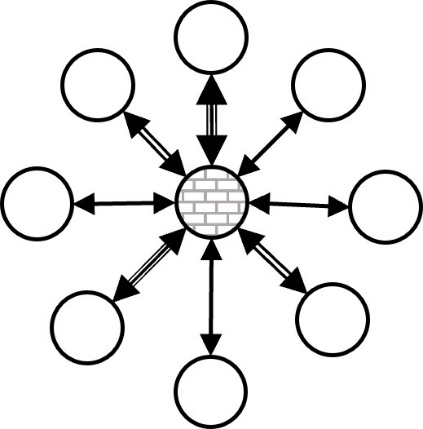
Figure 2 - Stylized visualization of an alliance network
Rhizome analysis of the alliance network. Figure 3 presents the rhizome profile for this arrangement. When analysing the alliance network, we notice that the literature considers only the network around one centre point – the ‘ego’ or the lead organization. This means that the network is limited in its possible connections. More significantly, the connections to the centre are prioritized, which means the connections among the organizations that connect to the centre point are not considered relevant in most cases. This means that the connections are low. As in most cases only the business alliances are considered and the relations only include subcontracting relationships, the heterogeneity is considered low as well. Although subcontracting can differ in the variety of elements included, these elements are subject to the same contract, this means that relations on different elements are not able to proliferate by themselves, they are not able to change without decisions being made.
This means that multiplicity is low as well. In case connections break or new connections are made, there is little impact of this on the other relations or the arrangement as a whole due to the focus on the centre point. Therefore, asignifying rupture is rated as high meaning that it is not very significant, it does not change much in the rest of the arrangement. The cartography is high as well, as there is no structured model used for the creation of the network, and the map is changing with any change in the alliances the firm has. As all communication flows through the centre, decalcomania will be low, but depending on the firm’s possibility to orchestrate its alliances and manage the communication flows and learning this may move to medium.
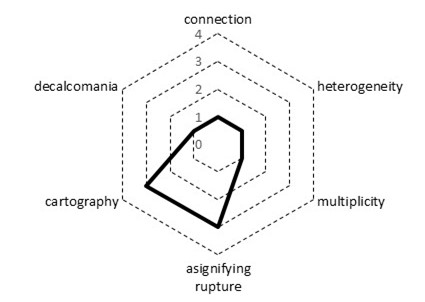
Figure 3 - Alliance network rhizome profile
Alliance constellations
The literature on alliance constellations focuses on the network of alliances among organizations. As many, if not all, organizations are connected through alliances with other organizations and thus could possibly connect all organizations on the globe, the study of the alliance constellation therefore demands some kind of meaningful restriction. This ‘artificial’, though meaningful, boundary is needed to be able to study the relation between organizations and the constellation or differences between constellations. Common boundary definitions used are industry-based, goal or content-based, or use a combination of these (e.g. R&D alliances in the semiconductor industry). Figure 4 presents a visualization of the alliance constellation. This kind of inter-organizational arrangement is emergent, when an alliance between two firms is dismantled or created, this arrangement changes its form. The main methods for analysis used in this literature are those developed for social network analysis.
Questions raised in this literature are related to the effects of the structure of the network, the paths within the network and the positions in such network (Powell et al., 1996; see, for example, Allen et al., 2007; Provan et al., 2007; Rosenkopf & Padula, 2008; Phelps, 2010). A prime example of a study of an alliance constellation is the analysis of airline code-sharing agreements by Corbo and Shi (2015).
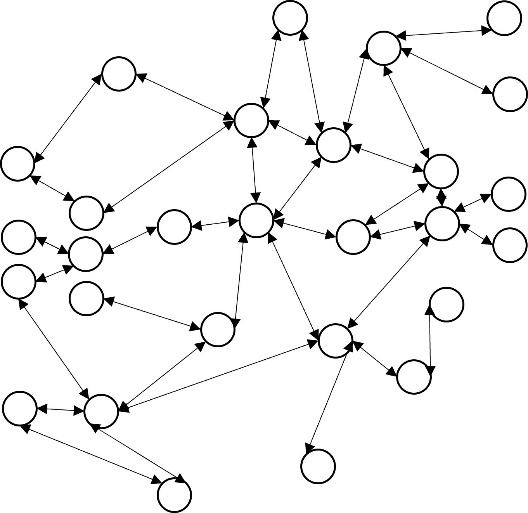
Figure 4 - Stylized visualization of an alliance constellation
Rhizome analysis of the alliance constellation. The alliance constellation considers a particular industry or field, Figure 5 synthesizes its rhizome profile. Each organization may connect, in principle, to any other and new connections can and are made while others are broken off. Some positions in the network are more beneficial than others, providing the organization with information or power. These positions are, at large, emergent and unstable as change is constant. This means that connection, heterogeneity, and multiplicity are high, as is the asignifying rupture. There is no structured model followed, but information is flowing while it is interpreted and changed to fit the circumstances it meets. This means that also cartography and decalcomania are high. This alliance constellation thus follows a similar pattern as the rhizome.
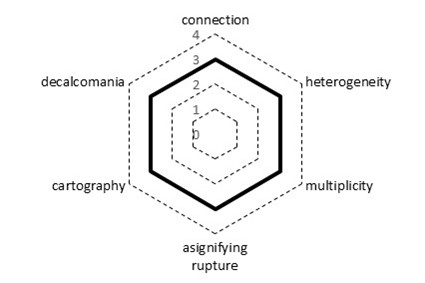
Figure 5 - Alliance constellation rhizome profile
Supply networks
A supply network is the network of companies involved, through supplying materials or parts, or services needed to produce a particular item (Harland et al., 2001) As Lamming et al. (2001, p. 69) describe it: “For most manufacturers, the supply chain looks less like a pipeline or chain than an uprooted tree, where the branches and roots are the extensive network of customers and suppliers”. The supply network looks different for each organization. (see also Figure 6 for a visualization). Harland, et al. (2001) has created a typology of supply network types, based on the amount of influence the focal firm has on its network (high or low), and the nature of the network (dynamic or routinized). Figure 5 presents the stylized visualisation of a supply chain. The importance for firms to understand their supply network has been highlighted by large disruptions, which as the 2011 Great East Japan Earthquake and subsequent tsunami (Son et al., 2021). This created some serious disruptions, for instance, in the automotive industries due to the lack of semi-conductors (Matsuo, 2015). It showed that even firms who had diversified their supplies to reduce reliance on any one supplier, did not realize the vulnerabilities in the second, third or subsequent layer away. It only became apparent when the tsunami disrupted production of an essential part that they had been reliant on this one firm down the road.
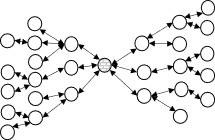
Figure 6 - Stylized visualization of a supply network
Rhizome analysis of the supply network. Figure 7 represents supply network’s rhizome profile. When considering the Rhizome principles in relation to the supply network as studied by, for example Harland and colleagues, it is important to see that they consider only those connections from the original supply source to the end customer. These connections between the organizations form a root and branch network. Although this network can be very complex and large, in principle the relationships of the supply chains of a firm can be traced. The connections are limited to those connections between the firms, which lead to the central firm. The network is thus not ever ramifying. The connection principle is therefore considered low. As supply networks include business-to-business relationships only and the connections are restricted to sales, marketing and logistics, the heterogeneity is low. As the supply networks only include the supply relationships, other connections between the firms are not considered. This means that multiplicity is low as well. Furthermore, the network can be disturbed and disrupted when one of the organizations falls out of the chain, as was experienced with the tsunami in Japan (Son et al., 2021). There is thus significant rupture present in these networks, which means asignifying rupture is very low. The interactions pattern in the relationships are, however, repetitive; firms are buying regularly from the same firms making cartography low as well. Finally, the supply network is low in replicability or transferability because the network changes as the supply sources or customers are changed.
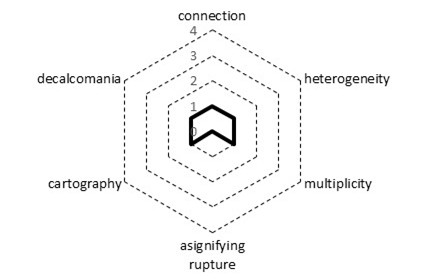
Figure 7 - Supply network rhizome profile
Industrial districts
Originating from economic geography, industry districts where initially identified as concentrations of small, family-owned and innovative firms (Pyke & Sengenberger, 1990) as observed in the study of the Italian textile industry (Paniccia, 2002), and later the study of the Silicon Valley (Harrison, 2002). Geographical proximity initially emerged an important key element of an industrial district (Pyke & Sengenberger, 1990). Besides being geographically concentrated in a small area, there can be a form of homogeneity in production(Brusco, 1990). This implies the development of specialized supply networks, knowledge sharing networks and other supportive connections among the firms in the region. However, industrial districts do not necessarily have a central unit or the possibility for collective decision-making (ibid). This concept is similarly to the concept of entrepreneurial ecosystems, though the entrepreneurial ecosystem concept lacks an industry specification (Cohen, 2006) and could therefore be considered having more diverse members. Figure 8 gives a stylized visualization of an industrial district, whereby the grey square represents the geographical area where firms operate, and the thickness of the lines indicates the diversity of network connections.
Where the concept of industrial district only includes firms, the studies do not only examine the relations between the firms, but also study how other organizations, such as universities, standard agencies, trade associations, and local governments support the development of the industrial districts. In addition, they have studied the conditions supporting the industrial district’s development, such as labour pool specialisation (Saxenian, 1996; Rosenfeld, 2002; Öz, 2004; Saxenian, 2006).
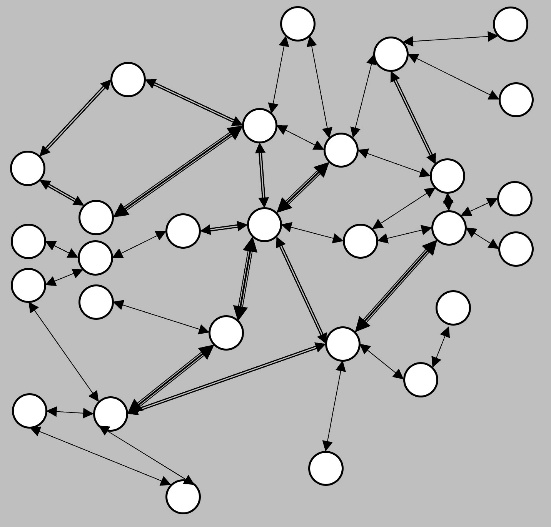
Figure 8 - Stylized visualization of an industrial district
Rhizome analysis of industrial district. Industrial districts can have various organizational boundaries such as specialized labour pool, geographical concentration, type of firms, etc. Within the loose boundaries defined, no decisions are made about who is included, and connections are possible among any company in a given territory as they simply result from interactions. We consider the connection principle therefore as medium. There can be a strong diversity of members (companies with variations among suppliers, clients, etc., institutions such as universities, etc.) and diverse elements from these organizations that connect (people, technologies, etc). Although there can be some order among the relations (based on type of interactions, flows of information, service relation etc.), there are no pre-determined, or decided patterns and the patterns can change. Level of heterogeneity is therefore assessed as high. The industrial district has no center for decision-making (at least in the industrial cluster that we take here as ideal types). The connections between the different elements can change without there needing to be unity, that is, companies may relate to different sets of organizations for questions of design purchasing of raw materials or policy lobby. This means that the multiplicity principle is considered very high. A rupture in the inter-organizational arrangements does not have a significant impact on the cluster itself, which means that the level of asignifying rupture is considered high. Assessing the principle of cartography is relatively more arduous in the sense that it depends on the type of industrial district. Interactions, however, tend to follow a structured model in a value chain. However, since there is no formal hierarchy in the relations, we consider that cartography level is medium. Finally, there are many differences and evolutions based on regional and economic contexts, as well as diffusion of innovations largely diverge inside clusters. The level of decalcomania is therefore considered high. Figure 9 represents the rhizome profile of industrial districts.
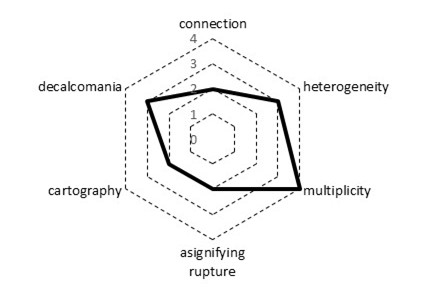
Figure 9 - Industrial district rhizome profile
Policy networks
Dowding (1995) argues that metaphors are at the origin of the label ‘policy network’. Policy networks refer to triadic relationships between various government sub-groups (see Figure 10). For instance, the “iron triangle” describes in the United States relationships between executive agencies, congressional subcommittees and interest group organizations on a specific policy issue (Dowding, 1995; Rhodes, 2007). Policy network literature later evolved to become a dominant paradigm in the analysis of policy-making processes (Dowding, 1995; Dahan et al., 2006). The concept became broader, to describe a variety of inter-organizational arrangements with a policy making goal (Rhodes, 2007), often aimed a more participatory or inclusive policy making process (Saarikoski et al., 2023). In the 90’s Spanish telecoms, Jordana and Sancho (2005) show that the policy network moves from a basic nucleus (Ministry, ruling party and Spanish firm Telefonica) to later include media groups, banks, political parties, and telecommunication operators.
Enroth (2010) identifies three core elements of the policy network concept, beyond the variety of policy networks. These elements are: an interdependence of actors that participate in the policy network, a coordination dimension between two actors or more that work together to achieve a common objective (Bevir, 2009), and a pluralism of actors. In a sense, policy network recall what sociologists Fligstein and McAdam (2012) coined as a strategic action field, with a broader sense. Strategic action field are a network where actors and organizations interact to achieve a specific goal. For instance, the authors study the strategic action field of civil rights in the United States. A field or policy network emerges around various actors that organize racial public policies: from white supremacists to Democrat party, the cotton industry, as the two authors analyse. Here we focus on policy networks
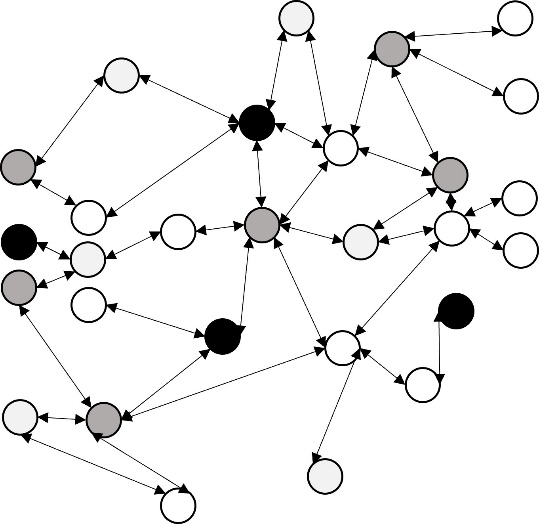
Figure 10 - Stylized visualization of a policy network. Different colours are used for different types of members.
Rhizome analysis of policy networks. What do we learn about policy networks based on our rhizomatic framework (see Figure 11)? ‘Connections’ may emerge among any actor that has an interest in a given field: telecommunications, health, financial technology or banking for instance. These actors may include public agencies, regulators, business, trade associations, non-profit, and other regulatory intermediaries. The level of connection is therefore high. Regarding heterogeneity, interactions may occur without strict hierarchical ordering. This does not mean power asymmetries or lobbying strategies do not exist on the contrary. However, there is typically no overarching authority that determines participation or emerges from the connections. The distributed character of policy networks, often involving multiple forms of negotiations and interdependences points to a high level of heterogeneity. Policy networks also exemplify a high degree of ‘multiplicity’ in the sense that different elements may connect and change in different ways, there is no demand for unity across the different elements. These networks are also often dynamic, changing depending on issues at stakes and evolutions of regulations. Thus, different organizations, and different parts of these organizations, at different times, may be involved in different issues and discussions related to the policy. We consider multiplicity therefore to be very high.
It follows that policy network demonstrate a high capacity for resilience and regeneration following disruptions in the connections. The departure or weakening of a specific actor (e.g. a ministry, a private company or a trade association) does not collapse the entire network (Dahan et al., 2006). Instead, other organizations may step in, relations may reconfigure, and influence redistributed. This is not to say that ruptures have no consequences. But they do not necessarily destabilize the existence of the network itself. We therefore consider asignifying ruptures in the policy network to be high.,
Regarding ‘cartography’, each policy network may grow and evolve in different ways depending of sectors, local, national and transnational specificities, history, geopolitics, economic and social context, etc. (Levi-Faur & Jordana, 2005; Dahan et al., 2006). In that sense, interactions do not follow a structured model centered on a formal hierarchy. On the contrary, they may grow organically depending on the contextual necessities, such as an ongoing construction of a regulation. Cartography is therefore high. Finally, using the principle of decalcomania compels us to analyse what is being transferred in a policy network. Different information may flow among members, as well as policy innovations, in transnational policy network (Elkins & Simmons, 2005; Meseguer, 2005). Similarly to the divergence of policy network’ cartography, diffusion of policy instruments may diverge and lead to transpositions to local contexts (Levi-Faur & Jordana, 2005). Decalcomania is also high. The policy network is an interesting case of inter-organizational arrangements disclosing many similarities with a full rhizome type of arrangement. However, connections may not indifferently be established with any actor.
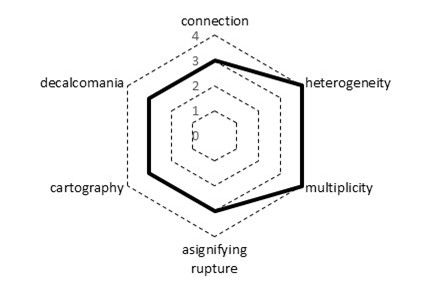
Figure 11 - Policy network rhizome profile
Meta-organizations
Originating in organization studies, meta-organizations are organizations whose members are themselves organizations (Ahrne & Brunsson, 2005; Ahrne & Brunsson, 2008). This includes associations (e.g. trade or industry, national, business, multi-stakeholder, sports or issue-based associations such women’s associations), unions (such as labour unions, but also political unions), alliances (particularly multi-partner alliances, which may sometimes also be multi-stakeholder), cooperatives (of businesses), organizations (e.g. international governmental organizations), networks (e.g. trans-governmental networks), and groups or communities (Boström, 2006; Karlberg & Jacobsson, 2015; Malcourant et al., 2015; see, for example, Ahrne et al., 2016a; Berkowitz et al., 2017; Cropper & Bor, 2018; Corazza et al., 2019; Garaudel, 2020; Roux & Lecocq, 2022; Carmagnac et al., 2022; Koch, 2023). The concept of meta-organization thus covers a broad range of phenomena, which have empirically been studied as separate from one another though share important central features (Ahrne & Brunsson, 2008). First, the meta-organization is itself an organization, established based on decisions. Members are also themselves organizations, voluntarily associating themselves and becoming part of the meta-organization. Members do so without giving up their own autonomy as separate organizations. This means that the organizational boundary created is permeable, though the relations within the boundary do differ from the relationships outside the boundary as they build on interactions and collective decisions (Ahrne & Brunsson, 2008). Meta-organizations can differ in the goals they have and what kinds of activity they undertake, from lobbying, to supporting members interaction, coordinating activities and , implementation of rules (Berkowitz et al., 2022), the roles they take (Bor & O’Shea, 2022) and they can also differ in their structures, e.g. where their resources come from (Bor & Cropper, 2023) or whether they have similar types of members or different ones (e.g. only firms or only governmental organizations or multi-stakeholder, cross-sector, etc) (Berkowitz et al., 2017). The visualization (Figure 12) shows the possibility for diverse members to interact with one another and to affect decisions in meta-organizations.
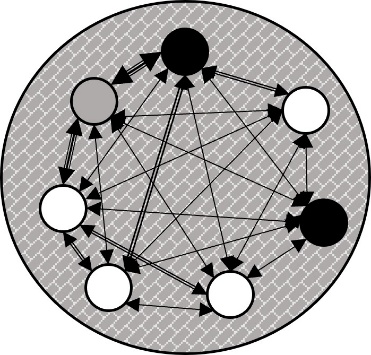
Figure 12 - Stylized visualization of a meta-organization
Rhizome analysis of meta-organizations. Figure 13 synthesizes the rhizome profile for this type of arrangement. In meta-organizations, membership is an essential dimension, since members remain autonomous organizations while they at the same time co-constitute the meta-organization. A new organizational boundary is created that separates the meta-organization from its environment. Meta-organizations make a decision concerning the acceptance of members, often defining specific areas of similarity (e.g. being a national union of a specific industry). The principle of connection is considered as low as not all organizations can or will connect through a meta-organization. Those who are accepted as members can connect freely to one another with little to no hierarchy among themselves. The members may connect to other members on a variety of topics (e.g. working groups, committees or other types of connections can be created), though they are often limited to their collective interests and the goals of the member organizations and the meta-organization. We therefore consider heterogeneity to be medium high. However, there is a unity of elements as members are accepted and these working groups or committees often themselves highly decided, supporting decisionality, i.e. a degree to which decisions are collectively made to organize the meta-organization and fix its boundaries (Berkowitz & Bor, 2022). This means that the meta-organization does not proliferate autonomously, and multiplicity is therefore assess as relatively low. When considering rupture in the connections within the meta-organization, Ahrne and Brunsson (2008) and further literature have shown that due to strong dependence of meta-organizations on members, a member-organization exiting the meta-organization affects the meta-organization much more than an individual leaving a business, for instance. This means that asignifying rupture is low as well (i.e. the rupture is signifying). Regarding cartography, meta-organizations follow a structured model that they have collectively decided (decisionality) (Berkowitz & Bor, 2022). For instance, meta-organizations may have specific task forces or working groups dedicated to a given topic (Berkowitz et al., 2017; Bor & Cropper, 2023). Meta-organizations also often have a board with elected members, who make collective decisions. This creates specific interaction patterns, and the cartography principle is therefore considered low. However, meta-organizations facilitate the diffusion of rules, innovations, and management practices, and although there might be transpositions and divergences, the standardization and capacity building processes are important. This tends to result in homogenization dynamics and replications across members. Therefore, decalcomania principle is rated low.
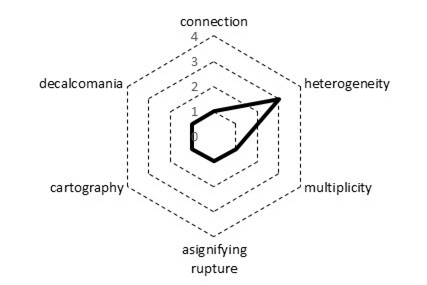
Figure 13 - Meta-organization rhizome profile
Discussion and conclusion
Starting from the diagnosis that inter-organizational collaborations are increasing and we need a conceptual tool to analyse their pluralism and diversity, our paper highlights the similarities and dissimilarities of several arrangements that may be difficult to comprehensively analyse with other concepts like network, organization or meta-organization for that matter. Further, this framework based on dimensions of the rhizome provides the foundations for a more integrative approach of inter-organizational arrangements where these arrangements 1) stratify, i.e. build various strata of arrangements that accumulate, pile up, fold, unfold over time and space, and 2) intersect, i.e. organizations may be involved in multiple arrangements that may or may not connect with one another, thus creating a complex web of inter-organizational arrangements.
Inter-organizational arrangements as rhizomes: beyond network or organization
“In Deleuzeguattarian terms, the rhizome becomes a way of thinking a decentered multiplicity without a center of emanation or point of representational reference” argues Wallin (2010, p. 86). In this paper, we have done precisely this, using the rhizome as an alternative way of thinking about inter-organizational arrangements. In so doing, we attempted to conceptualize a third-space (Wallin, 2010) to move beyond traditional dichotomies and categories that populate academic literatures in management, organization studies, political science, etc.
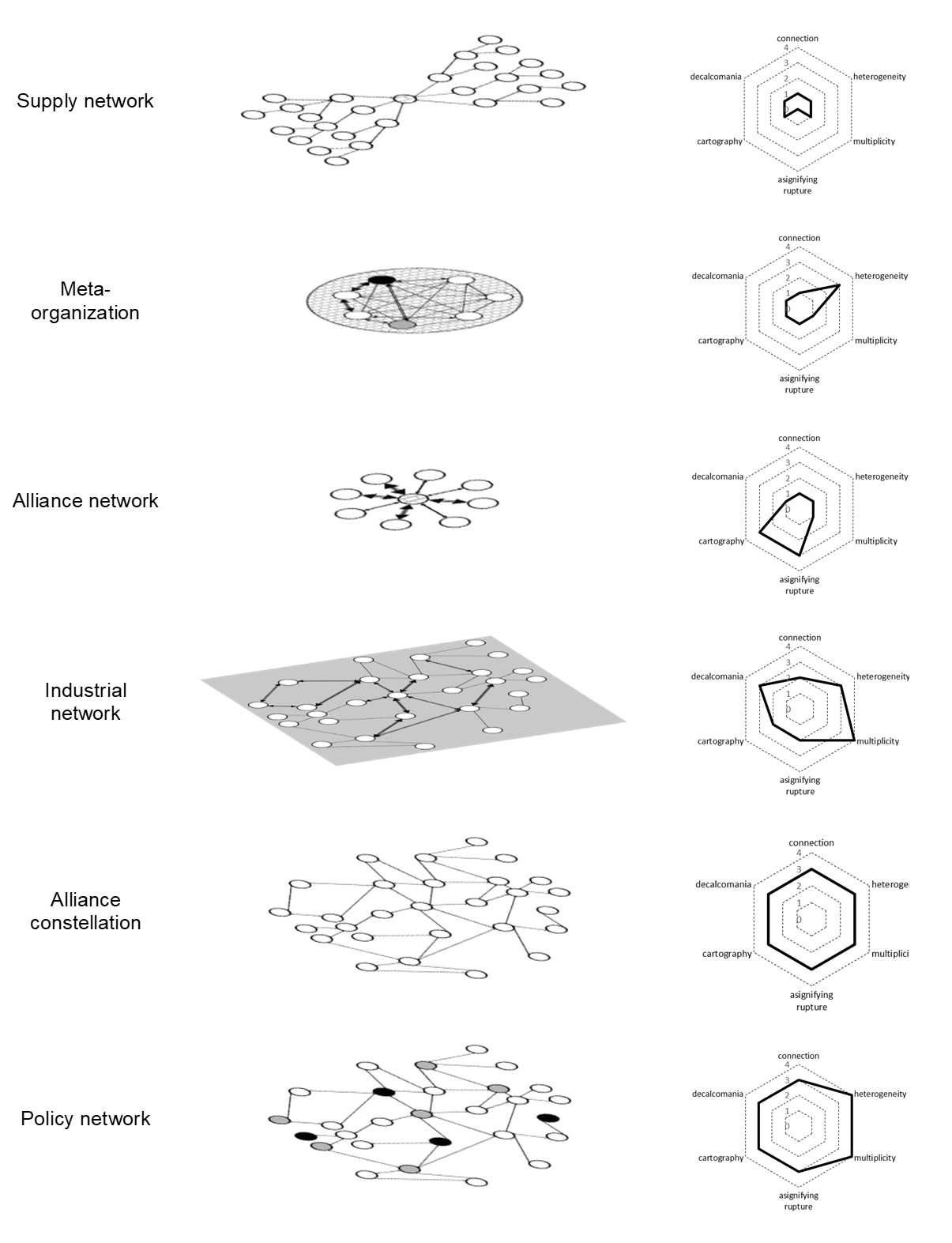
Applying this framework to selected inter-organizational arrangements, we systemically analyse and compare inter-organizational arrangements by developing rhizome profiles. We carried out these analyses on different concepts that sometimes describe similar empirical phenomena: alliance networks, constellation networks, supply networks, industrial districts, policy networks and meta-organizations. We highlighted different profiles, depending for instance on the openness of membership, the existence of a central unit of decision, the importance or unimportance of a member’s exit or transfers of knowledge. We compile all rhizome profiles in Figure 14 for comparison purposes, from least rhizome-like on top, to most rhizome-like at the bottom.
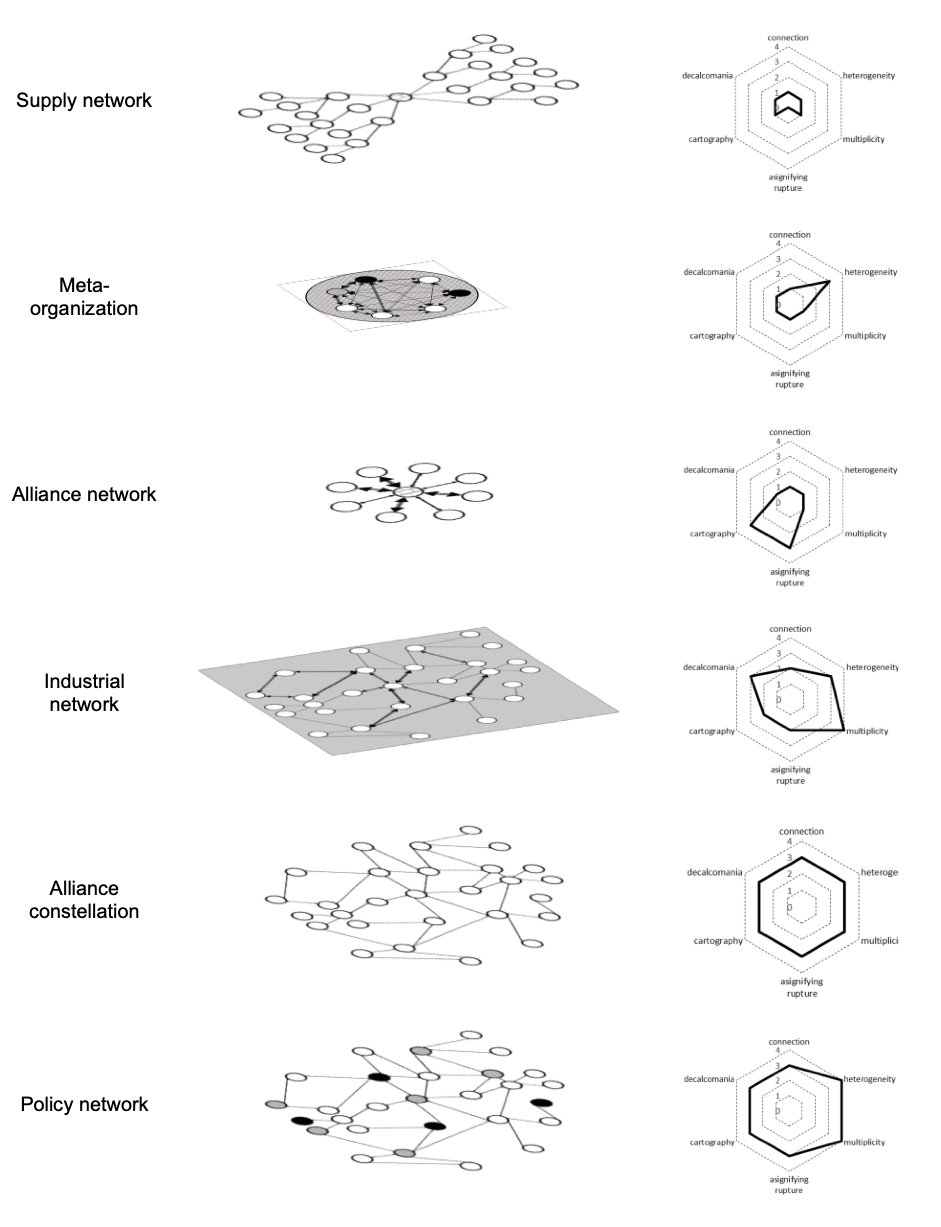
Figure 14 - Stratification of inter-organizational arrangements based on our rhizomatic framework
We believe this rhizome framework yields some interesting insights. For example, intuitively, the network/organization approaches may bring us to cluster together meta-organizations and multi-partner alliances as a more organized approach on the one hand, and policy networks, industrial districts as a more emergent or network approach on the other hand. Figure 13, however, shows how these arrangements may in fact differ based on our new dimensions. The supply network turns out to be the least rhizome-like profile whereas we could have expected it to look closer to a rhizome. Since they have formal collective structures and units of decision making, we could also have expected meta-organizations to be the least rhizome-like, while they in fact present more rhizome features than supply networks. Conceivably, all forms of arrangements of collaboration among organizations may be framed within a matrix of possibilities that oscillate between low and high levels of rhizome principles.
As Adkins (2015) argues, Deleuze and Guattari do not postulate pure rhizomatic arrangements, rather they seek to understand the internal limits of such arrangements, our shared endeavour. Acknowledging the concept of rhizome as both a conceptualization of inter-organizational arrangements and a botanical metaphor for analysis richly attracts attention on important but unthought dimensions of collaboration, namely connection, heterogeneity, multiplicity, asignifying rupture, cartography and decalcomania. This can be fruitfully developed to further analyse motivations for organized collaborations among organizations, but also outcomes and impacts of such collaborations depending on their rhizomatic profiles.
A thousand plateaus of inter-organizational arrangements or an organizational web?
Centred on Deleuze and Guattari concept of rhizome, our findings contribute to the literature on the plurality of organizations, and in particular the plurality of collaborations among organizations. Following Deleuze and Guattari’s metaphor, our findings contribute to developing an approach of collaboration among as fluid acts of collaborating among organizations. Further, we propose an inter-organizational web of collaboration, where each organization is connected to many other organizations and inter-organizational arrangements.
Acknowledging the conceptual power of rhizome and of the resulting inter-organizational web of collaboration, our paper contributes to recent scholarly efforts in rethinking organizations as more pluralistic (Brès et al., 2018; see also the recommendation of this paper, Brankovic, 2025) or heterogeneous (Lawley, 2005; Linstead & Thanem, 2007). In so doing, we also add to recent works on social orders seeking to move beyond strict oppositions between networks and organizations (Laamanen et al., 2020; Grothe-Hammer et al., 2022; Grothe-Hammer & Berkowitz, 2024), enabling a comprehension of more liquid phenomena, fluid organizing and hybrid, unconventional arrangements (Bauman, 2000; Brès et al., 2018; Hussenot, 2021; Clegg, 2024). As Linstead and Thanem (2007, p. 1487) note, “Deleuze pursues a non-dialectical politics of multiplicity, advocating a creative pluralism of organization (based on enfoldedness, relational connections and becoming) against a controlling pluralism of order (based on positions, interests and governmentality)”. Our inter-organizational web grows from such an approach of multiplicity based on “relational connections and becoming” at the level of collaborations among organizations. Inter-organizational arrangements may no longer be understood separately, but fruitfully integrated and compared based on “rhizomatic ontologies of flow” (Lawley, 2005, p. 36).
Limitations and implications for future research
This study has several limitations that indicate the need for additional research. This is a first attempt at operationalizing the concept of the rhizome and much more work is needed to better understand how connections among members, heterogeneity of members, multiplicity of interactions and connections, asignifying rupture in the connections, cartography of interactions, and decalcomania can be more precisely analysed and adapted to the variety of collaborations. Or on the contrary, where they fail to provide insights. Further, this conceptual paper is based on a selection of some exemplary types of inter-organizational arrangements and how they relate to each other thanks to an analytical framework. However, these types are themselves hardly homogeneous. Additional research is needed to examine similarities and dissimilarities both within said literatures (i.e. within alliances literature, within meta-organization, etc) and across literatures that address inter-organizational phenomena.
Like many others before us, we were attracted by the originality of Deleuze and Guattari’s thinking, but the rhizome might be sometimes too complex to operationalize as such. One way to approach this limit could be to focus on only those dimensions that have no equivalent so far in the literature, for instance asignifying ruptures. The aim of this paper was to provide a more fluid and pluralistic understanding of collaboration among organizations by developing a rhizomatic approach to inter-organizational arrangements. We showed that inter-organizational arrangements, e.g. alliance constellations, policy networks or meta-organizations, can be analysed based on six principles (connection, heterogeneity, multiplicity, asignifying rupture, cartography, decalcomania), building a “rhizomatic ontology of flow” (Lawley, 2005, p. 36). Inter-organizational arrangements, we have argued, cannot be analysed solely as networks or organizations. Even further, analysing world society, global and local social orders must involve a reckoning with this web of inter-organizational arrangements. In that sense, the so-called “environment” of organizations is itself highly organized (Bauman, 2000; Ahrne & Brunsson, 2011; Ahrne et al., 2016b; Apelt et al., 2017; Hussenot, 2021; Clegg, 2024), but in pluralistic ways. Inter-organizational arrangements can be understood as a stratification of more-or-less rhizomatic arrangements that ceaselessly accumulate, pile up, connect, fold and unfold. But more work is needed to know whether a rhizomatic approach can help understand differently how collaborations among organizations promote or prevent large-scale societal changes, such as sustainability transitions, climate actions, inequalities reduction, the dissemination of alternative organizations. It could be interesting to use the rhizomatic framework to identify and highlight possible lock-ins, points of intersections where stratified organizing among collaborations contributes to maintain hegemonic social orders.
Acknowledgements
Preprint version 3 of this article has been peer-reviewed and recommended by Peer Community In Organization Studies (https://doi.org/10.24072/pci.orgstudies.100003; Brankovic, 2025). The authors are grateful to Jelena Brankovic for her recommendation, handling of its review process and the feedback on earlier versions, and to the many reviewers for their feedback.
Funding
The authors declare that they have received no specific funding for this study.
Conflict of interest disclosure
The authors declare that they comply with the PCI rule of having no financial conflicts of interest in relation to the content of the article. Both authors are recommenders and members of the managing board for PCI Organization Studies.
- ↩︎
Figure 1 was developed by undertaking a Scopus keyword search with the following search string: “inter organizational” OR "inter-organizational" OR "alliance constellation" OR "alliance network" OR "business network" OR "cross-sector partnerships" OR "entrepreneurial ecosystem" OR "goal-directed network" OR "industrial district" OR "meta-organization" OR "multi-partner alliance" OR "platform organization" OR "policy network" OR "supply network" OR "whole network"
- ↩︎
“Our final mix of 2013 from Luke Abbott is a synapse-firing electronic work that explores the interconnectivity of all things. "Rhizome is the creeping root structure and a model for thought”, explains Luke “a diagram of interconnectivity. Start anywhere; go to another place, along any path. All connections are possible, as it is within music and all other things. From sound to place, from aesthetics to ethics, all hierarchy is undone and new orders can arise from a willingness to seek adventure.”” https://www.mixcloud.com/okini/rhizome-by-luke-abbott/
- ↩︎
“The Rhizomatic Composition Tool is a compositional tool (and method) inspired by the French philosophers Deleuze and Guattari. The core concept is that incomplete musical expressions find their completion in random encounters with one another, thereby forming a constantly evolving composition.” https://www.youtube.com/watch?v=bJJtszi6w5c
- ↩︎
As highlighted by reviewer 1.