
 CC-BY 4.0
Context of the current work
The terminology ‘Global North’ and ‘Global South’ has been increasingly used in academia and by scholars (Toshkov, 2018), although we want to acknowledge that it comes with its own limitations and pitfalls. The history of using this terminology goes back to the commission chaired by former West German Chancellor Willy Brandt, who prepared a report (Brandt 1980) presenting the concept of a baseline dividing the “developed” Global North and the “developing” Global South. This situation is the same with other terminologies coined in the past and still used today, such as “First-Third Worlds” and “Developed” and “Developing Countries”. While the current literature no longer uses the “Third World” term, the classification of countries within international organizations and statistical rankings remains highly stratified, despite substantial local variations (Lees, 2011). All of these terms tend to overly reduce and erase diverse experiences (Beattie, 2023), and the term “Global North-South” focuses on a geographical relation that does not directly translate culturally, historically, or economically (Toshkov, 2018). Further, Toshkov (2018) recommends not using this terminology and being more accurate when talking about specific countries (i.e., “less developed countries”). However, and precisely because of the popularity of the terminology (Toshkov, 2018), we prefer to use this familiar term and clarify its meaning here. Therefore, whenever we refer to the ‘Global South’ in this work, we are referring to low and middle-income, formerly and currently colonized countries.
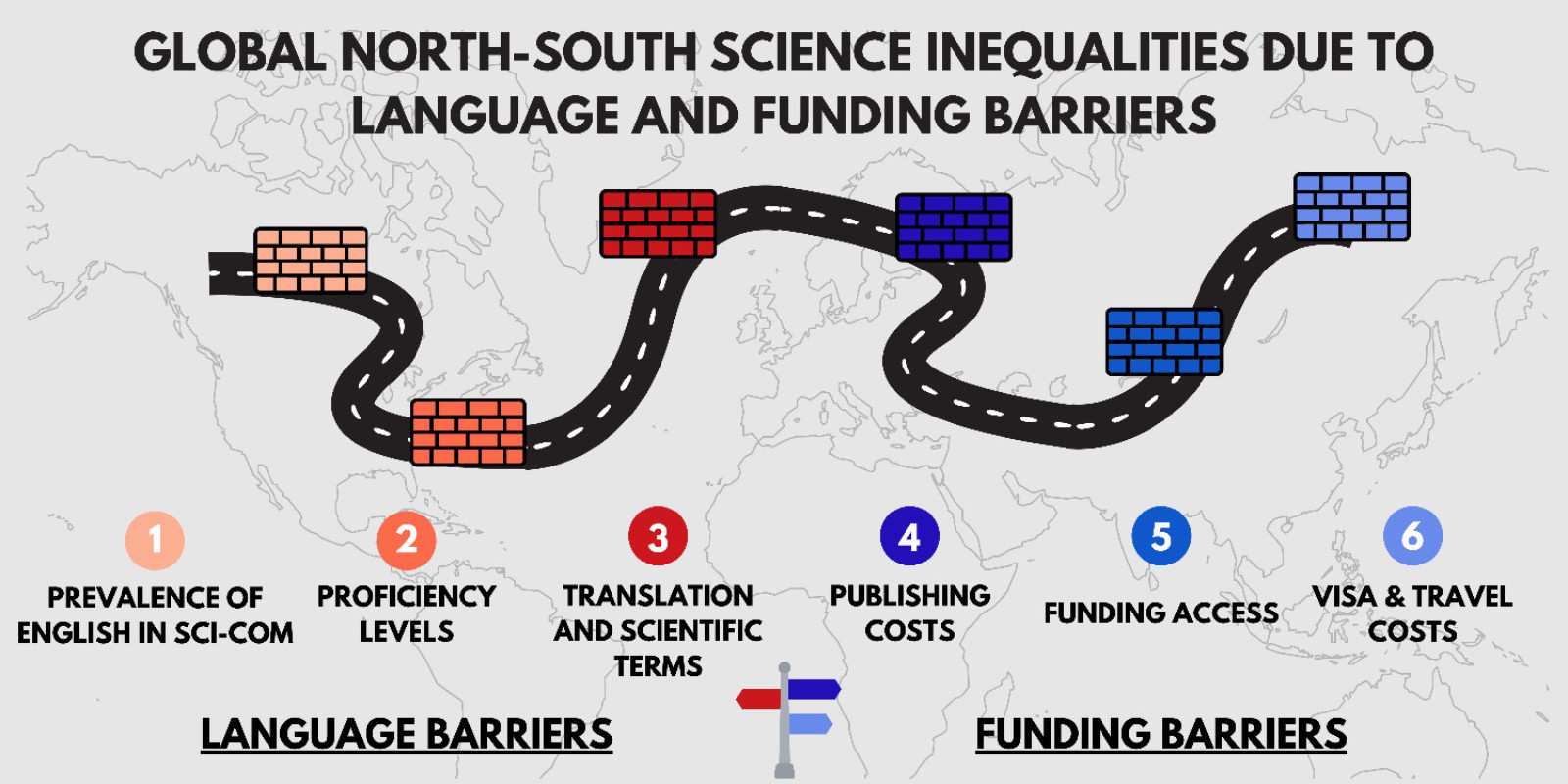
As this paper is written by many researchers from different regions of the world, we must acknowledge how our experiences have shaped this piece and have guided much of our discussions and views on this topic (see Table A1; Appendix). Our background and experiences relate to the challenges that we have faced when participating in science, influence our perspectives and views (hooks, 1994; Longino, 1995), and determine the focus and narrative of this manuscript. Therefore, we focus on two main barriers that are not only shared among us, but also envelop many other related issues regarding participation in modern science, namely the challenges of language and funding gaps.
Context of mainstream modern science
Perspective of the Eurocentric dominance in science
The term “scientific revolution” has been characterized in at least three different ways since it was coined and popularized (Cunningham & Williams, 1993). First, in a philosophical sense, it is defined as a particular method of inquiry that produces knowledge in the form of causal, mathematical laws, or which can be reduced to such laws. Second, as a moral enterprise, to amplify freedom, rationality, truth, and as the motor of social progress. And third, as the embodiment of the innate, universally curious human nature.
The history of science, as taught to most students, has long been understood in this way, despite drastic changes and contrasting views on this topic in the wider scientific community. The deductive, scientific method that most of us understand as the “scientific method” has long been questioned, with some philosophers of science like Okasha (2002) arguing that rather than one scientific method, there are several scientific methods specific for each scientific discipline (Marín, 2018). Hansson (2006) analyzed 70 highly-cited Nature articles and found that just two met Karl Popper’s deductive, falsification criteria. Of course, Popper’s ideas come directly from a characterization of science based on the reduction of phenomena to universal laws only (Okasha, 2002). That is why Popper had issues with demarcating some parts of the life sciences—like evolutionary biology—as science (Stamos, 1996). It would be very difficult to argue that whole disciplines like paleontology, mathematical modeling, naturalist exploration, and many others that do not directly test hypotheses in a deductive manner, do not constitute science. It should also be clear, at this point, that science can operate rather in an inductive manner, as argued by Okasha (2002), and also in an abductive manner, as argued by Charles Pierce (Santaella Braga, 2019). The first uses specific observations to make broader generalizations (i.e., the trisomy in the 21st chromosome of some patients was observed to conclude this is the cause of Down syndrome), while the second case is a form of logical inference of simplest explanation which also incorporates probability, uncertainty, and doubt (Fitzhugh, 2006).
The moral characterization of the scientific revolution has also long been questioned (Merton, 1938). Such characterization assumes that science is free of any religious, social, economic, and political influence. In reality, however, the scientific revolutions were clearly affected by religious (e.g., Puritanism) and economic values (e.g., modern capitalism) (Cunningham & Williams, 1993). It is difficult not to connect the development of many scientific ideas and theories with the specific social contexts and political powers into which they were born. Moreover, the European countries that hosted these scientific revolutions since the 17th century were, mostly, also the countries benefiting from the first forms of global trade and capitalism, colonization, and slave trade. Scientists in the 17th century were directly and indirectly affected, influenced, and funded by such colonization ideas and practices.
Although rationalization has been a valued trait in science since the time of Aristotle, research shows that factors like first impressions and negative experiences deeply affect reasoning, and scientists are not immune to this (Kuhn, 1962; Haidt, 2012; Kahan, 2012). Thus, scientists are equally and strongly influenced by emotions and intuitions (Haraway, 1988). Rather than abandoning reason and scientific inquiry in its entirety—as some academics have proposed (Sokal & Bricmont, 1999)—it is more beneficial to be conscious about the historical and psychological factors that affect the way that scientific revolutions started, and the way that individual scientists and the scientific community operate (Haraway, 1988; Haidt, 2012).
Several criticisms have been issued on the “universality” of scientific inquiry over the last decades, coming from many academic areas and thought systems (Cunningham & Williams, 1993), including indigenous scholars (Hird et al., 2023). The mainstream understanding of science originates from primary assumptions about the characteristics of science itself, which are based on idealizations of the world and what the scientific activity is (Liboiron, 2021). This has led to long-held views about the scientific method itself, which are still applied at different levels of scientific evaluation, affecting what gets funding, what gets to be published and therefore, taught and passed on to future generations (Paasi, 2005; Salager-Meyer, 2008). This cultural background of the scientific enterprise highlights how the current system operates and how researchers are able (or not) to overcome barriers for participation in the global research environment.
The publishing landscape and the move towards Findable, Accessible, Interoperable, and Reusable (FAIR) science
For most of the history of the European scientific enterprise, scholarly communication was accomplished through non-commercial means, such as letters, monographs, pamphlets, and essays (Zuckerman & Merton, 1971; Larivière et al., 2015). Publishing costs were mostly in the hands of individuals, or through the support of publishing organizations, such as university presses and donors. The scientific enterprise was concentrated in the hands of wealthy, white, independent, male scholars, and prestige was not yet tied to publication, but rather to social standing (Fyfe et al., 2017).
With the creation of the first learned societies, the first scientific journals appeared, although still far from the structure we understand now, operating more like magazines, with no systematic “peer review”, and primarily fulfilling the vision of the editor (Fyfe et al., 2017). Publishing also became a way to secure intellectual property rights, which motivated researchers to move from a culture of secrecy to open communication (Zuckerman & Merton, 1971). This transformed the ethos of the European scientific community to one of free circulation and sharing of knowledge and ideas.
Even though these first journals had the intention of generating revenue, they rarely did (Fyfe et al., 2015). However, things began to change in the 18th century with the print culture reducing the costs of publication and increasing accessibility to a wider readership. This, coupled with an increase of academic jobs and the professionalization of the academic community, meant that authorship became a tool for universities to evaluate their employees (Paasi, 2005). As universities increasingly became the hub of researchers, publications became a primary way to demonstrate the institution’s and one’s intellectual merits, slowly changing the culture of prestige (Zuckerman & Merton, 1971; Fyfe et al., 2017). Yet, “reputable” publications at that time still did not undergo full peer review as it exists today, and a rudimentary system of refereeing existed mainly in learned societies as a means to safeguard their reputation and representation (Zuckerman & Merton, 1971).
After World War II, there was a major expansion of governmental funding for research, especially in the United States (Baldwin, 2020). This created fertile ground for a new for-profit system of publishing, for several reasons, as discussed in Fyfe et al. (2017). First, the volume of research outputs began to outpace the capacity of scientific journals to handle them. Suddenly, finding articles to publish and keeping the periodicity was not an issue, which necessitated efficient mechanisms for sharing this wealth of information. This expansion was also due to the emergence of new scientific disciplines and fields of study. The diversification of research areas created a demand for platforms to disseminate new knowledge and findings. The post-war period also saw an increase in the internationalization of research, with conferences, collaborations, and societies growing in scope and reach. Scientific communities and the readership grew substantially, and the new publishers had a much larger customer base to explore. As the US was the main driving force in research funding and output, English was increasingly used as the international language of science (lingua franca) and was, therefore, the language chosen by these new publishers.
However, this growth in funding for research in the US also brought increased tension between accountability to the public and the government, and research autonomy, leading to a transformation of the refereeing system by the mid 1970s (Baldwin, 2020). This is when the term “peer review” started being used, with its definition implying that only a small group of people, the expert peers, should be responsible for evaluating an article or proposal’s worthiness. First employed mainly by US funding agencies, this process was later co-opted by publishers worldwide (Baldwin, 2020) since the judgment of peer reviewers was seen as a token of value and legitimization—one that is given for free and anonymously by a community that still serves the ethos of improving science and sharing knowledge.
While generous funding lasted, publishers focused on selling journal access to institutions, since they could charge more per subscription than to individuals. Due to its particular nature and through various strategies to reduce costs, publishing became a highly profitable business, one where neither the primary good nor its quality control is paid for (Larivière et al., 2015). By the 1980s, the stream of funding drastically decreased and universities and libraries struggled to keep up with the costs of acquiring titles (Fyfe et al., 2017). Unlike most commercial goods, there is no cheap alternative to scientific discoveries and ideas, and this limitation has exacerbated the inequality of access between institutions and academics, and their potential for innovation and participation in cutting-edge research.
More recent advances in technology, such as digital media and the internet, have brought the promise to facilitate the publication and circulation of academic research, democratizing its access. However, these technological advances have also brought new commercial opportunities by reducing production costs, and with new digital rights practices, publishers have taken control of intellectual property and thus prevented its free dissemination (Larivière et al., 2015; Fyfe et al., 2017). The academic culture of prestige that emphasizes a particular form of refereeing and journals has stymied alternative, non-profit models of academic publishing that lie outside of traditional systems of reward and recognition (Fyfe et al., 2017), and instead, has fueled up the creation of a publisher monopoly (Nolde-Lopez et al., 2023, although see Kulczycki et al., 2025 for examples of where open diamond models play a major role).
Over the past decade, the landscape of academic publishing has witnessed a transformative shift in the commitment to Open Science, particularly due to global-scale diplomatic commitments. For example, UNESCO has recommended the following Open Science principles on a voluntary basis: transparency, scrutiny, critique, and reproducibility; equality of opportunities; responsibility, respect, and accountability; collaboration, participation, and inclusion; flexibility; and sustainability (UNESCO, 2021). Moreover, current US-European policies and mandates increasingly require publicly funded research to be published in Open Access (OA) formats. While this shift promotes broader dissemination of knowledge, it has also led to a significant financial restructuring, especially for commercial publishers. The transition from institutions shouldering the costs to authors navigating the terrain through Article Processing Charges (APCs) has effectively transferred the financial burden onto research grants and projects’ funding (Pulverer, 2018). Consequently, government investment in Open Access inadvertently sustains and benefits for-profit publishing companies by ensuring a continuous stream of revenue through mandatory APCs. This financial re-calibration not only reinforces commercial publishers’ profitability but also reflects a broader reconfiguration in the traditional power structures of scholarly communication (Dudley, 2021).
The adoption of Open Science practices has not been without its share of challenges—after all, it is still built on the same foundations and, therefore, inherits many of the same systematic barriers as traditional science (Bahlai et al., 2019; Gownaris et al., 2022). Non-profit-driven models, designed to foster openness and collaboration, face resistance due to the deeply ingrained academic prestige culture (Bosman et al., 2021). The allure of “prestigious” journals and the associated impact factor often act as barriers to embracing alternative, non-profit-driven models (Lawson, 2015), and leads to many journals, even including those with an “open diamond” model, to be not indexed and left out of major citation databases, especially journals from the Global South (Bosman et al., 2021; Bol et al., 2023). This inertia within the system underscores the formidable challenge of reshaping entrenched norms and practices within the scholarly community.
In science, the conditions for participation are not equal across the globe. If we take a historical perspective based on studies such as those by Aagaard et al. (2020) and Graves et al. (2022), a consistent pattern emerges. Most breakthrough discoveries and research advances tend to come from wealthier regions and countries with robust, high-income economies and advanced infrastructure. This pattern is commonly referred to as “scientific inequality” and is manifested in three key aspects: funding, recognition, and resources.
Language diversity emerges as a persistent hurdle in the journey towards Open Science. The dominance of English in scholarly communication marginalizes non-native English speakers, limiting their ability to effectively disseminate their research findings (Amano et al., 2023a). Breaking down this language barrier is imperative for realizing the true inclusivity and global reach envisioned by the Open Science movement (Curry & Lillis, 2015) and scientific communication more generally (Rasekoala, 2023). More about this topic is discussed below in section 4.
Another significant impediment that hinders widespread participation in Open Science initiatives is the issue of funding. In the case of publication and dissemination of knowledge, the imposition of APCs, shifting financial responsibilities to authors, creates a new set of challenges, particularly for researchers in resource-limited settings. The inability to cover APCs due to funding constraints, inhibits the active engagement of researchers from diverse backgrounds (Nabyonga-Orem et al., 2020). More about this topic is discussed below in section 5.
Methods
Here, we performed an integrative review, consisting of a conceptual synthesis of a wide range of published studies (Torraco, 2005; Souza et al., 2010; Snyder, 2019), aimed to assess and critique the current state of Global South researchers’ experiences and participation in science, within the context of scientific conduct and community of the Global South (see definition in section 1). The motivation to write this review stemmed from a combination of personal experiences and everyday challenges that result from systemic barriers (see Table A1; Appendix) and reflections on work from authors from diverse fields, which has been woven into a conceptual framework to offer new perspectives on scientific practices. We synthesize conceptual papers, position papers, literature from different scientific disciplines, as well as statements and quotes from individual scientists. This is the result of a collaborative effort of the co-authors, which was coordinated through online communication and internal peer-reviewing processes. Our work contributes to the community’s knowledge on how science is practiced currently, and offers guidelines for the future, especially in the context of Open Science. These guidelines are intended to appeal not only to individual scientists, but also institutions.
Language barriers
It is important to note that inequalities in science are not driven exclusively by economic factors and the distribution of resources. These disparities manifest at the individual level as well (Xie, 2016), particularly concerning communication skills, where language assumes a central role. As Drubin & Kellogg (2012) highlight, the use of English as the lingua franca in scientific communication has implications for global collaboration (Amano et al., 2023a). This linguistic dominance, while seemingly unifying, often sidelines non-native English speakers, hindering their ability to access research, publish their work, and engage in scientific discourse (Soares et al., 2023). This situation not only disadvantages individual researchers from non-English speaking backgrounds, who find it challenging to compete in the scientific field, but it also impacts the global scientific community (Petersen, 2021). Breaking down language barriers invites a wealth of diverse perspectives, enriching global scientific understanding. Towards this end, practical steps can be implemented. Supporting researchers in language learning, translating crucial scientific texts, indexing non-English journals, and encouraging multilingualism in scientific forums are essential first steps. Such initiatives not only make science more accessible but also nurture a more diverse and vibrant scientific discourse, paving the way for comprehensive and globally inclusive scientific progress.
We note that here, and throughout the review, when discussing “language”, we refer to formal, spoken and written language. There are other ways in which the term “language” can be understood when discussing the scientific endeavor. For example, each sub-discipline has their own technical, specific language, which tends to diminish interdisciplinary work (Monteiro & Keating, 2009). Similarly, “language” can reflect Foucault’s concept of “discourse” (Miller, 1990), to understand how academia creates its own rules. However, discussing such interpretations of language regarding scientific research is beyond the scope of this review.
Prevalence of English in scientific communication
According to the Ethnologue website (https://www.ethnologue.com/; a curated database), there are around 7,168 living languages on Earth (Retrieved February 27, 2024). Drubin & Kellogg (2012) estimated that less than 15% of the world’s population speaks English, with just 5% being native speakers. Nevertheless, English ranks as the most widely spoken language and is the main language used in science. This extraordinary imbalance emphasizes the importance of recognizing and alleviating the difficulties faced by non-native speakers of English if we are to have a truly global community of scientists.
The majority of journals listed in academic indexes, especially those with a high impact factor (publications which typically have a disproportionately high impact on career advancement), publish their content in English (González-Alcaide et al., 2012; Cavacini, 2015; Liu et al., 2018). Publishing in English is also a common practice for career advancement in science, as it often leads to higher citation rates, contributes to job performance, and opens up better opportunities for career mobility. The majority of scientists around the world use English as an additional language (Elnathan, 2021), making it the international language of science, for better or for worse. The prevalence of English as a common language in the scientific community has some advantages, including facilitating communication between researchers from different countries and cultures. Without this common language, international collaboration in science would be significantly more difficult (Drubin & Kellogg, 2012; Woolston & Osório, 2019). In line with this, Steigerwald et al. (2022) highlights the importance of having a central scientific language to facilitate the global dissemination of science and advancement. However, this phenomenon has excluded scientific knowledge generated in other languages.
Stockemer & Wigginton (2019) found that about 60% of research papers submitted by non-native English-speaking scientists are written in English. This trend is especially strong among younger researchers, Europeans, and those in the natural sciences (Stockemer & Wigginton, 2019). The idea that writing in English can enhance the global recognition of their work is endorsed by many renowned science publishers, and is a reflection of the capital dominance of English-speaking countries in science—as previously discussed. It is also worth noting that, globally, 75% of authors recognize the value of non-English language papers as important sources of information (Amano et al., 2023b).
In the context of conservation research, studies published in non-English languages significantly influence local decision-making (Amano et al., 2023b; Choi et al., 2024). Unfortunately, these are frequently ignored in global assessments. Research across 37 countries and territories found that non-English-language literature forms a major part of local information sources, accounting for 65% of references in biodiversity assessment reports (Amano et al., 2023b). This indicates that, by excluding non-English-language science, international evaluations may miss crucial information about local and regional biodiversity (Amano et al., 2023b; Choi et al., 2024).
The scenario described here highlights a major obstacle within the scientific community. Collaborating with scientists from different cultural and educational backgrounds adds energy and creativity to the field. As noted by Meneghini & Packer (2007), many scientists in regions like Africa, Asia, Latin America, and Europe often publish their research in their native languages within local journals. While this is valuable for their local scientific communities, it can lead to important insights and discoveries being overlooked on the global stage because they are not easily accessible to English-speaking scientists. This language barrier hampers the worldwide sharing of knowledge and opportunities for cross-border collaboration. Ignoring scientific research published in languages other than English can have negative consequences in dataset analyses and science-based policy. For example, global biodiversity assessments regularly ignore non-English scientific literature, resulting in limited analysis and model development, leading to conservation recommendations that lack nuance and flexibility, and local capacity of application (Amano et al., 2023b).
Challenges for non-native English speakers
One important question, previously raised by Suzina (2021), is whether the English language serves as the lingua franca of science, or rather as a mechanism that sterilizes scientific work. For scientists who are non-native English speakers, to reach a high proficiency level in an additional language is an added hurdle. Scientists are aware that the better they speak English, the easier it is to integrate into the global scientific community and the job market. However, fluency in another language is fundamentally different from being a native speaker. People often think in their mother tongue and translate their thoughts into another language when communicating, a highly demanding cognitive process (McFarlane et al., 2020) that is subjected to scrutiny from native speakers.
Beyond the inherent linguistic challenges, many academic journals explicitly require non-native English speakers to have their manuscripts revised by a native speaker prior to submission. This additional step not only increases the time and financial burden on non-native English researchers—who must hire professional editors or seek informal assistance—but also creates a market for English speakers in academic editing. In some cases, this requirement leads to quid pro quo exchanges, where native speakers who merely revise a paper are granted co-authorship despite contributing no intellectual merit to the research. While linguistic clarity is essential for effective communication, such practices raise concerns about fairness and distribution of academic credit. Some have argued that Artificial Intelligence (AI) developments constitute an important tool to overcome such challenges—at least in writing (Golan et al., 2023).
According to Amano et al. (2023a), the impact of the English language barrier is significant. Ninety-one percent of non-native English speakers need more time to read papers and 51% spend more time writing them. Their papers are 2.6 times more likely to be rejected due to language issues, and they are 12.5 times more likely to need minor or major revisions. They spend 94% more time preparing and practicing presentations. In addition, 30% often decide not to go to conferences and half decide not to give oral presentations because of these language problems (see Figure 1 in Amano et al., 2023a).
It is evident for scientists who do not have a strong command of a foreign language that keeping up to date in their field can be a daunting task—only 25% of authors find non-English papers easy to understand (Amano et al., 2023b). Researchers face several challenges, such as struggling to communicate effectively, both orally and in writing (Flowerdew, 2019), keeping abreast of the latest advances in their field of research, getting their work published in prestigious scientific journals, and participating in specialized research teams. These difficulties can have far-reaching consequences, including limiting the visibility and dissemination of their research and limiting their ability to build collaborative partnerships with other scientists. Ultimately, these challenges can hinder their recognition within the scientific community and potentially slow down their career progression.
Open Science efforts to overcome language barriers
The UNESCO “Recommendation on Open Science” (UNESCO, 2021) is designed to strengthen the impact of scientific results and ensure equality of opportunities. It underscores values such as respect, responsibility, collaboration, flexibility, and sustainability. This recommendation urges international scientific institutions, academies, universities, associations, libraries, funders, and other stakeholders to actively promote global, multilingual, and cross-disciplinary research programs. By sharing information and fostering global interconnection, these efforts aim to contribute to addressing the challenges of our time and advancing the achievement of the sustainable development goals for a better world.
To enhance global scientific communication, research needs to be more internationally oriented. Acknowledging and supporting the efforts to overcome language barriers will pave the way for a more inclusive and diverse scientific community (Amano et al., 2023a). This includes facilitating international collaborations and accepting scientific literature in multiple languages to improve visibility and inclusivity (Soares et al., 2023). Language training programs in academic settings are gaining importance (e.g., AuthorAid), equipping researchers to participate more effectively in a field where English predominates. However, the success of these initiatives can be mixed, and still operates in maintaining the dominance of one language over others (Salager-Meyer, 2008; Márquez & Porras, 2020). A key factor in this endeavor is fostering an inclusive attitude towards non-native speakers, emphasizing that language proficiency does not equate to scientific merit. Efforts should be made to balance language use in scientific activities, supporting non-native speakers, and effectively utilizing resources to improve communication opportunities.
Translating and creating scientific terms in one’s own native language is vital for more effectively sharing ideas to a wider audience, which in turn increases participation and comprehension of science across cultures (Márquez & Porras, 2020; Wild, 2021; Rasekoala, 2023). Translation services, both at conferences and for publishing, assist researchers in sharing their work globally irrespective of their native language. Still, these services quite often represent an economic burden for lower and middle-income countries (Nolde-Lopez et al., 2023). Some journals offer abstracts in multiple languages (e.g., journals published in the Scientific Electronic Library Online [SciELO] database), while others are open to multiple languages within the same journal (e.g., Revista de Saude Publica) or preprint service (e.g., EcoEvoRxiv). These efforts already help to bridge some gaps in access, but multilingual translation of full articles is still an almost non-existent effort (Nolde-Lopez et al., 2023). Some exceptions are the PLoS journals and Emerging Themes in Epidemiology, which publish translations of articles, although still at the cost of authors and relegated to the supplemental material section (Fung, 2008).
Large Language Models (LLM) technology is gaining popularity due to their potential to overcome the language barriers that can still be an obstacle to accessing information (Rivera-Trigueros, 2022); they could serve as tools for various language-editing services. Presently, platforms such as Grammarly, Deepl, and Google Translate offer machine translation services with free online options. Nevertheless, such technologies are still a work in progress, necessitating further enhancements in accuracy and consistency, especially regarding scientific terminology translation. It is important to acknowledge that many languages are still inadequately represented in these machine translation systems (Steigerwald et al., 2022) and that language models, such as ChatGPT, are not substitutes for scientists or researchers. Indeed, human verification remains indispensable (Teubner et al., 2023), which has led authors like Khelifa et al. (2022) to propose the use of an integrated peer language proofing and translation systems in preprint platforms as a solution to overcome language barriers.
Funding barriers
Current funding barriers
Funding barriers pose substantial restrictions on researchers all around the globe, with researchers from the Global South—where the budgets allocated to scientific research may be more limited—often experiencing these restrictions more acutely (Moreira de Oliveira & Bomfim, 2023). These restrictions can impact scientific endeavors in various ways. First, minimal financial backing constrains the ability of researchers to conduct state-of-the-art research. In Global South countries, most research is conducted with public/university funds, and the proportion of funding related to Gross Domestic Product (GDP) spent in research is orders of magnitude lower than in Global North countries (Salager-Meyer, 2008). Researchers from the Global South often cannot access private foundations funding (as in the US) or multilateral funding that allows research/sampling in multiple countries (as in the EU). Inadequate or outdated infrastructure (Skupien & Rüffin, 2020), limited access to necessary consumables, and challenges in meeting running costs, constrain the quality and scope of research projects. This can significantly hamper competitiveness, particularly relative to researchers with more resources and access to advanced facilities and personnel (e.g., animal caretakers, research technicians, administrators). Moreover, it is not uncommon for researchers from the Global South to pay costs associated with research (i.e., sampling costs, products) from personal funds, and/or taking on additional jobs to cope with financial constraints, which diverts time and energy away from academic pursuits and perpetuates further disparities in academic competitiveness.
Publishing in academic journals is crucial for researchers and scientific progress but the associated costs can be prohibitive, especially for prestigious journals. For example, publishing immediate open access in Proceedings of the National Academy of Sciences costs US$4,995–5,495, depending on the license, while publishing Gold Open Access in Nature amounts to US$11,690. Some journals also charge submission fees, pushing researchers from the Global South to publish in less-reputable journals or avoid traditional outlets altogether. The Gold Open Access fee in Nature, for example, corresponds to 35.19% of the annual budget of a starting grant in Chile (Fondecyt Iniciación), 64.95% of an equivalent Peruvian starting grant (“Semilla”, Proyectos de Investigación Básica - Prociencia), 585% of an equivalent to the Iranian starting grant (Pajohaneh – Ostadyari), and 3.56% of the annual budget of a European Research Council Starting grant.
Furthermore, scientific knowledge is frequently not freely available, as a significant amount remains locked behind a paywall. High subscription costs to access such publications can particularly hinder institutes or individual researchers from the Global South without the means to afford access agreements, thereby hampering their ability to stay abreast of the latest advancements. Additionally, political issues and sanctions may impede researchers from publishing their works and participating in events, like summer school programs and conferences. This further compounds the already-challenging working conditions of researchers in these restricted countries, predominantly from the Global South (Ro, 2020).
In addition to science dissemination through academic journals, researchers typically showcase their research and foster collaborations through conference participation. However, membership fees, event enrollment costs, and the expenses associated with travel and accommodation (including costly and time-consuming procedures to obtain entry visas) can be prohibitive (Shaw et al., 2025). This disproportionately affects researchers from the Global South, not in the least because these events are often organized in touristic and expensive locations, which limits their participation in knowledge exchange and scientific collaboration. Beyond the negative effects this brings for the competitiveness of individual researchers, it also limits the participation of people with diverse backgrounds, including researchers from the Global South, jeopardizing scientific progress as a whole. Furthermore, financial constraints may prevent researchers from the Global South from engaging in learned societies, workshops, or research visits abroad, hindering their development of essential skills and expansion of their professional network (Lagisz et al., 2025). Ensuring inclusive opportunities for all groups in academia not only prevents the loss of valuable contributions that may reveal connections between overlooked ideas and concepts but also fosters a more equitable academic landscape, ultimately promoting a higher rate of scientific advancement (de Vaan et al., 2015; Hofstra et al., 2020).
Open Science as a solution
Several Open Science initiatives offer potential solutions that can alleviate the impact of limited research funding. First, in an effort to promote reproducibility, the Open Science movement encourages resource sharing, with researchers being increasingly willing to share materials such as specific reagents, equipment, or other physical resources such as tissues. This can reduce the financial burden on individual researchers and make state-of-the-art research more affordable. For example, researchers may describe the availability of resources in publications or use open-source software and databases (e.g., Anishare, AniMatch, Addgene) to offer (or seek) materials (Bertram et al., 2023). Furthermore, the development of open-source software and tools facilitates state-of-the-art research for researchers without the necessary means to acquire such resources commercially. Likewise, by making educational resources openly available, researchers who may not have the means to attend workshops can still benefit from research training.
The growing emphasis on open access publishing, a fundamental principle of Open Science, contributes to democratizing access to scientific knowledge. There are many OA diamond journals that do not charge for publishing or access (Bosman et al., 2021). Researchers are also increasingly publishing on preprint servers (e.g., arXiv, bioRxiv, ChemRxiv, EcoEvoRxiv, medRxiv), which makes their work quickly available to peers without traditional publication costs. Similarly, making data openly available and reusable can help researchers from the Global South who may lack the necessary financial means to collect original data to, nevertheless, meaningfully contribute to the scientific endeavor (Gomes et al., 2022).
Many Open Science communities actively target historically underrepresented groups, including researchers from the Global South, promoting equity, diversity, and inclusion, and fostering collaborations among researchers across the globe. In this respect, online conferences can facilitate such collaboration and networking, as costs for travel and accommodation are avoided. In addition, registration costs are often lower, making it easier for researchers from all across the world to participate.
Open Science challenges and considerations
Despite the promising potential of Open Science initiatives to help overcome financial barriers, especially those experienced by researchers from the Global South, many roadblocks remain that are not yet addressed or that may even inadvertently be exacerbated by current Open Science initiatives (Astell et al., 2018; Bahlai et al., 2019; Gomes et al., 2022; Gownaris et al., 2022). For example, while online conferences can enhance accessibility and facilitate participation of researchers from the Global South, they still require a stable internet connection, and can involve registration fees that may potentially exclude researchers with limited resources. In this respect, it is important to recognize that organizers may partially or completely waive participation fees, or provide the opportunity to apply for grants that facilitate participation to online or in-person events. Similarly, some learned societies may offer reduced membership fees for researchers from the Global South.
Further, the emphasis on Open Access publishing, while democratizing access, may inadvertently make the research of Global South researchers less visible if they cannot afford open access publication fees (Pulverer, 2018). In this respect, many academic journals already grant waivers to authors from low-income countries who lack the necessary funding to cover article processing charges. Nevertheless, many Open Science ambassadors are increasingly exploring other publication models, governed by the scientific community, which can replace traditional journals by decentralized, evolvable networks adhering to open standards and open-source norms (Brembs et al., 2023). This, in combination with revised incentives for career advancement and new ways of assessing merit, may help to overcome some of these financial barriers.
Recommendations
Overcoming the multifaceted challenges of language barriers and non-equitable funding in science requires a nuanced and collaborative approach. Redefining academic publishing norms demands a concerted effort to dismantle the traditional prestige-centric culture and promote the core values of open, accessible research. Addressing language barriers necessitates initiatives to diversify scholarly communication, recognizing and validating research contributions in multiple languages. Furthermore, establishing sustainable funding structures is critical for ensuring equitable access to Open Science practices. Developing funding mechanisms that cater to the financial constraints of researchers worldwide will be instrumental in fostering a more inclusive and collaborative research ecosystem. Chuan-Peng et al. (2025) offers some guidelines for engaging in Open Science from the perspective of developing countries, and below, we synthesize recommendations concerning the discussed barriers:
Language Diversity Initiatives:
Foster a culture that values linguistic diversity, and distinguish language skills from scientific quality.
Support journals that publish in languages other than English.
Practice “citation consciousness” by increasing the visibility of Global South and non-English-language science.
Provide language editing and translation services in events and publishing.
Offer training in multiple languages.
Equitable Funding Models:
Advocate for a fair distribution of financial resources within the Open Science framework.
Invest in programs, repositories, and publishers that are open diamond.
Establish funds to cover (totally or partially) Article Processing Charges (APCs) for authors from low-, lower-middle, and upper-middle-income regions.
Strategically organize meetings that encourage participation of researchers from all over the globe.
Include in-person events in diverse and accessible locations.
Offer travel grant programs.
Offer virtual attendance options to ease geographical and financial barriers.
Create mentorship programs.
Create online platforms that support and facilitate international collaborations.
Re-evaluate assessment metrics to be aligned with Open Science best-practices.
In Table 1, we list resources that we hope will be of value to the scientific community in relation to publication tools that can help to minimize the burden of publication fees and language barriers. This table is not meant to be exhaustive, and focuses on resources related to publishing, but the article by Bertram et al. (2023) provides other Open Science resources as well.
Table 1 - List of Open Science publication resources. Adapted from Bertram et al. (2023).
Open Science Practice | Tools | Description |
|---|---|---|
Use FAIR principle | GoFAIR | Initiative to implement the FAIR data principles |
Use persistent identifiers | ORCID ID | Provides a persistent digital identifier to distinguish among researchers (Open Researcher and Contributor ID) |
Research Resource Identifiers | Portal to promote research resource identification, discovery, and reuse | |
Publish pre-prints | arXiv | Preprint server for studies in various disciplines |
bioRxiv | Preprint server for studies in biology | |
ChemRxiv | Preprint server for studies in biology | |
EcoEvoRxiv | Preprint server for studies in ecology, evolution and conservation | |
medRxiv | Preprint server for studies in medicine | |
OSF Preprints | Preprint server for studies in various disciplines | |
Publish open access | DOAJ | Platform to identify the open access policies of scientific journals (Directory of Open Access Journals) |
Jsic Open policy finder | Platform to identify the open access policies of scientific journals | |
OA Diamond Journals Inventory | Inventory of OA Diamond Journals collected by Bosman et al., 2021 (https://zenodo.org/records/4562828) | |
Participate in open peer review | Peer Community In | Open research peer-reviewing and publishing platform |
F1000 | Open research peer-reviewing and publishing platform | |
LifeCycle Journal | Open research peer-reviewing and publishing platform | |
Language and writing tools | AuthorAid | Canadian program providing editing assistance to inexperienced and non native English speakers researchers |
Deepl | AI translation tool | |
Google Translate | AI translation tool. As an example, this tool uses Google Translate to translate documents in any format and free: www.onlinedoctranslator.com | |
Social media (e.g. Bluesky) | Social networking service | |
ResearchGate | Social media and social networking service for researchers | |
Academia | For-profit open repository of academic articles, free to read by visitors. Uploading and downloading is restricted to registered users. Additional features are accessible only as a paid subscription. Social media and social networking service for researchers. | |
Mutual Aid | Platform for upload, download and comment on scientific papers and articles from various topics and sources | |
Business and employment-focused social media and networking service |
Conclusion
Understanding the modern context of science and the effect that large for-profit publishers have in it should make it clear that the importance we give to the impact factor of journals is tied to arbitrary values of “prestige”. It demonstrates that perceived “prestige” relies much more on a social construct than on tangible contributions. With ongoing cultural and technological developments, researchers now have the ability to make the ethos of free—or, at least, almost free—sharing of knowledge as close to a reality as possible. We can already see this happening through the efforts of many individuals that adhere to the idea of open knowledge sharing, such as through the creation of archives and free peer-reviewing networks. This goal is more achievable than ever once we understand that we can make the shift of priority from “prestige” to open access to knowledge and ideas.
Mastroianni (2022) advocates for the idea of abolishing the system of peer review as it currently exists, in the formalized structure that often tends to work more as a gatekeeper than an actual evaluation system. If a true open system is one that is accessible to all, all research should be available for scrutiny and feedback from the community and hopefully beyond. Some archives already work as a forum for discussions on manuscripts and most of the issues that arise with publications do not come from peer-review itself, but emerge from systematic reviews and meta-research (van Noorden, 2023; Brainard, 2024). Most mainstream scientific ideas are established through years of dialogue and community discussion, and we miss out on this by gate-keeping and selecting which ideas are accessible and widespread and which ones are not.
Measures to achieve epistemic justice must be pursued (Vučković and Sikimić, 2023). In philosophy, some efforts in this space already exist, such as the Linguistic Justice Society (https://hiw.kuleuven.be/ripple/research/linguisticjusticesociety). While some mitigating measures have been proposed to achieve epistemic linguistic justice in science (Vučković and Sikimić, 2023) and software (Nee et al., 2022), perhaps is time to re-consider the configuration of how science operates at a global scale. Moving beyond Eurocentrism has long been advocated for in philosophy (Dussel, 1993), and the scientific community should recognize and cede space for other ways of knowing and practices (e.g. Kimmerer, 2013; Liboiron, 2021; Levis et al., 2024; McAllister et al., 2025).
Of course, this does not mean that journals do not have a place in the future of scientific publication, and there are many services that journals could offer. In the contexts mentioned above, journals could help to manage these forums and discussion boards, rewarding contributors, potentially hiring data scientists for meta-research, and helping to highlight those studies that have been thoroughly investigated and tested, in a “distribute then print” fashion (Paasi, 2005). Another main service discussed here is translation. This would be a major point of interest and investment with potential to grow, especially now with many technological advancements in linguistic software available. This, in turn, would help to reach a much larger audience for publications.
Open diamond access, where authors do not have to pay to publish or read, is common in some places and uncommon in other places (Costa & Leite, 2016; Bosman et al., 2021; Kulczycki et al 2025). Authors should not have to make a choice between doing their research (which mostly stems from public funds) or paying for-profit publishers. There are also other strategies that include a decentralized, open access, and open peer review model of publication, such as F1000 (https://f1000research.com/about), LifeCycle Journal (https://lifecyclejournal.org), and Peer Community In (https://peercommunityin.org/). At a minimum, authors have argued for “citation consciousness” (Paasi, 2005; Bol et al., 2023), a practice that should help to increase the visibility of Global South authors and journals. One way that journals can aid in this process is by referring authors to relevant publications outside of the Global North.
Considering that it is difficult to eliminate the “prestige” culture, prestige should at least be tied to concrete values of transparency, inclusion, and diversity of ideas and experiences for the betterment of science and its contribution to the world (Longino, 1995). Working on the re-evaluation of assessment metrics to be more closely aligned with Open Science best-practices will be key to facilitating this important change.
Appendix
Table A1. Personal testimonies that show how the experiences of the authors have shaped this work.
Author | Country | Experience with funding and/or language barriers |
RT | Brazil | As an ESL (English as second language) early career researcher, I have been trained to seek high impact journals for publication, since the Impact Factor has a significant weight in competition for public funding and positions in Brazil. This meant submitting manuscripts to international journals in English, even when research was done in Brazil with Brazilian samples, or when stakeholders most interested in my research could not easily access my publication due to paywalls. |
ESJT | Belgium | Drawing from my own experience as a first-generation academic and having experienced the challenges of growing up in an economically disadvantaged background, I have come to intimately understand the obstacles many people face in academia. I have experienced firsthand how insufficient proficiency in English and limited experience in academic speech can significantly hinder the full engagement and success of talented researchers. Additionally, having worked and collaborated across national borders, institutes, and sectors, I have witnessed how limited funding opportunities disproportionately affect promising researchers in areas with limited financial support. |
HB | Colombia / Germany | Throughout my international career, I have noticed a troubling tendency to equate foreign language proficiency with professional competence. This misconception often distorts the evaluation of an individual’s abilities and, in many cases, overlooks the valuable scientific contributions that non-native speakers bring to the field. I believe this highlights the urgent need for greater inclusion and equity within the scientific community, recognizing that non-native speakers navigate significant language barriers every day. Pronunciation and native intonation, in particular, are difficult to master in a short time, and I find it essential to emphasize that communication challenges do not reflect intellectual capacity. These difficulties should never diminish the impact or recognition of one’s scientific work. |
CM, MG | Chile | I have had several national level projects, but I do not have the budget to pay APCs for Open Access articles. This hinders both the impact and reach of my publications but also getting more funding. Early career scientists face significant challenges due to the lack of funding for open science initiatives, hindering their ability to conduct transparent and collaborative research. |
MGB | Australia / Sweden | I am passionate about Open Science because I believe in making scientific knowledge accessible to all. I see it as a way to democratise research, foster collaboration, and accelerate innovation. My enthusiasm for Open Science also stems from the belief that the scientific process should be accessible to everyone, transcending barriers of geography, wealth, and privilege. However, Open Science also has major issues, such as the ongoing shift towards high APCs in many journals. This creates a barrier to entry for some researchers and exacerbates inequalities in accessing scientific knowledge. |
SSS | Iran | I received my PhD in the Netherlands and currently do research in Iran; so have experience doing research in two different continents. As an independent researcher, I think providing financial applications/facilities for early career researchers based in developing countries can help to develop science and share thoughts more internationally. And I do not have the financial support/funding/budget to pay APCs for Open Access articles therefore I am passionate about Open Science. |
ACSF | Brazil/Spain | My personal experience as a scientist from a Global South country involves dealing with the language barrier starting in my undergraduate years, where texts were in English. Coming from a poor family, I had to learn the language later in life. During my career, I had the opportunity to come to Spain as a PhD and postdoc. English helped, but in everyday life and in integrating with colleagues, speaking the local language became essential. Language thus remains a constant barrier, extending beyond English. Moreover, funding opportunities are very limited for early-career scientists in non-permanent positions, especially in Global South countries. To this day, the grants I have received have been in the name of PIs, even though I have been the main responsible for the projects. This limits the consolidation of my profile and my competitiveness for certain positions, compared to a scientist who has spent their career in Global North countries. |
Acknowledgments
Preprint version 4.0 of this article has been peer-reviewed and recommended by Peer Community In Organisation Studies (https://doi.org/10.24072/pci.orgstudies.100148; Bittencourt Meira 2026) The challenges of establishing Open Science against the commodification of knowledge. Peer Community in Organization Studies, 100148).
We would like to thank Luisa Diele-Viegas for first proposing the idea of a collection of writings to discuss the challenges of conducting research in the Global South, and for gathering a great team of researchers for this effort. Without this first seed, this project would have not happened. We are also thankful to the Society of Open, Reliable and Transparent Ecology and Evolutionary Biology (SORTEE) for providing the space for a more enriched conversation about this topic in an unconference session during the 2023 SORTEE Conference, which resulted in more insights and partnerships for this manuscript. CM thanks the ANID + Convocatoria Nacional Subvención a Instalación en la Academia, Convocatoria Año 2021 + Folio No. SA77210019, and the Fondecyt Regular Project No. 1240186 (ANID, Convocatoria 2024). RT would like to thank the Coordenação de Aperfeiçoamento de Pessoal de Nível Superior – Brasil (CAPES), and Conselho Nacional de Desenvolvimento Científico e Tecnológico (CNPq) research agencies for the funding of their post doctorate, during which this manuscript was developed. MG acknowledges the ANID Fondecyt Regular Project No. 1240712.
Funding
The authors declare that they have received no specific funding for this study.
Conflict of interest disclosure
The authors declare that they comply with the PCI rule of having no financial conflicts of interest in relation to the content of the article.