

 CC-BY 4.0
Introduction
Vector-borne diseases are infectious diseases caused by parasites, bacteria or viruses, and account for more than 17% of all infectious diseases and 700,000 deaths annually (WHO, 2024a). Among these diseases, mosquito-borne diseases are those spread by mosquitoes through infectious bites. They include many human and zoonotic diseases, among which malaria, a parasitic disease transmitted by Anopheles mosquitoes that caused an estimated 263 million cases and 597,000 deaths in 2023 (WHO, 2024b), and dengue fever, caused by Aedes mosquitoes and affecting over 80 countries today (WHO, 2024c). Aedes mosquitoes are also the major vectors of Zika, chikungunya, and yellow fever viruses.
To prevent and control Aedes-borne diseases, mosquito control remains the cornerstone of health prevention. However, controlling Aedes albopictus and Ae. aegypti, the two major species responsible for dengue, chikungunya and Zika epidemics, is difficult to implement using conventional methods such as larval control, as these species use small and cryptic oviposition sites, often located in inaccessible places such as private gardens (Iyaloo et al., 2014). In addition, the use of adulticides against Aedes populations has limited effectiveness and may have negative environmental side effects and lead to insecticide resistance in target mosquito populations. An alternative method suitable for cryptic-breeding insects such as Ae. albopictus mosquitoes is the Sterile Insect Technique (SIT), relying on the mass-release of males sterilized by ionizing radiation (Dyck et al., 2021; Lees et al., 2021; Bouyer, 2024).
In order to optimize the strategies of sterile male releases, mathematical models have been developed over the last decade to test in silico the impact of SIT alone (e.g. Almeida et al., 2019; Cai et al., 2014; Dufourd and Dumont, 2013; Haramboure et al., 2020; Huang et al., 2021a, 2017; Li and Ai, 2020; Li and Yuan, 2015; Mishra et al., 2018; Multerer et al., 2019; Strugarek et al., 2019; White et al., 2010; Yu, 2020) or combined with other control methods (e.g. Douchet et al., 2021; Hendron and Bonsall, 2016; Lee et al., 2013; Renee Fister et al., 2013; Thomé et al., 2010; Zheng et al., 2019). However, to our knowledge, if these models are developed and used ex-ante to identify optimal strategies, the results of the simulations they provide are rarely compared with data observed in field trials.
The objective of the present study was thus to evaluate the ability of a mathematical model to simulate the impact of SIT releases by comparing the model outputs with entomological data collected during and after SIT trials, with the example of Mauritius, where Ae. albopictus is the sole chikungunya and dengue vector and where a SIT field trial was implemented in 2017 in a small village, during which data on Aedes population dynamics and egg fertility were collected (Iyaloo et al., 2020a).
We used a deterministic model of Ae. albopictus population dynamics (Tran et al., 2020a) that was validated in Mauritius using extensive entomological data (Iyaloo et al., 2021). The model realistically integrates the meteorological variations in temperature and rainfall as well as the availability of breeding sites to simulate the population dynamics of Ae. albopictus. The model, with a user-friendly interface, is currently being used by the Vector Biology and Control Division of the Ministry of Health and Wellness in Mauritius, as a tool for decision support called ”ALBOMAURICE” (Iyaloo et al., 2021). Recently, the software has evolved into a more generic tool, allowing the simulation of both Ae. aegypti and Ae. albopictus species, in temperate and tropical environments, and called “ARBOCARTO” (Marti et al., 2025). In the present study, we modified the ARBOCARTO mosquito population dynamics model to incorporate SIT, following Haramboure et al. (2020), as well as the corresponding user interface. We then simulated SIT releases under the same conditions as the field experiment described in (Iyaloo et al., 2020a) and assessed the ability of the ARBOCARTO model to realistically reproduce the impact of SIT releases by comparing the simulation outputs with observed entomological data.
Material and methods
Study area
Mauritius (1 865 km2, 1 236 817 inhabitants in 2022) is situated in the southwestern Indian Ocean, about 890 km east of Madagascar (Figure 1). The climate is tropical with mild, dry austral winters (May–October) and hot rainy summers (November–April), which favors the development of Ae. albopictus mosquitoes throughout the year. Mean summer temperature is 24.7°C and mean winter temperature is 20.4°C. Long term mean annual rainfall (1971-2000) is 2,010 mm (Mauritius Meteorological Services, 2024). Because of the prevailing southeasterly trade winds, the climate is drier on the leeward (western) side of the island, and humid on the windward (eastern) side. Temperatures gradually decrease from the coast to a high central plateau located about 600 m above sea level.

Figure 1 - Study area. Location of the control area Pointe des Lascars (PDL) and the Sterile Insect Technique (SIT) pilot area Panchvati (PAN) in Mauritius, southwestern Indian Ocean. Data sources: elevation data: Shuttle Radar Topography Mission (SRTM); districts: Ministry of Health and Wellness, Mauritius, background image: World Imagery, Maxar (Vivid) imagery, 2022.
Two study sites were selected: Panchvati village (PAN) was chosen for SIT releases, whereas the Pointe des Lascars (PDL) area was chosen as control area (Iyaloo et al., 2020a; Iyaloo et al., 2014). They are two rural villages, located approximately 1.6 km apart in the northeast of Mauritius (Figure 1). PDL (800 inhabitants, 203 houses in 2017) is bigger than PAN (268 inhabitants, 67 houses). Both sites are surrounded by sugarcane fields. Panchvati village, located in the center of PAN area (Figure 1) was selected as SIT release site because of its smaller size and relative isolation (Iyaloo et al., 2014). This first pilot SIT field trial against Ae. albopictus in Mauritius, conducted in a small village, is part of a phased conditional pathway aimed at making the SIT approach operational (Oliva et al., 2021). The next step will be to perform new field trials, taking into account the lessons learned from this pilot one and the improvements to be made, on a larger scale and evaluating not only the entomological impact of the intervention, but also its effect on arbovirus transmission.
Entomological data
Aedes albopictus sterile males were released in PAN on a weekly basis from 17 May 2017 to 09 February 2018. On each release date, the total number of males released (50,000 from 17 May to 31 May 2017, and 60,000 from 07 June 2017 to 09 February 2018) was distributed equally among the release stations (10 stations from 17 May 2017 to 25 October 2017 – Figure 1, and 20 stations from 01 November 2017 to 09 February 2018; the average distance between stations was 100 meters).
In addition, an Integrated Vector Management (IVM) strategy was implemented during the first two months of the sterile release programme (15 May to 15 July 2017), in PAN and PDL. This strategy included larval source reduction activities, weekly larviciding of mosquito breeding sites using Bacillus thuringiensis israelensis (Bti) and bi-weekly fogging operations with a pyrethroid-based insecticide (Iyaloo et al., 2020a).
Before the start of the SIT trials, ovitraps were set up in PAN (n=24) and PDL (n=43) and eggs collections were performed weekly from 09 February 2017 to 13 April 2018. The ovitrap coverage was at least 1.5 ovitraps per hectare. The percentage of fertile eggs was calculated at both sites. The complete methodology is detailed in (Iyaloo et al., 2020a). Additional egg collections were performed weekly from January to December 2019 at the PDL sites.
Meteorological data
Daily data on temperature (minimum and maximum) and rainfall from 2016 to 2019 were obtained from two sources: during the period of sterile male releases, a local weather station was placed at the PAN SIT trial site (model Davis Vantage Pro2, Davis Instruments, USA). Outside this period, data were downloaded from the Copernicus website for the same location (https://cds.climate.copernicus.eu/datasets).
Estimation of the environmental carrying capacity
Results of surveys of potential mosquito larval breeding sites in PDL and PAN (Iyaloo et al., 2014) were used to estimate the environmental carrying capacity for larvae and pupae in the two sites, following (Tran et al., 2020a). In the ARBOCARTO model, the environmental carrying capacity for larvae and pupae reflects the availability of oviposition sites in a given location and is derived from the number and productivity of potential breeding sites of different types. Of note, a distinction is made between the fixed environmental carrying capacity (Kfix), that includes breeding sites due to artificial flooding (e.g. flower plates, vases), and the variable environmental carrying capacity (Kvar), that includes all other types of breeding sites, whose filling is driven by rainfall. Calculation details are provided in Appendix 1.
Modifying the ARBOCARTO mosquito population dynamics model to incorporate SIT
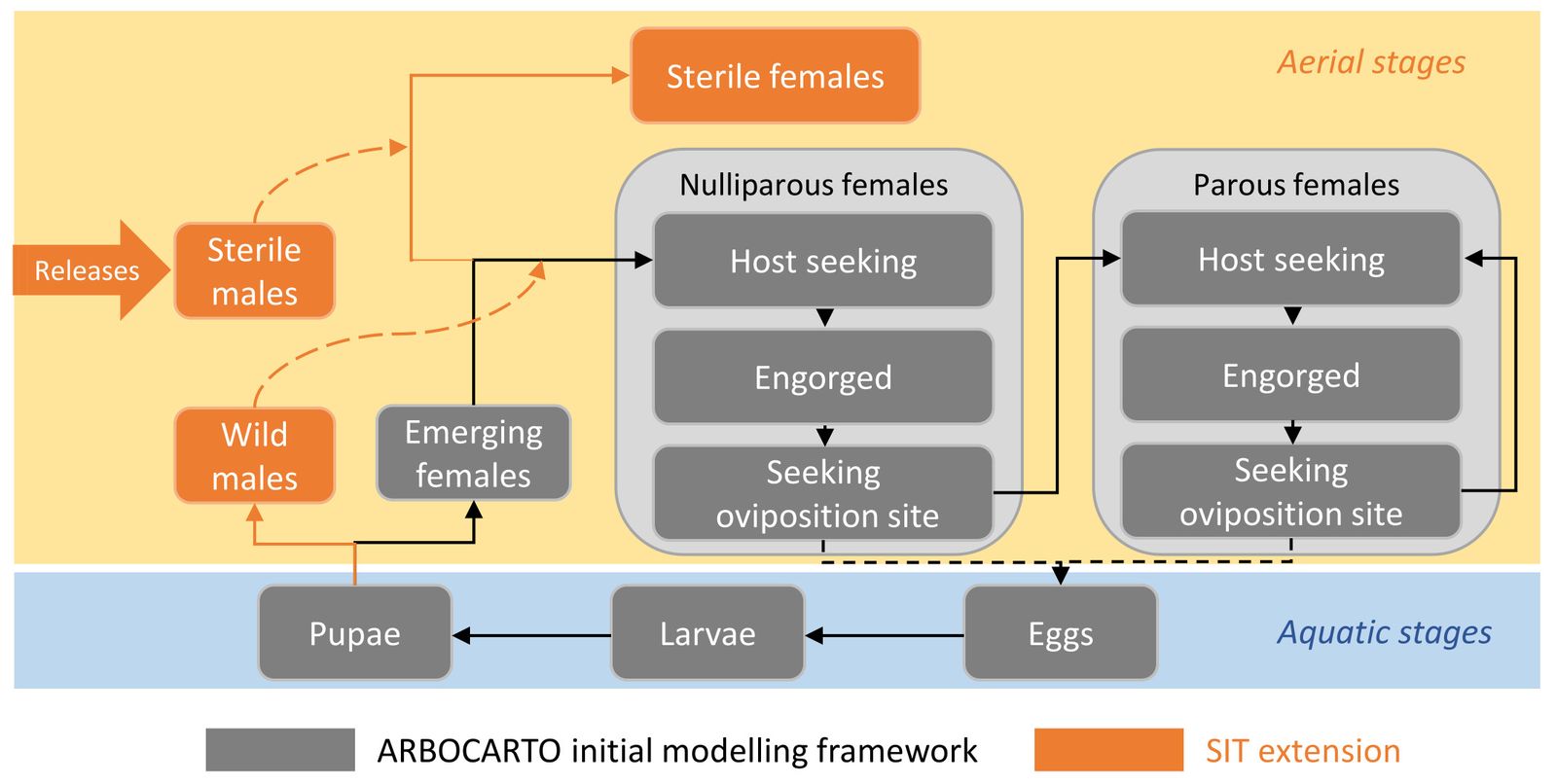
ARBOCARTO model computes the densities of the different stages of the life cycle of Ae. albopictus, both aquatic and aerial, using a system of ordinary differential equations (ODE) for a given geographical area (Marti et al., 2025; Tran et al., 2020a, 2013). Here, it has been extended to include the effects of sterile male releases for the SIT control method, as proposed by (Haramboure et al., 2020). Three compartments (wild males, sterile males and the sterile females) were added to the initial modelling framework used to model the population dynamics of Ae. albopictus (Figure 2). During the simulated SIT control period (defined by a start and end date for releases), a number λS of male mosquitoes sterilized by radiation are released periodically (periodicity τ ) in a defined area. These sterile males are characterized by their mortality rate μSM and their mating competitiveness c (i.e. the ability of sterile males to compete with wild males to find females, mate and transfer semen), which partly depend on the irradiation dose (Oliva et al., 2013; Bouyer and Vreysen, 2020). In the model, emerging wild females that mate with sterile males become sterile, whereas those that mate with wild males become inseminated females and follow the mosquito life cycle as described in (Figure 2). The proportion of wild females that potentially mate with sterile males is estimated by the proportion of the area covered by the SIT releases, which depends on the location of the SIT release stations, and on the dispersal of sterile males.
Details of the model equations, parameters and functions are provided in Appendix 2. The SIT module was implemented in the Ocelet language (www.ocelet.org).

Figure 2 - Diagram of the ARBOCARTO model with SIT implementation. The grey compartments indicate the ARBOCARTO model, and the orange compartments indicate the compartments added to simulate the SIT.
In the user-friendly ARBOCARTO interface (Marti et al., 2025), the simulation model displays several input parameters that are used to control the simulations (Figure 3). Regarding SIT, the parameters that the user can modify from the interface are the start and end dates of the release period, the frequency and quantity of releases, the zone where the releases take place and the proportion of the area covered by the releases, the daily mortality rate of sterile male mosquitoes and their competitiveness.

Figure 3 - ARBOCARTO user interface. A) Main configuration menu B) Vector control menu for parametrization of SIT.
Simulations
Simulations were run over four years (2016–2019) on the PAN and PDL areas, using daily precipitation and temperature data as input for the model. The first year was not retained for outputs computation. We considered four simulation scenarios: i) without SIT at both sites, ii) with SIT applied to 100% of the PAN area, iii) with SIT applied on 75% of the PAN area, and iv) with SIT applied to 50% of the PAN area. Indeed, the impact of SIT may depend on the dispersal distance of Ae. albopictus mosquitoes: considering a maximum dispersal distance of 200 m around the SIT release stations, the area covered represents 48.5% of the total PAN area, whereas 74% of the area is covered considering a dispersal distance of 265 m (Appendix 3). Of note, the IVM strategy that was implemented in both areas before the SIT trials (15 May to 15 July 2017), was simulated in the model in all scenarios. Model parameters related to SIT and IVM are summarized in Table 1 and Table 2, respectively.
Table 1 - Model parameters related to SIT
|
Parameter |
Notation |
Value |
Reference |
|
Competitiveness of sterile mosquito males |
c |
0.4 |
|
|
Daily mortality rate of sterile mosquito males |
μSM |
0.086 |
|
|
Daily mortality rate of wild mosquito males |
μM |
0.074 |
|
|
Start date of releases |
dstart |
2017-05-17 |
Field data |
|
End date of releases |
dend |
2018-02-09 |
Field data |
|
Periodicity of releases |
τ |
1 week |
Field data |
|
Quantity of sterile males released |
λS |
50,000 |
Field data |
Table 2 - Model parameters related to IVM strategy
|
Parameter |
Value |
|
Start date |
2017-05-15 |
|
End date |
2017-07-15 |
|
Reduction of breeding sites coefficient |
0.50 |
|
Larviciding coefficient |
0.04 |
|
Biocidal action on adult stage coefficient |
0.08 |
Model assesment
Assessment of the model to reproduce the Ae. albopictus population dynamics
The average number of eggs observed per trap (relative to the maximum value of the average number of eggs observed per trap) in the PDL area (SIT control area) was compared to the simulated abundances of newly produced eggs (relative to the maximum value of the simulated abundance of new eggs), as eggs collected in ovitraps are removed after sampling (see Tran et al. 2013). We compared relative abundances because it was not possible to obtain absolute quantitative information on the mosquito abundance for the whole PAN and PDL areas for which the model estimates abundances (we only had information on the mosquitoes collected in the ovitraps). Therefore, comparing the absolute numbers of observed or simulated eggs was meaningless. The degree of correlation between observed and simulated data was assessed by calculating the Spearman correlation coefficient, a non parametric measure of rank correlation; values of Spearman correlation coefficient, noted ρ, range from -1 (negative association between simulated and observed data) to +1 (positive association).
Assessment of the model to reproduce the observed SIT impact on Ae. albopictus population dynamics
The average number of eggs observed per trap (relative to the maximum value of the average number of eggs observed per trap) in the PAN area (SIT trial area) was compared to the simulated abundances of newly produced eggs (relative to the maximum value of the simulated abundance of new eggs) and the degree of correlation between the observed and simulated data was assessed in the PAN area by calculating the Spearman correlation coefficient. Moreover, the degree of correlation between the mean percentage of fertile eggs observed in the PAN area was compared to the simulated percentage of fertile eggs by calculating the Spearman correlation coefficient.
Model outputs
Synthetic model outputs were calculated to evaluate the effect of SIT: the mean proportion of fertile eggs during the SIT trial period; the reduction rate, defined as 1 minus the size of the female mosquito population during the SIT trial period divided by the size of the female population without control; the resilience, defined as the time required to return to the natural dynamics and calculated as the number of days after the SIT trials for the controlled mosquito population to reach the same abundance as an uncontrolled population.
Results
Simulated abundances of eggs, based on weather conditions, are consistent with the entomological data collected in the PDL area from 2017 to 2019 (Figure 4), with a Spearman correlation ρ = 0.56 (p-value < 10-9). The ARBOCARTO model reproduced the major trends in the intra-annual population variations: abundances indeed show a peak occurring at the end of the austral summer (March-April), and reach a minimum at the end of the austral winter (August-September). In addition, the model reproduced inter-annual variations (higher densities observed in 2018 compared to 2017 and 2019).

Figure 4 - Validation of the ARBOCARTO model in the SIT control area (PDL area). The mean number of eggs collected per ovitrap in the PDL area (orange dots) using relative abundances was compared to the simulated dynamics of newly produced eggs at time t (black line) based on observed temperatures and precipitations from January 2017 to to December 2019.
Regarding the SIT trials, the model fits the data, both for the predicted number of newly produced eggs (Spearman correlation ρ ranging from 0.66 to 0.82, p-value < 10-7) and for the percentage of fertile eggs (Spearman correlation ρ ranging from 0.78 to 0.82, p-value < 10-11) (Figure 5). Under the conditions of the field trials conducted in the PAN area, the observed reduction in eggs fertility is reproduced, considering the partial coverage of the area by the release of sterile males (Figure 5b). As observed in the field, the effects of SIT quickly disappeared at the end of the period of sterile mosquito releases.
Table 3 - Synthetic model outputs according to the different scenarios
|
Scenario |
Proportion of fertile eggs |
Reduction rate |
Resilience (days) |
|
Observed values |
68% |
- |
- |
|
SIT applied on PAN area: 100% |
24% |
0.90 |
119 |
|
SIT applied on PAN area: 75% |
55% |
0.52 |
87 |
|
SIT applied on PAN area: 50% |
71% |
0.30 |
76 |

Figure 5 - Validation of the ARBOCARTO in the SIT trial area (PAN area). a) The mean number of eggs collected per ovitrap in the PAN area was compared to the simulated dynamics of newly produced eggs at time t. b) The percentage of fertile eggs observed in the PAN area was compared to the simulated percentage of fertile eggs. The orange dots correspond to the observed data, the grey line is the line without SIT control, the green, black and red lines correspond to the SIT applied respectively on 50%, 75% and 100% of the area. The shaded area corresponds to the period of sterile mosquito releases.
The results of simulations highlight the impact of SIT according to the different scenarios (Table 3). The larger the area covered, the greater the effect of SIT: the mean proportion of fertile eggs ranged from 24% with SIT applied on 100% of the PAN area to 71% with SIT reaching 50% of the PAN area, a value close to the proportion of fertile eggs observed in the field during the SIT trial period (68%). The reduction rate ranged from 0.90 with SIT applied to 100% of the PAN area to 0.30 with SIT applied to 50% of the PAN area. In Figure 5, this synthetic index is 1 minus the ratio between the areas under the black, red or green curves and the area under the grey curve (no SIT). Finally, the resilience ranged from 76 days with SIT applied to 50% of the PAN area, to 119 days with SIT applied to 100% of the PAN area.
Discussion
The ARBOCARTO model has been modified in order to model the effects of the SIT. As in the original model, it predicts the abundance of Ae. albopictus by stage (eggs, larvae, pupae, adults: females and males) over time, using daily rainfall and temperature data. The number of sterile eggs is also provided. The simulated mosquito abundance dynamics are consistent with the entomological data collected in the SIT control (Figure 4) and trial (Figure 5) areas. To our knowledge, this article presents the first model simulating SIT impact on Aedes mosquitoes, that has been validated using field data. The parameters related to SIT were chosen from experimental studies (Table 1), thus our results show that the values chosen are consistent and applicable to the Mauritian context.
The simulated reduction rates (Table 3) are in line with the results of other SIT trials conducted against Ae. albopictus (Tur et al., 2023) and with the predictions of other models with similar simulation conditions in tropical environments (Douchet et al., 2021; Dumont and Duprez, 2024; Huang et al., 2021b). These latter modelling studies stressed that in tropical environments, SIT against Ae. albopictus must be combined with mechanical control (reduction of the number of breeding sites) to be effective (Douchet et al., 2021; Dumont and Duprez, 2024), as it was processed during the SIT trials in Mauritius.
Our results also demonstrate that the coverage of the area by the release of sterile males is a key parameter, impacting fertility rates, reduction rate and resilience (Table 3). The simulations considering a coverage of 75% and 50% of the PAN area better reproduced the observed trends than the scenario with SIT applied to 100% of the PAN area (Figure 5). Thus, this coverage is a crucial parameter to estimate when assessing the efficiency of SIT releases, taking into account the dispersal distance of sterile male mosquitoes and the location of the release stations. The dispersal distance can be estimated from mark-release-recapture experiments (Balestrino et al., 2022; Hapugoda et al., 2024; Le Goff et al., 2019; Velo et al., 2022). For Ae. albopictus, the dispersal distance of males was estimated lower than 100 m (around 50 meters) on the neighbouring Reunion Island (Le Goff et al., 2019), a distance consistent with the dispersal distance of sterile males observed in Mauritius (80% of sterile males collected within 40 meters of the release station) (Iyaloo et al., 2020b; Iyaloo et al., 2019). Similar dispersal distances have been estimated for Ae. aegypti in tropical urban environments (Reiter et al., 1995). Based on this this distance value, the location of the release stations can be optimized to cover the entire target area, considering a buffer zone around each release station with a radius corresponding to the active dispersal of male mosquitoes. According to (Iyaloo et al., 2020b), the mean distance travelled by sterile males in Panchvati during two mark-release-recapture trials ranged from 36 to 73 m. Considering a short (50 meters) dispersal of these sterile males of Ae. albopictus, the predictions of our model lead us to recommend a higher number of release sites per ha (~1 station / ha) than that used in this trial (0.4 station / ha). Of note, the dispersal of wild female mosquitoes and the impact of landscape structure, may also affect SIT impacts. In this study, we considered a limited dispersal of wild females. Indeed, PAN and PDL are two areas providing all the resources for Ae. albopictus female mosquitoes (breeding sites, resting sites, hosts for blood meals), thus we assumed that their active dispersal in search of resources was limited. Moreover, we neglected the potential impact of landscape features on the dispersal of mosquitoes because the landscape of the PAL and PDL areas is homogeneous (extensive sugar cane fields, low elevation, absence of barriers to dispersal). In more contrasting areas, the heterogeneity of the landscape could be accounted for by fine-tuning the area covered by the sterile males released, instead of using a simple buffer zone around the release stations.
Thanks to the new SIT functionality, the ARBOCARTO model is a ready-to-use decision support tool (Figure 3) enabling vector control services and health stakeholders to simulate in silico the impact of SIT releases, taking into account the operational capacity of rearing facilities to continuously produce sterile males (parameter λS) and the environmental conditions of the releases. Preliminary tests may be useful to optimize the release strategy, as recommended by (Oliva et al., 2021) for critical parameters such as the periodicity (τ) and the period of releases (start and end dates). Indeed, in the litterature, the models recommend starting releases when the Ae. albopictus population abundance is at its lowest (Douchet et al., 2021), and the ARBOCARTO mosquito population model can be used to identify this period of the year, using rainfall and temperature data for the target area. Moreover, the IVM strategy can be optimized (start, duration, intensity, frequency, location…) with the help of modelling approaches to maximize the reduction of the mosquito populations, before or during the SIT releases. The model can help obtain an initial estimate of the duration of SIT releases, which can be refine during the SIT control (Dumont and Duprez, 2024). In this study, the competitiveness (c) and mortality rates (μSM) of sterile males are two parameters that have been estimated from experimental studies (Iyaloo et al., 2020b; Oliva et al., 2013). The ARBOCARTO model allows these two parameter values to be easily updated based on new data from observational or experimental studies (Figure 3B). Simulations can also be run to study the impact of these parameters on the SIT efficiency, and compare it to the coverage of the area by the release of sterile males (Appendix 4).
The weather-driven ARBOCARTO model presented in this study accurately describes the population dynamics of Ae. albopictus (Figure 4) and allows the simulation of IVM and SIT control (Figure 5). However, active mosquito dispersal is not modelled, as this process was neglected in the first version of the model, whose initial objective was to simulate only the mosquito population dynamics (Tran et al., 2020a), with the assumption that mosquito inflows and outflows are negligible compared to the population of an area in tropical regions. In the case of SIT control leading to a strong reduction in mosquito populations, this hypothesis is no longer valid, and the model may simulate an extinction of the population if migration processes are not modelled (Haramboure et al., 2020). Also, the current model does not allow for the laying of fertiles eggs by fertile females dispersing from surrounding untreated areas, which is considered as a major challenge in SIT trials at a small scale like in our study (Bouyer et al., 2025; Tur et al., 2023). A potential improvement to the tool would be to incorporate realistic dispersal processes into the model, accounting for the influence of the landscape on Aedes dispersal, as for example plant cover, human activity (Bergero et al., 2013), and anthropogenic barriers (Hemme et al., 2010). Another perspective of this work would be to use the ARBOCARTO model to assess the impact of SIT control on the basic reproduction rate of Aedes-borne diseases such as dengue fever (Benkimoun et al., 2021).
Acknowledgements
The authors thank the Vector Biology and Control Division of the Ministry of Health and Wellness, Mauritius, for implementation of the SIT project, field monitoring and data compilation. This study was conducted under the platform in partnership One Health Indian Ocean (www.onehealth-oi.org) in the framework of the PRERISK_OI project “Preventing Infectious Risks in the Indian Ocean,” co-financed by the European Union and the Réunion Region. Europe is committed to Réunion with INTERREG (agreement 2024-1402-006701). Preprint version v4 of this article has been peer-reviewed and recommended by Peer Community In PCI Mathematical and Computational Biology (https://doi.org/10.24072/pci.mcb.100430; Almeida, 2026).
Funding
Marion Haramboure was funded by International Atomic Energy Agency (IAEA) under the project “Sustaining the suppression of Aedes albopictus in a rural area with possible extension to an urban dengue-prone locality through Integrated Vector Management strategy” (MAR5026-EVT2003571). The SIT package was developed using funds of the IAEA under the inter-regional project “Modelling Aedes albopictus population dynamics in Mauritius and development of an operational tool for surveillance and control” (INT 5155). Tests and validation additional tasks were performed under the project OPTIMOUSTIK (Optimization of thec control of Aedes mosquitoes) funded by the French Ministry for Europe and Foreign Affairs. The funders had no role in study design, data collection and analysis, decision to publish, or preparation of the manuscript.
Conflict of interest disclosure
The authors declare that they comply with the PCI rule of having no financial conflicts of interest in relation to the content of the article.
Data, scripts, code, and supplementary information availability
Data are available online (https://doi.org/10.18167/DVN1/ZKJBMK; Iyaloo et al., 2025). Scripts and code are available online (https://doi.org/10.18167/DVN1/APVHYM; Tran et al., 2020b; Marti et al., 2025).
Appendices
Appendix 1. Estimation of the environmental carrying capacities
According to (Iyaloo et al., 2014), the typology of Ae. albopictus breeding sites in Pointe des Lascars and Panchvati includes the following types: flower pots, rubber tyres, large water containers, others. The type of the breeding site (rainfall-independent or -rainfall-dependent filling) and the mean number of larvae per breeding site were estimated from (Tran et al., 2020a) and our expertise. The environmental carrying capacities is then obtained by multiplying, for each study site, the number of breading sites by the number of larvae per breeding site (Table S1).
Table S1 – Potential mosquito larval breeding sites in Pointe des Lascars (PDL) and Panchvati (PAN) and corresponding fix (κfix) and variable (κvar) environmental carrying capacities
|
Filling |
Breeding site |
Estimated number of larvae / breeding sitea |
Observed number of breeding siteb |
κfix |
κvar |
|||
|
PDL |
PAN |
PDL |
PAN |
PDL |
PAN |
|||
|
Rainfall-independent |
Flower pots |
10 |
1093 |
28 |
10930 |
280 |
||
|
Rubber tyres |
90 |
279 |
128 |
25110 |
11520 |
|||
|
Rainfall-dependent |
Large water containers |
50 |
861 |
2095 |
43050 |
104750 |
||
|
Others |
15 |
152 |
71 |
2280 |
1065 |
|||
|
Total |
36040 |
11800 |
45330 |
105815 |
||||
a Values adapted from (Tran et al., 2020a)
b Values from (Iyaloo et al., 2014)
Appendix 2. Model equations, parameters and functions
The modified ARBOCARTO is based on a system of ordinary differential equations (ODE):
\(\left\{ \begin{matrix} \begin{matrix} \begin{matrix} \begin{matrix} \dot{E} = f_{Ao}\left( \beta_{1}A_{1o} + \beta_{2}A_{2o} \right) - \left( m_{E} + f_{E} \right)E \\ \dot{L} = f_{E} - \left( m_{L}\left( 1 + \frac{L}{k_{L}} \right) + f_{L} \right)L \\ \dot{P} = f_{L}L - \left( m_{P} + f_{P} \right)P \end{matrix} \\ \dot{A_{em}}{= f_{P}P\sigma e}^{( - \mu_{em}\left( 1 + \frac{P}{k_{P}} \right))} - (m_{A} + \gamma_{A_{em}})A_{em} \\ \dot{A_{1h}} = \gamma_{A_{em}}\frac{cM_{s}}{cM_{s} + M}A_{em} - (m_{A} + \mu_{r} + \gamma_{Ah})A_{1h} \end{matrix} \\ \dot{A_{1g}} = \gamma_{A_{h}}A_{1h} - (m_{A} + f_{Ag})A_{1g} \\ \dot{A_{1o}} = f_{A_{g}}A_{1g} - (m_{A} + \mu_{r} + f_{Ao})A_{1o} \end{matrix} \\ \begin{matrix} \dot{A_{2h}} = f_{A_{o}}\left( A_{1o} + A_{2o} \right) - (m_{A} + \mu_{r} + \gamma_{Ah})A_{2h} \\ \dot{A_{2g} =}\gamma_{A_{h}}A_{2h} - (m_{A} + f_{Ag})A_{2g} \\ \dot{A_{2o} =}f_{A_{g}}A_{2g} - (m_{A} + \mu_{r} + f_{Ao})A_{1o} \end{matrix} \\ \begin{matrix} \dot{M}{= f_{P}P(1 - \sigma)e}^{( - \mu_{em}\left( 1 + \frac{P}{k_{P}} \right))} - \mu_{M}M \\ \dot{M_{S}} = - \mu_{M_{S}}M_{S} \\ \dot{F_{S}} = \gamma_{A_{em}}\left( 1 - \frac{cM_{s}}{cM_{s} + M} \right)A_{em} - m_{A}F_{S} \end{matrix} \end{matrix} \right.\ \) (Eq. S2)
with E, eggs; L, larvae; P, pupae; Aem, emerging adult females; A1,nulliparous females; A2, parous females, which are subdivided in compartments regarding their behaviour : h, host-seeking; g, transition from engorged to gravid; o, oviposition site seeking. The three stages added for modelling SIT impacts are: M, wild males; MS, the sterile males that are released; FS, the wild mosquito females that become sterile after mating with sterile males. Greek letters represent parameters that are not influenced by weather, whereas the Arabic letters are weather-driven functions. Parameters and functions are detailed in Tables S2 and S3, respectively.
Table S2 – Model parameters
|
Notation |
Definition |
Value |
|
\(\beta_{1}\) |
Number of eggs laid/ovipositing nulliparous female |
60 |
| \(\beta_{2}\) |
Number of eggs laid/ovipositing parous female |
80 |
|
\(\sigma\) |
Sex-ratio at emergence |
0.5 |
| \(\gamma_{Aem}\) |
Development rate of emerging adults (day-1) |
0.4 |
|
\(\gamma_{Ah}\) |
Transition rate from ovipositing to host-seek adults (day-1) |
0.2 |
|
\(\gamma_{Ao}\) |
Minimum transition rate from ovipositing to host-seek adults (day-1) |
0.2 |
|
\(\mu_{E}\) |
Minimum egg mortality rate (day-1) |
0.05 |
|
\(\mu_{em}\) |
Mortality rate during emergence (day-1) |
0.1 |
|
\(\mu_{r}\) |
Mortality rate related to seeking behaviour (day-1) |
0.08 |
|
\(T_{E}\) |
Minimal temperature needed for egg development (°C) |
10 |
|
\({TDD}_{E}\) |
Total number of degree-day necessary for egg development (°C) |
110 |
|
\(T_{Ag}\) |
Minimal temperature needed for egg maturation in females (°C) |
10 |
|
\({TDD}_{Ag}\) |
Total number of degree-day necessary for egg maturation (°C) |
77 |
|
\(\kappa_{fix}\) |
Standard rainfall-independent environment carrying capacity |
Field observation (see Appendix 1) |
|
\(\kappa_{var}\) |
Standard rainfall-dependent environment carrying capacity |
Table S3 – Model functions
|
Notation |
Definition |
Expression1 |
|
\(f_{E}\) |
Transition function from egg to larva |
\(\left\{ \begin{matrix} \frac{(T - T_{E})}{{TDD}_{E}} & if\ T(t) > T_{E} \\ 0 & otherwise \end{matrix} \right.\ \) |
| \(f_{L}\) |
Transition function from larva to pupae |
\(- 0.0007T^{2} + 0.0392T - 0.3911\) |
|
\(f_{P}\) |
Transition function from pupae to emerging adult |
\(- 0.0008T^{2} - 0.0051T - 0.0319\) |
| \(f_{Ag}\) |
Transition function from engorged adult to oviposition site-seeking adult |
\(\frac{(T - T_{Ag})}{{TDD}_{Ag}}\) |
|
\(f_{Ao}\) |
Transition function from ovipositing to host- seeking adult |
\(\gamma_{Ao}(1 + P_{norm})\) |
|
\(m_{E}\) |
Egg mortality |
\(\mu_{E} + \left\{ \begin{matrix} 0.1 & if\ P > 80 \\ 0 & otherwise \end{matrix} \right.\ \) |
|
\(m_{L}\) |
Larva mortality |
\(0.02 + 0.0007e^{0.1838(T - 10)} + \left\{ \begin{matrix} 0.5 & if\ P > 80 \\ 0 & otherwise \end{matrix} \right.\ \) |
|
\(m_{P}\) |
Pupa mortality |
\(0.02 + 0.0003e^{0.2228(T - 10)} + \left\{ \begin{matrix} 0.5 & if\ P > 80 \\ 0 & otherwise \end{matrix} \right.\ \) |
|
\(m_{A}\) |
Adult mortality |
\(0.025 + 0.0003e^{0.1745(T - 10)}\) |
|
\(k_{L},\ k_{P}\) |
Environment carrying capacity for larvae and pupae |
\(\kappa_{fix} + \kappa_{var}*P_{norm}\) |
1. T: temperature (°C); P: rainfall (mm); Pnorm is defined as the rainfall amount summed over a one week period, and normalized in order to vary between 0 and 1
Appendix 3. Location of SIT release stations and ovitraps in the PAN area delimited in red

Figure S1 - Location of SIT release stations and ovitraps in the PAN area delimited in red
Appendix 4. Impact of the competitiveness of sterile males released and the coverage of the area by the releases on the reduction of adult mosquito females, the mean proportion of fertile eggs, and resilience duration.

Figure S2 - Impact of the competitiveness of sterile males released and the coverage of the area by the releases on the reduction of adult mosquito females, the mean proportion of fertile eggs, and resilience duration.