


 CC-BY 4.0
Introduction
Considering causality as complex is critical to advance our explanatory capabilities in organizational studies. While the traditional approach, the Newtonian paradigm, has provided valuable insights, it is increasingly being recognized as insufficient to capture the multifaceted and dynamic nature of organizational phenomena. To do so, scholars, such as Misangyi et al. (2017), have argued for the benefits of adopting a causal complexity perspective instead of relying on the Newtonian paradigm. Indeed, the Newtonian perspective considers only one type of cause and one type of causality, where the relationship between cause and effect is linear and proportional (Cohen, 1994; Goldstein, 1999, 2000). This conceptualization limits our explanatory capabilities and understanding, for example of organizational differences, as causes of these phenomena are treated similarly and as always leading to the same result (Furnari et al., 2021). The Newtonian paradigm has also been critiqued for its inherently dichotomous, binary reasoning, which fails to account for the complexities and contradictions inherent in organizational contexts (Toulmin, 1992; Zara & Delacour, 2023). For example, this leads to considering ethics as antithetical to science and organizations as fixed objects, neglecting the possibility of understanding them as fluid, socially constructed entities. Furthermore, this paradigm struggles to address multi-level interactions—the dynamic influences between micro, meso, and macro levels—that are fundamental to organizational studies (McKelvey, 2004).
In contrast, the causal complexity perspective provides a more thorough and nuanced understanding of organizational phenomena, acknowledging contradictions, exploring dynamics, and offering richer explanations for organizational behavior and results (Tsoukas, 2017). Despite these advantages, this perspective is rarely used in organizational studies (Cornelissen & Höllerer, 2020; Tsoukas & Hatch, 2001). Two main challenges account for this gap: the central concepts of causes and causality remain poorly understood, even though they are crucial to our explanatory endeavor (Durand & Vaara, 2009; Misangyi et al., 2017); and causal complexity is difficult to articulate and apply (Cornelissen & Durand, 2014; Furnari et al., 2021; Meyer et al., 2005).
To address these challenges, we aim, in this paper, to operationalize causal complexity by developing an analytical framework based on Aristotle's conceptualization of causes and causalities. Aristotle enriches and complements these two concepts, bringing in different types of causes and causalities, as opposed to the Newtonian perspective. He also ontologically grounds these two concepts which offers a broader and deeper understanding which allows for a more holistic view of organizational phenomena (Zara & Delacour, 2023).
The structure of the paper is as follows: First, we review the existing literature on causal complexity, its benefits and shortcomings. Based on that, we explain why Aristotle’s conceptualization of causes and causalities provides a strong ontological foundation for an analytical framework to address the issues observed. Next, we present our three-step framework for operationalizing causal complexity based on Aristotle's conceptualization of causes and causalities. Step 1 examines the four per se causes. Step 2 analyzes the other causes, i.e., instrument, secondary causes and accidents. Step 3 explores the interrelations between these causes revealing different types of causality (reciprocal and total, or partial divergent/convergent). We illustrate the applicability of the framework at a macro level and show how it enables us to advance our understanding of causal complexity for any multi-level organizational phenomena.
This paper contributes to the literature on causal complexity in two main ways. First, it provides an ontological grounding for understanding causes and causality. This enhances our conceptual clarity and enables us to operationalize causal complexity. Second, our analytical framework being plastic and fine-grained, allows us to examine any organization and organizational phenomena, at different levels, making it not only broadly applicable but also deepening our understanding of causal complexity.
Embracing causal complexities
Despite the growing appeal of the causal complexity perspective, according to Tsoukas (2017), the Newtonian paradigm continues to dominate organizational studies. Scholars have pointed to two key challenges for the causal complexity perspective: first, causes and causalities are still not fully understood; and second, applying causal complexity remains difficult (e.g., Cornelissen & Durand, 2014; Durand & Vaara, 2009). We argue that these challenges come from the inherent richness of the causal complexity perspective itself. To address these limitations, while preserving the depths of the perspective, we propose to ontologically ground causes and causalities. This approach not only broadens our understanding of these central concepts but enables us also to develop a practical analytical framework for operationalizing causal complexity.
Causal complexity as a rich perspective
The extensive literature on causal complexity includes a wide range of research streams and approaches, all positioned in opposition to the Newtonian paradigm. Despite this broad interest, there is no widely accepted definition of causal complexity (Braumoeller, 2003), as scholars draw from various theoretical backgrounds to develop this perspective.
For instance, some scholars have adopted a theoretical approach to emphasize the benefits of causal complexity for understanding phenomena in organizational studies (Tsoukas, 2017). This body of research suggests that recognizing causality as complex is essential to avoid reducing and fragmenting reality. The Newtonian paradigm breaks down reality into small parts from which it induces the laws governing the higher levels (Morçöl, 2001). In contrast, complexity theories assert that higher levels of analysis also play a significant role (Juarrero, 2000). As a result, reality cannot be fully understood by focusing solely on lower-level elements; it requires to address multi-level influences, an appreciation of both top-down and bottom-up interactions (McKelvey, 2004).
Furthermore, the Newtonian paradigm's reliance on an either/or approach pushes us into binary choices (Toulmin, 1992). This dichotomous way of thinking, coupled with its focus on variance theory, diminishes our ability to understand phenomena as dynamic processes, limiting the examination of organizational change and development (McKelvey, 2004; Mohr, 1982; Poole et al., 2000; Van de Ven & Poole, 2005). In contrast, complexity theories advocate integrating diverse approaches and perspectives to capture the richness of reality. This more comprehensive structure of thought allows for the exploration of contradictions, the understanding of dynamic processes, and the recognition of the inherent complexity in organizational phenomena (Tsoukas, 1998, 2017; Tsoukas & Cummings, 1997; Tsoukas & Hatch, 2001). By embracing the perspective of causal complexity, we can more effectively study organizational phenomena, which are inherently complex. This perspective not only enhances our explanatory capabilities but also recognizes that complex phenomena demand equally complex frameworks for proper understanding (Cornelissen & Durand, 2014; Meyer et al., 2005; Tsoukas, 2017).
In a complementary way, scholars have focused on exposing the limitations of the Newtonian paradigm and how causal complexity offers an alternative (Cohen, 1994; Furnari et al., 2021; Goldstein, 1999, 2000; Misangyi et al., 2017; Morçöl, 2001). The Newtonian paradigm views causality as linear, unidirectional, and proportional (Bunge, 2009). This unique type of causality leads to "net effect" thinking—where a single variable is thought to solely explain a result, which fails to address the issue of necessity and sufficiency (Abbott, 1988; Delbridge & Fiss, 2013; Ragin, 2008). In contrast, complexity theories emphasize diverse types of causality, such as feedback loops —where the output of a system circles back as input, influencing future results—, discontinuities and non-proportional effects—where small causes can lead to large consequences, referred to as the "butterfly effect" (Holbrook, 2003; Maguire et al., 2006). This more nuanced view deepens our understanding of causality and enables us to grasp complex phenomena (Bunge, 2009; Goldstein, 2000).
Parallel to this critique, scholars have explored causes. In the Newtonian perspective, all causes are treated as efficient causes (Bunge, 2009; Chia, 2003; McKelvey, 2004; Van de Ven & Poole, 2005), this means that despite the fact that there are many causes, they are considered of the same nature and having the same meaning (univocal). In contrast, causal complexity acknowledges the diversity of causes. These causes are not only heterogeneous but can also interact in various ways—combining (Immergut, 1998), co-evolving (Lewin & Volberda, 1999), or diverging and converging toward a particular result (Bunge, 2009). Furthermore, novelty and emergent properties, central to causal complexity, arise from the non-additive interaction between causes (Bunge, 2009; Thelen, 1999, 2003), highlighting the intricacy of causal relationships which reveals how simple causes can lead to complex effects (Maguire et al., 2006). As such, the causal complexity perspective focuses on multiple causes and their intricacy
To advance this understanding, configurational theory has introduced the idea that multiple factors or attributes combine to form complex configurations, it is these configurations, not causes themselves, which explain a result (Misangyi et al., 2017; Ragin, 1987, 2008). In other words, configurational theory embraces "multiple conjunctural causation" (Ragin, 1987, p. 20), meaning that different combinations of factors, or "multidimensional constellations of attributes," shape the result (Furnari et al., 2021, p. 4). Contrary to the Newtonian paradigm, this perspective argues that factors cannot be considered in isolation, nor are they sufficient or necessary on their own. Instead, it is the interactions of these factors within different configurations that explains the result. Building on this idea, Fiss (2011) differentiates between core and peripheral elements based on their causal strength. Core elements have a strong causal link to the result, while peripheral elements exhibit weaker causal strength (Fiss, 2011). While this approach sheds light on causal complexity, it tends to prioritize configurations over the factors or attributes themselves.
In summary, the causal complexity perspective brings in new elements of understanding and complementary insights, offering new ways to understand complex phenomena. This creates a very rich perspective which explains its appeal. However, because the concepts of causes and causality are grasped from different theoretical perspectives, they remain under-defined. While there is an agreement that causes are multiple and diverse, it is not clear what they are, how they differ, or what their nature is. Similarly, while causality needs to expand from the unique type of causality suggested in the Newtonian paradigm, there is limited clarity on how to conceptualize different types of causality or if different types of causes have different types of causality. Furthermore, causes are said to combine and interrelate, but what type of causality is here at play? The fact that causes and causalities, which are critical to our explanatory capabilities, remain vaguely defined and poorly understood does not help us to use and concretely apply causal complexity (Chia, 2003; Delbridge & Fiss, 2013; Durand & Vaara, 2009; Misangyi et al., 2017).
To address this gap, we propose that these concepts—causes and causality—must be ontologically grounded, as ontology allows for clearer definitions and a deeper understanding of their nature (Fleetwood, 2005). To achieve this, we turn to Aristotle for two main reasons. First, scholars such as Toulmin (1992), MacIntyre (1985), and Cummings and Tsoukas (1997) have emphasized Aristotle’s difference from the Newtonian paradigm and recognized his compatibility with causal complexity (e.g., Juarrero, 2000; Tsoukas, 2017). Second, previous literature has acknowledged Aristotle’s conceptualization of the four primary or per se causes—material, formal, efficient, and final (Maguire et al., 2006; McKelvey, 2004; Poole et al., 2000; Van de Ven & Poole, 2005). More recently, Zara & Delacour (2023) have expanded this understanding, pointing out that Aristotle also considers additional causes—instruments, secondary causes, and accidents—and distinguishes between different types of causality. They emphasize that Aristotle’s ontological framework allows for a more profound understanding of causes and causalities and provides a basis for concretely operationalizing causal complexity.
In the next section, we briefly outline Aristotle’s conceptualization of causes and causalities before developing our analytical framework.
Aristotle’s conceptualization of causes
Aristotle (1991, 1993, 2006, 2010) characterizes what a cause fundamentally and ontologically is (see Zara & Delacour, 2023 for a synthesis). First, for Aristotle there are always the four per se causes, that are principal and fundamental: material, formal, efficient and final. Broadly speaking, a material cause is the stuff from which something is made, such as the marble for a statue, to use the famous example of the Phidias’ statue. A formal cause is one that makes something like that and no other (Juarrero, 2000)—it is the pattern by which something is made (Van de Ven & Poole, 2005). It is the figure (morphe), such as the figure of Athena for the statue. An efficient cause is a force that brings an object into being (Juarrero, 2000), such as the blacksmith for the brazen sphere, or Phidias as the sculptor. This type of cause has been described as a 'push' cause (Van de Ven & Poole, 2005). A final cause is the goal, purpose or end towards which something is directed or for which it is made—this has been described as a 'pull' cause (Juarrero, 2000). These four per se causes are fundamental. They are the principles of any object under consideration (Stein, 2011). As such they are irreducible to each other, and all are necessary to produce an effect.
While the four per se causes have been succinctly presented in organization studies to deal with complexity (Maguire et al., 2006; McKelvey, 2004; Poole et al., 2000; Van de Ven & Poole, 2005), Aristotle also considers secondary causes, instruments, and accidents. These accompany the four per se causes and help to define any object under consideration. Secondary causes are contingent to the per se causes. As their name suggests, they are not primary like the per se causes, but they still contribute to their effect, just as the sculptor (efficient per se cause) needs an assistant (secondary cause) to make a statue. For Aristotle, instruments are the means used by an efficient cause to achieve an end (Physics II, III, 194b35, Metaphysics Δ 2, 1013b1). Which instrument is chosen is circumstantial and depends on the efficient cause; instruments are objects of deliberation, and which is chosen depends on the capacity of judgement of the agent who decides to use a particular one and how to use it. Finally, Aristotle considers accidents (or circumstances) that may or may not occur, depending on the context (Metaphysics Θ 5, 1048a18-20). These accidents affect the object under consideration. They affect one of the per se causes and can be said to act (by extension) as material, formal, efficient or final accidental causes. If we take the example of a marble statue, the fact that the marble is pink (an accident of the marble), and that the sculptor is Phidias and not the author of this text (an accident of the agent) will specify the particular statue that emerges.
In conclusion, contrary to Hocutt's (1974) position, the four per se causes are not merely explanations or logical propositions confined to the realm of epistemology. Instead, they are ontological categories (Stein, 2011). Additionally, we must avoid the linguistic fallacy of assuming that every explanatory statement in English containing the word "because" refers to the same type of cause or causality (Bunge, 2009). Causes are multiple and not univocal; in other words, they do not convey one meaning, or indicate a single meaning (Stein, 2011). While causes can be expressed in different ways, they can nonetheless be categorized as the four per se causes (Metaphysics Δ2, 1013b4) and as secondary causes, instruments, and accidents (Table 1). As such, for Aristotle there are many different types of cause, not solely the efficient one as in the Newtonian perspective. Causes are multiple as the causal perspective suggests. Aristotle, because of his ontological grounding, provides further a way to categorize these different causes and explain their different nature.
Aristotle’s conceptualization of causality
In addition to characterizing causes, Aristotle also considers how these different types of causes combine, influence, and interact. According to him, there are two types of causality: total and reciprocal causality for per se causes, and partial converging or diverging causality for secondary causes and accidents (see Zara & Delacour, 2023 for a review). As the different causes can affect each other through these two different types of causality, the interrelations between the per se causes and the other causes become apparent.
On the one hand, the total and reciprocal causality emphasizes an inherent relationship between the four per se causes. This binds them into pairs (material and formal – efficient and final) where each cause participates in the causality of the other, thus denoting reciprocity. The two pairs each inform us respectively of the nature (the essence) of the object under consideration or assess the object in its exercise (the entelechy). This type of causality is considered as total because both causes are necessary to produce an effect or an end result. This explains why they are both necessary and irreducible to each other (Zara & Delacour, 2023).
Table 1 - Different types of cause defined by Aristotle
| Causes | Description | Statue illustration | |
| Per se causes | Material | Material, subject, or parts | Marble |
| Formal | Eidos, definition, paradigm, the object, the whole | Athena’s figure | |
| Efficient | Agent, the principle that initiates a process, author | Sculptor | |
| Final | End, good | Aim of sculptor | |
| Other causes | Secondary | Cause dependent on the primary ones | Assistant of sculptor |
| Instrument | Means used by the efficient cause to reach the aim | Tools to sculpt | |
| Accident | Specific thing, circumstances that affect the other per se causes | Pink marble, broken arm, etc. | |
We can add here, that because of the specific nature of this type of causality, per se causes cannot be aggregated or added up but reveal an inherent interrelation. Per se causes, because they are principal, also exert their specific causality on their contingent secondary causes, affecting and influencing them, thus denoting an interrelation between per se and secondary causes.
On the other hand, secondary causes, and accidents underline, a contrario, a partial convergent or divergent causality. Aristotle considers them partial because neither is necessary and because they do not give rise to the causality of another cause. This does not mean, however, that they have no causality or effect. They can and do affect other causes. Accidents can affect per se causes, since every object under consideration exists in a certain context (See Metaphysics Z 1, 1028a 15-30). Secondary causes can also affect the per se cause to which they are contingent. In this case, there is some action and reaction and feedback loop between them, as per se causes affect secondary causes. Secondary causes or accidents may, for example, partially cause the efficient cause to choose a particular instrument or to pursue a particular end (which may be different from that of the final cause) and thus affect its act, but not in a way that causes the causality of the efficient cause.
Secondary causes and accidents can either converge or diverge. Converging or diverging can be metaphorically apprehended as two horses pulling a cart (Zara & Delacour, 2023). Each horse may not pull the cart in unison, i.e., in the same direction, but one or the other may pull in a different direction. This means that they can converge/diverge towards the same effect and thus partially affect their end result, or they can affect the different per se causes by diverging or converging in their effect. To illustrate, we can consider two different assistants to Phidias, one with more mastery than the other, affecting either the end result or the agency of Phidias. This underlines the fact that these causes cannot be aggregated or simply summed up and that their effect on the per se causes can be different due to their convergence or divergence. This underlines the interrelations between the different causes.
Instruments are somewhat different. As mentioned above, they can be given by the context and thus by accidents, circumstances, and resources. For Aristotle, they do not exert a specific causality, but they do affect the act of the efficient cause, influencing how it reaches its goal. They are thus key to the perfection of the efficient cause’s act (see, for example, Book III, Nicomachean Ethics (Aristotle, 1990). Indeed, the use of a particular drug (and not another) defines the art and the mastery of the doctor, just as the choice of a tool and its handling define the mastery of the sculptor. An instrument could positively or negatively affect the act of the efficient cause in achieving its goal, i.e., the final cause.
In summary, these two different types of causality (total and reciprocal causality for per se causes and partial converging or diverging causality for secondary causes and accidents) allow us to understand the interrelations between per se causes, secondary causes and accidents. Indeed, by understanding how these causes exert their causality, we gain insights on how they influence each other, on how they combine and sheds light on their interrelations, which is essential for operationalizing causal complexity. Figure 1 provides a theoretical overview of the different types of cause and causality as conceptualized by Aristotle.

Figure 1 - The different causes and types of causality
Proposed Aristotelian analytical framework
An analytical framework not only facilitates theorizing but also enables the practical application of causal complexity. In Aristotelian terms, it serves as an instrument that an efficient cause (in this case, a scholar) can use to achieve its objectives. Following the approach of Furnari et al. (2021), we argue that providing scholars with concrete methods is essential for fully embracing causal complexity. To that end, we develop and propose a three-step analytical framework grounded in Aristotle’s ontological conceptualization of causes and causalities. This approach enables us to make sense and to tangibly apply these two foundational concepts-causes and causalities- and concretely operationalize causal complexity. The first step involves identifying the four per se causes; the second addresses the secondary causes, instruments, and accidents; and the third step examines the interrelations among these causes, considering the different types of causality.
We illustrate how this analytical framework can be applied to any organization or organizational phenomenon. In this section, we have deliberately focused on a macro-level perspective, treating organizations as global entities. This approach aligns with a long-standing tradition in organizational studies and resonates with several well-established typologies of organizations (Furnari et al., 2021). Our examples and illustrations are therefore intentionally broad. However, it is important to note that this framework has a plasticity and can be applied at any level of analysis, whether at a more micro-level, focusing on individual actions, events, or specific aspects of an organization, such as its structure. While we explore these possibilities further in the discussion section, we have chosen to maintain a single level of analysis throughout this section to provide clarity and consistency, avoiding the potential confusion that could arise from shifting between different analytical levels.
Step 1. Looking for the four per se causes
The first step focuses on the four per se causes. In the search for the material cause, scholars should ask themselves: from what is the object under consideration made of, what materially constitutes it? (Van de Ven & Poole, 2005). An organization can be made of bricks and stones or buildings and factories, but these can be destroyed and removed and do not represent the true nature of an organization. In this respect, the organizational structure (i.e., how units are organized horizontally or vertically) could correspond to the material cause. The formal cause, i.e., the pattern by which something is made (Juarrero, 2000), assesses the quality that makes the object under consideration what it is. For an organization, the formal causes could be multiple such as the norms, values, and beliefs that give the organization its nature.
Together, as the intrinsic pair, the material and the formal causes describe the essence of an organization. As such, an organization always has two intrinsic causes: an organizational structure and a set of norms, values, and beliefs. In organizations, the efficient cause could be the agents; and the final cause could be their environment. Indeed, the environment triggers agents to make decisions, it shapes the work of agents to respond to their environment, i.e., they act as efficient causes in an organization to achieve this end. This perspective highlights organizations in act, i.e., in exercise or in motion. As such, any organization could be understood through its structure (material cause), norms (formal cause), agents (efficient cause), and environment (final cause). This gives us a very generic framework for assessing any organization, but it can also be applied to any other object under consideration and level of analysis.
While all organizations inherently possess these four, equally necessary, per se causes, bound in pairs (intrinsic and extrinsic), it is crucial to delve deeper into these causes to understand the specific characteristics of the organization under consideration. For instance, what kind of environment and structure does this specific organization have? Its environment may be stable or changing, while its structure could run from lean to hierarchical. This provides a way to examine the variety of organizations. By further detailing the four per se causes, we can provide a comprehensive description of a specific organization. For instance, a bureaucracy is defined not only by its material cause—such as its functional and hierarchical structure—but also by its formal cause, which includes the norms, values, and beliefs that guide its operations. Bureaucracy also entails a specific set of decisions made by its agents (efficient causes) and pertains to a particular environment to which the organization is oriented.
Step 2. Looking for instruments, secondary causes, and accidents
The second step involves examining instruments, secondary causes, and accidents, as every organization is shaped by its unique context (MacKay & Chia, 2013).
Instruments describe the contextual means that agents (efficient causes) select to achieve their goals (final causes). For example, strategy can be viewed as an instrument agents choose based on a specific context and on the agents' judgment. Instruments can thus be wisely or unwisely chosen, potentially facilitating or hindering goal achievement. For instance, adhering to a business-as-usual strategy in a rapidly changing environment can be detrimental to an organization (Holbeche, 2015). A poor or inappropriate strategy not only impacts the desired result but also affects the agents' capacity to act effectively. For instance, a misguided instrument, such as a cost-cutting approach, may hinder engineers' ability to innovate or develop creative solutions to problems (Kanter, 2006). Thus, instruments are essential for understanding organizations, highlighting the dynamic aspect of strategy implementation that can either help or hinder the realization of organizational goals.
Secondary causes are contextual factors that accompany all four per se causes in an organization. For instance, consider technology: while it may not be essential for defining an organization, it significantly shapes its characteristics. Technology can be seen as a secondary material cause that contributes to the primary material cause—an organization’s structure. Indeed, a certain technology can influence the structure of an organization. For example, the technology of the assembly line, AI, low tech or even no tech, have impacts on how the organization is structured. Similarly, processes can be viewed as secondary formal causes that influence and are influenced by the organization’s norms, values, and beliefs- its formal cause.
While efficient causes refer to agents within the organization, simply labeling agents as such does not provide a comprehensive understanding and the thick descriptions necessary to organization studies (Tsoukas, 2017). Secondary causes help refine this description by identifying the various roles agents play, such as top managers, middle managers, or employees. Top managers may be the primary efficient causes, but they rarely act in isolation; they rely on the contributions of other agents, like middle managers. Thus, secondary causes deepen our understanding of organizational dynamics by highlighting how they influence the per se causes they relate to or depend upon. In the following subsection, we will further explore these interrelations and their implications.
Finally, we must consider accidents, which encompass either circumstances or resources. Unlike secondary causes, accidents are contingent and may or may not occur, yet they significantly influence the organization in question. For instance, external events like the COVID-19 pandemic can impact the instruments chosen by agents, altering their strategies and decisions. Additionally, accidents can refer to specific situations, such as when an agent encounters a consultant who proposes an innovative approach. In such cases, the agent must use judgment to determine whether to implement this new approach. Resources also can similarly be considered. For example, a substantial budget can profoundly affect an organization’s structure, norms, and overall strategy. Thus, understanding accidents is essential, as they introduce unpredictable elements that shape the organization.
Having identified the four per se causes along with the other causes—namely, instruments, secondary causes, and accidents—the third and final step is to examine the causality exerted by the different causes. This analysis reveals the intricate interrelations among them.
Step 3. Assessing the different interrelations between the diverse causes, via the two different types of causality
Based on Aristotle’s conceptualization, we can assess how these different types of causes dynamically combine, affect, and interrelate with each other. As previously noted, the per se causes are bound in pairs through reciprocal and total causality, while secondary causes and accidents exert a partial causality (see Figure 1). In this section, we build on this conceptualization to emphasize the interrelations between the different types of causes, highlighting how they influence, modify, or transform one another. This perspective offers a dynamic view of these interrelations, which is crucial for operationalizing causal complexity.
To structure our argument, we will first analyze the interrelations between secondary causes and the per se causes, followed by an examination of the interrelations between accidents and the per se causes, focusing on their partial convergent or divergent causality. Finally, we will explore the interrelations between the per se causes bounded in pairs, emphasizing their total and reciprocal causality.
Interrelations between the secondary causes and the per se causes, via a partial convergent or divergent causality
First, it is essential to recognize the clear interrelation between the per se causes and secondary causes, as the former significantly influences the latter. For instance, the existing structure (material cause) influences the technology (secondary material cause) utilized within an organization. Similarly, the existing norms, values, and beliefs (formal cause) shape the processes (secondary formal cause), and the CEO (efficient cause) influences top and middle management (secondary efficient causes). The CEO's ideas, and leadership style, play a pivotal role in shaping top and middle managers (e.g., Maak et al., 2016; Ng & Sears, 2012; Resick et al., 2009).
Correspondingly, secondary causes exert a partial convergent or divergent causality on the per se cause to which they are contingent, creating a dynamic feedback loop of action and reaction. Just as the CEO influences the managers, managers can also shape the CEO’s approach and decisions. However, this influence is considered partial because secondary causes do not fully determine the causality of the per se cause, they can nevertheless transform and modify it. The nature of this influence can be either convergent or divergent, as secondary causes may either converge to the same effect or diverge from the same effect, ultimately transforming or modifying the per se cause.
Indeed, when several secondary causes converge, they can effectively modify the per se cause. For example, if both top and middle management (secondary causes) unite around a new idea or innovation, they can influence the CEO (the per se efficient cause) in a direction different from the CEO’s original intentions, ultimately altering his or her actions. This dynamic applies to all per se causes; various convergent processes (secondary causes) can change existing norms, values, and beliefs (formal cause). Additionally, secondary causes may not only converge with each other but can also line up with the causality of the per se cause, thereby reinforcing it. For instance, if the ideas of top and middle management converge with those of the CEO (efficient cause), the CEO's actions will be consolidated.
Conversely, if secondary causes diverge from each other, they will not affect or modify the per se cause. For example, if top and middle management are at odds and they do not agree, they likely won’t influence the CEO.
In summary, while the per se causes are fundamental they do not operate in isolation. If the per se causes exert a primary influence on the secondary causes, secondary causes through their partial converging or diverging causality, can also influence the per se causes, illustrating a feedback loop of mutual influence. These interrelations are depicted in Figure 2.
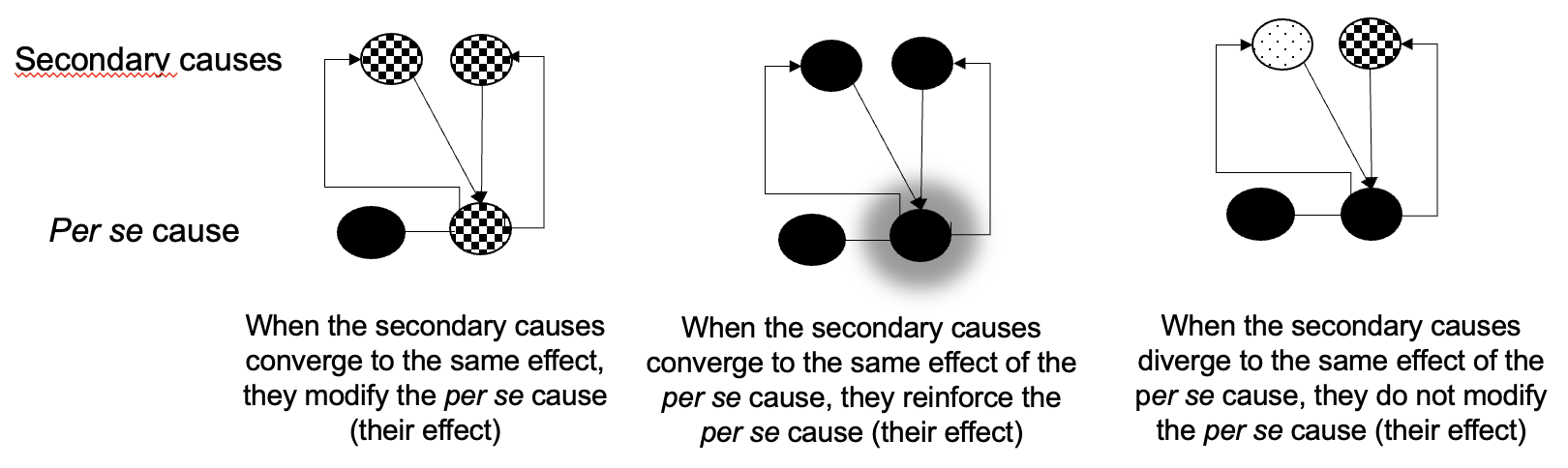
Figure 2 - Interrelations between secondary causes and the per se causes via a partial convergent or divergent causality
Interrelations between accidents and the per se causes, via a partial convergent or divergent causality
Next, we explore the interrelations between accidents and the per se causes, showing how accidents can transform or modify the per se causes. While accidents have the same partial and convergent/divergent causality as secondary causes, they differ in that accidents may or may not occur. Consequently, the interrelation between accidents and the per se cause they may influence is weaker than that between secondary and the per se cause. Nevertheless, accidents clearly play a role as all objects under consideration are shaped by their context.
One noteworthy aspect is that accidents can trigger subsequent accidents, creating a causal chain in which one event leads to another. For example, accidents like the subprime crisis illustrate this point (Demyanyk & van Hemert, 2011). Each accident can generate additional accidents or amplify the effects of the initial accident, showcasing an accumulation or non-proportional interrelation akin to the butterfly effect (Holbrook, 2003; Maguire et al., 2006). This non-proportionality contrasts sharply with the Newtonian paradigm and is crucial for understanding causal complexity. Accidents can affect all the four per se causes; for instance, the Covid pandemic (an accident) has profoundly altered norms, values, and beliefs (formal cause) related to work, as well as the strategies (instruments) employed by efficient causes.
Additionally, like secondary causes, accidents can converge with the effects of the per se cause that they influence, thereby reinforcing it. Consider the scenario where a CEO meets a consultant (an accident); the consultant’s ideas may converge with those of the CEO, thereby reinforcing the CEO's decision to pursue a particular direction. Conversely, accidents can also diverge from the causality of the per se cause. For instance, if the consultant presents ideas that conflict with the CEO's original plans, this divergence could lead the CEO to reconsider the initial decision or postpone it in favor of further consultation. Interestingly, a divergent accident can also have the opposite effect. Indeed, while presenting an idea that conflicts the CEO’s original plans, the consultant might be poorly prepared or employ inadequate tactics. This will exert a lower causality and instead of changing the CEO’s mind, the consultant would this time inadvertently reinforce the CEO's initial decision. This dynamic is particularly significant for organizational studies, as it illustrates how a cause can sow the seeds of its own perdition. We depict these interrelations in Figure 3.
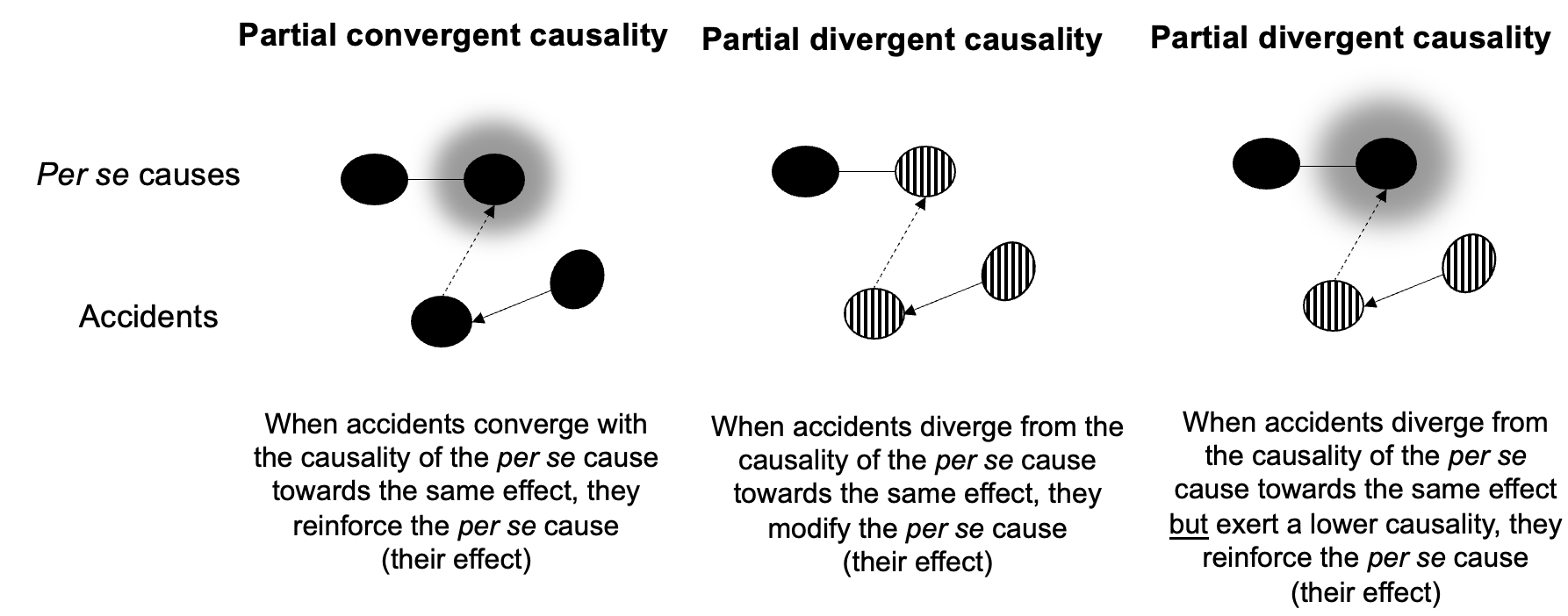
Figure 3 - Interrelations between accidents and the per se causes, via a partial convergent or divergent causality
To summarize, accidents and secondary causes can influence the end result by transforming or modifying the per se cause. However, the extent of this influence ultimately depends on the strength of the per se causes themselves, as we will elaborate on below. For instance, if a CEO has firmly established ideas on how to proceed, the impact of accidents or secondary causes will be relatively weak. Conversely, if the CEO is uncertain about the direction to take, the influence of accidents or secondary causes will be more pronounced. In other words, the influence of accidents and secondary causes depend on the causality of the per se cause they affect. The stronger the causality of the per se cause, the more difficult it is for accidents and secondary causes to exert influence. This leads us to explore the interrelations among the per se causes.
Interrelations between the per se causes in pairs, via a total and reciprocal causality
The interrelations between Aristotle's four per se causes demands careful examination for two main reasons. First, understanding their causal power is essential to determine how these causes can be modified. Second, the interrelation between the per se causes considered in pairs (intrinsic and extrinsic) explains how together they influence the end result, i.e., the specific organization under consideration.
As mentioned above, Aristotle's per se causes are linked, through a reciprocal and total causality, in their respective pairs: intrinsic (material and formal) and extrinsic (efficient and final). These interrelations differ from those between the per se causes and secondary or accidental causes. In the case of the per se causes, the interrelation is reciprocal: both causes within each pair affect each other's causality, either reinforcing or diminishing it. Moreover, both causes in each pair are total causes of the effect, meaning that both are necessary to lead to an effect.
The intrinsic pair describes the substance or quiddity of an organization (an organization is their common or joint effect), while the extrinsic pair describes the organization in entelechy, or in exercise, in movement, as an actualized potential. This conceptual framework allows us to examine organizations from two distinct perspectives: its substance (quiddity) and its realization in action (entelechy).
The total aspect of their type of causality highlights why all four per se causes are necessary to produce an effect. The reciprocal aspect of their type of causality, highlights how each cause in its pair, gives the causality of the other, and explains why and when these per se causes can be transformed or modified by secondary or accidental causes. As noted above, the more a per se cause is imbued with causality, the less susceptible it is to be influenced. This dynamic is expanded upon in the following sections.
Focusing on the intrinsic pair, the material and formal causes may sometimes be misaligned, as in cases where organizational norms, values, and beliefs such as freedom, democratic consensus (formal cause) conflict with a hierarchical structure (material cause). This misalignment would diminish their causality. While these two misaligned causes would still constitute a substance, the organization's quiddity—its potential— will be low, making it harder to be actualized by the extrinsic causes (efficient and final). For instance, if organizational values are at odds with its structure, agents may struggle to exercise agency and move the organization toward its goals. This point has been repeatedly stressed in organizational studies (e.g., Mintzberg, 1980). Conversely, when intrinsic causes are aligned, the substance has a high potential to be enacted, due to the reciprocal enhancement of causality between aligned causes. The reciprocal causality means that each per se cause affects the other’s effectiveness. In cases where intrinsic causes are misaligned, each diminishes the other's causality. Conversely, when aligned, they enhance one another, leading to better organizational function.
The same reasoning applies to the extrinsic pair of efficient and final causes. Just as quiddity may be low when the intrinsic causes are misaligned, the organization’s entelechy—the actualization of its substance, the actualized potential —can also be low if the actions of agents (efficient cause) are not aligned with the environment of the organization (final cause). This occurs when the management does not agree on how to act, having different understandings of their environment or the strategy to use. This misalignment can also manifest when the acts of agents differ from official policies, such as in cases of decoupling (e.g., Boxenbaum & Jonsson, 2017; Hirsch & Bermiss, 2009). In such scenarios, the full potential of the organization's quiddity remains unrealized. Conversely, when the extrinsic causes are aligned, entelechy is high and the organization effectively realizes its goals.
Finally, attention must be given to instruments. Instruments serve as the means through which agents (efficient cause) achieve their goals and reach or not the final cause. As mentioned, they can be wisely or unwisely chosen, and as such affect the end result and the specific organization under consideration. Instruments also denote that the mere will or potential of agents is not sufficient to ensure success Instruments can enable or constrain, shape the expression of the efficient cause (agents) thereby contributing to the overall level of entelechy. This denotes that agency is not unbounded and can be affected and shaped by instruments, but also accidents, resources, secondary causes, as we have underscored above.
In summary, an organization characterized by high entelechy and quiddity will be more efficient. Figure 4 illustrates how the alignment or misalignment of these per se causes bounded in pairs affects causality, quiddity, and entelechy.
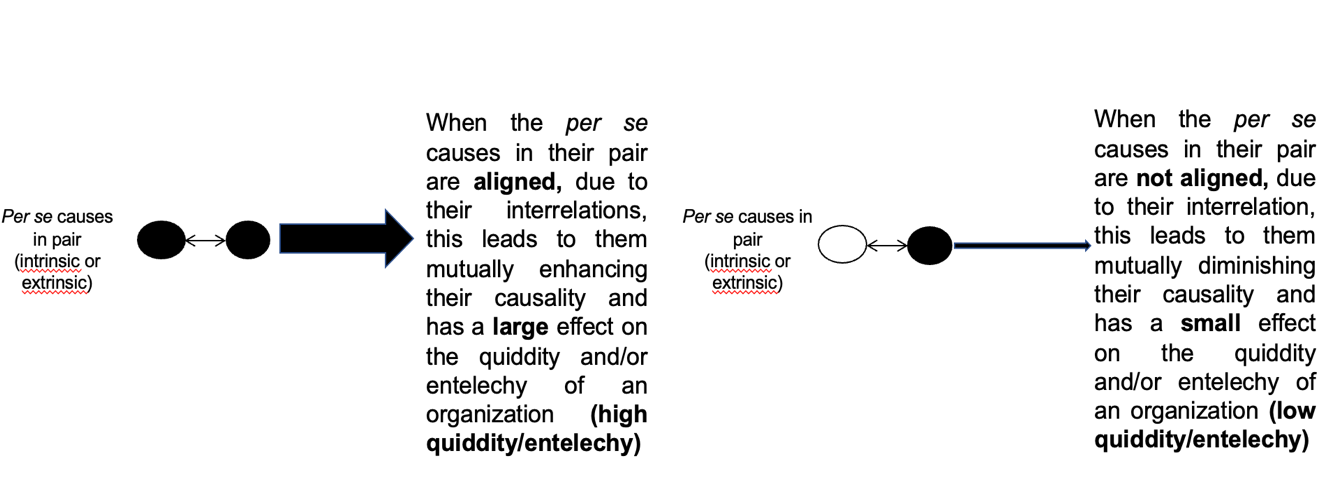
Figure 4 - Interrelations between the per se causes in pairs, via a total and reciprocal causality
The idea of enhanced or diminished causality, along with the notions of high or low quiddity and entelechy, offers a valuable lens through which to understand the effects of secondary causes and accidents on organizations. As mentioned earlier, they are pivotal in determining when accidents significantly affect the per se causes, thereby fundamentally altering an organization or its enactment. According to Aristotle, this influence depends not only on the convergence or divergence of various accidents but also on the inherent quiddity and entelechy of the organization.
When the levels of quiddity and entelechy are low, due to misalignment between the per se causes, the organization is more vulnerable to the effects of accidents. Conversely, when quiddity and entelechy are high, accidents tend to exert less influence. However, over time, the impact of accidents can accumulate, either further diminishing an organization's low potency or quiddity and entelechy or gradually eroding its high levels. This cumulative process can lead to substantial changes, even if these changes are not immediately enacted. Eventually, the accumulation may reach a tipping point, where a minor accident triggers a significant transformation—a phenomenon akin to the threshold effect described by Granovetter (1978).
This perspective also underscores the role of discontinuities in causal complexity, an issue extensively discussed by scholars such as Morçöl (2001). Discontinuities arise when small, seemingly insignificant events produce disproportionately large effects. Our framework explains this by the dynamic interrelations between the organization’s per se causes and the accumulated effects of secondary causes and accidents.
In conclusion, the final step in our analytical framework explores the interrelations between the different causes. By distinguishing between total and reciprocal causality for the per se causes and partial, convergent, or divergent causality for secondary causes and accidents, our analytical framework reveals the different types of causes. It also clarifies their respective effects, illuminates potential transformations of the organization, and emphasizes the dynamic and evolving nature of these interrelations.
Discussion
Our aim in this paper was to advance the causal complexity perspective by providing an analytical framework that allows scholars to ontologically ground and concretely apply causal complexity, answering calls to do so (Cornelissen & Durand, 2014; Furnari et al., 2021; Meyer et al., 2005; Tsoukas, 2017). In the last section we have proposed an analytical framework based on Aristotle’s conceptualization of causes and causalities that follows three steps (Figure 5).
In this section we discuss the advantages brought in by our analytical framework. First, we underscore how by ontologically grounding causes and causalities it enables us to operationalize causal complexity, but also to complement existing literature. Second, we discuss how the plasticity and in-depthness of the framework enables us to examine any organization and organizational phenomena at different levels. This not only enables us to concretely apply and use causal complexity but also to discover and bring in new elements of understanding.
Enabling to operationalize causal complexity by ontologically grounding causes and causalities
While causal complexity has underscored that we need to move beyond the Newtonian paradigm which asserts only a unique type of cause and causality (e.g., Bunge, 2009; Chia, 2003), Aristotle’s ontological conceptualization of causes and causalities, brings in different types of cause and causality, and enables us to understand these two concepts in their diversity (as non-univocal), but also to categorize them. This makes it possible to define them and to assess their specific nature, as literature has called for (Durand & Vaara, 2009; Misangyi et al., 2017).
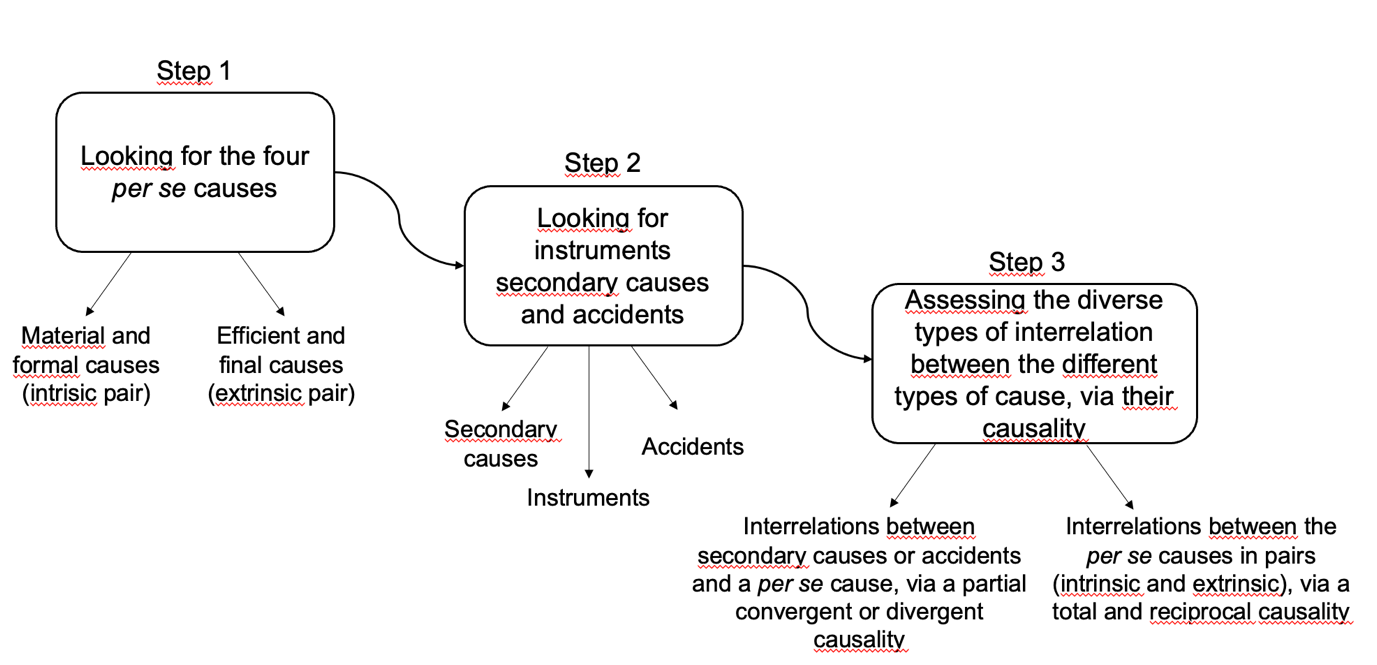
Figure 5 - A three-step analytical framework based on Aristotle’s conceptualization of causes and causalities
This complements existing insight in the causal complexity perspective. For example, if Fiss (2010) has distinguished core and peripheral elements, our conceptualization of causes and causalities explains why some elements are core and others are peripheral. We underscore that per se causes in their respective pairs are core because they are all necessary to produce an end result. They are not only necessary, but due to their reciprocal and total causality, they not only affect the causality of each other but if they are aligned, they exert a strong causal power affecting the end result (and conversely when they are misaligned, they have less causal strength); as we have underscored above in our example with the high and low quiddity and entelechy. This shows how the causal strength depends not only on the type of cause, the type of causality but also the interactions among causes. Indeed, secondary causes and accidents exert a weaker causal power due to their nature and type of causality, and hence correspond to Fiss’s peripheral elements. Nonetheless, interrelations formed by secondary causes with the per se cause can also become core, for example, when secondary causes reinforce the per se cause. Aristotle’s conceptualization thus explains and complements why an element is core or peripheral by virtue of its nature, and reveals that not only single causes, but also pairs of causes and above all, interrelations are essential to understanding what is core or peripheral.
Emphasizing the importance of interrelations, the third step of our analytical framework describes how causes relate to and influence each other, and how they contribute each in its own way to an end result. This provides a way to assess and develop these interrelations. This complements existing insights but also enables to concretely operationalize causal complexity by underscoring its dynamics. For example, causal complexity has underscored that causes cannot be aggregated, but are complementary (Thelen, 1999, 2003). Aristotle’s conceptualization explains why they cannot be aggregated. Indeed, per se causes cannot be aggregated because of their total and reciprocal causality, and secondary causes cannot be aggregated or simply summed up, as well, due to their partial convergence or divergence. Our framework emphasizes how causes instead complement, transform, or modify each other. As we have shown above, the different causes must be understood in their interrelations and none of them alone in isolation can explain the specific object under consideration. This brings in elements of understanding why configurations are indeed key to understanding the end result and that there is no net effect (Abbott, 1988; Ragin, 2008).
In addition, configurational theory does not directly address the dynamics within configurations (e.g., Furnari et al., 2021). However, as we have highlighted in the previous section, interrelations are not static, as each cause can be influenced by another and can be transformed or modified, thus providing a dynamic view of these interrelations. Moreover, as we showed, these dynamic interrelations are not linear because they involve feedback loops and can lead to non-proportional effects through accumulation, which is consistent with causal complexity (Cohen, 1994; Goldstein, 2000). We also highlight why interrelations exclude conjunctions of causes and pure causal chains, thus sustaining causal complexity. Causal chains can only be considered for accidents. Conjunction of causes are rejected because causes are not only diverse in nature but also exert different types of causality.
An ontological grounding of causes and causalities makes our understanding of these two concepts more robust and solid. This not only brings in new elements of understanding but enables us to better apply them, something we would not have been able to do if their conceptualization would have remained vague and imprecise. In addition, our specific ontological grounding allows us to make connections between causes and causalities, assess and map their dynamic interrelations, thereby providing a way to concretely apply causal complexity.
Enabling to operationalize and expand causal complexity by providing a plastic and fine-grained analytical framework
Our analytical framework provides an alternative reading and scrutinizing grid, a way to examine organizations and organizational phenomena. Its broad applicability allows it to concretely apply and operationalize causal complexity. Its plasticity and analytical depth enhance and sharpen our explanatory capabilities, this brings in additional elements of understanding that expand and develop the causal complexity perspective.
Our analytical framework is applicable to any object under consideration, underscoring its potential for widespread use. In this paper, we have applied it to organizations and organizational phenomena, remaining purposefully at an organizational and macro level. Using it at this level we can explore the diversity of organization. But we can also use it to study and analyze events, practices, a particular actor, and so on. Thus, it is concretely applicable to any level of analysis, from a macro to a micro level of analysis, as causal complexity for calls (McKelvey, 2004); highlighting its generalization and applicability to a wide range of organizational phenomena.
Indeed, it could be used to analyze a specific element such as the environment. We have mentioned that the environment can be seen as a final cause of an organization and that a stable or stable or changing environment depicts the particular environment of a specific organization. But we could also focus explicitly only on the environment. In this case stability and change could be seen as accidents and this analyzing lens could bring in other elements of understanding. Our analytical framework could as well be used to examine agents' acts, adopting a more micro and process-oriented focus. In this case, final causes such as the goal of the agents’ practices could highlight the intentional aspects that remain less tangible in our illustration because of our specific macro focus on organizations, but which are far from being excluded from Aristotle’s framework. Indeed, both angles and approaches are not mutually exclusive; on the contrary, they complement and integrate each other. While these examples are rooted in organization studies, our framework could also be used to analyze other phenomena such as global warming, or be of use to political perspectives analyzing states, which opens up new avenues for future research. As such, our framework provides a structured approach to understand complex phenomena, is broadly applicable, but also highly plastic which enables us to accommodate different perspectives without excluding any possibility.
Furthermore, by emphasizing different types of causes, we provide a fine-grained analytical framework that allows for thick descriptions, as causal complexity calls for (Tsoukas, 2017) and in-depth understandings. In fact, the distinction between the per se causes, secondary causes, accidents, and instruments provides a more refined description and thus enhances our ability to describe the complex nature of any object under consideration. This brings in new elements of understanding and nuances. For example, Aristotle’s instruments enable underscore means agents use to reach their goal. Indeed, agents’ potency, their action potential, can be constrained or shaped not only by resources and accidents, but also by the tools and means they chose. This resonates with Actor-Network Theory (ANT), which emphasizes the role of non-human factors in shaping results (Akrich et al., 2006).
It also expands our understanding and shed lights on elements and connections that could have remained overlooked. For example, in our last section, we emphasized that a cause can sow the seeds of its own perdition. To the best of our knowledge, this aspect has only been highlighted once in the literature (Zara & Delacour, 2023) about the inherent complexity and intricacy of different types of institutional work. We echo this suggestion, highlighting the interrelations among the different causes and their mutual influences, showing how they interrelate, transforming and modifying each other and thus affecting the end-result. Our framework reveals another aspect, underscoring that the outcome of a cause is not only given by its specific causality and causal power but also by the causal power the cause it affects possesses. In our illustration, the consultant can seek to lead the CEO to another idea than the initial one but be ill-prepared (weak causality of the consultant). This will result in the CEO not only not choosing the new idea but reinforcing the original idea, hence to the opposite result the consultant was seeking to attain. This all depends on the CEO’s own causal power: the more causal strength, the more difficult it would be to transform and vice versa.
Similarly, the idea of accumulation leading to tipping points and discontinuities has been emphasized as the key to the causal complexity perspective (e.g., Granovetter, 1978; Morçöl, 2001). Our analytical framework brings in new elements to examine deeper the issue of accumulation. It highlights how accidents can accumulate without triggering any impact but can reach a tipping point when an additional accident can lead to an impact and affect organizations. The new element we highlight is that a low quiddity or entelechy will create more vulnerability and thus trigger the discontinuity. To illustrate, change could be driven by different causes such as new norms emerging by shifts in the environment (accidental formal causes). Those might not be sufficient to modify neither the existing norms, nor the structure of the organization, especially when the quiddity of the organization is high. In time other accidents, such as other norms, or even other types of accidental causes such as new structural elements, specific events, etc. could happen and slowly accumulate. This would trigger effective change only if it sufficiently erodes the high quiddity or lower it sufficiently to create a discontinuity.
As such, our framework analytical depth allows us to thoroughly examine organizations and organizational phenomena, and thus to better understand them and expand our explanatory efforts, but also to incorporate new elements of understanding and nuances. However, our framework is not only a simple epistemological tool, expanding our knowledge, but also an ontological tool (Stein, 2011).
The notions of quiddity and entelechy are rooted in a specific ontology. Aristotle argues that this represents a distinction of reason, not a real one, and that it depicts two perspectives of the same thing, as to sides of the same coin (Zara & Delacour, 2023). As such and to illustrate, an organization is a substance (quiddity) and is entelechy which represents the organization as a process, a dynamic progression. Stability and movement are considered by Aristotle equally, as two ways to look at, deal and examine the same thing/situation. This enables to view organizations through both a variance/static approach and a process/dynamic approach (e.g., Hernes, 2007, 2014; Van de Ven & Poole, 2005). Both approaches are not only valid for Aristotle, but they need to be integrated to make sense of reality.
Similarly, Aristotle’s ontology transcends dichotomies, either/or choices and forces us instead into integrating seemingly opposed perspectives (see Zara & Delacour, 2023). For example, Aristotle’s ontology does not fit neatly into contemporary categories of subjectivism or objectivism. Aristotle instead recognizes the existence of objective realities while also acknowledging the role of agents' intentions and actions in shaping outcomes, creating a nuanced perspective that transcends strict subjectivist or objectivist perspectives. As such, it can accommodate the subjective dimension of agents, including their volition, free will, and the judgments they make about particular objects, but this does not negate its objective aspect. For Aristotle, agents are free because they are pulled by a final cause. This means that while agents define self-directed goals, these goals are shaped by an overarching final cause. While this may seem contradictory from the perspective of a subjectivist or objectivist, it is central to Aristotle’s ontology and the dynamic nature of causes within it. This also brings in a very different and nuanced understanding of determinism. Complexity theory rethinks determinism with chaos, non-linear, non-proportional interrelations, configurations, discontinuities, etc. It still considers a type of determinism, although one which cannot lead to predictability. Aristotle not only encompasses these latter aspects but also integrates subjectivist approaches, giving to the efficient causes – agents – free will, power, judgement, etc. Both the subjective and objective perspectives coexist in his framework, allowing for the coexistence of multiple, complementary viewpoints, seeking to reconcile these perspectives.
To sum up, our analytical framework is an analytical grid, a way of structuring our thoughts, which enables us to grasp, understand, comprehend, make sense of, analyze and examine an object, an event, a process. It is an intellectual exercise but also an ontological approach that opens up new perspectives and aspects that were not apparent before. As such, it helps to explore and broaden our understanding of complex phenomena by not only applying causal complexity but also integrating different perspectives without excluding any possibility.
Conclusion
Despite its numerous advantages, the causal complexity perspective remains underutilized compared to the more dominant Newtonian paradigm. To encourage wider adoption among scholars, we have developed an analytical framework grounded in Aristotle’s causes and causalities. This framework offers a structured methodological approach rooted in both ontology and epistemology, making the application of causal complexity more accessible and operationalizable across various levels of analysis. Furthermore, it complements existing theories by providing alternative explanations for complex phenomena.
Our framework not only deepens the understanding of causal complexity but also facilitates a more comprehensive, holistic view. It underscores the richness of causal complexity, which encompasses a wide array of theories, configurations, and perspectives. Scholars often engage with causal complexity from specific angles, whether theoretical, causal, or configurational, while contrasting it with the Newtonian paradigm (e.g., Furnari et al., 2021; Tsoukas, 2017). While this diversity is enriching, it can lead to fragmentation, causing the holistic and systemic nature of causal complexity to be overlooked. By anchoring our framework in Aristotle’s ontology, we demonstrate how this approach can unify disparate perspectives, thereby offering a more integrated understanding of causal complexity.
In addition, we hope this paper has reignited interest in the value of philosophy, particularly Aristotle, for organizational studies. There are many contemporary issues, such as positivism, domination or gender bias, etc., that Aristotle has obviously not tackled as those concepts were not existing during his time. Therefore, scholars might easily dismiss insights he could bring in. While considering Aristotle, like any other non-contemporary philosopher, it is important to look back in history not through our own contemporaneous views and lenses, but adopt a historical approach, staying as close as possible to the original texts. Doing so, we can nonetheless, grasp and apprehend how Aristotle’s philosophical insights can illuminate and bring in a different perspective to contemporaneous issues. Hence, although Aristotle’s work may seem distant from modern concerns or excessively conceptual, we have sought to demonstrate its enduring relevance and practicality. Aristotle’s ideas provide contemporary scholars with a robust analytical framework, as well as ontological insights and methodological tools that can significantly broaden our understanding of organizational phenomena.
Acknowledgements
Preprint version of this article has been peer-reviewed and recommended by Peer Community In the PCI Organization Studies (https://doi.org/10.24072/pci.orgstudies.100038; Shanahan, 2025)
Conflict of interest disclosure
The authors declare that they comply with the PCI rule of having no financial conflicts of interest in relation to the content of the article. The authors declare the following non-financial conflict of interest: HD is recommender of the managing board of PCI Organization Studies.
Funding
The authors declare that they have received no specific funding for this study.