

 CC-BY 4.0
Introduction
The accelerating global population and growing environmental pressures are reinforcing the search for new food sources, especially sustainable proteins (Despommier, 2024). According to recent life-cycle assessments, mealworm farming has a comparatively low footprint. In Austria, Dreyer and collaborators estimated that producing 1 kg of edible protein results in 20.4 kg CO₂-eq, 213.7 MJ of non-renewable energy use, and 22.4 m² of land occupation. Compared with organic broiler, impacts were 18-72 % lower across most categories, except for freshwater eutrophication, which was slightly higher (Dreyer et al., 2021). In this context, the yellow mealworm (Tenebrio molitor, T. molitor) is a relevant model to discuss sustainable protein supply and co-product valorisation within circular bioeconomy strategies. The arid-zone model is here defined as a decentralized, low-input farming system. It operates under scarce water conditions, strong day/night temperature fluctuations, and relies on irregular local waste streams with minimal capital or energy infrastructure. Among edible insects, this species is notable for its balanced nutritional profile, low environmental footprint, and potential to integrate into circular bioeconomy models (Khanal et al., 2023). Recent research has also highlighted the multi-sectoral value of its biomass. The exuviae are a promising source of high-quality chitosan with applications in food packaging and biomedical materials (Marín-Morales et al., 2025), while its frass and oils are increasingly incorporated into agricultural and cosmetic products (Maciejewska et al., 2025; Khan et al., 2025). Over the past five years, investigations have shifted from basic feasibility studies (Tlak Gajger & Dar, 2021) to advanced applications. New findings include bioactive protein hydrolysates with antioxidant properties (Chewaka et al., 2023), functional peptides, and decentralized low-tech farming systems adapted to rural contexts (Montalbán et al., 2023). At a more mechanistic level, tachykinin-related peptides have been reported to modulate immune-gene expression in the mealworm beetle, illustrating the expansion of functional biology around T. molitor beyond nutritional profiling (Urbański et al., 2022). From a regulatory perspective, T. molitor has progressively gained Novel Food recognition in Europe. Pioneering policies outside the EU have also supported its early commercialization (Food Standards Australia New Zealand, 2023). This evolving legal framework underscores the growing institutional interest in insect-based proteins. Across alternative protein categories, unclear regulatory guidance and uneven safety evidence can still slow uptake, including for insect-based products (Malila et al., 2024). Technological innovation is also moving the sector forward; for example, machine learning-based monitoring systems are being developed to support rearing management and quality control at scale (Majewski et al., 2022). Research so far has revealed both opportunities and limits. Promising avenues include the economic use of co-products, the development of bioactive compounds, and socio-economic gains. However, these coexist with hurdles such as variable frass composition (Zunzunegui et al., 2024), allergenic risks (EFSA Panel on Nutrition, Novel Foods and Food Allergens, 2021), and uneven consumer acceptance (Maciejewska et al., 2025). A global synthesis confirms strong regional contrasts in acceptance and willingness to pay, with higher uptake in Africa, Asia and Latin America and stronger psychological barriers in Western contexts (Abro et al., 2025). Recent reviews also argue that insect-based foods are unlikely to significantly displace meat consumption at scale in the near term, mainly due to persistent acceptance barriers and limited market momentum (Biteau et al., 2025). These bottlenecks are reviewed in detail elsewhere (Kotsou et al., 2023). Objectives and scope: this review synthesizes peer-reviewed evidence published between 2020 and 2025, a period that coincides with rapid growth in industrial deployment, expanded regulatory approvals, and diversification of applications for T. molitor. Earlier foundational work is acknowledged but lies outside this update. We map key advances across food, feed, and co-products, and focus on key sustainability constraints that condition scale-up, including energy demand, water and substrate constraints, frass variability, allergenicity, and consumer acceptance. We also discuss how these constraints manifest across production contexts, including decentralized low-input systems relevant to arid regions.
Materials and methods
Literature scope and selection. This narrative review synthesizes peer-reviewed literature published between 2020 and 2025 on Tenebrio molitor in relation to food, feed, co-products, and circular bioeconomy applications. This time window was chosen to capture recent regulatory developments, industrial deployment, and the diversification of applied research in the field. Earlier landmark studies were cited selectively for context, but they were not the main focus of this update. Literature was included on the basis of its relevance to the review objectives, especially when studies addressed nutritional value, food and feed applications, safety and allergenicity, frass and co-product valorization, life-cycle assessment, and constraints affecting scale-up or low-input production contexts. Official regulatory and institutional sources were also used where needed to support legal or policy-related statements. This review was designed as a critical narrative synthesis and does not aim to provide an exhaustive systematic inventory of all publications on T. molitor.
Regulatory Framework and Legitimacy
This section reviews the regulatory and safety conditions that most directly shape the deployment of T. molitor in food and feed systems. Rather than serving as extended background, it focuses on the constraints most relevant to implementation and scale-up, including authorization, market access, contaminant control, allergenicity, and quality monitoring.
Regulatory Landscape and Approvals
The regulatory status of T. molitor has progressed markedly in recent years, especially in Europe. Since 2021, the European Union has authorized processed insect proteins for use in poultry and pig feed (European Commission, 2021). In parallel, EFSA concluded that frozen and dried whole T. molitor larvae are safe as a Novel Food under defined specifications and labelling requirements, and this position was reaffirmed in a later opinion (EFSA Panel on Nutrition and Novel Foods, 2025; EFSA Panel on Nutrition, Novel Foods and Food Allergens, 2021). In January 2025, the European Commission further extended this framework by authorizing UV-treated whole mealworm powder for use in processed foods (AGRINFO, 2025). Regulatory development is also advancing outside Europe, although unevenly. In Asia, initiatives supported by FAO Korea Partnership have contributed to regional discussions on edible insect regulation and harmonization (FAO Korea Partnership, 2022). For implementation, the main issue is not only authorization itself, but also the conditions attached to it. Regulation (EU) 2015/2283 provides the legal basis for Novel Food authorization, including transitional measures for products already lawfully marketed before EU-wide decisions (European Parliament, 2015). In practice, labelling, traceability, product specifications, and market-access requirements directly affect commercialization and scale-up, even when technical feasibility has already been established (Żuk-Gołaszewska et al., 2022).
Safety, Toxicology, and Allergenicity
Safety remains a central condition for the broader use of T. molitor. Available evidence shows that substrate composition can directly influence contaminant profiles, including heavy metal accumulation, making substrate selection and monitoring critical (Malematja et al., 2023). Toxicological studies are generally reassuring under the tested conditions, but longer-term datasets remain limited, especially for endpoints beyond short sub-chronic exposure (Machona et al., 2024). EFSA safety assessments also emphasize processing, stability, microbiological criteria, and labelling as part of the overall suitability framework for food use (EFSA Panel on Nutrition and Novel Foods, 2025; EFSA Panel on Nutrition, Novel Foods and Food Allergens, 2021). Microbiological quality is another practical constraint. Properly processed batches can meet acceptable microbiological standards under Hazard Analysis and Critical Control Points (HACCP) monitoring, but this depends on reproducible processing and batch control (Niyonsaba et al., 2021). From a scale-up perspective, this makes safety an operational issue as much as a biological one.
Allergenicity remains a major constraint for implementation. Current evidence shows sensitization and cross-reactivity risks, especially with crustaceans and mites. This supports the need for clear labelling and cautious risk communication (Majsiak et al., 2025; Scala et al., 2025). Sensitization, however, does not necessarily predict clinical allergy, and oral food challenge data remain limited, although clinical reactions to insect ingestion have been documented (Garino et al., 2020; Majsiak et al., 2025). More broadly, regulation and safety directly shape the scalability of T. molitor production, as well as the conditions required for traceability, quality control, and market acceptance.
Cost and Environmental Impact
The economic viability of T. molitor production depends largely on two interlinked factors: (1) feedstock cost efficiency and (2) regional resource availability (Shah et al., 2024). These parameters shape both the operational strategy and the long-term sustainability of production systems, regardless of scale.
Environmental Performance and Circularity
In recent years, several investigations have shown that T. molitor farming, when embedded within circular agri-food systems, can cut environmental impacts while still generating outputs of economic value. Among these outputs, frass stands out. Analyses report nitrogen levels between 2.8 % and 4.1 %, phosphorus (P₂O₅) from 1.5 % to 2.4 %, and potassium (K₂O) ranging from 1.4 % to 2.0 %, together with a range of beneficial microorganisms (Zunzunegui et al., 2024). This composition makes frass a valuable organic fertilizer, able to promote plant growth and support soil microbial communities. To achieve consistent agronomic benefits, nutrient ratios may need to be adjusted to the needs of each crop, while also meeting EU contaminant limits for heavy metals and other hazards.
The choice of substrate plays a major role in environmental performance. Life-cycle assessments show that agro-industrial by-products, including malt residual pellets, wheat bran, or corn germ meal, help sustain high larval yields and close nutrient cycles (Oh & Lu, 2023; Lienhard et al., 2023). Lienhard and co-authors reported that malt residues matched the growth performance of wheat bran while making productive use of a local waste stream (Lienhard et al., 2023). Such substitutions can reduce carbon emissions by up to 50 % and cut water use by 40-60 % compared with conventional fishmeal production (Khan et al., 2025). Similarly, an Austrian life-cycle assessment found that while heating drives most of the climate burden, T. molitor still outperformed organic broiler across nearly all impact categories (Dreyer et al., 2021). Production scale is another determining factor. Small, low-tech farms, often relying on manual operation, can function with much lower energy requirements than fully automated industrial plants. These decentralized approaches can be well-suited to areas with limited resources, provided that strict biosecurity and quality standards are maintained to ensure consistent outputs (Mahmoud et al., 2025; Sowmya et al., 2024). Nevertheless, Table 1 reveals that small-scale labour costs (8-12 hrs/kg) negatively impact the Return on Investment (ROI) in high-wage areas, favouring automated systems (Sowmya et al., 2024). Economic analyses suggest that integrating frass upcycling into the production chain can also improve environmental metrics. For example, in Dutch models, such integration was estimated to offset 20 % to 25 % of operational costs while simultaneously reducing the overall ecological footprint (Niyonsaba et al., 2021, 2023). Policy incentives like EU tax breaks could help industrial systems overcome nutrient loop challenges while boosting circularity (Niyonsaba et al., 2023). In this review, the “low-tech” column reflects an arid-zone low-input production model: scarce water, wide day/night temperatures, and irregular substrates. Practical adaptations are simple: passive ventilation, only essential evaporative cooling, and strict substrate screening. These constraints help explain higher labour inputs and the variability seen for growth and frass.
As summarized in Table 1, small-scale systems excel in circularity but face scalability trade-offs, whereas industrial production prioritizes consistency at higher energy costs. This contrast is not only about scale but also geography. Small-scale, low-tech systems often match the realities of arid regions, where energy is costly and water is scarce. Local residues, like downgraded fruits or crop by-products, become the main resource. In these contexts, the arid-zone low-input model is less about yield maximization and more about survival and resilience. Industrial farms, by contrast, depend on stable inputs and heavy infrastructure, which are rarely feasible in such environments. Here, “arid-zone low-input production” refers to decentralized, low-input rearing under water scarcity and large day/night temperature fluctuations, with minimal active climate control and reliance on locally available residues. Concrete examples discussed in this review include by-product-based diets (e.g., malt residues; Lienhard et al., 2023), on-farm frass stabilization (e.g., rice hull blending; Noyens et al., 2023), and frass use as fertilizer in arid sandy soils (Verardi et al., 2025a).
Table 1 - Sustainability constraints across T. molitor production contexts, contrasting small-scale/low-tech (arid-zone relevant) with industrial/large-scale approaches.
Parameter | Small-Scale Low-Tech (arid-zone relevant) | Industrial Large-Scale | Key Implications |
|---|---|---|---|
Substrate | Local by-products (high variability) (Noyens et al., 2023; Truzzi et al., 2019) | Standardized diets (consistent nutrients) (Noyens et al., 2023) | Small farms adapt to waste but face contamination risks |
Climate and humidity control | Minimal active control, passive ventilation, only essential cooling (Lienhard et al., 2023) | Heating, Ventilation and Air Conditioning (HVAC) with controlled temperature and humidity, year-round output (Mahmoud et al., 2025) | Infrastructure intensity and energy demand vs robustness in constrained environments |
Energy Use | 15–20 kWh/kg (passive systems) (Lienhard et al., 2023) | 25–30 kWh/kg (HVAC + automation) (Mahmoud et al., 2025) | Industrial cuts labor costs but increases energy demand. |
Labor | 8–12 hrs/kg (manual processes) (Mahmoud et al., 2025) | 1–2 hrs/kg (automated) (Mahmoud et al., 2025) | Critical for Return on Investment (ROI) in high-wage regions (Sowmya et al., 2024) |
Monitoring and quality control | Lower instrumentation, relies on Standard Operating Procedures (SOPs) and substrate screening | Digital monitoring and automation support rearing management and quality control at scale (Majewski et al., 2022) | Traceability and batch consistency vs cost and complexity |
Frass Quality | Variable Nitrogen, Phosphorus, Potassium (NPK), occasional arsenic (As) exceedance (Truzzi et al., 2019) | Uniform NPK, European Food Safety Authority (EFSA) compliant (Truzzi et al., 2019) | Small-scale requires blending, e.g., rice hulls (Noyens et al., 2023) |
Circularity | High (local waste recycling) (Lienhard et al., 2023) | Moderate (logistics constraints) (Niyonsaba et al., 2023) | Policy incentives could boost industrial circularity (Niyonsaba et al., 2023) |
Note: Data compiled from multiple sources (Khan et al., 2025; Lienhard et al., 2023; Mahmoud et al., 2025; Niyonsaba et al., 2023). Energy estimates exclude transport emissions for decentralized systems. The low-tech column is particularly relevant for arid-zone constraints (water scarcity, large diurnal temperature range, limited infrastructure).
Economic Feasibility and Production Models
The economic viability of T. molitor production depends largely on two factors: feedstock cost structures and the availability of local resources (Shah et al., 2024). Controlled trials have shown that agricultural by-products such as malt pellets and corn germ meal can match the yields obtained with conventional wheat bran (Lienhard et al., 2023). An illustrative observation from Biskra, Algeria, an arid-zone context, was reported by Debache (2021). In that study, larvae reared on downgraded local dates showed growth outcomes comparable to those obtained on vegetable scraps (Debache, 2021). Because compositional measurements were not available, this example should be regarded as preliminary and interpreted cautiously.
In Europe, profitability depends above all on three factors. Feed conversion efficiency is the key driver. Labour productivity also matters but is often underestimated. Finally, the market value of insect proteins adds volatility that producers must manage (Niyonsaba et al., 2021, 2023; Truzzi et al., 2019). Together, these factors explain why small-scale and industrial systems follow distinct economic paths. Small-scale operations often achieve financial stability sooner. Their reduced capital requirements and localized distribution networks shorten the path to breakeven. In contrast, industrial-scale production relies on substantial upfront investment but can deliver lower unit costs through economies of scale. Interestingly, such outcomes are more likely when policy support and adaptable business models are present (Aguilar-Toalá et al., 2025).
The choice of production model ultimately reflects regional assets and constraints. Regions rich in agro-industrial residues but with limited capital tend to favour decentralized, low-tech approaches. In arid-zone settings, the cost structure shifts from electricity to labour and logistics. Consequently, decentralized hubs can remain viable where wages are low, even if biomass is scarce. In contrast, high-wage economies inevitably favour automated, large-scale systems. This framing helps clarify the arid-zone model as a distinct pathway within the broader spectrum of mealworm production systems. Capital-intensive environments, by contrast, lend themselves to automated vertical integration, though careful energy management becomes essential to control ongoing costs (Mahmoud et al., 2025). In these settings, gentle drying preserves lipids and vitamins. In practice, low-energy drying requires tighter time and temperature control and microbiological monitoring, including HACCP-based oversight for processed batches (Pöllinger-Zierler et al., 2023). These low-tech adaptations are not just cost-driven but also context-specific, directly linking production models to territorial resilience. Dutch models suggest that profitability can be reached within three to five years when co-products such as oil and frass are fully valorised (Niyonsaba et al., 2023)
Nutritional Quality and Food Innovation Potential
It is now well established that T. molitor larvae are protein-rich, with values typically ranging from 44.2% to 60.2% of dry matter (Dalmoro et al., 2023; Kotsou et al., 2024; Pöllinger-Zierler et al., 2023). However, these concentrations should not be interpreted as uniformly higher than all conventional animal protein sources. What makes mealworm protein particularly valuable is its complete amino acid profile, with substantial amounts of lysine (K), leucine (L) and valine (V), similar to what we find in lean meats (Kotsou et al., 2024). These proteins consist of both structural components like actin and myosin, and soluble fractions packed with essential amino acids. The lipid fraction is also of considerable interest, representing between 20.0% and 36.0% of dry matter (Kotsou et al., 2024). In line with many other animal-derived sources, the fatty acid profile is largely shaped by polyunsaturated fats, with omega-6 linoleic acid making up 47-54% of total lipids. By contrast, omega-3 α-linolenic acid remains scarce (1.0-1.8%), which leads to an omega-6 to omega-3 ratio in the range of 25:1 to 35:1 (Dalmoro et al., 2023; Maciejewska et al., 2025). The larvae further provide notable amounts of oleic acid (27-32%) and a saturated fraction (21-26%) dominated by palmitic acid at roughly 15% (Kotsou et al., 2024). It should be noted that processing may influence these qualities. Lipid stability can decline over time, and drying steps may accelerate this effect. Heat during processing can also destroy certain vitamins. Microbiological safety considerations are addressed in Section 2.2. Here, we only note that processing and monitoring can support compliance with microbiological criteria for food batches (Pöllinger-Zierler et al., 2023). Recent innovations have successfully incorporated T. molitor into various food products, as highlighted in the comprehensive review by Kotsou and collaborators (Kotsou et al., 2023). The applications range from protein-packed snacks to pasta and bakery items. Food technologists are addressing sensory challenges through fine milling, flavor masking, and blending with familiar ingredients (Kotsou et al., 2023). In bakery applications, T. molitor larval powder replacing 5-10% of wheat flour increases water absorption (+4-6%) and improves mixing stability. The resulting breads show greater volume and a softer crumb; above ~15% substitution, crumb darkening and roasted notes intensify. A practical mitigation is protease pre-treatment, which improves gas retention and helps maintain texture (Verni et al., 2025). In a study tracking composition across larval instars, later instars reached up to 56% protein (dry matter) and showed high levels of leucine, lysine, and valine. Earlier instars contained more polyunsaturated fats, while later instars accumulated a higher proportion of monounsaturated oleic acid (Kröncke et al., 2023). For producers, this suggests that harvest timing may be adjusted either to maximize protein yield or to target a specific fatty acid profile, depending on the intended application. In arid contexts, later-instar harvests can help prioritize protein when cooling is limited. The next section shifts from composition to evidence in animal feed.
Applications in Animal Nutrition
The meal and oil derived from T. molitor are increasingly studied for their potential in animal feed, particularly for monogastric species (poultry, pigs, fish). This section explores recent scientific findings regarding the use of T. molitor in these species, highlighting zootechnical, digestive, and health-related benefits. Two subsections are dedicated to the main sectors concerned: poultry and other monogastrics.
Poultry (broilers, quails)
Several authors have reported that incorporating T. molitor into poultry diets delivers clear nutritional benefits (Nieto et al., 2022; Vasilopoulos et al., 2023). Studies using inclusion levels as low as 5-10 % have still shown measurable gains in growth and feed efficiency (López-Gámez et al., 2024; Petkov et al., 2024; Vasilopoulos et al., 2023). In slow-growing chickens, full replacement of soybean meal with T. molitor can reduce feed intake and early growth. Performance, however, converged by ~95 days, with final outcomes comparable to conventional diets (Nieto et al., 2022). Biasato and colleagues evaluated Hermetia illucens meal, T. molitor meal, and a 1:1 mixture of both meals in broiler diets at 5% and 10% inclusion. In that study, the 5% T. molitor diet improved feed efficiency relative to the control. However, as results from mixed-insect diets are study-specific, they are not used here to support conclusions on mealworm meal alone (Biasato et al., 2025). In addition, Japanese quail fed graded inclusion levels of T. molitor meal showed slight changes in performance and carcass traits. The authors concluded that inclusion levels above 1.65% slightly impaired growth performance (Secci et al., 2022). From a market perspective, poultry stands out as the most widely consumed and culturally accepted monogastric worldwide. It faces fewer religious restrictions than pork. It also requires less water and infrastructure than aquaculture. All these factors keep poultry in a leading position as the prime target for insect-based feed innovations.
Other Monogastrics (pigs, fish)
Mealworm larvae protein shows high in vitro digestibility (91-99%) and good-to-excellent protein quality as determined by in vitro DIAAS (Digestible Indispensable Amino Acid Score, a measure of protein quality based on the digestibility of each indispensable amino acid) values of 89-92, comparable to high-grade animal proteins such as poultry or fish meal (Hammer et al., 2023). These profiles include approximately 6.5 % lysine and 2.1 % methionine (of crude protein), both key amino acids for post-weaning piglets. In addition, T. molitor meal has been assessed in growing pigs using integrated transcriptomics, metabolomics, and lipidomics (Meyer et al., 2020). This study reports diet-associated metabolic effects and changes in plasma metabolite profiles, providing a detailed evaluation beyond basic performance endpoints. Moreover, in post-weaning pigs, replacing fishmeal with 10% T. molitor meal over a 42-day trial resulted in overall average daily gains of approximately 0.39 to 0.40 kg/day and feed conversion ratio (FCR) values around 2.05 to 2.17, with final body weights comparable across groups. Hematological parameters and most biochemical indices were not affected, although cholesterol was modified (Zacharis et al., 2023).
In aquaculture, T. molitor has been widely tested as a sustainable replacement for fishmeal. In Nile tilapia, both partial and total substitution achieved growth rates and feed efficiency equal to, and sometimes exceeding, those from fishmeal diets, with average gains of 1.2-1.4 g/day and feed conversion ratio (FCR) values in the 1.3-1.4 range (Khan et al., 2025). Fillet lipid profiles also shifted towards a higher proportion of polyunsaturated fatty acids (Khan et al., 2025). Similarly, in rainbow trout, partially defatted T. molitor meal replacing fishmeal up to 100% (corresponding to 20% dietary inclusion) did not affect growth performance, and feed conversion ratio (FCR) values remained within a similar range across treatments (Chemello et al., 2020). The next section examines bioactive compounds and functional ingredients.
Bioactive Compounds and Human Health Applications
Recent work increasingly links the nutritional value of T. molitor to hydrolysates, peptides, and lipid fractions with potential functional properties. However, the current evidence base remains predominantly preclinical. Most reported effects derive from in vitro assays, supported in some cases by animal models, whereas controlled human validation is still lacking. This section therefore focuses on the main functional categories emerging from recent studies and distinguishes between established observations, promising applications, and current translational limits. Protein hydrolysates from T. molitor consistently show antioxidant and anti-inflammatory potential in vitro. Controlled hydrolysis and simulated gastrointestinal digestion have generated low-molecular-weight peptide fractions with radical-scavenging activity and modulation of inflammatory markers in cell models, including reductions in TNF-α, IFN-γ, and IL-6 under stimulated conditions (Gonzalez-de La Rosa et al., 2024; Villanova et al., 2024). Recent syntheses further support the view that such fractions may provide promising functional food or nutraceutical leads (Ma et al., 2025; Stephan et al., 2025). Experimental studies using food-grade proteases likewise reported DPPH radical-scavenging and ferric-reducing activities, while structure–activity modelling suggests that amino acid composition may influence antioxidant potency (Du et al., 2022; Rivero Pino et al., 2020). Nevertheless, these findings remain strongly dependent on processing conditions, assay design, and peptide fractionation, and they do not yet demonstrate efficacy under realistic dietary exposure.
Cardiometabolic applications are also increasingly reported. Several studies identified T. molitor-derived peptides with angiotensin-converting enzyme inhibitory or dipeptidyl peptidase-IV inhibitory activity, suggesting possible relevance for blood pressure and postprandial glucose regulation (Berraquero-García et al., 2024; Brai et al., 2022; Ferrazzano et al., 2023; Kotsou et al., 2023; Tan et al., 2022). Because dipeptidyl peptidase-IV degrades the incretin hormones GLP-1 and GIP, inhibition of this enzyme is mechanistically relevant to postprandial glucose regulation (Deacon et al., 2002). In animal models, defatted larval extracts or selected peptide fractions were associated with antihypertensive and cardioprotective effects, including reductions in systolic blood pressure and improvements in selected oxidative and inflammatory markers (Ferrazzano et al., 2023; Pessina et al., 2020). These results are promising, but translation remains preliminary because bioavailability, effective dose, pharmacokinetics, and long-term safety in humans remain insufficiently characterized.
More exploratory evidence concerns neuroprotective and dermocosmetic applications. A recent mouse study reported improved cognitive readouts after administration of an extract containing T. molitor-derived material (Tran et al., 2025). Other studies described moisturizing, cytoprotective, or anti-inflammatory effects relevant to skin care and dermatitis models, including peptide-based dermocosmetic perspectives, trypsin hydrolysates active in vivo, and topical applications of mealworm oil (Fan et al., 2022; Ngoc et al., 2023; Verheyen et al., 2023). At present, however, these applications should be considered emerging rather than established, because the evidence is still limited to experimental models and early formulation studies.
Overall, the literature supports T. molitor as a promising source of bioactive fractions, but the current evidence remains uneven across applications and is largely preclinical. For clarity and to avoid overinterpretation, specific peptide sequences and compound-level details are retained in Table 2, while the main text emphasizes evidence strength and translational constraints. Future work should prioritize standardized processing pipelines, reproducible characterization of active fractions, bioavailability studies, and controlled human trials before strong health claims are advanced.
Table 2 - Bioactive compounds from T. molitor and their reported health effects. AA = amino acids; YAN = Tyrosine-Alanine-Asparagine; DPP-IV = dipeptidyl peptidase IV; GI = gastrointestinal; TLR = Toll-like receptor; MAPK = mitogen-activated protein kinase.
Bioactive Compound | Health Effect | Refs. |
|---|---|---|
Cryptides (2–20 AA) | Antioxidant, anti-inflammatory | |
YAN | Antihypertensive | |
Hydrophobic fractions | Cardiovascular protection | |
LPDQWDWR, APPDGGFWEWGD | Type 2 diabetes | |
VVYPWTQ, AWYGANK, LWDHKV | Antihypertensive | |
Defatted larval extract | Cardioprotective, anti-inflammatory | |
DPP-IV inhibitors | Type 2 diabetes | |
Glycosides & heterocycles | Neuroprotective | |
Alcalase hydrolysates (standardized process) | Antioxidant; antimicrobial vs. S. aureus, E. coli | |
Food-grade protease | Antioxidant activity (DPPH, ferric-reducing) | |
WLNSKGGF, GFIPYEPFLKKMMA | Antimicrobial candidates prioritised in silico; validation pending | |
Protein hydrolysates (time-resolved) | Increasing antioxidant capacity during hydrolysis | |
Fermented hydrolysates (L. plantarum) | Anti-inflammatory; improved GI motility (mouse) | |
Phenolic compounds (methanolic extracts) | Antioxidant (DPPH, FRAP) | |
Dermocosmetic peptides (review) | Anti-ageing, moisturizing, soothing (skin) | |
Trypsin hydrolysates (in vivo, dermatitis) | Atopic dermatitis amelioration (TLR-MyD88-MAPK) | |
T. molitor oil (keratinocytes) | Moisturizing; cytoprotective for skin repair |
Note: References compiled from multiple studies between 2020 and 2025; values indicate reported experimental outcomes under controlled conditions. These examples collectively highlight the potential of T. molitor proteins and extracts as functional ingredients in health-oriented applications.
Low-Tech Scalability & Biorefineries
Substrate Flexibility and Local Waste Streams
In this section, “arid-zone low-input production” is used as defined in Section 3.1. Low-tech T. molitor production offers a surprisingly adaptable solution for resource-limited regions. These resilient insects naturally tailor their growth to local conditions, as demonstrated by Shah and colleagues (Shah et al., 2024), who showed how larval development and body composition shift with dietary changes, essentially making the most of whatever food is available. This remarkable flexibility was also observed by Mahmoud and colleagues (Mahmoud et al., 2025). They reported distinct developmental patterns when switching between cereal byproducts and vegetable residues. In the same line, Greek researchers tested wheat bran, brewery spent grains, olive leaves, and mushroom waste, showing that larvae performed well on bran and spent grains, whereas other substrates gave inconsistent results (Vrontaki et al., 2024). To adapt rearing systems to local conditions, researchers have proposed simplified steps. Fondevila and colleagues demonstrated that tuning the starch-to-fiber ratio can significantly improve larval performance, making even low-quality residues more suitable for growth (Fondevila et al., 2024). López-Gámez and collaborators observed that when dried vegetables or crop residues were added, the larvae found the diet more palatable. This adjustment also increased protein yield and improved nutrient availability (López-Gámez et al., 2024). In another trial, Yakti and colleagues tested bean and strawberry vegetative wastes. They applied simple pre-treatments such as autoclaving and solid-state fermentation with Trichoderma reesei. Results were mixed. Autoclaved bean residues maintained larval yields and enriched the biomass with minerals like calcium and iron. In contrast, strawberry residues, whether raw or pretreated, reduced larval performance. Still, they improved micronutrient content (e.g., manganese, zinc, iron). Overall, bean residues supported larval performance more consistently than strawberry residues. The key message is that even modest processing can strongly change both growth outcomes and nutritional profiles (Yakti et al., 2025). Taken together, these studies suggest that locally available residues can support T. molitor rearing under constrained conditions, although performance remains strongly substrate-dependent. Finally, resource loops can close directly on-farm. In arid sandy soils, the application of T. molitor frass produced clear effects. Lettuce and tomato biomass increased by 20-28%, linked to higher foliar nitrogen and potassium levels that supported stronger plant growth (Verardi et al., 2025a). Compared with a conventional mineral fertilizer, frass often achieved similar or even superior results. The benefit extended beyond yields, since soil microbial stability was also maintained, confirming the multifunctional role of frass within low-tech rearing systems. Scalability and socio-economic feasibility in low-input settings ultimately depend on labour costs, residue availability, minimal processing capacity, and the ability to maintain basic biosecurity and traceability.
Frass and Co-Product Valorisation
As previously outlined (see Section 3.1), frass nutrient values vary considerably with substrate and rearing conditions. Zunzunegui and co-authors reported ≈ 4.5 % N, 2.6 % P, and 2.5 % K, together with calcium (~2.4 %), magnesium (~0.8 %), and trace elements such as Zn, Cu, and Fe. They also suggested that residual chitin fragments may stimulate beneficial soil microorganisms. In greenhouse tomato trials, the same material provided not only a solid nutrient supply but also a clear biostimulant-like boost (Zunzunegui et al., 2024). However, Lopes and colleagues caution that this composition is highly variable, shifting considerably with the original substrate and processing conditions, and point out that “frass” can include insect excreta, uneaten feed, larval cuticles and associated microbes. As a result, results differ across studies, and harmonised analytical protocols are needed (Lopes et al., 2025). Still, outcomes remain inconsistent. This is not surprising, given the mix of materials involved. Before strong biostimulant claims can be made, reproducibility and standardization must come first. Alternative routes have also been explored. Through solid-state fermentation, Aspergillus oryzae produced protease activities around 350-400 U/g when frass humidity was near ~ 65 %; activity remained stable for several days (Muñoz-Seijas et al., 2024). In parallel, anaerobic digestion studies reported biogas outputs of 44-668 m³ ton⁻¹ VS and methane yields of 26-502 m³ ton⁻¹ VS, placing them within the range of livestock manures (Magro et al., 2024). In that study, performance depended on feedstock mix, operating conditions, and co-digestion strategies. A distinct environmental application comes from He and collaborators carbonising T. molitor frass yielded an Fe-loaded biochar catalyst (Fe/FBC; surface area 90.65 m²/g; Fe(III) 6.0 %). In a photo-assisted Fenton-like process, the catalyst removed 67 % of total organic carbon from malachite-green dye in ~ 5 min and remained stable over reuse cycles. The main pathways involved N-demethylation, hydroxylation and chromophore disruption. Life-cycle analysis indicated lower impacts than standard composting, notably for climate change, aquatic toxicity and eutrophication (He et al., 2020).
In parallel, integrated biorefinery concepts underline the complementarity between insect rearing and co-product recovery. Oil fractions, protein hydrolysates and residual frass can be channelled into food, feed or energy loops (Muñoz-Seijas et al., 2025). Within this framework, protein hydrolysates surpassed 72% protein while demonstrating valuable emulsifying, foaming, and antioxidant capabilities. Similar high protein levels have been reported in other studies. Some hydrolysates even exceeded 70% protein, showing potential for food and nutraceutical applications due to their emulsifying and antioxidant properties (Maciejewska et al., 2025; Shah et al., 2024; Verni et al., 2025). For example, Chewaka and co-authors used nuruk extract to obtain very small peptides (< 1 kDa) reaching 71.6% protein, all while keeping their key functional properties (Chewaka et al., 2023).
Systemic Integration and Biorefinery Models
Several technical innovations aim to optimize resource recovery within circular systems. Kröncke and colleagues developed a zigzag air separator for larval isolation, combined with image-based neural networks for quality control. The same work noted that drying duration and temperature directly affect nutritional profiles. Oil extraction by screw pressing, followed by conversion of the press cake into insect meal using rolling mills, produced a feed comparable to fishmeal (Kröncke et al., 2023).
Moruzzo and colleagues emphasized in their review that T. molitor acts as a central agent in circular food and agriculture systems, turning diverse residues into proteins, lipids, chitosan, or biofertilizers (Moruzzo et al., 2021). Despite this potential, structural bottlenecks persist. Substrate logistics, lack of product standards, and consumer acceptability limit expansion. Vodenicharova (2024) added that in Europe, the absence of harmonized supply chain strategies, across pre-sale, on-sale, and post-sale stages, remains a major obstacle (Maria Vodenicharova, 2024). Recent work also points to hybrid biorefineries combining insect co-products with bioenergy production. Anaerobic digestion or biogas generation from frass and side-streams can provide both material and energetic returns, situating T. molitor within broader resource recovery frameworks (Muñoz-Seijas et al., 2025).
Agroecological and Biotechnological Synergies (2020-2025): Towards a Circular Bioeconomy
T. molitor is now recognized as a flexible organism positioned between agroecology, biotechnology, and circular economy practices. Studies from the past five years show its use in waste recovery, the design of new biomaterials, and its integration into sustainable food and industrial systems. Unlike Section 6, which focuses on direct human health applications of bioactive compounds, this section emphasizes technological, agro-industrial, and cross-sectoral developments.
Cross-Sector Innovations and Integrated Applications
Recent work has expanded the upcycling of T. molitor beyond its nutritional potential toward biopolymers, oils, and system-wide applications. High-tech urban models such as vertical farming consolidate production in controlled environments using LEDs, sensors and automation, but raise energy-efficiency constraints (Sowmya et al., 2024). Chitosan has been obtained from discarded larvae and exuviae, with yields close to those reported for marine sources. This insect-derived material shows reduced allergenic risk and a smaller environmental footprint (Azzi et al., 2024; Izadi et al., 2025; Terkula Iber et al., 2022). One study reported antibacterial effects of insect chitosan against Pseudomonas aeruginosa, pointing to possible agro-industrial and biomedical uses (Nafary et al., 2023). New technologies are also streamlining protein processing. For example, Perez and collaborators used pulsed electric fields to boost protein recovery from mealworm flour. This method improved foaming properties without changing its nutritional value. Such non-thermal methods expand the functional applications of insect proteins in food and industrial formulations (Perez et al., 2024).
The oil fraction of T. molitor offers further technological opportunities. Martínez-Pineda and co-authors found that the oil contained about 43% oleic acid and 33% linoleic acid. γ-tocopherol and sterols were also identified. The extract showed high oxidative stability (Martínez-Pineda et al., 2024). Furthermore, in food applications, South Korean studies (Jeong & Oh, 2024; Kim & Oh, 2022) demonstrated that this oil can be blended with natural waxes to form stable oleogels. These oleogels successfully replaced shortening in bakery products, with no loss of quality. Larvae of T. molitor are able to consume many types of agro-industrial residues. For example, studies mention brewery by-products, cassava peels, date pits, and other side streams (Debache, 2021; Fondevila et al., 2024; López-Gámez et al., 2024). In addition, dairy by-products such as mozzarella whey and whey permeate have been successfully upcycled, with larvae showing increased protein content (≈ +7 %) and favourable fat composition (Brai et al., 2024). On their own, such inputs have almost no commercial value. Yet the larvae manage to turn them into protein- and lipid-rich biomass. This process also significantly helps to lower rearing costs for producers. At present, most of these outputs remain at pilot scale. Oil, peptides or oleogels are produced in hundreds of kilos, rarely in tonnes. The near-term value lies in niche applications and full recovery of co-products, not in replacing bulk commodities. Frass, the coproduct of this activity, has been studied on its own. Zunzunegui and colleagues highlighted how leftover chitin fragments can stimulate soil microorganisms, which indirectly supports plant growth (Zunzunegui et al., 2024). Interestingly, Muñoz-Seijas and collaborators placed frass within a biorefinery perspective. In that context, adding it to anaerobic digesters was linked with higher biogas yields (Muñoz-Seijas et al., 2025).
In addition to organic waste, larvae can also process synthetic materials. This capacity for plastic biodegradation is mediated by their gut microbiota. Metagenomic studies by Mamtimin and colleagues revealed that T. molitor larvae fed with polystyrene harbor microbial consortia. These communities were dominated by Exiguobacterium and Pseudomonas, both known for polymer decomposition (Mamtimin et al., 2023). Nutritional co-substrates such as lysine and methionine further enhance degradation efficiency (Wang et al., 2025). Enzymes such as feruloyl esterase-like PETases isolated from larvae confirm the direct enzymatic potential of this system (Mamtimin et al., 2024). Yet efficiency remains limited, and degradation rates are slow compared to industrial recycling. The potential for generating secondary microplastics remains an open question. For now, these efficiency and safety constraints limit the large-scale relevance of this process. Notably, bioinformatics is now contributing to this field as well. Recent work on the T. molitor proteome has identified cuticular proteins as promising precursors of bioactive peptides, particularly DPP-IV inhibitors (Dávalos Terán et al., 2020). Although mainly discussed in health contexts, such in silico tools may also be adapted to predict functional traits of insect proteins and, by extension, support agro-industrial applications. In a separate but equally critical line of research, several teams have investigated how plant secondary metabolites interfere with insect physiology. This is a key consideration when using agricultural residues as feed. For instance, larvae of T. molitor exposed to high doses of the mycotoxin zearalenone showed weakened antioxidant defences and even a loss of locomotor activity (Janković-Tomanić et al., 2024). A similar outcome was noted when phytochemicals forced T. molitor to reshape its digestive and detoxification enzymes, which required adjustments in its enzymatic toolkit (Chamani et al., 2025). More recently, Winkiel and colleagues showed that Solanaceae glycoalkaloids modulate energy metabolism in T. molitor, affecting glycolysis (phosphofructokinase, PFK), the TCA cycle (citrate synthase, CS), and β-oxidation (3-hydroxyacyl-CoA dehydrogenase, HADH) (Winkiel et al., 2024). In a companion study, Winkiel and co-authors showed disruptions in lipid metabolism, with altered triacylglycerols and a drop in 3-hydroxyacyl-CoA dehydrogenase activity in the fat body (Winkiel et al., 2023). In addition to glycoalkaloids, essential-oil volatiles such as (E)-2-decenal, furfural, 2-undecanone and (E,E)-2,4-decadienal impaired T. molitor reproduction in vivo. They reduced terminal oocyte size, vitellogenin expression and follicular patency, cutting oviposition by ~33–43% with lower hatchability; at 10⁻⁵ M, (E)-2-decenal also lowered female survival to ~39% (Walkowiak-Nowicka et al., 2023). In broilers, Biasato and colleagues found that including 5% Tenebrio molitor ™ or a 1:1 blend of Hermetia illucens (HI) and T. molitor ™ improved feed efficiency and carcass weight, whereas 10% HI or a 10% HI-TM blend yielded the weakest outcomes; meat-quality effects were variable (Biasato et al., 2025). In that study, feed conversion improved and intestinal morphology showed favourable changes (Biasato et al., 2025). Additional work has explored effects on gut health. Interestingly, ingredients derived from T. molitor were shown to modulate the microbiota and to enhance immune responses in monogastric animals (Jiang et al., 2024). This places insect rearing within a wider perspective of livestock health and welfare, suggesting that it can contribute to One Health approaches.
Biotechnologies and Innovative Materials
Applications of T. molitor-derived biomolecules extend into material sciences. Chitosan-based packaging films and coatings have demonstrated enhanced barrier properties, antimicrobial activity, and fruit preservation capacities (Benashvili et al., 2025; Liu et al., 2024; Mwita et al., 2024). These biodegradable solutions represent sustainable alternatives to petrochemical plastics. Microbiota-assisted biodegradation further broadens the portfolio of green biotechnologies. Mixed diets combining plastics and organic substrates modulate gut microbial communities toward polymer-degrading taxa (Ilijin et al., 2025), while co-feeding strategies improve larval survival under otherwise suboptimal diets (Wang & Tang, 2022). Biomedical research has also leveraged T. molitor chitosan for advanced materials. Nanofibrils and bioengineered chitin–lignin complexes show compatibility with extracellular matrices, supporting applications in tissue scaffolding, wound healing, and controlled release systems (Marín-Morales et al., 2025; Mersmann et al., 2025; Morganti et al., 2023). These results place insect-derived chitosan as a promising renewable resource for next-generation biomaterials. Notably, insights from non-insect models reinforce this perspective. A recent study on tilapia skin successfully isolated cytoprotective peptides and validated their function in silico, showing protection of ovarian granulosa cells against oxidative stress (Yin et al., 2023). Such workflows, combining peptide isolation with computational validation, highlight transferable strategies that could equally enhance the biotechnological exploitation of T. molitor. Agroecological studies also point to synergies between insect-derived polymers and plant systems. For example, insect chitosan has been shown to trigger defence pathways in crops, offering a sustainable alternative to synthetic fungicides (Dalmoro et al., 2023). This aligns the use of T. molitor with integrated pest management strategies.
Modular Biorefineries and Territorial Modeling
Integrated biorefineries represent one of the most promising avenues for scaling T. molitor. In practice, no fraction of T. molitor is wasted. Primary products include protein flour, oils, and chitosan. Secondary outputs cover frass and bioinformatic data. These flows lead to urban fertilization, animal feed, and sustainable agriculture, as shown in Figure 1.
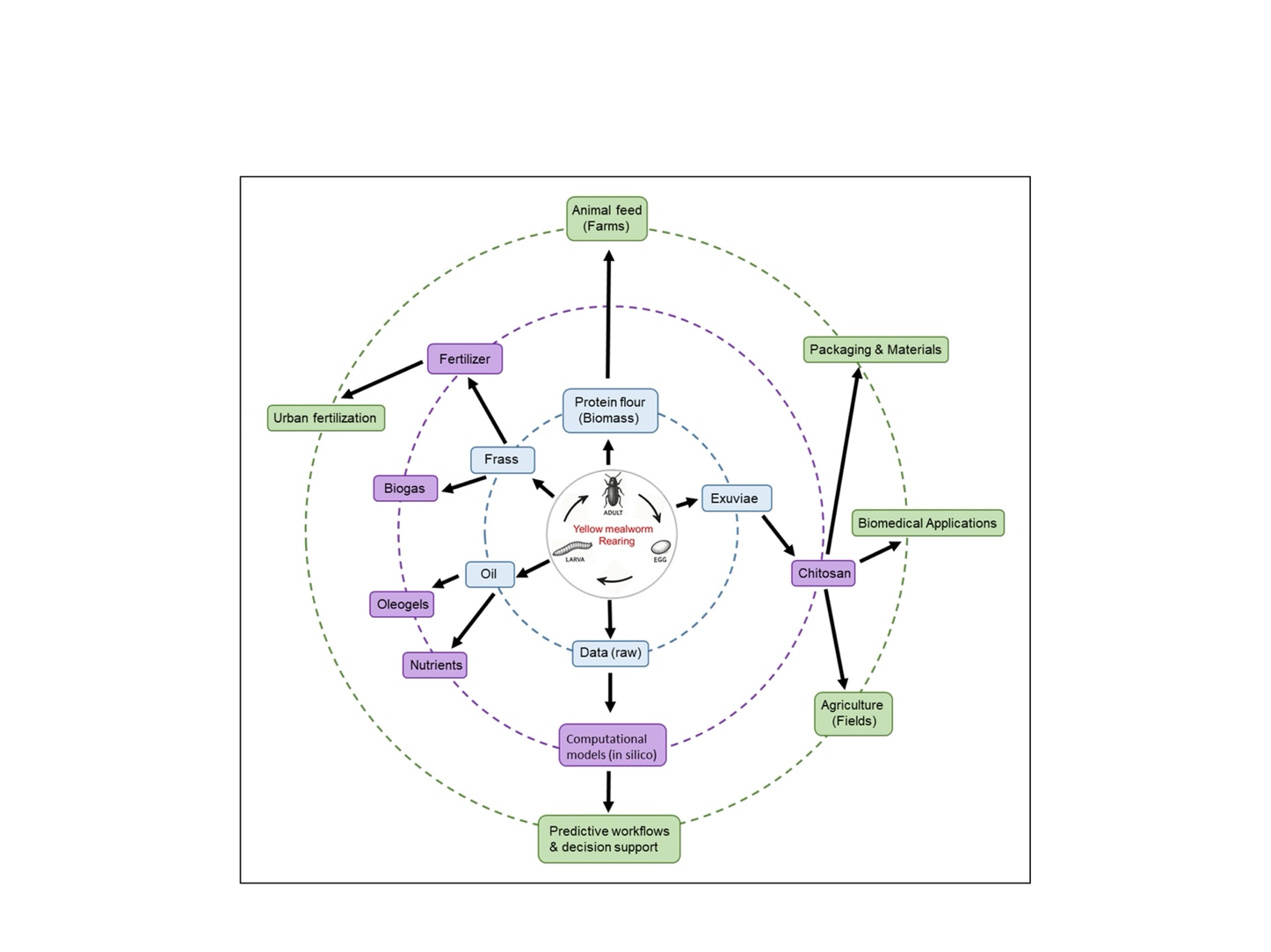
Figure 1 - Integrated modular biorefinery for T. molitor. Center: rearing and life cycle. Ring 1: primary outputs (protein flour, oils, exuviae). Ring 2: intermediate valorisation (fertiliser, biogas, oleogels, chitosan, in-silico data). Outer nodes: territorial uses (urban fertilisation, animal feed, field crops, packaging/materials and biomedical). Arrows indicate transformation or use; no reverse flows are implied.
Case studies in France and the Netherlands demonstrate that combining insect farming, peptide extraction, and urban fertilization can achieve profitability within three years (Muñoz-Seijas et al., 2025; Niyonsaba et al., 2023). Techno-economic models point out that substrate costs (~1 939 €/t DM), capital expenditure (~1 459 €/t DM), and energy use (~693 €/t DM) remain the primary economic bottlenecks (Leipertz et al., 2024; Niyonsaba et al., 2023). Life cycle assessments reveal lower greenhouse gas emissions and water use than conventional animal proteins, but also highlight non-renewable energy demand as a critical impact category (Modahl & Brekke, 2022; Vinci et al., 2022). This is consistent with an Austrian LCA of mealworm farming, which identified heating as a dominant hotspot while still outperforming organic broiler across most impact categories (Dreyer et al., 2021). Comparative studies with other alternative proteins (e.g., Spirulina) show similar challenges of cost and scalability (Villaró-Cos et al., 2024). This has brought coproduct recycling and territorial integration into focus. Moreover, pilot projects indicate that the use of frass in agro-aquaculture systems supports nutrient recycling and reduces reliance on chemical fertilizers (Maciejewska et al., 2025). This demonstrates the capacity of T. molitor coproducts to contribute to climate-resilient territorial models. Beyond insects, predictive workflows developed for agro-industrial by products such as tomato residues have demonstrated the feasibility of identifying bioactive peptides entirely in silico (Morena et al., 2024). Transferring such computational approaches to T. molitor could enhance integrated biorefineries, enabling not only the extraction of proteins and lipids but also the conversion of secondary flows in a circular economy framework.
Challenges and Prospects for Sustainable Industrialization
Scaling T. molitor production faces systemic barriers. Maintaining a steady supply of substrates remains a challenge. Energy efficiency is another unresolved issue, and seasonal variations still complicate production. Nevertheless, LCAs consistently flag non-renewable energy demand, largely from heating, as the dominant hotspot; the Austrian study confirms this even though mealworms still compare favourably to poultry systems (Dreyer et al., 2021). Importantly, in slow-growing animals, full soybean replacement is not performance-neutral during early phases (Nieto et al., 2022). Plant secondary metabolites, especially Solanaceae glycoalkaloids, can blunt energy metabolism and disrupt lipid handling in T. molitor, likely contributing to the performance variability seen on plant-residue diets (Winkiel et al., 2023, 2024). Environmental concerns also enter into the picture. One relates to competition with other industries for feedstock. Another is the ecological risk that could occur if insects escape and establish themselves in non-native ecosystems. Social acceptance continues to constrain expansion. Consumer surveys indicate greater acceptance of flours and processed forms than of whole insects (Hammer et al., 2023; Maciejewska et al., 2025).
Camouflaged or blended ingredients, combined with transparent communication and traceability, appear critical for improving adoption. Regulatory frameworks are progressing unevenly. While EFSA approvals in Europe are expanding (EFSA Panel on Nutrition and Novel Foods, 2025; EFSA Panel on Nutrition, Novel Foods and Food Allergens, 2021), other regions such as Africa lack harmonized standards despite traditional entomophagy practices (FAO Korea Partnership, 2022). Asia presents a mixed picture, with countries like South Korea moving faster than others (Meijer et al., 2025). Harmonized safety and labelling protocols will be essential for global trade.
Perspectives for Innovative Applications
In addition to the domain-specific applications detailed in Table 3, recent years have seen the emergence of transversal bioinformatic workflows and predictive in silico pipelines. These tools facilitate the discovery of novel bioactive peptides in T. molitor. Moreover, they provide transferable methodologies that can be applied to other organisms and by-products. This dual capability reinforces the systemic integration of insect biotechnology into a circular bioeconomy.
Table 3 provides a synthetic overview of these promising cross-sectoral opportunities identified between 2020 and 2025. Note that rows focused solely on human nutraceutical peptides (e.g., antihypertensive agents, DPP-IV inhibitors) have been excluded, as they are discussed in depth in Section 6. It is important to note that while Table 3 effectively highlights sectoral opportunities and functional benefits, it does not convey their environmental footprint. To provide this crucial perspective, Figure 2 contrasts the life cycle impacts of mealworm production with a conventional protein source, using data from recent LCA studies (Modahl & Brekke, 2022; Vinci et al., 2022). When considered together, Table 3 and Figure 2 offer a comprehensive view of both the industrial potential and the ecological positioning of T. molitor valorisation.
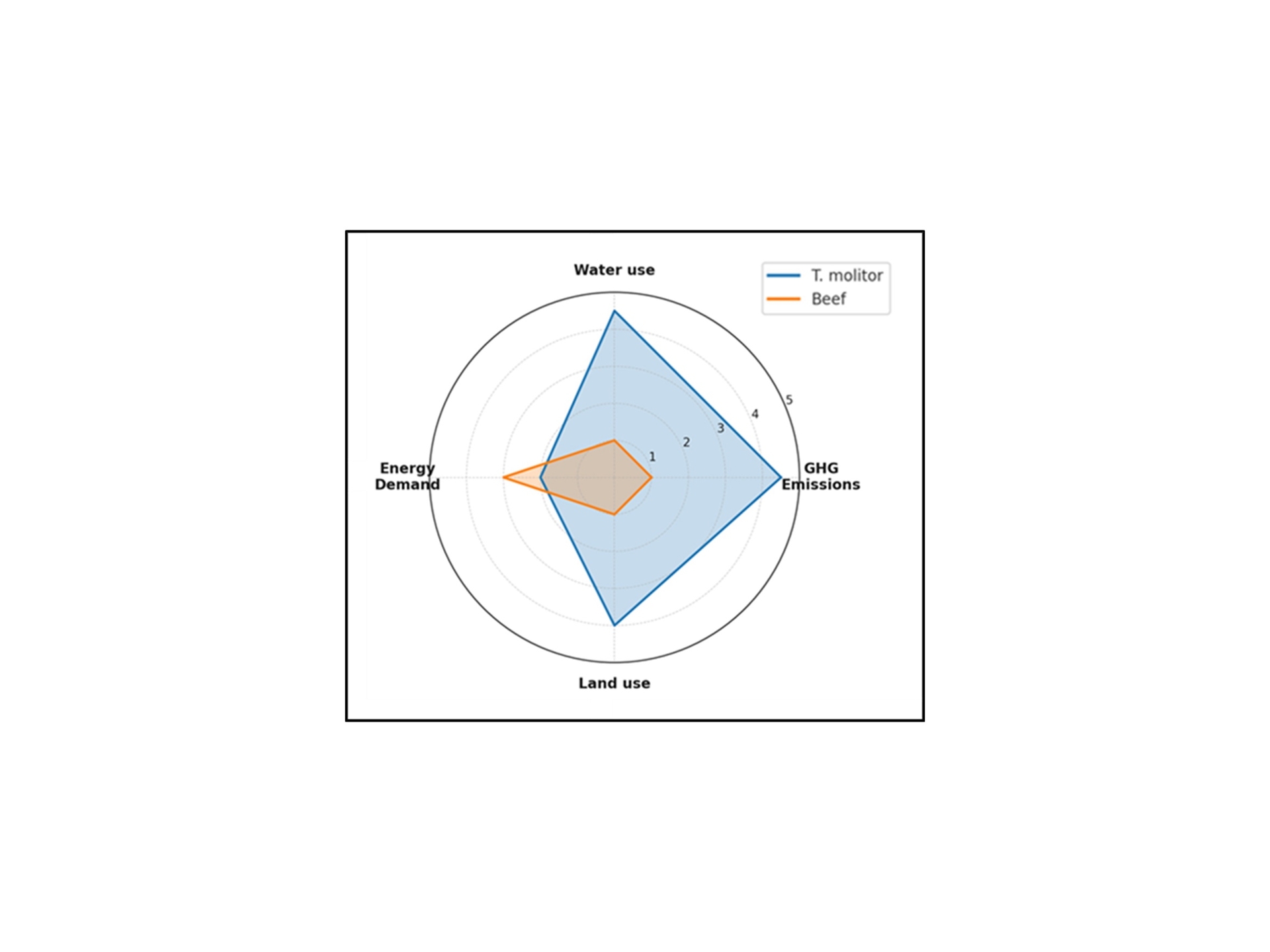
Figure 2 - Comparative environmental performance of T. molitor and beef (illustrative). Radar diagram based on life cycle assessment (LCA) results. Axes cover greenhouse gas (GHG) emissions, water use, energy demand, and land use. T. molitor shows lower impacts in GHG emissions, water, and land use, while energy demand remains a relative weakness. Scores are normalized (1 = highest impact, 5 = lowest impact), so higher values indicate better environmental performance. Values are indicative, derived from published LCA studies (Malila et al., 2024; Modahl & Brekke, 2022).
Table 3 - Summary of major application domains, opportunities, key constraints, and research gaps for T. molitor.
Domain | Opportunity | Constraints | Research gaps | Refs. |
|---|---|---|---|---|
Animal feed | Most deployment-ready application, with promising results in poultry, pigs, and fish. | Batch consistency, substrate quality, and species-specific formulation. | Longer-term trials, field validation, and standardized inclusion thresholds. | |
Food innovation | Powders, breads, snacks, and oleogels broaden food applications. | Sensory acceptance, allergenicity, and processing-related variability. | Realistic inclusion rates, shelf life, nutritional stability, and consumer acceptance. | |
Bioactive fractions | Peptides and hydrolysates show antioxidant, anti-inflammatory, antihypertensive, and DPP-IV inhibitory potential. | Evidence remains largely preclinical, with limited bioavailability data. | Standardized processing, pharmacokinetics, and controlled human trials. | (Berraquero-García et al., 2024; Brai et al., 2022; Fan et al., 2022; Ferrazzano et al., 2023; Gonzalez-de La Rosa et al., 2024; Jo et al., 2025; Ma et al., 2025; Ngoc et al., 2023; Pessina et al., 2020; Rivero Pino et al., 2020; Stephan et al., 2025; Tan et al., 2022; Torres-Acosta et al., 2021; Tran et al., 2025; Verheyen et al., 2023; Villanova et al., 2024) |
Frass and agricultural valorisation | Frass can support fertilization, biostimulation, digestion, and biochar production. | Composition varies with substrate and processing, and definitions remain inconsistent. | Harmonized definitions, field validation, contaminant benchmarks, and regulatory alignment. | |
Chitin, chitosan, and biomaterials | Insect-derived polymers show promise for packaging, antimicrobial films, and biomaterials. | Extraction routes, standardization, and scale-up remain limiting factors. | Process optimization, comparative performance, and industrial validation. | |
Low-input and arid-zone systems | Local residues may support rearing in resource-constrained settings. | High variability, labour intensity, limited monitoring, and still limited evidence. | Replicated field studies, standardized low-input protocols, and techno-economic validation. | |
Integrated biorefineries | Proteins, oils, frass, and side-streams can be valorised within circular systems. | Capital costs, energy demand, logistics, and traceability bottlenecks. | Integrated life-cycle assessment, techno-economic validation, and territorial implementation models. | |
Predictive workflows | In silico discovery and biodegradation-related tools may widen future applications. | Predictions still require validation, and biodegradation remains slow and safety-sensitive. | Mechanistic studies, experimental confirmation, and better scale assessment. |
Note. This table synthesizes the main application domains discussed in this review and highlights their current opportunities, key constraints, and principal research gaps. Human nutraceutical applications are discussed separately in Section 6. Key references are provided as representative examples rather than an exhaustive list.
Conclusion
Across the 2020–2025 evidence synthesised here, T. molitor emerges as a versatile resource for circular bioeconomy strategies. It can convert diverse residues into proteins, lipids, chitin-derived materials, and frass, supporting applications in feed, food innovation, and co-product valorisation. Among these applications, feed appears the most deployment-ready, provided that diet formulation, hygiene, and batch consistency are properly controlled. Chitin-derived materials also show clear potential for biomaterial and dermocosmetic applications. By contrast, most reported bioactivities linked to food and functional ingredients remain preclinical. Many findings are based on in vitro assays or short-term animal models, often under conditions that are not directly translatable to realistic dietary exposure. Their practical relevance therefore depends on standardized processing, robust safety and quality control, and stronger evidence on bioavailability and efficacy in controlled human studies. A central constraint across the literature remains reproducibility. Results vary with substrate choice, processing conditions, and analytical methods. This limits comparability across studies and weakens the strength of some health or agricultural claims. Sustainability outcomes also reflect a clear trade-off. Industrial systems provide greater consistency and traceability, but they require more infrastructure, process control, and compliance capacity. Low-input systems may fit arid and resource-constrained settings, but they remain more exposed to variability, labour constraints, and standardisation limits.
Overall, T. molitor is a credible component of the circular bioeconomy, but its long-term impact will depend on realistic positioning and stronger methodological consistency. The sector is ready to scale selectively in applications where quality control, traceability, and markets are already aligned. Broader claims, especially for health-related applications or low-input deployment models, still require stronger standardisation and validation.
Acknowledgements
The author used AI-based tools to assist with reference management and style editing. All scientific content, data interpretation and conclusions are the sole responsibility of the author. Preprint version 4 of this article has been peer-reviewed and recommended by Peer Community In Animal Science (https://doi.org/10.24072/pci.animsci.100388; Barragán-Fonseca, 2026).
Funding
This research was self-funded by the author and received no external funding from public, commercial, or non-profit sources.
Conflict of interest disclosure
The author declares they have no conflict of interest relating to the content of this article.
Data, script, code, and supplementary information availability
This review relies on published literature. No new datasets, statistical scripts, command lines, or simulation code were generated. All sources are cited in the reference list. No supplementary information is associated with this manuscript.