
Section: Ecology
Topic:
Ecology
Camera trap monitoring of unmarked animals: a map of the relationships between population size estimators

Corresponding author(s): Calenge, Clément (clement.calenge@ofb.gouv.fr)
10.24072/pcjournal.725 - Peer Community Journal, Volume 6 (2026), article no. e45
Get full text PDF Peer reviewed and recommended by PCI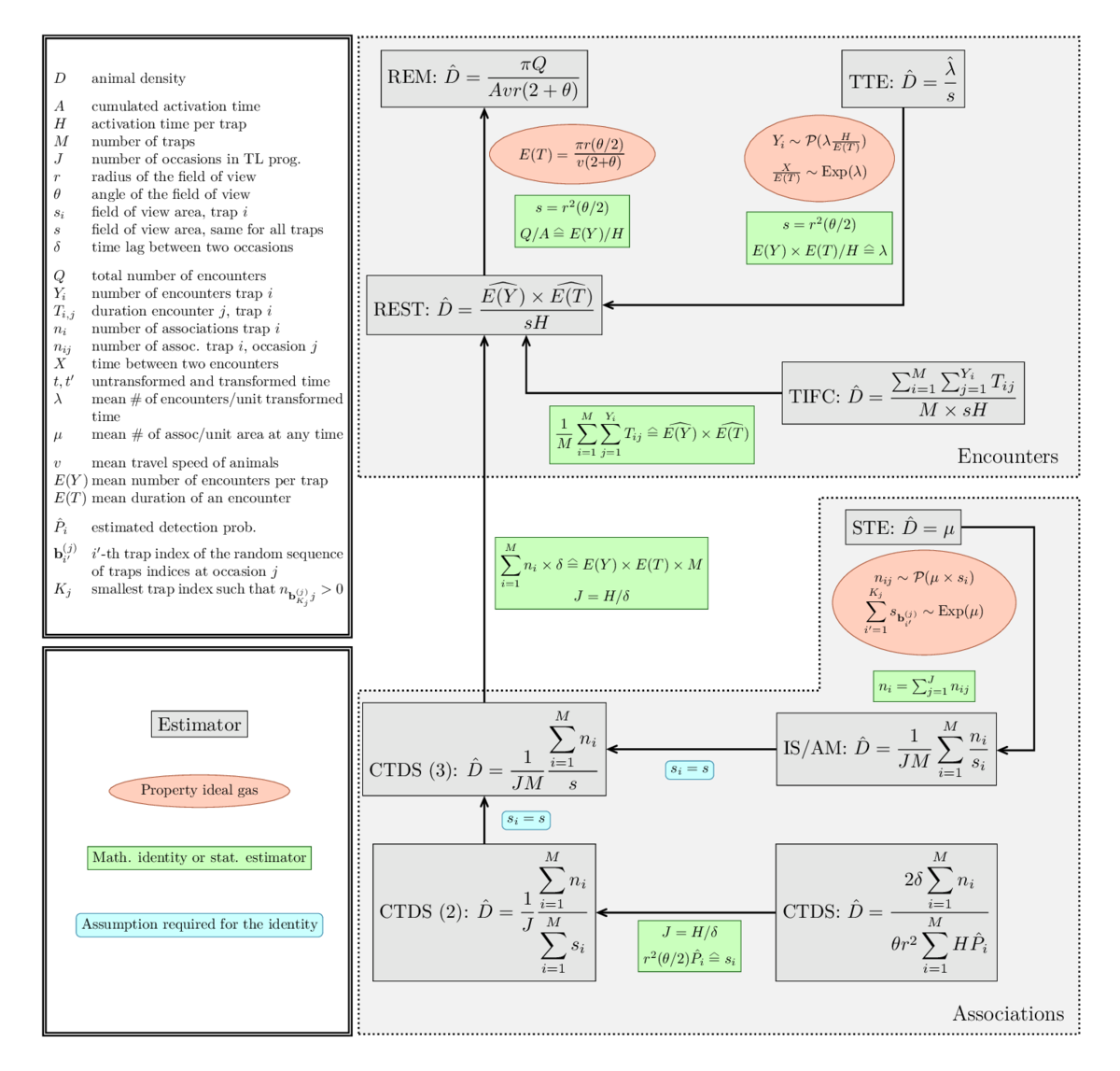
The use of camera traps to monitor unmarked animal populations has expanded during the last decade, leading to the development of several density estimation methods. This plethora of methods may be confusing for the newcomer to the field. Some methods, such as the random encounter model, require the knowledge of the mean travel speed of the animals, while others, such as camera trap distance sampling, do not rely on such assumptions. Different methods, like instantaneous sampling, camera trap distance sampling, and the association model, rely on similar types of data, but do not seem identical. In this article, I explore the relationships between different density estimators, including the random encounter model, the random encounter and staying time model, the time in front of camera approach, the time-to-event model, camera-trap distance sampling, the association model, and the space-to-event model. I show how these different estimators are related under two simplifying assumptions (perfect detectability, and animals moving as molecules in an ideal gas). I develop a map of mathematical relationships between these estimators. This framework helps readers understand how these methods are interconnected, providing a clearer conceptual foundation for selecting and implementing density estimation studies.
Type: Research article
Keywords: random encounter models, random encounter and staying time, instantaneous sampling, time-to-event model, space-to-event model, camera-trap distance sampling
Calenge, Clément 1
 CC-BY 4.0
Calenge, C. Camera trap monitoring of unmarked animals: a map of the relationships between population size estimators. Peer Community Journal, Volume 6 (2026), article no. e45. https://doi.org/10.24072/pcjournal.725
@article{10_24072_pcjournal_725,
     author = {Calenge, Cl\'ement},
     title = {Camera trap monitoring of unmarked animals: a map of the relationships between population size estimators
},
     journal = {Peer Community Journal},
     eid = {e45},
     year = {2026},
     publisher = {Peer Community In},
     volume = {6},
     doi = {10.24072/pcjournal.725},
     language = {en},
     url = {https://peercommunityjournal.org/articles/10.24072/pcjournal.725/}
}
TY  - JOUR
AU  - Calenge, Clément
TI  - Camera trap monitoring of unmarked animals: a map of the relationships between population size estimators

JO  - Peer Community Journal
PY  - 2026
VL  - 6
PB  - Peer Community In
UR  - https://peercommunityjournal.org/articles/10.24072/pcjournal.725/
DO  - 10.24072/pcjournal.725
LA  - en
ID  - 10_24072_pcjournal_725
ER  -
%0 Journal Article
%A Calenge, Clément
%T Camera trap monitoring of unmarked animals: a map of the relationships between population size estimators

%J Peer Community Journal
%] e45
%D 2026
%V 6
%I Peer Community In
%U https://peercommunityjournal.org/articles/10.24072/pcjournal.725/
%R 10.24072/pcjournal.725
%G en
%F 10_24072_pcjournal_725
PCI peer reviews and recommendation, and links to data, scripts, code and supplementary information: 10.24072/pci.ecology.100791
Conflict of interest of the recommender and peer reviewers:
The recommender in charge of the evaluation of the article and the reviewers declared that they have no conflict of interest (as defined in the code of conduct of PCI) with the authors or with the content of the article.
[1] Are camera traps fit for purpose? A rigorous, reproducible and realistic test of camera trap performance, African Journal of Ecology, Volume 56 (2018) no. 4, pp. 710-720 | DOI
[2] Revealing links between population size estimators for camera trap data, Peer Community in Ecology (2026) | DOI
[3] Applying and testing a novel method to estimate animal density from motion‐triggered cameras, Ecosphere, Volume 13 (2022) no. 4 | DOI
[4] Distance Sampling: Estimating Abundance of Biological Populations., Chapman & Hall, London, 1993
[5] Evaluating camera trap methods for monitoring population trends in ungulates: insights from simulation, bioRXiv (2025) | DOI
[6] A camera-based method for estimating absolute density in animals displaying home range behaviour, Journal of Animal Ecology, Volume 87 (2018) no. 3, pp. 825-837 | DOI
[7] Spatially explicit models for inference about density in unmarked or partially marked populations, The Annals of Applied Statistics, Volume 7 (2013) no. 2, pp. 936-954 | DOI
[8] Sampling techniques, third edition, John Wiley & Sons, 1977
[9] Statistical analysis of spatial point patterns, Academic Press, London, 1983
[10] Statistical analysis of spatial and spatio-temporal point patterns, Chapman and Hall/CRC, 2013 | DOI
[11] Estimating the encounter rate variance in distance sampling, Biometrics, Volume 65 (2009) no. 1, pp. 225-236 | DOI
[12] Abundance estimation of unmarked animals based on camera-trap data, Conservation Biology, Volume 35 (2020) no. 1, pp. 88-100 | DOI
[13] Towards a general formalization of encounter rates in ecology, Theoretical Ecology, Volume 6 (2013), pp. 189-202 | DOI
[14] Characteristic Spatial and Temporal Scales Unify Models of Animal Movement, The American Naturalist, Volume 178 (2011), pp. 113-123 | DOI
[15] Distance sampling with camera traps, Methods in Ecology and Evolution, Volume 8 (2017) no. 11, pp. 1558-1565 | DOI
[16] Use, misuse and extensions of “ideal gas” models of animal encounter, Biological Reviews, Volume 82 (2007) no. 3, pp. 335-359 | DOI
[17] Estimation of tiger densities in India using photographic captures and recaptures, Ecology, Volume 79 (1998), p. 2952-2862 | DOI
[18] Assessing the robustness of time‐to‐event models for estimating unmarked wildlife abundance using remote cameras, Ecological Applications, Volume 31 (2021) no. 6 | DOI
[19] Three novel methods to estimate abundance of unmarked animals using remote cameras, Ecosphere, Volume 9 (2018) no. 8, p. e02331 | DOI
[20] Estimating animal density without individual recognition using information derivable exclusively from camera traps, Journal of Applied Ecology, Volume 55 (2017) no. 2, pp. 735-744 | DOI
[21] Guidelines for evaluating density estimation models for unmarked populations - Santini et al. (2022), Basic and Applied Ecology, Volume 65 (2022), pp. 109-110 | DOI
[22] Estimating day range from camera-trap data: the animals’ behaviour as a key parameter, Journal of Zoology, Volume 309 (2019) no. 3, pp. 182-190 | DOI
[23] Assessing the camera trap methodologies used to estimate density of unmarked populations, Journal of Applied Ecology, Volume 58 (2021) no. 8, pp. 1583-1592 | DOI
[24] Random encounter model is a reliable method for estimating population density of multiple species using camera traps, Remote Sensing in Ecology and Conservation, Volume 8 (2022), pp. 670-682 | DOI
[25] Distance and size matters: A comparison of six wildlife camera traps and their usefulness for wild birds, Ecology and Evolution, Volume 8 (2018) no. 14, pp. 7151-7163 | DOI
[26] Stochastic processes, Wiley, 1996
[27] Estimating animal density using camera traps without the need for individual recognition, Journal of Applied Ecology, Volume 45 (2008) no. 4, pp. 1228-1236 | DOI
[28] Clarifying assumptions behind the estimation of animal density from camera trap rates, Journal of Wildlife Management, Volume 77 (2013), p. 876 | DOI
[29] Population assessment without individual identification using camera-traps: A comparison of four methods, Basic and Applied Ecology, Volume 61 (2022), pp. 68-81 | DOI
[30] Sampling. Second Edition, Wiley series in probability and statistics, 2002 | DOI
[31] Population density of sitatunga in riverine wetland habitats, Global Ecology and Conservation, Volume 24 (2020), p. e01212 | DOI
[32] Estimating animal density for a community of species using information obtained only from camera-traps, Methods in Ecology and Evolution, Volume 13 (2022) no. 10, pp. 2248-2261 | DOI
Cited by Sources: