
Section: Archaeology
Topic:
Archaeology,
Anthropology,
Computer sciences
Conference: CAA2025
Experimental interpretation of ancient games through playtesting

Corresponding author(s): Konstantakis, Markos (mkonstadakis@aegean.gr)
10.24072/pcjournal.738 - Peer Community Journal, Volume 6 (2026), article no. e56
Get full text PDF Peer reviewed and recommended by PCI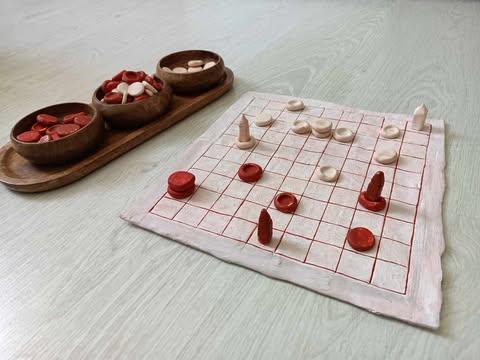
Reconstructing the rules of ancient games remains one of archaeology’s most intricate interpretive challenges. While surviving boards and pieces provide tangible evidence, the logic of play, rules, roles, and goals have largely vanished. Traditional reconstructions rely on text and comparisons to better known games, yet these methods seldom capture the experiential and social dimensions of ancient gameplay. This paper presents an experimental framework designed to explore how such systems might emerge through play itself. Using Ludus Latrunculorum (“The Game of Little Soldiers”) as a case study, participants engaged in iterative, co-creative sessions where they invented, refined, and transmitted rules across successive lineages of play. The resulting games revealed recurring mechanics that closely parallel known reconstructions of Ludus Latrunculorum. While the outcomes do not claim historical accuracy, they demonstrate how collective experimentation can illuminate the cognitive and social processes underlying the development of structured games in antiquity. The study thus proposes experimental play as a complementary archaeological tool for examining how rulesets evolve, stabilize, and reflect the societies that produce them.
Type: Research article
Keywords: game reconstruction, experimental archaeology, game studies, game rules, ancient games
Tsilogiannis, Angelos 1 ; Konstantakis, Markos 1 ; Vosinakis, Spyros 1
 CC-BY 4.0
Tsilogiannis, A.; Konstantakis, M.; Vosinakis, S. Experimental interpretation of ancient games through playtesting. Peer Community Journal, Volume 6 (2026), article no. e56. https://doi.org/10.24072/pcjournal.738
@article{10_24072_pcjournal_738,
     author = {Tsilogiannis, Angelos and Konstantakis, Markos and Vosinakis, Spyros},
     title = {Experimental interpretation of ancient games through playtesting
},
     journal = {Peer Community Journal},
     eid = {e56},
     year = {2026},
     publisher = {Peer Community In},
     volume = {6},
     doi = {10.24072/pcjournal.738},
     language = {en},
     url = {https://peercommunityjournal.org/articles/10.24072/pcjournal.738/}
}
TY  - JOUR
AU  - Tsilogiannis, Angelos
AU  - Konstantakis, Markos
AU  - Vosinakis, Spyros
TI  - Experimental interpretation of ancient games through playtesting

JO  - Peer Community Journal
PY  - 2026
VL  - 6
PB  - Peer Community In
UR  - https://peercommunityjournal.org/articles/10.24072/pcjournal.738/
DO  - 10.24072/pcjournal.738
LA  - en
ID  - 10_24072_pcjournal_738
ER  -
%0 Journal Article
%A Tsilogiannis, Angelos
%A Konstantakis, Markos
%A Vosinakis, Spyros
%T Experimental interpretation of ancient games through playtesting

%J Peer Community Journal
%] e56
%D 2026
%V 6
%I Peer Community In
%U https://peercommunityjournal.org/articles/10.24072/pcjournal.738/
%R 10.24072/pcjournal.738
%G en
%F 10_24072_pcjournal_738
PCI peer reviews and recommendation, and links to data, scripts, code and supplementary information: 10.24072/pci.archaeo.100684
Conflict of interest of the recommender and peer reviewers:
The recommender in charge of the evaluation of the article and the reviewers declared that they have no conflict of interest (as defined in the code of conduct of PCI) with the authors or with the content of the article.
[1] Biases in Cultural Transmission Shape the Turnover of Popular Traits, Evolution and Human Behavior, Volume 35 (2014) no. 3, pp. 228-236 | DOI
[2] Board and Table Games from Many Civilizations, Oxford University Press, 1960
[3] A Practical Introduction to the Ludii General Game System, Advances in Computer Games (ACG 2019) (Lecture Notes in Computer Science), Volume 12516, Springer, 2020, pp. 167-179 | DOI
[4] Computational Approaches for Recognising and Reconstructing Ancient Games: The Case of Ludus Latrunculorum, Games in the Ancient World: Places, Spaces, Accessories (Monographies Instrumentum), Volume 79, Éditions Mergoil, 2024, pp. 63-80
[5] The Digital Ludeme Project: Combining Archaeological and Computational Methods for the Study of Ancient Board Games, Journal of Archaeological Science: Reports, Volume 49 (2023) | DOI
[6] Ancient Egyptians at Play: Board Games Across Borders, Bloomsbury, 2016
[7] Using Heuristics to Evaluate the Playability of Games, CHI '04 Extended Abstracts on Human Factors in Computing Systems, ACM, 2004, pp. 1509-1512 | DOI
[8] On the Rules for the Royal Game of Ur, British Museum Studies in Ancient Egypt and Sudan, Volume 7 (2007), pp. 19-32
[9] Playing the Rules Back into Existence: A Generative Approach to Ancient Games, Peer Community in Archaeology (2026) | DOI
[10] Cumulative Cultural Evolution in the Laboratory: An Experimental Approach to the Origins of Structure in Human Language, Proceedings of the National Academy of Sciences, Volume 105 (2008) no. 31, pp. 10681-10686 | DOI
[11] Cultural Evolution: How Darwinian Theory Can Explain Human Culture and Synthesize the Social Sciences, University of Chicago Press, 2011 | DOI
[12] A History of Board Games Other Than Chess, Oxford University Press, 1952
[13] Introduction to Experimental Archaeology, World Archaeology, Volume 40 (2008) no. 1, pp. 1-6 | DOI
[14] Lost and Found: The Object Biographies of Roman Gaming Sets from the Western Provinces, Pallas, Volume 119 (2022), pp. 241-262 | DOI
[15] The Art of Game Design: A Book of Lenses, CRC Press, 2019 | DOI
[16] Latrunculi—A Forgotten Roman Game of Strategy, Ancient Board Games in Perspective, British Museum Press, 2007, pp. 118-132
[17] Latrunculi in the Roman World, Board Game Studies, Volume 4 (2001), pp. 47-68
[18] The Rule Book: The Building Blocks of Games, MIT Press, 2024 | DOI
[19] The Cultural Origins of Human Cognition, Harvard University Press, 1999
[20] Cultural Transmission in the Ancient Near East: Twenty Squares and Fifty-Eight Holes, Journal of Archaeological Science, Volume 40 (2013) no. 4, pp. 1715-1730 | DOI
Cited by Sources: