

 CC-BY 4.0
Introduction
Linked to many aspects of economic structures, from raw material management and administration, to value and wealth calculation, the development of measurement systems is one of the fundamental fundation of complex ancient societies. Despite early interest in the subject, we know very little about how Celtic peoples counted and weighed. Written sources dealing with the topic are scarce, and the archaeological evidence has so far prevented us from fully understanding the mechanisms of counting and measuring practices, their tools, and the people involved. For these reasons, the Celts have alternately been described either as barbarians lacking abstract institutions such as metrology, or as a developed society trading with the Romans and other peoples in ways that differ little from modern economic practices.
Consequently, our understanding of Celtic peoples’ use of measurement is still rooted in general ideas, sometimes conveyed through broad assumptions. One example is the story of Brennus, who used false weights (pondera) to cheat the Romans, suggesting their lack of reliability in commercial dealings (Livy 5.48.9). However, this story may also imply that the Gauls possessed a system of weighing, perhaps based on units different from those used by the Romans. It is also frequently assumed that the Celts, or at least the Gauls, used a vigesimal counting system, that is, a counting system based on the number twenty (for example Lacroix, 2005, p. 250). It is also commonly assumed that the Gauls and other Celtic peoples used metrological systems because traces of them are found in Roman times and even later. The most famous of these resilient metrological units is probably the Gallic leuca, which appears notably in the Peutinger Table.
This paper, based on a talk presented at the 2024 EAA Congress in Rome, aims to untangle the evidence relating to Celtic weighing metrologies by comparing written and archaeological sources on the subject. After a brief overview of what is known about the existence of Celtic metrological units for capacity and length, we shall discuss the more concrete evidence for a weight-based metrological system, before questioning the common belief that a vigesimal system was used in the Celtic world.
Preliminary notions
Defining the Notions of the Celtic Area and Metrology.
To begin with, it seems necessary to define precisely what is meant by the two main concepts underlying this work.
In this paper, the terms “Celts” and “Celtic world” are employed in a contemporary sense, rather than according to an ancient ethnological concept. In this study, the term “Celts” is used as an analytical tool in order to provide a broad overview of the Late Iron Age in Western Europe. This concept is understood to partially coincide with the areas and periods in which Celtic languages were used, the La Tène archaeological culture, and the regions designated as “Celtic” or “Gallic” by Greek and Roman sources, despite the differences between these categories (see, among others, Collis, 2003). This overall definition encompasses an area on the European continent, extending from France to Serbia and western Romania from west to east, and from northern Italy to southern Germany and the Czech Republic from south to north (Lejars, 2015, p. 179; figure 1). Chronologically, we consider the entire Iron Age, from the 8th to the 1st century BCE, even though ancient authors and modern scholarship tend to restrict the Celts to the Late Iron Age, also known as the La Tène period (5th–1st century BCE). All the sites considered in this paper are dated to the Iron Age, and the data examined are representative of the metrological practices of this period. Marginally, some artefacts from unclear contexts may date to later occupation phases at the beginning of the Roman period, but they remain similar to Iron Age artefacts and practices.
In the field of metrology, the term “system of measurement” refers to a structured framework for quantifying physical quantities numerically. Such a system is based on the concept of “unit”, an arbitrary quantity that takes the value of one within the system, with subsequent measurements expressed as multiples and submultiples of this fundamental unit. Nevertheless, systems may combine several units. Metrological systems are not universal; they result from social consensus and reflect technical and economic considerations (see in particular Chambon & Otto, 2023; Kula, 1986; Morley & Renfrew, 2010). For this reason, a metrological system is employed by a specific group of people whose size may vary, ranging from a single settlement to a large empire or a defined trading area.
Besides Weighing System, some Examples of Gallic Units of Measurement.
From an archaeological point of view, the Iron Age is far from being rich in evidence for metrological practices. Capacity metrology has been poorly studied so far, and the current state of research prevents us from knowing precisely whether Celtic peoples used structured metrological systems for dry and liquid measures. Recently, however, a study based on a series of ceramic vessels has shown that such practices may have existed, at least in some areas of present-day southern France, since the Late Bronze Age (Poigt et al., 2025). Nevertheless, to date, the extent of these practices remains unknown, and nothing indicates that they continued into the Iron Age. Other discoveries nonetheless suggest that people at least made rough use of capacity measurements. In particular, the study of the capacity of certain Iron Age vessels shows that they share integer ratios with one another, suggesting processes of quantification, if not the existence of a complex metrological system (Saurel, 2024).
Length metrology has been explored more extensively in recent years, particularly in relation to architectural features. The work of Wassong highlights the use of several metrological tools in the planning of rural and urban settlements in Celtic Europe, identified through the repetition of modules and ratios (Wassong, 2019a; 2019b; Wassong et al., 2022). In the same way, the work of Fochesato (2020), p. 277–281) suggests that similar processes were in use on the oppidum of Bibracte for the preparation of wooden structural frames used in construction. Nevertheless, this research does not lead to the conclusion that there existed a single “Celtic system of measurement”, but rather suggests practical uses of basic modules and units that vary considerably from place to place.
Beyond counting and weighing units, the best-known metrological unit of the Celtic world is a distance unit, known as the leuca or leuga, the “Gallic league”. According to the Tabula Peutingeriana, the Itinerarium Antonini, and the Itinerarium Burdigalense, this unit of distance was used from Lugdunum (Lyon) throughout the Gallic provinces, with the exception of Gallia Narbonensis. In the Lexicon of Hesychius of Alexandria, the leuca is explicitly defined as a “Gallic” (Γαλατικός) unit of measurement (Hsch. Λ717), information that also appears in the works of Ammianus Marcellinus, Jordanes, and Isidore of Seville (Amm. Marc. 15.11.17; 16.12.8; Jord. Get. 36; Isid. Etym. 15.16.1–3). Etymologically, however, no Celtic formation of the word leuca has yet been securely identified, and its Celtic origin has therefore been questioned by linguists (Delamarre, 2018, p 200). These three ancient authors also indicate the value of the leuca, equating it with 1.5 Roman miles (approximately 2.22 kilometres). However, J. Dassié has argued that this value represents a “Romanised” form of the unit. Drawing on his research on the historical topography of Gallo-Roman sites, as well as the analysis of ancient itineraries in Aquitania, Dassié proposes the existence of an indigenous unit of measurement that he calls the “large Gallic league”, which would have corresponded to approximately 2.45–2.5 km (Dassié, 1999). This hypothesis is of considerable interest and deserves to be reconsidered in the context of further and more comprehensive research.
An Archaeological Approach of Celtic weighing systems
Weighing instruments
Weights and scales have always occupied an important place in metrological studies, particularly because of the substantial body of evidence they provide in both archaeological and written records. The same is true for the Bronze and Iron Ages in Europe, for which most metrological studies have focused on weighing practices (see recently Rahmstorf & Stratford, 2019; Rahmstorf et al., 2021; Poigt, 2022a; Ialongo, 2025). Nevertheless, the current state of research does not allow the identification of a specific type of weight that could be considered distinctly “Celtic”. Even when some units appear to be associated with the La Tène culture or with Celtic populations, their identification remains hypothetical and must therefore be treated with caution.
Weights and scales have been used in Europe since at least the Middle Bronze Age, as the result of a combination of Near Eastern influences, technological transfers, and local choices and innovations, with a clear expansion of these practices during the Late Bronze Age (Ialongo, 2025; Poigt, 2022a). Nevertheless, the archaeological record of the Early Iron Age provides very little evidence for the persistence of weighing practices. Although their existence is attested during the Late Iron Age, weighing instruments remain relatively rare for this period.
Most of the known examples come from the Iberian Peninsula. These are copper-alloy or lead discs with a central perforation, inherited from Late Bronze Age traditions. Their use is mainly attested between the fifth and the second centuries BCE, and several metrological units can be identified depending on the geographical region, particularly when comparing the eastern littoral with the western regions of the peninsula. Nevertheless, these objects appear to reflect similar practices, characterised by weights of comparable shapes, relatively homogeneous measurement intervals, and related internal structures (Poigt, 2022a, p. 239-259).
Another category of weights is found in the western regions of continental Europe and in southern England. These are pear-shaped weights topped with a ring used either for suspension or handling. The body of the object is generally made of stone, whereas the handling device is metallic. Evidence for these pear-shaped weights appears as early as the Middle Bronze Age in northern Italy and the Alpine regions, and more generally in Western Europe during the later phases of the Late Bronze Age (Cardarelli et al., 1997; 2001, Ialongo, 2025, Pare, 1999, Poigt, 2022a, p. 150-176).
These pear-shaped weights persist during the Iron Age, although a clear chronological continuity is difficult to establish. Almost none have been identified for the beginning of the Early Iron Age, but several examples are known from contexts associated with the “Princely Phenomenon” of the Hallstatt D/La Tène A period (Rahmstorf & Pare, 2007; Rahmstorf, 2022; Poigt, 2022a, p. 185-187). It is likely that they continued to be used in several parts of Europe afterwards, although only rare and generally isolated examples can be identified during the Late Iron Age (Figure 1) and the early phases of the Roman period. They do not disappear completely, and this general shape actually remained in use until the modern invention of the automatic scale.
For the Late Iron Age, most of these weights come from a single settlement: the hillfort of Danebury (England), which has yielded seventy-one examples. They are dated from the fifth or fourth century BCE to the first century AD. Despite a relative concentration in southern England, it is plausible that similar practices existed on the continent. At Danebury, these weights range between c. 600 g and 4500 g and appear to relate to two units: 258 g and 309 g (Poigt, 2022b). The specificity of Danebury probably results from a combination of several factors: the extensive excavations conducted at the site (almost 50% of the settlement), the attention paid to lithic artefacts even when poorly preserved (only 3 out of the 71 weights are complete), and the systematic publication of the archaeological data. Consequently, the large number of weights identified at Danebury probably reflects both specific activities carried out at the site that required weighing practices and a by-product of the intensity of archaeological research conducted there (Cunliffe, 1984a; 1984b; Cunliffe & Poole, 1991a; 1991b; Poigt, 2022a; 2022b). In other settlements, particularly on the continent, when only a single weight is identified it is often difficult to locate it in the literature, especially if it is not graphically documented.
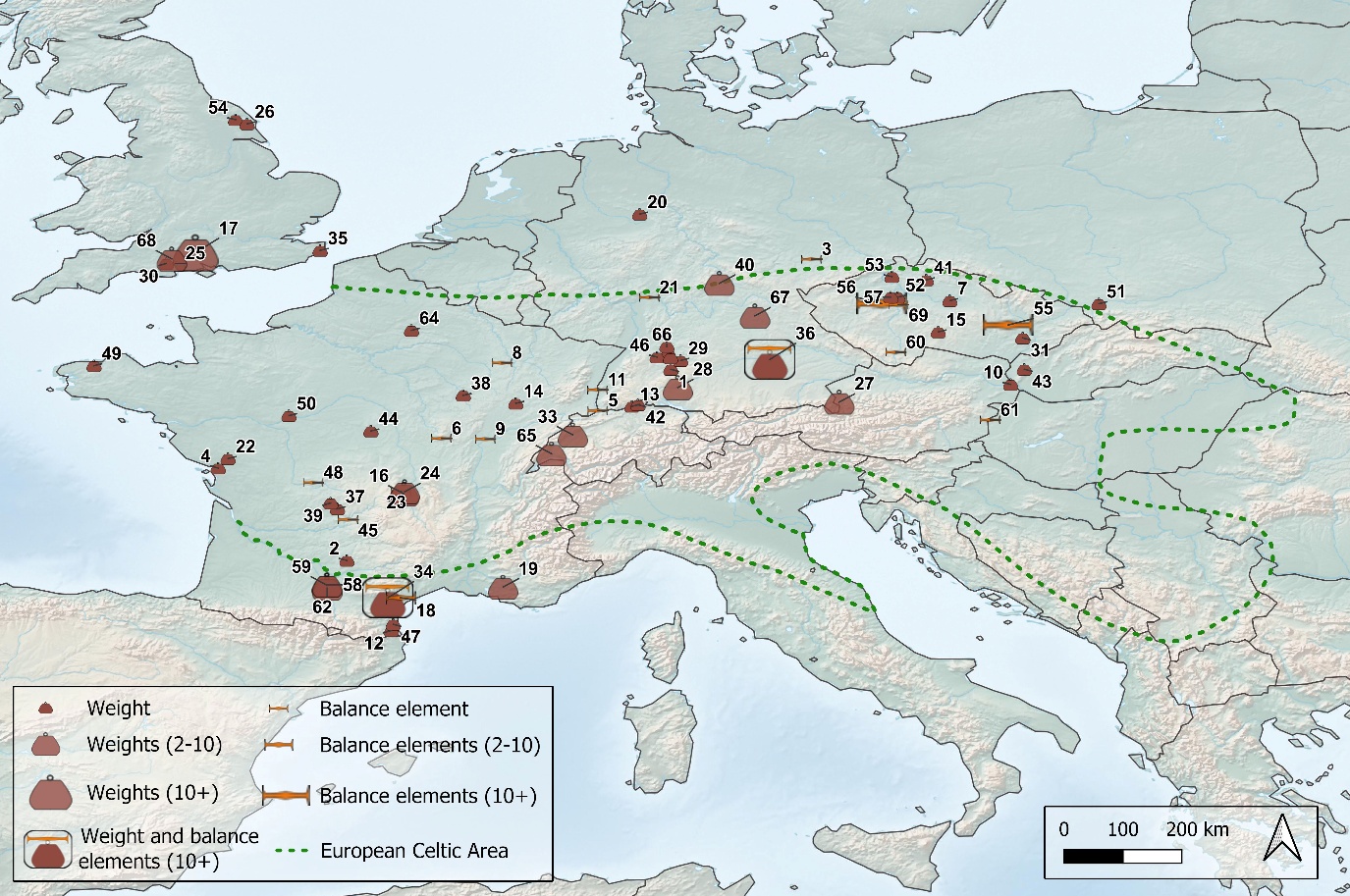
Figure 1 - Map of attested weights, balance beams, and pans in the Celtic world, according to current research (data from Demierre & Girard, 2020; Gangloff et al., 2007; Gorgues, 2009; Jannoray, 1955; Kotarba et al., 2007; Krämer, 1997; Meduna, 1961; Nillesse, 1997; Peschel, 1985; Poigt, 2022a; Rahmstorf, 2022; Rahmstorf & Pare, 2007; Rybová & Drda, 1994; Savarese, 2023; Vacher, 2016; van Endert, 1991; European Celtic area after Lejars, 2015; see Table 1 for site details. map created by authors – Basemap: © Natural Earth Data).
Smaller weights have also been identified in the Alpine region and eastern France. These objects are dated between the third and the first centuries BCE and weigh between 2 g and 257 g (Demierre & Girard, 2020). Their masses are therefore significantly smaller than those of the weights from Danebury, although some share the same general shape with a handling device, particularly three objects from Corent and Entremont and one from La Cloche (all in France). Two units have been proposed on the basis of their study: 2.558 g and 6.26 g (Demierre & Girard, 2020). Nevertheless, it is possible to hypothesise that these correspond to the same units as those identified at Danebury. Indeed, the unit of 2.558 g is very close to one hundredth of 257 g (less than 0.5% deviation), while 6.26 g corresponds approximately to one fiftieth of 309 g (around 1.3% deviation).
For the period of the oppida, at the end of the Iron Age (second and first centuries BCE), large settlements in Central Europe (Manching, Staré Hradisko, Stradonice or Závist) have yielded numerous small balance beams made of copper alloy, as well as several pans (Figure 2). The settlement of Manching alone has provided thirty-two such copper-alloy balance beams. These balances are relatively small, ranging from 6.7 to 18 cm in length for the examples from Manching. Because of their proportions, they can be associated with flat or concave pans measuring between 3.9 and 6.5 cm in diameter (van Endert, 1991, p. 59–60, pl. 15). Similar balances have been found further west at settlements such as Bibracte, Gergovie, Ensérune, Saint-Gence or Le Cayla in France (Peschel, 1985, p. 148–149), the latter providing a balance beam almost identical to the examples from Manching (Poigt, 2027).
Bronze instruments provide relatively good resistance to mechanical stress; however, the small size of these beams and pans necessarily limits the loads they could support. They were therefore probably dedicated to what is generally described as precision metrology, that is, the weighing of small quantities or light materials. The strong development of these objects at the very end of the Iron Age, and their absence earlier in the archaeological record, may be consistent with a use connected with monetary practices. Nevertheless, it is also possible that earlier balances were made from perishable materials and have therefore left no archaeological trace, whereas during the Late Iron Age changes in practice led to their production in bronze. Regardless of the hypothesis adopted, it seems reasonable to suggest that the second and first centuries BCE correspond to a transformation in the way weighing practices were carried out in Central Europe, and probably in parts of Western Europe as well. These changes may be linked to the broader social, political and economic transformations that occurred during this period. These transformations are connected with the emergence, during the same period (from the 2nd century BCE, with some precursors in the 3rd century BCE), of new types of collective settlements. We observe a growing concentration of populations in open, lowland settlements displaying urban characteristics, such as spatial organisation, public and collective spaces (e.g. plazas and temples), and the presence of economic activities related to production and exchange. From the mid- to late 2nd century BCE, new fortified sites, known as oppida, emerge. Some of them coexist with earlier open settlements, while others replace them; and in the case of one of the most well-known examples, Manching, a massive fortification was added to the previously open settlement (Moret, 2017, p. 183–185).The urban character of these new types of settlement, as well as their captation of economic activities, may have stimulated the developments in weighing practices that we observe.
Despite more than eighty balances identified in present-day Germany and the Czech Republic, almost no weights have been discovered in association with them (Jandrasits, 2003; Krämer, 1997; Meduna, 1961; Píč & Déchelette, 1906, p. 75–76; Jacobi, 1974; Jansová, 1974; van Endert, 1991, p. 125–126). In addition to a probable pear-shaped weight and a possible lenticular weight (Lorenz & Hermann, 2004), three atypical weights have been identified at Manching (Krämer, 19971). They are made of thick rectangular sheets of lead. One of them bears geometric decoration consisting of five circular incisions forming a square with a central circle on one face and an irregular wheel on the other. The two others are more carefully crafted and very similar to one another. They have a flat back side and an anthropomorphic figure in relief. The character, identified by Krämer as a deity, wears a torc around the neck and holds an unidentified object, possibly a plough, recalling certain Celtic representations such as those known from Paule or Levroux (France). Because of their shape, material and decorative style, these objects may represent imitations of Greek market weights (Krämer, 1997, p. 77).
These objects weigh 50.6 g for the geometrically decorated example and 125.25 g and 62 g for the anthropomorphic ones. Although the relationship between the latter two appears relatively straightforward (one corresponding approximately to the double of the other), the position of the lighter weight within the system is more difficult to determine. At first sight, there is no clear correspondence between the weights from Manching and those identified at Danebury or in the Alpine and French contexts of earlier periods.
In addition to these objects, Jandrasits has suggested that a series of copper-alloy artefacts discovered during surveys in Lower Austria may have functioned as weights, and more specifically as monetary weights (Jandrasits, 2003). He identifies thirty-eight artefacts, sixteen of which are circular objects with a flat base and a semi-circular section in most cases. Some of them present distinctive decorative features such as crosses, ocelli, or fluted edges. The remaining twenty-two artefacts studied by Jandrasits are zoomorphic, most often in the form of birds such as owls, chickens or ducks, although examples representing a bull, a boar, a mule and a fantastic creature are also known. As these remains come from field surveys, the contextual information is very limited. Jandrasits dates the items from the 2nd to 1st century BCE, based on coins found in the same spots, but in the absence of proper excavations, this data remain uncertain.
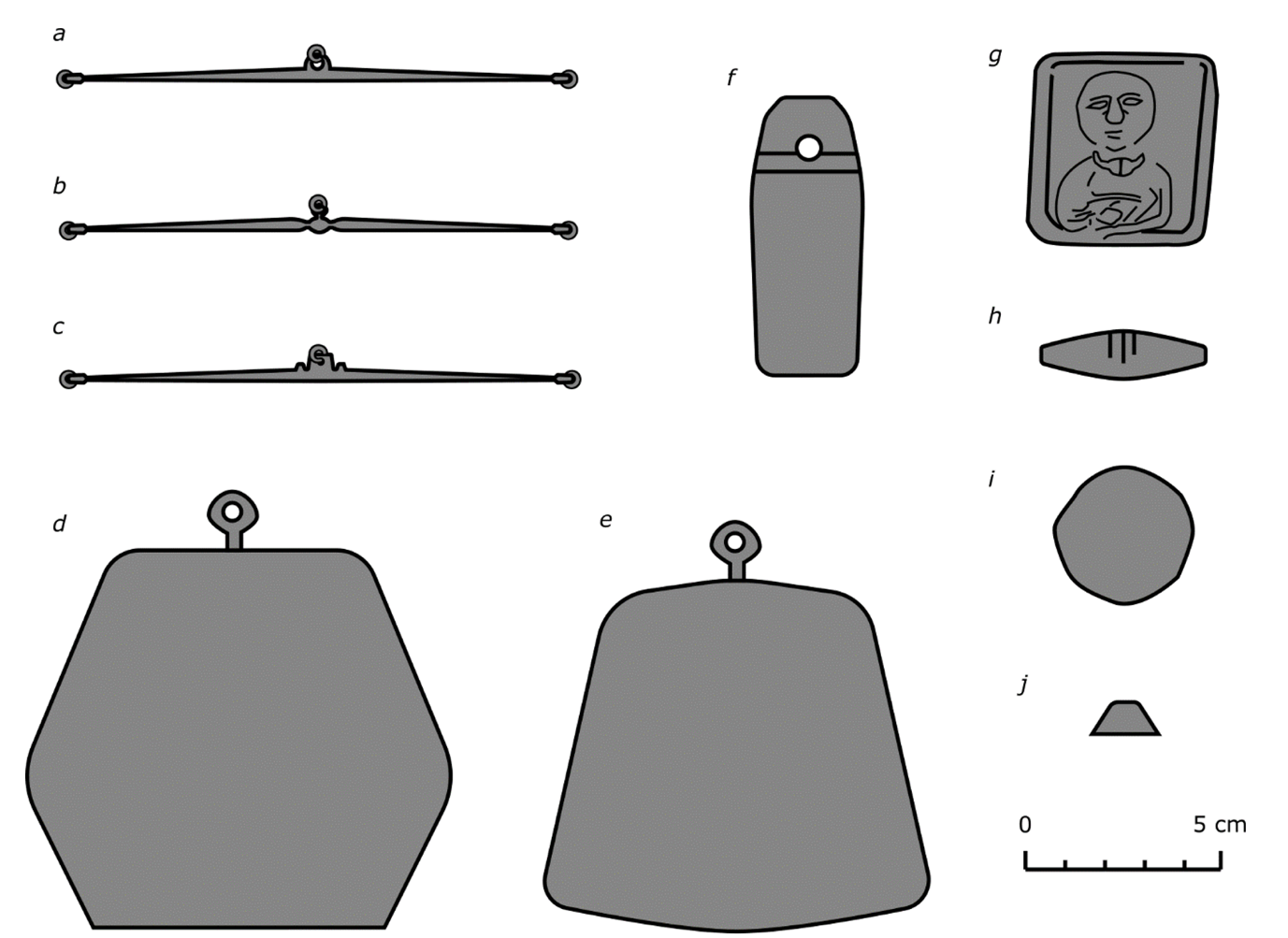
Figure 2 - Schematic representation of the principal types of balance beams and reference weights in the Celtic world: a) beam with simple central hanging device; b) beam with ovoid central hanging device; c) beam with notched central hanging device; d) pear-shaped weight with circular basis; e) pear-shaped weight with quadrangular basis; f) pseudo-pear shaped weight; g) rectangular weight with decorated face; h) sphenoid weight; i) discoid weight; j) plano-convex/conical weight.
From a metrological point of view, Jandrasits attributes each object to different known units. In his interpretation, independently of the shapes of the weights, they correspond to divisions of the gold stater (stater, third of a stater, eighth of a stater) or the silver stater (drachm, half-drachm, quinarius). However, some objects do not correspond clearly to any such system. As has been discussed elsewhere (Poigt, 2022a, p. 79-81), comparative metrology can be difficult because numerous units were in use across Europe and the Mediterranean during Late Prehistory and Antiquity, many of which are very close in value. It is therefore often hazardous to attribute an object with certainty to a specific unit on the basis of its present mass alone. Furthermore, the metrological systems used as comparisons are based on monetary standards that vary significantly through time.
The overall distribution of the masses identified by Jandrasits is close to a continuum, without clearly distinguishable clusters that would allow secure interpretations of these artefacts from a metrological perspective. This also makes it difficult to compare them properly with the units suggested by the weights discussed above. Nevertheless, it may be noted that the most likely clusters correspond approximately to values around 4 g and 8 g, with a possible value around 12 g and smaller clusters near 1 g and 2 g (Figure 3).
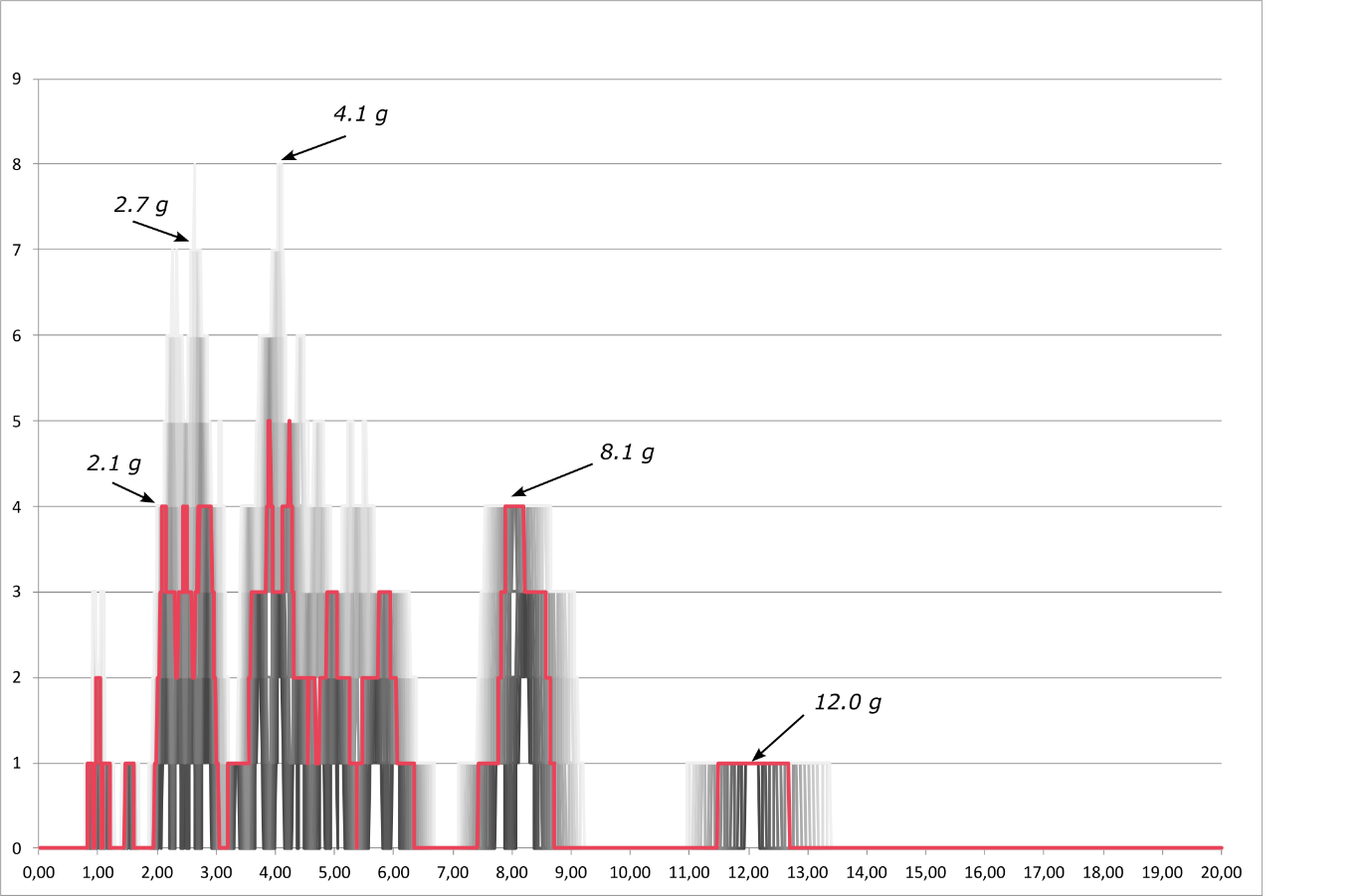
Figure 3 - Frequency Distribution Analysis of the potential monetary weights identified by Jandrasits (2003), with margins of tolerance from 0% (black) to 10% (light grey), with the average 5% tolerance in red. The central values of the main clusters are mentioned in top of them (for a complete list of these weights coming from field surveys, see the Table 2 in the Appendix).
If such an organisation indeed reflects a weighing system centred on a unit of approximately 2 g, it could be compatible with certain monetary standards, although this cannot be established with confidence. In any case, it shows no clear correspondence with any of the units identified through the study of the other categories of weights discussed above.
The case study of Britain Weighted Iron
In the well-known work of C. Julius Caesar, De Bello Gallico, we find a particularly interesting passage referring to a metrological practice among a Late Prehistoric population. This account was recorded when the Roman general crossed into Britannia and described the inhabitants of the island:
Vtuntur aut aere aut nummo aureo (β: aereo) aut taleis (AM, BRS: aliis ; LN: anulis) ferreis ad certum pondus examinatis pro nummo (β: om.). (Caesar, Gallic War, 5.12.4, ed. Damon 2025)
Although this passage is of considerable interest, it presents several interpretative and philological difficulties. Concerning the manuscript tradition of De Bello Gallico, several dozen manuscripts are known today. These are generally divided into two main classes, conventionally designated as α and β, both considered of comparable philological value and each subdivided into several families (see the commentary of L.-A. Constans in the Belles Lettres edition of Caesar’s text). Taking into account the variations within this manuscript tradition, the passage can be interpreted as follows.
Caesar states that the Britons used (utuntur), as money (pro nummo, absent from the manuscripts of class β), either bronze (aes, meaning “bronze” or “copper”), gold coins (nummus aureus), or, most interestingly, certain iron objects (ferrea) whose weight had been precisely determined (ad certum pondus examinatis).
Within the alpha manuscript tradition, the reading aliis ferreis appears, although its meaning is not entirely clear. Manuscripts L and N emend aliis to anulis (anulus, “ring”), producing the reading anulis ferreis, which is semantically more coherent. However, in the nineteenth century the discovery of two additional manuscripts belonging to class β confirmed an earlier conjecture already proposed in the seventeenth century: the reading taleis ferreis, with talea meaning “rod”, “bar”, or “stake” (Allen, 1968, p. 319). A survey of modern editorial practices shows that most recent editions now favour the reading taleis ferreis, relegating the alternative readings (aliis, anulis ferreis) to the critical apparatus.
Beyond purely philological or stemmatological considerations, this preference also appears justified in light of archaeological evidence, which provides plausible material parallels supporting the interpretation taleis ferreis.
At the beginning of the twentieth century, Reginald Smith (1905) proposed identifying a series of iron bars with rolled ends, preserved in the British Museum, as the taleae ferreae mentioned by Caesar. He introduced the term “currency bars” to designate these objects, a designation that remains widely used today (see in particular Berranger, 2014, p. 73–77). Smith’s interpretation was based on the identification of a metrological unit that would structure the masses of these bars. However, this hypothesis was later challenged by Derek Allen, who re-examined the question several decades later using a larger sample. In particular, Allen highlighted significant regional differences in the masses of the so-called currency bars (Allen, 1968).
On the basis of a comparison between a hoard of currency bars discovered at Danebury and the weights recovered from the same site, we have proposed that these iron bars were indeed regulated by weight, although their characteristics varied according to geographical context (Poigt, 2022b).
At Danebury, the weights suggest the use of two units, as mentioned above. The first corresponds to approximately 309 g, which is also the unit identified by Smith in his study of the iron bars preserved in the British Museum. This unit is further attested by later weights discovered both in the British Isles and on the continent and is sometimes referred to as the “Celtic pound”. The second unit, estimated at 257.7 g (here rounded to 258 g), has not been clearly identified elsewhere except possibly through the smaller weights dating to the end of the Iron Age, discussed above.
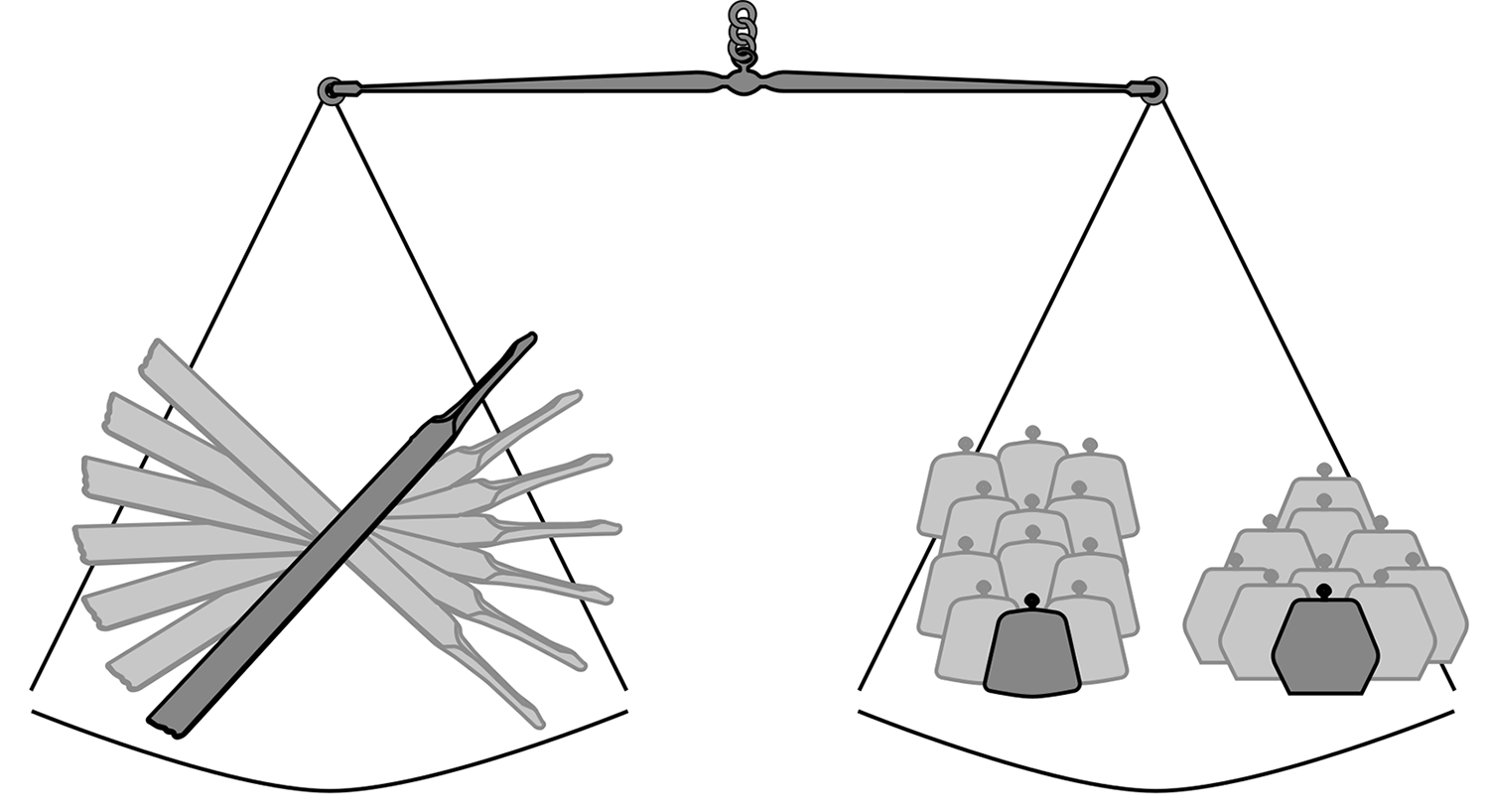
In this interpretation, the bars should not be considered individually but rather as elements of a set, in a manner comparable to the Greek obeloi (see van Driessche, 2009), allowing the deviations of individual objects to be averaged. The average mass of the bars discovered at Danebury is 452.9 g (Cunliffe & Poole, 1991a, p 351; Cunliffe & Poole, 1991b, p. 357–361). On this basis, seven bars correspond approximately to ten times the unit of 309 g and twelve times the unit of 258 g (Figure 4).
The hoard itself was initially described as containing twenty-one bars (3 × 7), although this number was later corrected to twenty. Nevertheless, several other hoards have yielded iron bars with rolled ends in quantities that are multiples of seven (Poigt, 2022b).
Consequently, we propose that the metrological relationship observed at Danebury between the two weight units and the iron bars may constitute archaeological evidence supporting Caesar’s account. At the same time, the broader dataset published by Allen (1968) suggests that the practice described or observed by Caesar was probably not widespread throughout Britain, or at least did not occur everywhere in the same form or according to identical metrological standards.
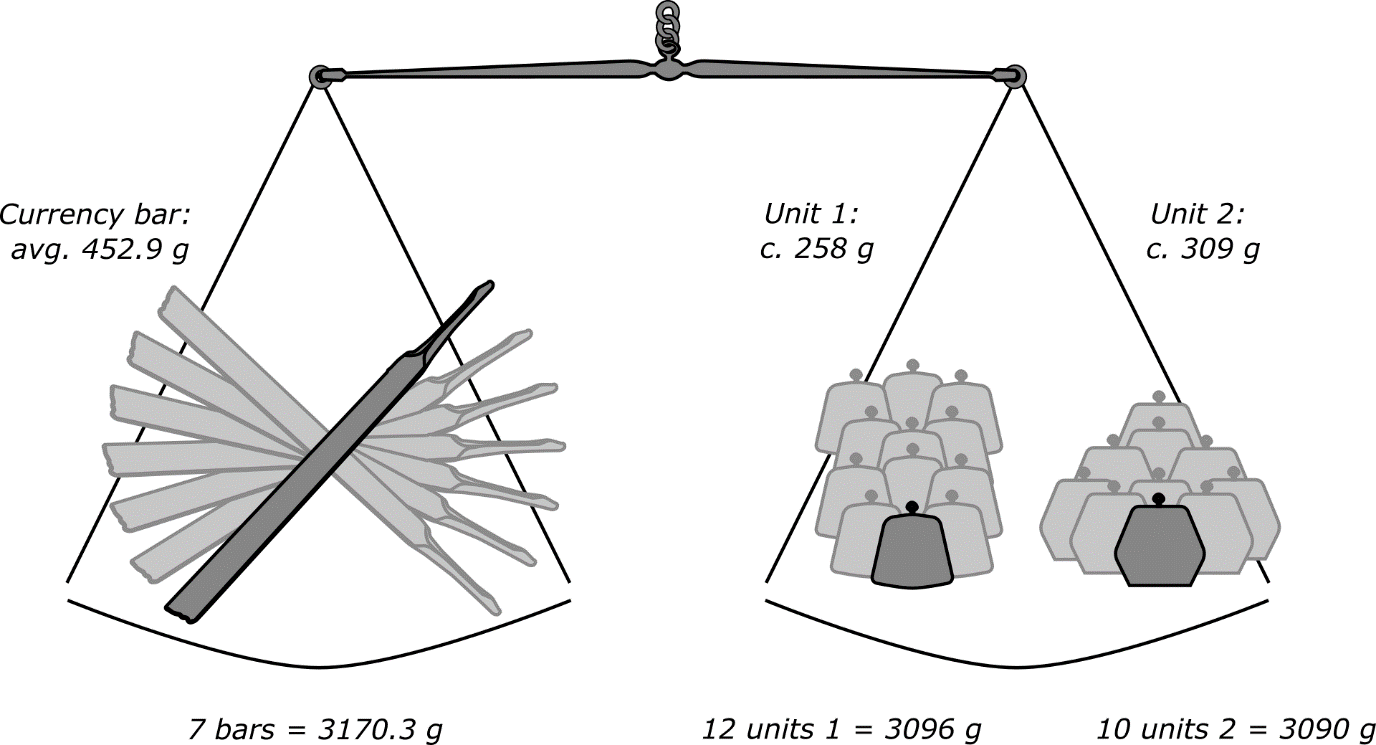
Figure 4 - Schematic representation of the way the currency bar from Danebury could have been weighed in regard with the weights analysed and the two units (258 g and 309 g) around which they are organised.
Beyond Practices, a Celtic weighing system?
Metrological Evidences
In light of the evidence currently available concerning weights and weighing practices within the Celtic cultural sphere, it is legitimate to question whether a system of measurement specific to this context may have existed. As discussed above, the evidence for weighing practices varies considerably depending on both chronology and geographical location, and several units appear to emerge from the available data. These include units of 2.558 g and 6.26 g identified in the Alpine region and eastern France during the third to first centuries BCE (Demierre & Girard, 2020), possible units of 62 g or 125.25 g at Manching during the second and first centuries BCE (Krämer, 1997), and two additional units of 258 g and 309 g documented in southern England, possibly between the fifth and first centuries BCE. These latter units appear in both weights and so-called “currency bars”, and at least one of them may have continued to be used during the Roman period in the British Isles as well as on the continent.
If one assumes that these various units emerged within a cultural complex which, although not homogeneous, nevertheless displays a certain degree of coherence, it becomes possible to hypothesise that they belonged to a common metrological framework. As noted above, the units of 2.558 g and 258 g share a ratio of 1:100, with a deviation of approximately 0.9%. Similarly, the unit of 309 g corresponds to fifty times the unit of 6.26 g (1.3% deviation). This implies that the two smaller units share a ratio of approximately 5:12 (1.9% deviation), while the two larger units are related by a ratio of 5:6 (0.2% deviation). With regard to the rectangular lead weights from Manching, it has already been observed that the weight of 62 g corresponds approximately to half that of the 125.25 g specimen (1% deviation). The latter is itself approximately 2.5 times heavier than the third weight of 50.6 g (1% deviation).
It is also possible to explore the arithmetic relationships between these lead weights and the other units (Figure 5). The weight of 50.6 g corresponds to twenty times the unit of 2.558 g (1.1% deviation). The weight of 62 g corresponds to twenty-five times the unit of 2.558 g (3.1% deviation) and ten times the unit of 6.26 g (1% deviation). Finally, the weight of 125.25 g corresponds to fifty times the unit of 2.558 g (2.12% deviation) and twenty times the unit of 6.26 g (less than 0.1% deviation).
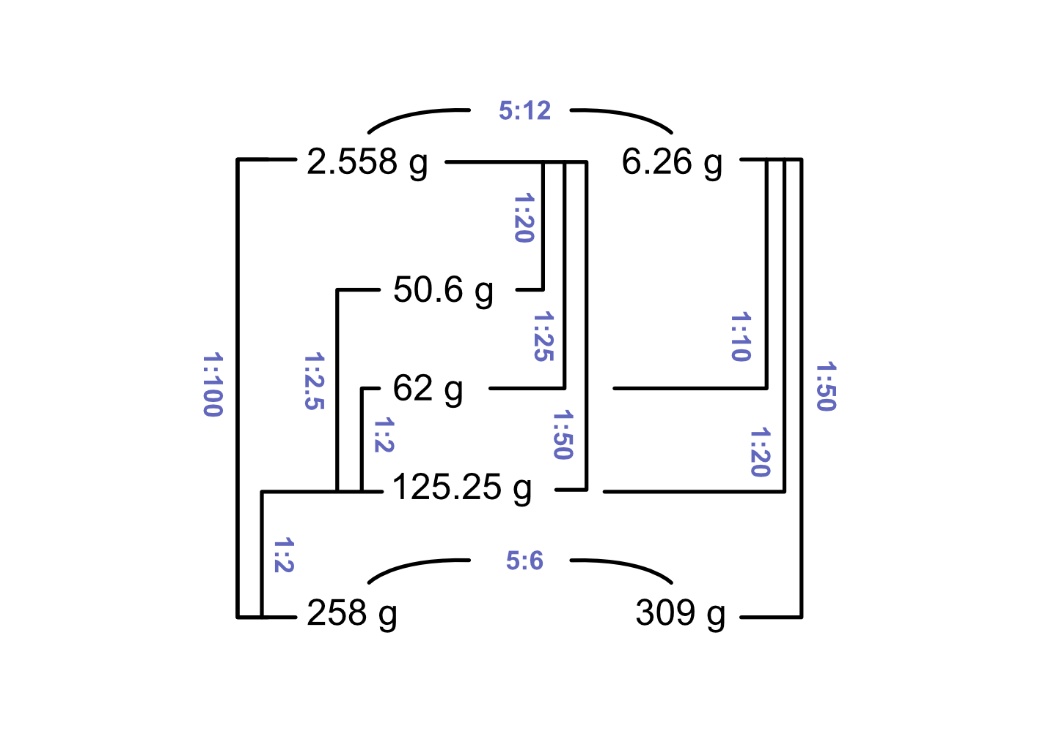
Figure 5 - Synthetic diagram of the different units inferred by Celtic weights analyses and the proposition of logical relationships between them.
In summary, it appears possible to move relatively easily from one unit to another using primarily decimal or quinary relationships. Only the conversion from 2.558 g to 6.26 g, and from 258 g to 309 g, requires the use of a duodecimal ratio. For this reason, the overall coherence of the system is not perfect. For example, if one accepts that 2.558 g and 6.26 g are related by a ratio of 5:12 and that 125.25 g corresponds to twenty times the unit of 6.26 g, then it cannot simultaneously correspond to fifty times the unit of 2.558 g, since the ratio between the two smaller units would then become 2:5 (or 5:12.5). Nevertheless, such mathematical inconsistencies may reflect practical adaptations intended to facilitate calculations and conversions.
These observations are not sufficient in themselves to demonstrate the existence of a distinct Celtic metrological system. However, they strongly suggest the presence of a degree of large-scale metrological consistency across territories inhabited by Celtic populations. At the same time, they invite further consideration of the numerical bases that may have structured these practices.
The former idea of a Celtic vigesimal system: evidence from weight artefacts?
Another commonly cited aspect of Celtic metrology is the idea that the “Celts” used a vigesimal counting system, that is, a system based on the number twenty. This assumption appears in various scholarly works. For instance, Jacques Lacroix has suggested that the French word quatre-vingt (“eighty”, literally “four-twenty”) reflects the influence of a Gallic counting system (Lacroix, 2005, p. 249–250). However, although this idea is frequently mentioned, it is rarely supported by a rigorous or convincing demonstration.
The origin of this hypothesis can be traced back to the mid-nineteenth century. At that time, Albin d’Abel de Chevallet attempted to demonstrate the “Gallic” origin of this particularity of the French language by referring to vigesimal counting systems preserved in Breton, Scottish Gaelic, and Welsh (reported in Perrein, 2018, p. 36). Even without entering into a detailed linguistic analysis, several weaknesses in this argument become apparent. First, although these Celtic languages indeed preserve traces of vigesimal counting, they belong to the insular Celtic branch and therefore cannot be considered representative of the continental Celtic world. Second, the chronological dimension remains problematic: it is impossible to determine whether the vigesimal features observed in French or in these Celtic languages might instead result from later influences dating to the medieval period. For these reasons, it is difficult to maintain that the modern French quatre-vingt constitutes a genuine survival from the Gallic language.
A more recent attempt to support the existence of a Celtic vigesimal system was proposed by Theodor Schwarz (1963). In this study, the author compared historical and archaeological evidence by confronting a text attributed to Isidore of Seville with three weights discovered at Aventicum (Avenches, Switzerland).
The passage from Isidore of Seville used by Schwarz presents a series of equivalences between monetary units supposedly used among the Gauls:
Iuxta Gallos vigesima pars unciae denarius est, et duodecim denarii solidum reddunt. ideoque iuxta numerum denariorum tres unciae quinque solidos complent. sic et quinque solidi in très uncias redeunt. nam duodecim unciae libram XX solidos continentem efficiunt. sed veteres solidum qui nunc aureus dicitur nuncupabant. (Isidore of Seville, frg. 138, ed. Hultsch, 1864).
“Among the Gauls, the denarius is the twentieth part of the ounce. Twelve denarii correspond to one solidus. Consequently, when counting in denarii, three ounces correspond to five solidi. Likewise, five solidi correspond to three ounces. Twelve ounces make up a pound containing twenty solidi. In earlier times, what is now called the aureus was called the solidus.” (pers. trans.)
On the basis of these equivalences, Schwarz argued that the Gauls used both duodecimal and vigesimal numerical systems simultaneously.
Regarding the archaeological evidence, Schwarz analysed three weights discovered at Aventicum and probably dating to the third century AD. These objects are discoid or biconical weights consisting of a bronze casing within which another material, most likely lead, has been cast. The three weights, labelled A, B, and C, weigh respectively 128.2 g, 325.4 g, and 638.2 g. Weight A bears four circular marks, weight B is marked with the numeral “I”, and weight C with “II”. Schwarz observed that weight B corresponds approximately to the Roman libra (327.4 g), whereas weights A and C do not fit the Roman metrological system. To explain this discrepancy, he proposed that weight A corresponds to four solidi of approximately 32.05 g, and that weight C corresponds to five times weight A, that is twenty solidi. Moreover, weight A is close in mass to a weight discovered at Colchester (Camulodunum), marked with five notches and weighing 126.8 g.
For Schwarz, this relationship constituted evidence for the vigesimal system mentioned by Isidore, but applied to units specific to Celtic populations: a solidus of 31.7 g, an uncia of 51.8 g, and a libra of 634 g. In this model, the following equivalences would apply: 12 unciae = 20 solidi = 1 libra.
However, this interpretation deserves to be reconsidered. The relationships proposed by Schwarz are largely constructed on the basis of Isidore’s text, and the archaeological data alone do not necessarily support such a system. Moreover, weight A corresponds relatively well to the 125.25 g weight from Manching, with a deviation of 2.4%. It could therefore indeed correspond to a unit of approximately 31–32 g that is not represented among the weights discussed above. Nevertheless, the Colchester weight, bearing five marks instead of four, suggest the existence of a subunit to approximately 25.36 g. In Schwarz’s interpretation this would represent a half-uncia (semuncia), yet it is also extremely close to half of the 50.6 g unit identified at Manching (less than 0.1% deviation). Furthermore, the vigesimal relationship mentioned by Isidore concerns the solidi and the libra, a relationship that is never observed among Iron Age weights.
Several aspects of Isidore’s text itself also call Schwarz’s interpretation into question. First, the passage does not belong to Isidore’s well-known Etymologiae, but rather to an isolated fragment compiled by the nineteenth-century philologist Friedrich Hultsch in his Metrologicorum scriptorum reliquiae (Hultsch, 1864). More importantly, Isidore is a very late author, writing in the seventh century AD, long after the period of Gaulish independence. Furthermore, the sources from which he derived this information remain unknown. It is therefore impossible to determine whether he was referring to pre-Roman Gauls or to the inhabitants of the Gallic provinces under the Roman Empire. Consequently, this text cannot provide reliable evidence for metrological practices or counting systems during the Celtic period.
Finally, the continental Celtic languages themselves preserve a few isolated lexical elements relating to numerical or metrological concepts that do not correspond, or correspond only marginally, to a vigesimal system. For example, Isidore of Seville reports that the Gauls used the term candetum to designate an area of 100 square feet in urban contexts and 150 square feet in rural contexts (Etym. 15.15.6), an information also found in Columella’s De re rustica (5.1). This word clearly derives from the Celtic root canto(n), meaning “hundred” (Delamarre, 2018, p. 104), which also appears in ethnonyms such as Uo-contii (“two-hundred”) and Tri-contii (“three-hundred”).
In addition, the word for “fourteen” is attested in a Latin inscription (CIL no. 2494): petru-decamenos, composed of petru- (“four”) and -decamenos (“ten”) (Lambert, 2003, p. 134). Although such forms do not strictly prove the predominance of a decimal system, they appear more consistent with a ten-based numerical structure than with a vigesimal one.
More broadly, the aim here is not to demonstrate the absence of a vigesimal system, since the available evidence remains too limited to support such a conclusion. Rather, this discussion highlights that the notion of a “Gallic vigesimal system”, frequently repeated in modern literature, rests on fragile foundations and should therefore be treated with caution.
Conclusion
Thus, the archaeological evidence of weights suggests the existence of specific metrological practices in Celtic Europe. A certain degree of correlation can indeed be observed between Caesar’s description and the iron bars discovered in Britain. The available evidence from weights further suggests that relatively consistent metrological practices may have been used over long periods and across large territories, or at least that sufficiently homogeneous practices existed to facilitate straightforward equivalences between different units.
By contrast, the frequently repeated idea of a Celtic vigesimal system finds no clear correspondence in the weighing archaeological record and cannot be convincingly supported by the historical sources currently available.
Future research could address this question through other dimensions of metrology, including units of length and surface, as well as through a renewed examination of what the ancient Celtic languages may reveal about numerical concepts and measurement practices. A comparative and interdisciplinary approach, combining linguistic, archaeological, and historical evidence, may ultimately make it possible to reconstruct more precisely the underlying logic of Celtic metrology, not as the survival of a supposed Gallic vigesimal system, but rather as an autonomous and evolving set of regional practices within the broader framework of exchange in the ancient Mediterranean world.
Acknowledgements
Preprint version 2 of this article has been peer-reviewed and recommended by Peer Community In Archaeology (https://doi.org/10.24072/pci.archaeo.100952; Scholtus, 2026).
Funding
The authors declare that they have received no specific funding for this study.
Conflict of interest disclosure
The authors declare that they comply with the PCI rule of having no financial conflicts of interest in relation to the content of the article.
Appendix
Table 1 – Sites with attested weighing equipment in the Celtic world.
| Map number | Site | Country | Weight(s) | Balance element(s) | Reference |
|---|---|---|---|---|---|
| 1 | Achalm | Germany | 1 | Rahmstorf & Pare, 2007 | |
| 2 | Al Claus | France | 1 | Gangloff et al., 2007, Figure 25 | |
| 3 | Altenburg | Germany | 1 | Peschel, 1985 | |
| 4 | Andilly | France | 1 | Vacher, 2016 | |
| 5 | Basel-Gasfabrik | Switzerland | 1 | Peschel, 1985 | |
| 6 | Bibracte | France | 1 | Peschel, 1985 | |
| 7 | Bílé Břehy | Czech Republic | 1 | Rahmstorf & Pare, 2007 | |
| 8 | Bourguignon-lès-Morey (Camp de César) | France | 1 | Poigt, 2022a | |
| 9 | Boviolles | France | 1 | Peschel, 1985 | |
| 10 | Bragny-sur-Saône | France | 1 | Poigt, 2022a | |
| 11 | Braunsberg | Austria | 1 | Rahmstorf & Pare, 2007 | |
| 12 | Breisach-Hochstetten | Germany | 1 | Peschel, 1985 | |
| 13 | Brouilla | France | 1 | Kotarba et al., 2007, p 260 | |
| 14 | Brunnenäcker | Germany | 1 | Rahmstorf & Pare, 2007 | |
| 15 | Černov | Czech Republic | 1 | Rahmstorf & Pare, 2007 | |
| 16 | Corent | France | 10 | Demierre & Girard, 2020 | |
| 17 | Danebury | England | 71 | Poigt, 2022a | |
| 18 | Ensérune | France | 2 | Jannoray, 1955 | |
| 19 | Entremont | France | 3 | Demierre & Girard, 2020 | |
| 20 | Erdwerk I | Germany | 1 | Rahmstorf & Pare, 2007 | |
| 21 | Fechenheim | Germany | 1 | Peschel, 1985 | |
| 22 | Fontenay-le-Comte (Genâts) | France | 1 | Nillesse, 1997, vol. 4, Figure 12, 783-16-27601 | |
| 23 | Gergovie | France | 1 | Peschel, 1985 | |
| 24 | Gondole | France | 2 | Demierre & Girard, 2020 | |
| 25 | Gussage All Saints | England | 1 | Poigt, 2022a | |
| 26 | Hanging Cliff | England | 1 | Poigt, 2022a | |
| 27 | Hellbrunner Berg | Austria | 2 | Rahmstorf & Pare, 2007 | |
| 28 | Heuneburg | Germany | 2 | Rahmstorf & Pare, 2007 | |
| 29 | Hochdorf | Germany | 1 | Rahmstorf & Pare, 2007 | |
| 30 | Hod Hill | England | 1 | Poigt, 2022a | |
| 31 | Hoštice | Czech Republic | 1 | Rahmstorf & Pare, 2007 | |
| 32 | Kornwestheim | Germany | 1 | Rahmstorf & Pare, 2007 | |
| 33 | La Tène | Switzerland | 5 | Demierre & Girard, 2020 | |
| 34 | Le Cayla de Mailhac | France | 22 | 9 | Poigt, 2022a |
| 35 | Malmains Farm | England | 1 | Poigt, 2022a | |
| 36 | Manching | Germany | 5 | 32 | Krämer, 1997 ; van Endert, 1991 |
| 37 | Mine du Chazal | France | 1 | Poigt, 2022a | |
| 38 | Mont Lassois | France | 1 | Rahmstorf, 2022 | |
| 39 | Montfumat | France | 1 | Poigt, 2022a | |
| 40 | Mühlfeld | Germany | 2 | Rahmstorf & Pare, 2007 | |
| 41 | Mužský | Czech Republic | 1 | Rahmstorf & Pare, 2007 | |
| 42 | Neunkirch-Tobeläcker | Switzerland | 1 | Poigt, 2022a | |
| 43 | Pohanská | Slovakia | 1 | Rahmstorf & Pare, 2007 | |
| 44 | Port sec Sud | France | 1 | Poigt, 2022a | |
| 45 | Puy-du-Tour | France | 1 | Peschel, 1985 | |
| 46 | Renningen | Germany | 1 | Rahmstorf, 2022 | |
| 47 | Ruscino | France | 1 | Savarese, 2023 | |
| 48 | Saint-Gence | France | 1 | Lintz, 1999 | |
| 49 | Saint-Martin-des-Champs | France | 1 | Poigt, 2022a | |
| 50 | Saint-Roch | France | 1 | Poigt, 2022a | |
| 51 | Schlesien | Poland | 1 | Rahmstorf, 2022 | |
| 52 | Sedlec-Hůrka | Czech Republic | 1 | Rahmstorf & Pare, 2007 | |
| 53 | Sedlo | Czech Republic | 1 | Rahmstorf & Pare, 2007 | |
| 54 | Staple Howe | England | 1 | Poigt, 2022a | |
| 55 | Staré Hradisko | Czech Republic | 18 | Meduna, 1961 | |
| 56 | Stradonice | Czech Republic | 30 | Rybová & Drda, 1994 | |
| 57 | Středokluky | Czech Republic | 1 | Rahmstorf & Pare, 2007 | |
| 58 | Toulouse (Caserne Niel) | France | 2 | Demierre & Girard, 2020 | |
| 59 | Toulouse (Place Jean Jaurès) | France | 2 | Poigt, 2022a | |
| 60 | Třísov | Czech Republic | 1 | Peschel, 1985 | |
| 61 | Velem-Szent-Vid | Hungary | 1 | Peschel, 1985 | |
| 62 | Vieille-Toulouse | France | 9 | Gorgues, 2009 | |
| 63 | Viesenhäuser | Germany | 1 | Rahmstorf & Pare, 2007 | |
| 64 | Villeneuve-Saint-Germain | France | 1 | Demierre & Girard, 2020 | |
| 65 | Vuffens-la-Ville | Switzerland | 2 | Demierre & Girard, 2020 | |
| 66 | Walheim (Burg) | Germany | 1 | Rahmstorf & Pare, 2007 | |
| 67 | Wiesenthau-Schlaifhausen (Ehrenbürg) | Germany | 3 | Rahmstorf & Pare, 2007 | |
| 68 | Winklebury Camp | England | 2 | Poigt, 2022a | |
| 69 | Závist | Czech Republic | 1 | Peschel, 1985 |
Table 2 – list of the potential monetary weights identified by Jandrasits (2003) discovered during field surveys in Austria.
| Object | Type | Mass (g) | Findspot |
|---|---|---|---|
| 1 | planoconvex | 0,983 | Lower-Austria, South of the Danube |
| 2 | planoconvex | 0,86 | Lower-Austria, North of the Danube |
| 3 | planoconvex | 2,1 | Lower-Austria, North of the Danube |
| 4 | planoconvex | 2,77 | Lower-Austria, North of the Danube |
| 5 | planoconvex | 4,09 | Lower-Austria, North of the Danube |
| 6 | planoconvex | 3,72 | Lower-Austria, North of the Danube |
| 7 | planoconvex | 3,69 | Lower-Austria, South of the Danube |
| 8 | planoconvex | 2,88 | Lower-Austria, South of the Danube |
| 9 | planoconvex | 7,79 | Lower-Austria, South of the Danube |
| 10 | planoconvex | 2,14 | Lower-Austria, North of the Danube |
| 11 | planoconvex | 2,61 | Lower-Austria, North of the Danube |
| 12 | planoconvex | 1,14 | Lower-Austria, South of the Danube |
| 13 | planoconvex | 2,56 | Lower-Austria, South of the Danube |
| 14 | planoconvex | 2,18 | Lower-Austria, North of the Danube |
| 15 | planoconvex | 1 | Lower-Austria, South of the Danube |
| 16 | planoconvex | 4,78 | Lower-Austria, South of the Danube |
| 17 | zoomorphic | 4,03 | Lower-Austria, North of the Danube |
| 18 | zoomorphic | 6,02 | Lower-Austria, North of the Danube |
| 19 | zoomorphic | 4,43 | Lower-Austria, North of the Danube |
| 20 | zoomorphic | 3,34 | Lower-Austria, North of the Danube |
| 21 | zoomorphic | 2,84 | Lower-Austria, South of the Danube |
| 22 | zoomorphic | 4,98 | Lower-Austria, South of the Danube |
| 23 | zoomorphic | 12,05 | Lower-Austria, South of the Danube |
| 24 | zoomorphic | 5,1 | Lower-Austria, South of the Danube |
| 25 | zoomorphic | 2,04 | Lower-Austria, South of the Danube |
| 26 | zoomorphic | 5,64 | Lower-Austria, South of the Danube |
| 27 | zoomorphic | 2,81 | Lower-Austria, South of the Danube |
| 28 | zoomorphic | 8,2 | Lower-Austria, South of the Danube |
| 29 | zoomorphic | 2,37 | Lower-Austria, South of the Danube |
| 30 | zoomorphic | 8,15 | Lower-Austria, North of the Danube |
| 31 | zoomorphic | 1,52 | Lower-Austria, North of the Danube |
| 32 | zoomorphic | 4,32 | Lower-Austria, North of the Danube |
| 33 | zoomorphic | 2,33 | Lower-Austria, South of the Danube |
| 34 | zoomorphic | 4,07 | Lower-Austria, North of the Danube |
| 35 | zoomorphic | 3,75 | Lower-Austria, South of the Danube |
| 36 | zoomorphic | 2,46 | Lower-Austria, South of the Danube |
| 37 | zoomorphic | 8,28 | Lower-Austria, South of the Danube |
| 38 | zoomorphic | 5,74 | Lower-Austria, North of the Danube |
- ↩︎
The third object is only known by us through an online notice available at: https://www.museum-manching.de/dauerausstellung/objekt-des-monats/gewicht-mit-gesicht-gesicht-mit-gewicht