
 CC-BY 4.0
Introduction
Diet is a major contributor to non-communicable diseases, as evidenced by the Global Burden of Disease study, which identifies suboptimal diets as one of the leading risk factors for deaths worldwide (Disease and Injury and Risk Factor Collaborators, 2025). Beyond its effect on individual health, diet is also a significant driver of climate change, with food systems accounting for nearly one-third of global greenhouse gas emissions (Crippa et al., 2021). Taken together, these findings underscore the urgent need to improve population diets by shifting towards dietary patterns that support both human and planetary health (Rockström et al., 2025). In response, the EAT-Lancet Commission proposed a universal healthy reference diet and called for systemic changes in both dietary behaviours and food systems to meet health and environmental targets by 2050 (Rockström et al., 2025). This transformation is framed not only as a nutritional imperative but also as a political and ethical challenge, requiring multi-sectoral, justice-oriented policies, and new forms of democratic engagement (Rockström et al., 2025). Dietary behaviour is complex and shaped by a wide range of individual, interpersonal, environmental and policy determinants (Stok et al., 2017), making improvements in population diets particularly challenging (Breda et al., 2020). Addressing these challenges requires multi-level interventions, with particular emphasis on food environments, defined by Swinburn et al. as “the collective physical, economic, policy and sociocultural surroundings, opportunities and conditions that influence people’s food and beverage choices and nutritional status” (Rutter et al., 2017; Swinburn et al., 2013).
Transforming food environments requires collaboration among a wide range of actors, including citizens, the food industry and policy-makers (Vargas et al., 2022), who often have differing priorities and interests (Pineda et al., 2022; Vandevijvere et al., 2023). Co-creation approaches offer a promising way to bring these different actors together, fostering a shared understanding of complex challenges and supporting the development of contextually relevant initiatives (Vargas et al., 2022). Among these approaches, citizens’ assemblies are increasingly recognised for their potential to address complex public issues that are difficult to tackle through conventional methods (Smith, 2024). They bring together small groups of randomly selected lay citizens who are invited to learn, deliberate and formulate policy recommendations for public ahthorities. Initially implemented at national level (e.g. Ireland’s citizens assembly on climate change (Devaney et al., 2020), France’s citizens assemblies on climate (Giraudet et al., 2022) and end of life (Delfraissy et al., 2024)) and at regional level (e.g. Budapest’s public consultation on climate strategy (King & Wilson, 2023)), these processes have more recently been adapted to the university context (Pek & Kennedy, 2025).
The first student citizens’ assembly was held in 2021 at University Paris-Est Créteil, France, focusing on food systems (Delorme & Frenkiel, 2025). It was followed by similar initiatives in over twenty universities across Europe and the United States, most of which addressed the broader issue of climate change mitigation (Deliberating Universities Network, 2025). Some assemblies involved students only (i.e. student citizens’ assemblies), whereas others bring together students and staff to jointly formulate recommendations (i.e. university citizens’ assemblies). The Deliberating Universities Network, a research network dedicated to promoting deliberative practices in higher education, has documented many of these initiatives (Deliberating Universities Network, 2025). Several recommendations emerging across different assemblies (Universities Paris-Est Créteil (Bellicha et al., 2025a) and Sorbonne Nouvelle in France, Universities of Lausanne in Switzerland and Copenhagen in Denmark), such as prioritising local, seasonal produce and expanding the availability of plant-based options, reflect the a strong focus on climate change.
Dietary behaviours and food environments warrant deliberation within universities, given the current state of student nutrition, characterised by high levels of food insecurity (Nikolaus et al., 2020), poor overall diet quality (Winpenny et al., 2018), and limited adoption of sustainable dietary practices (Aguirre Sánchez et al., 2021). By raising awareness of the health and environmental impacts of diet and fostering healthier,more sustainable food environments, universities have the potential to support large populations of students in improving their dietary habits. This may also contribute to reducing the environmental footprint of universities and strengthening their societal role in advancing the dietary transition and preparing students for future challenges (Franchini et al., 2023; Krattenmacher et al., 2023). However, there is limited evidence on the most effective strategies to improve student diets. Recent systematic reviews indicate that nutritional interventions, whether educational or involving small-scale modifications to campus food environments, have had only moderate effects on student dietary behaviours (Assilian et al., 2024; Belogianni & Baldwin, 2019). Notably, few interventions have combined educational and environmental approaches, and even fewer have been co-developed with students and campus stakeholders (Assilian et al., 2024). Taken together, these limitations may have reduced the relevance and impact of previous interventions (Franchini et al., 2023).
In this project, we implemented a student citizens’ assembly at a French university located in a socioeconomically disadvantaged area. The assembly brought together students, researchers, and local and institutional stakeholders to co-create interventions aimed at promoting healthier dietary habits with lower environmental impacts. To avoid confusion between environmental determinants of diet and environmental impacts of diet, we use the term “climate-friendly diets” to refer to diets with lower environmental impacts. The present study aims to explore how students conceptualise and prioritise solutions to diet-related challenges. Our analysis is grounded in two frameworks: (i) the Determinants of Nutrition and Eating (DONE) framework (Stok et al., 2017), which distinguishes individual, interpersonal, environmental and policy determinants of diet and (ii) the FAO definition of sustainable diets, encompassing health, ecological, socioeconomic and cultural dimensions (FAO & WHO, 2019).
Material and methods
Study setting
This study was conducted at the University Sorbonne Paris Nord (USPN), located in Seine-Saint-Denis, an administrative district bordering Paris, France. USPN has approximately 25,000 students across three main campuses. Seine-Saint-Denis has distinct sociodemographic characteristics compared with the wider Paris region, including a higher proportion of young adults (< 25 y) (Insee, 2020a) and higher levels of unemployment (Insee, 2023) and households living in poverty (Insee, 2020b). The USPN student population is characterised by high levels of food insecurity, with 11% students reporting quantitative food insecurity (i.e. not having enough to eat) and 35% reporting qualitative food insecurity (i.e. having enough to eat, but not always the desired food) (Dehove et al., 2025). This research was conducted in accordance with the guidelines laid down in the Declaration of Helsinki, and all procedures have been approved by the University Sorbonne Paris Nord Research Ethics Committee (no. 2024-055) and registered with the Commission Nationale de l’Informatique et des Libertés (no. 2228413 v0). All participants provided an electronic informed consent prior to their enrolment in the study. This research was registered at ClinicalTrial.gov (NCT06580795).
Overall procedures of the student citizens’ assembly
Mandate and members of the assembly
In November 2024, USPN organised a student citizen’s assembly with the aim of co-creating a set of concrete proposals to improve USPN students’ access to healthier and more climate-friendly diets and to promote physical activity (see study protocol for a detailed description of the assembly (Bellicha et al., 2024)). The present study focuses exclusively on diet-related proposals (i.e. excluding those related to physical activity).
In September 2024, a university-wide communication campaign (including emails, social media, and on-campus events) was launched to recruit volunteer students. A stratified random selection was then performed based on gender, campus, academic discipline and level of study. In total, 140 students expressed interest, of whom 95 were randomly selected and invited to participate. Of these, 35 accepted the invitation, and 27 ultimately took part in the assembly (48% women). While participants represented a range of backgrounds, postgraduate students and those enrolled in humanities and social sciences were overrepresented. Table 1 presents the demographic and academic characteristics of the assembly members compared to the overall USPN student population.
Table 1- Characteristics of the student citizens’ assembly participants and the USPN student population
Student citizens’ assembly (N= 27) | USPN student population (N = about 25,000)* | |
|---|---|---|
Gender | ||
Women | 48% | 60% |
Men | 52% | 40% |
Study level | ||
Undergraduate | 52% | 74% |
Post-graduate | 44% | 24% |
PhD students | 4% | 2% |
Discipline | ||
Humanities, Languages and Social Sciences | 52 % | 36 % |
Health, Medicine and Human Biology | 30 % | 33 % |
Engineering sciences | 11 % | 12 % |
University Institutes of Technology (technical studies) | 7 % | 19 % |
Students on scholarship | ||
Yes | 33% | 31% |
No | 59% | 69% |
Missing data | 7% | -- |
* Administrative data provided by the university
Stakeholder engagement and co-creation team
During the assembly, students had the opportunity to interact with a multi-stakeholder co-creation team comprising both academic and non-academic actors involved in student life, nutrition and public policy. These included university administrative, teaching and research staff, elected student representatives, local stakeholders, staff from the student services agency responsible for university housing and catering, as well as members of non-profit organisations (Table 2).
Table 2- Characteristics of the co-creation team
Type of partners | Number of persons involved | Domain of expertise / function |
|---|---|---|
Researchers, PhD students | 3 | Public health nutrition |
University administrative staff | 5 | Student and campus life, pedagogy and training organisation, university libraries, sports department |
University student health service | 3 | Dietician, psychologist, nurse |
Public institution | 3 | University housing and catering, managers and student representative |
Territorial actors | 5 | Municipal, inter-municipal, and district level, persons in charge of higher education and territorial food project |
Associations | 4 | Student and community associations engaged in solidarity groceries, food empowerment initiatives, and social and ecological transition projects |
Student union | 1 | Advocacy |
Participatory research and co-creation methods
The student citizens’ assembly was designed and organised by a governance committee comprising researchers, university representatives, staff members, one elected student and a non-profit organisation. This committee was responsible for guiding the research agenda, ensuring political and operational support, and repesenting the student perspective through the elected student member. The roles of the governance committee, described in detail elsewhere (Bellicha et al., 2024) included defining the assembly’s mandate and guiding principles, determining the selection process for student participants, the co-creation team, and invited experts, overseeing the organisation of the assembly, establishing data protection procedures, proposing mechanisms to recognise students’ contributions, designing and implementing the communication strategy, disseminating the proposals to students and local stakeholders, and contributing to the interpretation and dimmension of the study findings.
In addition, several students (including volunteers and MSc students in public health nutrition) and local stakeholders were involved at different stages of the participatory research process (Bellicha et al., 2024). They contributed to drafting grant applications, conducting the initial assessment of USPN students’ eating habits, co-designing the student citizens’ assembly, reviewing the communication strategy, designing and delivering an interactive training session during the first day of the assembly, facilitating the sessions, developing proposals for future nutrition interventions, and disseminating these proposals to both the general public and the scientific community.
The typology proposed by Biggs (Biggs, 1989), as described in the article by (Cornwall & Jewkes, 1995) and more recently applied in nutrition research (Assilian et al., 2024; Tay et al., 2021), conceptualises participation as a continuum ranging from contractual to collegial modes. These included: i) contractual participation, in which citizens take part in experiments led by researchers), ii) consultative participation, where citizens’ views are sought priori to intervention designe), iii) collaborative participation, involving joint work on projects initiated and managed by researchers, iv) collegiate participation, in which researchers and citizens work as equal partners in a process of mutual learning, with shared control over the research process. According to this typology, the present aligns with a collegiate mode of participation. Throughout the study, a non-profit organisation acted as an independent guarantor, ensuring that conditions were in place to safeguard the autonomy of assembly members and to uphold best practices in participatory research and collective deliberation (Alliance Sciences Société, 2017).
Participant regognition
Students did not receive financial compensation for participating. However, their engagement was formally recognised through two forms of academic accreditation. First, students could, upon request, obtain ECTS credits through a course designed to acknowledge civic engagement. Second, they received a university-issued certificate documenting their participation and the skills developed, which could be used to support applications for internships or employment. Programme directors were informed of the initiative to ensure that students were not penalised for their participation, including potential absences from scheduled classes. Refreshments and meals were also provided over the three days of the assembly.
Procedures and timeline of the assembly
The assembly took place over three non-consecutive days in November 2024 and combined scientific input, deliberative sessions and participatory proposal development.
Day 1 focused on training, collective problem identification and knowledge building. Activities included lectures, round tables and interactive workshops aimed at identifying key issues affecting students' access to healthy, climate-friendly diets and physical activity. Students also participated in a Student diet fresk, an interactive workshop designed to foster collective reflection on both individual and collective levers for improving student dietary practices (Bellicha et al., 2025b). Training sessions were delivered by researchers invited by the governance committee and covered five pre-defined themes: i) reducing the burden of food insecurity among students, ii) improving the nutritional quality of student diets, iii) promoting sustainable food choices, vi) improving students’ relationships with their body, weight, and eating behaviour, v) increasing physical activity and active mobility. All training materials are available on the student citizens’ assembly website (University Sorbonne Paris Nord, 2024). These themes were defined prior to the assembly by the governance committee, based on existing scientific literature on student diet (Bellicha et al., 2025b), and on survey data collected among USPN students regarding food insecurity (Dehove et al., 2025) and dietary bevahiours (including adherence to national dietary guidelines, sustainable practices, meal conditions, cooking practices and weight-loss behaviours). Due to time constraints, students were not involved in the initial selection of themes, as the duration of the assembly was shorter than in comparable deliberative processes (Delorme & Frenkiel, 2025). However, the themes were intentionally broad to allow flexibility in how students engaged with them. As an initial step, students were invited to identify and prioritise key issues within each theme, enabling them to shape the direction of the discussions and subsequent proposals.
Day 2 was dedicated to structured and facilitated deliberation. Deliberation is understood as a process of exchanging and critically examining ideas in a context of mutual respect and learning, based on the principle that legitimate decisions should draw on diverse forms of knowledge and experience (Smith, 2024). In the morning, students deliberated to define preliminary proposals in each theme. In the afternoon, these proposals were discussed and refined in plenary sessions.
Day 3 focused on the co-creation and consolidation of proposals. Students presented their proposals and engaged in deliberation with the co-creation team, resulting in a set of jointly developed proposals. Members of the co-creation team shared their experiences, knowledge, and know-how with students, and supported them in refining their proposals. Students were free to choose which partner to consult with partners of their choice and to raise questions they considered relevant. For each proposal, students were asked to rate anonymously their approval on a 10-point Likert scale. Participation rates were 96%, 96% and 93% during day 1, 2 and 3, respectively.
All sessions were facilitated by a certified health education specialist, supported by 11 MSc students in public health nutrition who had received prior training in facilitation. Following the assembly, the coordination team, in collaboration with voluntary students, prepared a summary report, which was reviewed, amended, approved and signed by all student participants. This report was submitted to the President of USPN in February 2025 and made publicly available in both French and English on the university website (University Sorbonne Paris Nord, 2025) and at https://doi.org/10.17605/OSF.IO/2UWJB (Bellicha & Karmouni, 2026). Prior to the assembly, USPN committed to making all proposals publicly available and to presenting them to the relevant university decision-making bodies. The university also commited to providing a reasoned response to each proposal, outlining any potential barriers to implementation.
Analysis of proposals
The proposals were analysed using two complementary frameworks. First, we used the DONE framework, developed by a multidisciplinary consortium, which provides a comprehensive and structured overview of the multiple determinants shaping dietary behaviours (Stok et al., 2017). This framework classifies these determinants into four categories: individual (e.g. biological, demographic, psychological factors), interpersonal (e.g. social, cultural aspects), environmental (e.g. characteristics of the food environment) and policy (e.g. industry regulations, administrative regulations) (Stok et al., 2017). For the purpose of this analysis, environmental and policy determinants were examined jointly. Second, we drew on the widely recognised definition of sustainable diets proposed by the FAO, which encompasses four dimensions: health (dietary patterns that promote all dimensions of individuals’ health and wellbeing), ecological (diets with low environmental pressure and impact), socioeconomic (accessible, affordable and equitable diets) and cultural (culturally-acceptable diets) dimensions (FAO & WHO, 2019).
For each proposal, we assigned labels indicating the type of determinant targeted (based on the DONE framework) and the sustainability dimension addressed (based on the FAO definition). The coding process therefore consisted of classifying each proposal according to these predefined categories. Each proposal was assigned one label per framework. In cases of ambiguity, the accompanying justification for each proposal (Bellicha & Karmouni, 2026) was used to identify the dimension most strongly emphasised by the students. Coding was conducted independently by two researchers (HEK and AB), and discrepancies were resolved through discussion until consensus was reached. For example, the proposal “Offer a daily plant-based dish and more plant-based options” was classified as targeting environmental/policy determinants (DONE framework) and the ecological dimension of sustainable diets (FAO framework). In contrast, the proposal “Organize monthly cooking classes open to all students” was classified as targeting individual determinants and the health dimension.
For each framework, we calculated the number and percentage of proposals within each category of determinants or sustainability dimensions. We also analysed proposals according to students’ approval ratings. For each proposal, the mean (SD) approval rating was calculated and used to rank proposals. Within each category of determinants or sustainability dimensions, the mean (SD) approval rating was then calculated to rank the categories. The data and SAS code at available at https://doi.org/10.17605/OSF.IO/2UWJB (Bellicha & Karmouni, 2026).
Results
Overall, 31 proposals were formulated (Supplementary Table 1). According to the DONE framework, most proposals (n=24, 77%) targeted environmental and policy determinants of diet (Figure 1). These proposals encompassed a range of actions, including institutional regulations (e.g. ensuring every university residence has a functional kitchen), university-level policies (e.g. adjusting class schedules to lengthen lunch breaks, creating a “Mental Health Referent” position), and food assistance initiatives (e.g. asking the university Foundation to raise funds for food vouchers for the most vulnerable students). Additional proposals in this category focused on improving food affordability (e.g. selling unsold cafeteria food at low prices), increasing the availability of healthier and more sustainable options (e.g. increasing fruit and vegetable options in cafeterias and vending machines at constant current price), enhencing front-of-pack food labelling (e.g. displaying Nutri-Score), adapting food service infrastructure (e.g. extending cafeterias opening hours to include dinner), and strengthening links with local producers through short supply chains. In contrast, a smaller proportion of proposals (n=6, 19%) addressed individual determinants (e.g. organizing monthly cooking classes open to all students, distributing dietary guides). Only one proposal (n=1, 3%) explicitly targeted interpersonal determinants, focusing on raising awareness of social norms related to food and body image.
When analysed using the FAO definition of sustainable diets, most proposals addressed the health dimension (n=12, 39%), including actions such as revising low-cost menus to include a fruit or vegetable serving, providing healthy snack options throughout the day, or creating a digital guide with recipes and shopping tips. Fewer proposals addressed the socio-economic dimension (n=9, 29%, e.g. updating student grant eligibility criteria, improving cafeteria flow to reduce queues) and ecological dimensions (n=7, 23%, e.g. running a food waste awareness campaign, offering a daily meat-free dish and more plant-based options). Only three proposals (10%) were related to the cultural dimension (e.g. providing spaces and times for conviviality, raising awareness about social norms on food and body image).
Regardless of proposal classification, mean (SD) approval ratings for each proposal ranged from 6.7 (4.0) to 9.7 (0.9), with an overall mean (SD) value for all proposals of 8.6 (0.7). Proposals addressing the socioeconomic dimension received the highest ratings (9.0 [0.6]), with the five highest-rated proposals falling within this category. Proposals addressing the health and ecological dimensions received similar ratings (8.4 [0.6] and 8.4 [0.8], respectively), while those focusing on the cultural dimension received lowest ratings on average (7.9 [0.4]). In addition, 14 of 15 highest-rated proposals targeted environmental/policy determinants. Overall, proposals targeting these determinants received higher ratings than those focusing on individual determinants (8.7 [0.7] vs. 8.3 [0.5]).
Discussion
This study examined the proposals generated through a student citizens’ assembly held at a French university located in a socioeconomically disadvantaged area, with the aim of co-creating strategies to improve students’ access to sustainable diets. The findings revealed a strong preference for structural interventions, with 77% of proposals targeting environmental or policy determinants of diet. These proposals focused on enhancing economic and physical access to sustainable diets, including reforms to financial support mechanisms, access to cooking facilities, and increased affordability and availability of healthier and more climate-friendly food options. In contrast, educational interventions were less frequently proposed and received lower levels of support. These results are consistent with findings from similar assemblies at the University Paris-Est Créteil (another French socioeconomically disadvantaged university), where proposals also predominantly targeted environmental or policy determinants of diet (Bellicha et al., 2025a). More broadly, they align with current public health evidence emphasising the predominant role of upstream determinants of health over individual determinants (Swinburn et al., 2011; Vandevijvere et al., 2023). Their structural framing of diet-related challenges also echoes research on food insecurity, showing that economically constrained individuals tend to advocate less for education and more for direct institutional action (Leung et al., 2025). Taken together, these findings challenge health promotion strategies that rely primarily on individual behaviour change, such as awareness campaigns or educational interventions (Breda et al., 2020). They also question a substantial body of research on student nutrition, which has largely focused on behavioural interventions delivered either in face-to-face or digital format (Assilian et al., 2024; Belogianni & Baldwin, 2019).
Several proposals echoed those identified in other student or university citizens’ assemblies conducted in France (Paris, Créteil, Rennes, Lyon), Switzerland (Lausanne) and Denmark (Copenhagen), most of which focused on climate change mitigation (Deliberating Universities Network, 2025). Common recommendations included promoting local and seasonal foods, expanding the availability of plant-based options, reducing packaging waste, improving food labelling and implementing awareness campaigns. However, a distinctive feature of our assembly lies in the central role given to economic accessibility, which has been less prominent in previous assemblies. While earlier initiatives included economic-related recommendations such as discounted sales of leftover food (Copenhagen), low-cost organic food baskets (Créteil), or mapping existing social support services (Sorbonne Nouvelle), the USPN assembly explicitly called for strengthened economic support, the sale of unsold food at low prices, food vouchers for disadvantaged students, and expanded access to university restaurants by reduced waiting time, longer lunch breaks, and extended opening hours. Indeed, in France, university restaurants are widely recognised as the most affordable source of healthy meals for students (Gourmelen, 2017) (i.e. 3.30€/meal for all students, and 1€ for those receiving scholarships, thanks to public subventions). This focus on socioeconomic issues likely reflects the high prevalence of food insecurity within the USPN student population (Dehove et al., 2025). It is also consistent with evidence on lower environmental concerns and lower health-related resources among individuals facing economic hardship (McCoy et al., 2024; Peisker, 2023).
The assembly process enabled students to engage in collective reasoning on complex issues affecting their health, environment and future (Pek & Kennedy, 2025). The resulting proposals were both consistent with public health frameworks and firmly grounded in the local context. This illustrates the value of co-creation approaches and participatory research, which aim to design interventions that more effectively address the needs and expectations of target populations (Vandevijvere et al., 2023; Vargas et al., 2022). The deliberative space, first among students, and later involving a diverse group of stakeholders, may have helped bring to light issues that are often overlooked in top-down policymaking, particularly those related to economic vulnerability. Another key objective of co-creation lies in fostering dialogue among stakeholders with potentially divergent views and agenda (Pineda et al., 2022; Smith, 2024). The diversity of participants, and their respective expertise in diet-related health and environmental issues, student life, university housing and catering, non-profit work, social aid, or food assistance, likely contributed to the development of more relevant proposals. Early involvment of these stakeholders may also have strengthened their engagement during the sessions and could facilitate the translation of the proposals into actual implementation (Smith, 2024). However, an important challenge that warrants further investigation is the capacity of stakeholders to invest the necessary resources and commitment to implementing such proposals (Kennedy & Pek, 2023).
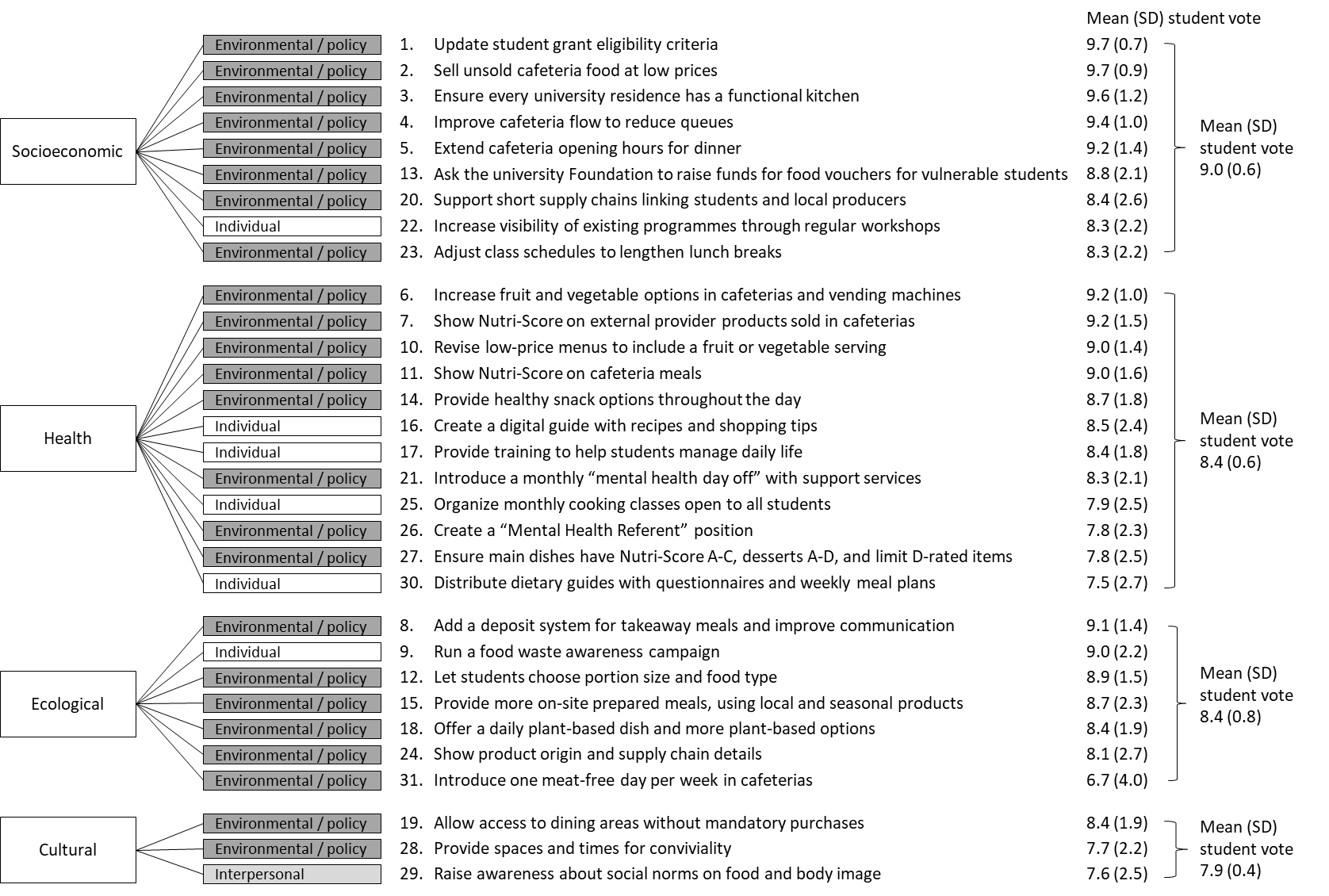
Proposals are classified a posteriori according to the FAO definition of sustainability, which encompasses health, ecological, economic and cultural dimensions. Within each of these dimensions, proposals are ranked according to the student approval rating, from highest to lowest. The mean (SD) approval rate is presented for each proposal, as well as the mean (SD) approval rate within each dimension. In addition, each proposal is assigned a determinant category based on the DONE classification, which distinguishes individual, interpersonal, and environmental/policy determinants
Figure 1 - Proposals of the student citizens’ assembly
Nonetheless, these results contribute to a growing body of literature showing that deliberative processes can be successfully implemented in different contexts (Giraudet et al., 2022), including in higher education settings (Delorme & Frenkiel, 2025), and can enrich decision-making by incorporating student perspective (Smith, 2024).
One dimension of sustainable diets was partially overlooked in the proposals: the cultural aspect. Only three proposals explicitly addressed this dimension, and these received the lowest approval ratings. This finding is consistent with previous research showing that French consumers rarely mention the sociocultural dimension when asked about their representations of sustainable diets (Chene et al., 2024). Yet, cultural acceptability is critical to the successful implementation and long-term adoption of policies and interventions (FAO & WHO, 2019). Previous analyses of citizens’ assemblies on climate change have shown that proposals often skew towards certain policy areas, likely reflecting how the assemblies’ work themes were defined (Smith, 2024). In this assembly, the initial training sessions, structured around five pre-defined themes (including food insecurity, nutritional quality, sustainable diet, eating behaviour, and physical activity) may not have sufficiently encouraged reflection on cultural dimensions. While it is not possible to disentangle framing effects from genuine student priorities, this underscores the importance of carefully designing training sessions to foster comprehensive and balanced deliberation.
Strengths and limitations
A key strength of this study lies in the systematic analysis of proposals using two complementary and well-established frameworks in public health nutrition. This approach enabled a structured assessment of both the determinants targeted and the sustainability dimensions addressed. In addition, the detailed documentation of the student citizens’ assembly process (Bellicha et al., 2024) strengthens the interpretation of findings, particularly in relation to the local context.However, some limitations should be mentioned. First, although participants were randomly selected from a pool of volunteers, the voluntary nature of recruitment limits representativeness. Despite efforts to ensure diversity of gender, discipline, and study level, the final sample overrepresented postgraduate and humanities students. Second, although proposals were independently coded by two researchers to enhance reliability, some degree of interpretive bias remains possible in the categorisation and analysis process. Besides, the choice of assigning a single label per framework to each proposal may have simplified the multidimensional nature of some proposals. Indeed, many nutritional interventions may generate co-benefits across health, environmental and social domains (Rockström et al., 2025). Third, the influence of organisers and framing effects cannot be entirely ruled out. For instance, the inclusion of specific themes and the use of specific public health tools such as the Nutri-Score during training sessions may have subtly oriented participants’ perspectives. Similarly, presenting local survey findings highlighting high levels of food insecurity may have shaped the prioritisation of socioeconomic issues. Finally, this study focused on the development of proposals rather than their implementation, which limits conclusions regarding feasibility, acceptability, and impact of the proposed measures.
Conclusion
This participatory research shows that a student citizens’ assembly conducted in a socioeconomically disadvantaged university context generated concrete and contextually relevant proposals, primarily targeting structural determinants of diet, particularly affordability and accessibility. The participatory process highlighted students’ awareness of the systemic nature of dietary challenges and their capacity to engage in collective deliberation and contribute meaningfully to health and sustainability policymaking within the university setting. More broadly, this work suggests that involving students in structured deliberative processes can help identify priorities aligned with their lived experiences and shift the focus of interventions towards strucrtural determinants that remain under-adressed in campus-based nutrition interventions. Such approaches may therefore be particularly relevant for adaptation across diverse institutional and socio-cultural contexts. In light of recent systematic reviews showing that most interventions in university settings have yielded only moderate results and rarely involved co-creation (Assilian et al., 2024), this study provides empirical support for the added-value of co-creation and participatory approaches and a valuable model for action. Future research should examine whether co-created proposals enhance legitimacy, strengthen student engagement, and increase the likelihood of effective implementation.
Appendices
Supplementary Table 1. Proposals and approval rate
Full proposals | Short proposals | Student vote Mean (SD) [min-max] | |
|---|---|---|---|
#1 | Update the eligibility criteria for student grants | Update student grant eligibility criteria | 9.7 (0.7) [7-10] |
#2 | Sell unsold food at low prices in university cafeterias | Sell unsold cafeteria food at low prices | 9.7 (0.9) [6-10] |
#3 | Establish a strict set of guidelines for university residences to ensure that every student has access to a fully functional kitchen | Ensure every university residence has a functional kitchen | 9.6 (1.2) [5-10] |
#4 | Organize better flow management in cafeteria areas to reduce waiting times | Improve cafeteria flow to reduce queues | 9.4 (1.0) [7-10] |
#5 | Extend the opening hours of university cafeterias to enable students to have dinner there | Extend cafeteria opening hours for dinner | 9.2 (1.4) [5-10] |
#6 | Enhance the availability and variety of fruits and vegetables across cafeterias and vending machines | Increase fruit and vegetable options in cafeterias and vending machines | 9.2 (1.0) [7-10] |
#7 | Display the Nutri-Score on products from external providers sold in university cafeterias | Show Nutri-Score on external provider products sold in cafeterias | 9.2 (1.5) [5-10] |
#8 | Introduce a deposit system for takeaway meals at university cafeterias, and enhance communication about the existing takeaway service | Add a deposit system for takeaway meals and improve communication | 9.1 (1.4) [5-10] |
#9 | Raise awareness about food waste among students and university staff through a dedicated communication campaign | Run a food waste awareness campaign | 9.0 (2.2) [0-10] |
#10 | Revise the €1 or €3.30 menus in university cafeterias to include at least one mandatory serving of fruit or vegetables | Revise low-price menus to include a fruit or vegetable serving | 9.0 (1.4) [6-10] |
#11 | Display the Nutri-Score on meals prepared and sold in university cafeterias | Show Nutri-Score on cafeteria meals | 9.0 (1.6) [5-10] |
#12 | Allow students to select both the portion size and the type of food served | Let students choose portion size and food type | 8.9 (1.5) [5-10] |
#13 | Call on the Sorbonne Paris Nord Foundation to organize a fundraising campaign aimed at providing food vouchers to vulnerable students | Call on the university Foundation to raise funds for food vouchers for vulnerable students | 8.8 (2.1) [2-10] |
#14 | Provide healthy snack options throughout the day | Provide healthy snacks throughout the day | 8.7 (1.8) [4-10] |
#15 | Provide more on-site prepared meals, using local and seasonal products | Provide more on-site prepared meals, using local and seasonal products | 8.7 (2.3) [0-10] |
#16 | Create a digital guide offering cooking recipes and practical tips for grocery shopping | Create a digital guide with recipes and shopping tips | 8.5 (2.4) [0-10] |
#17 | Implement an awareness and training program to help students better manage their daily lives | Provide training to help students manage daily life | 8.4 (1.8) [4-10] |
#18 | Offer a meat-free dish daily in Crous restaurants and cafeterias, and expand the overall range of plant-based options | Offer a daily meat-free dish and more plant-based options | 8.4 (1.9) [3-10] |
#19 | Create dining areas accessible to students who have not purchased their meals from university cafeterias | Allow access to dining areas without mandatory purchases | 8.4 (1.9) [4-10] |
#20 | Support short supply chains by connecting students with local producers | Support short supply chains linking students and local producers | 8.4 (2.6) [1-10] |
#21 | Create a monthly “mental health day off”, outside of exam periods, with access to psychological support | Introduce a monthly “mental health day off” with support services | 8.3 (2.1) [4-10] |
#22 | Organize regular training sessions and awareness workshops for all students to increase the visibility of existing programs | Increase visibility of existing programmes through regular workshops | 8.3 (2.2) [3-10] |
#23 | Reorganize class schedules to lengthen the lunch break | Adjust class schedules to lengthen lunch breaks | 8.3 (2.2) [3-10] |
#24 | Communicate the geographical origin of products as well as the supply chain (short or long) | Show product origin and supply chain details | 8.1 (2.7) [0-10] |
#25 | Organize monthly cooking classes open to all students | Organise monthly student cooking classes | 7.9 (2.5) [0-10] |
#26 | Create a “Mental Health Referent” position | Create a “Mental Health Referent” position | 7.8 (2.3) [3-10] |
#27 | Provide products with a Nutri-Score A to C for all main dishes and A to D for desserts, minimizing the quantity of those rated D | Ensure main dishes have Nutri-Score A–C, desserts A–D, and limit D-rated items | 7.8 (2.5) [2-10] |
#28 | Create spaces and times for conviviality | Provide spaces and times for conviviality | 7.7 (2.2) [3-10] |
#29 | Create a campaign to raise awareness about social norms surrounding food and body image | Raise awareness about social norms on food and body image | 7.6 (2.5) [0-10] |
#30 | Distribute dietary documentation, including a questionnaire and a personalized guide with weekly meal plans | Distribute dietary guides with questionnaires and weekly meal plans | 7.5 (2.7) [0-10] |
#31 | Introduce one meat-free day per week in university cafeterias | Introduce one meat-free day per week in cafeterias | 6.7 (4.0) [0-10] |
Proposals are ranked student approval rating (on a 10-point Likert scale), from highest to lowest. The full proposals are presented as they were formulated by the students. The short proposals were drafted by the researchers to facilitate the presentation of the results in the main figure of the article. The summary report of the student citizens’ assembly is available at https://www.univ-spn.fr/wp-content/uploads/SCA_Synthetic-final-report.pdf.
Acknowledgements
Preprint version 3 of this article has been peer-reviewed and recommended by Peer Community In Nutrition (https://doi.org/10.24072/pci.nutrition.100006; Fernandez, 2026).
The authors warmly thank all volunteer members of the student citizens’ assembly for their participation in the study. We would also like to thank the academic, institutional, territorial and associative partners for their support of the study.
Members of the “USPN Student Citizens’ Assembly Group” collaboration Group should be searchable through their individual PubMed records: Alice BELLICHA, Carole BAEZA, Laurent BAUER, Yann CHAPIN, Henri DEHOVE, Vanessa DEWALLERS, Jean-Luc DUMAS, Aude-Marie FOUCAUT, Emilie FRENKIEL, Olivia GROSS, Céline GUERRAND, Inaara HAIDARALY, Goran KAYMAK, Nathalie LIDGI-GUIGUI, Malo MOFAKHAMI, Pascale MOLINIER, Leslie NOUNDOU, Olivier OUDAR, Raphaëlle PISTORESI, Lucile VIGOUROUX.
Funding
This research has undergone independent peer-review and has received funding from the French National Research Agency (Agence Nationale de la Recherche, DACCORD study, no. ANR-23-SSAI-0020–01) and the Institute for Public Health Research (Institut pour la Recherche en Santé Publique, CoCoNut study, AAP-2022-SIP-312743).
Conflict of interest disclosure
The authors declare they have no conflict of interest relating to the content of this article.
Data, scripts, code, and supplementary information availability
Data, SAS code and supplementary information (reports of the student citizens' assembly) are available in the OSF repository (https://doi.org/10.17605/OSF.IO/2UWJB) associated with this study (Bellicha & Karmouni, 2026).