

 CC-BY 4.0
Introduction
To improve clarity and avoid conceptual ambiguity, key terms used throughout this manuscript are defined in a glossary.
Natural selection (NS) occurs when heritable differences among individuals cause systematic differences in reproductive success (Darwin, 1859; Maynard Smith, 1993). Genetic drift can also produce differential reproductive outcomes without trait-based causation (Nei et al., 1975; Slatkin, 1987). Despite the important role of drift, NS remains the dominant evolutionary phenomenon favoring traits that increase individual fitness (Williams, 1966; Stearns & Medzhitov, 2015). However, the processes through which selection operates may differ across levels of biological organization (Okasha, 2006; Gould & Lloyd, 1999).
Wong et al. (2023) recently introduced an expanded framework: selection for function (SF). Rather than centering solely on reproduction, SF emphasizes the persistence of functional configurations, even in non-replicating systems such as minerals, stars, or prebiotic networks (Hazen & Wong, 2024). These systems share three properties: (1) they consist of interacting components that form diverse configurations; (2) these configurations arise dynamically; and (3) those enhancing persistence tend to accumulate over time. SF thus highlights that stable configurations may be differentially retained even without replication. Conceptual and theoretical clarifications are provided in Box 1 and Table 1.
Box 1 - Conceptual relationships between Darwinian selection and
selection for function
To clarify the relationships between Darwinian selection (DS), multilevel selection (MLS), and selection for function (SF), we adopt a broad formulation of evolution by natural selection (ENS) that encompasses both reproduction-based and persistence-based dynamics.
In this framework, “heritable” is understood in a generalized Price-equation sense, as a statistical or organizational correlation across successive instances of a system, whether or not reproduction is strictly genetic or fully reconstructive (Bourrat, 2014, 2021). While persistence can generate continuity across system states, it should not be equated with heritability in the strict Darwinian sense, which requires lineage-based transmission through reproduction. For persistence-based differences to contribute to cumulative dynamics, some degree of continuity across system states is required, although this need not take the form of strict lineage-based inheritance. Importantly, persistence or partial copying of components should not be confused with lineage-based inheritance. In many systems, individual components (e.g., molecules, cells, or interacting units) may be reproduced or reused across system states without reproduction of the system as an integrated whole. In such cases, no well-defined lineage is formed at the level of the focal configuration, which is reassembled rather than transmitted through descent. Heritability may therefore arise through persistence, scaffolding, or partial reproduction. This broader interpretation connects with philosophical work on reproducers, which emphasizes the maintenance and transmission of organizational structure across cycles, even when reproduction is incomplete or developmentally mediated (e.g., Van Valen, 1976; Bourrat, 2014, 2015a, 2025).
SF is conceptually related to MLS theory (Okasha, 2006; Wilson & Sober, 1989; Damuth & Heisler, 1988), but should not be conflated with it. In MLS1, collective fitness is measured through the reproductive success of lower-level particles, whereas in MLS2 it is defined by the reproduction of collectives themselves (Bourrat, 2023, 2025). As emphasized by Bourrat (2021), 2023), these formulations may converge under certain conditions. In contrast, SF shifts attention away from reproductive output—whether at the particle or collective level—and toward the persistence of functional organization. In many systems, higher-level persistence arises not through selection acting on the collective as such, but as a consequence of differential reproduction or turnover among lower-level entities that stabilize the collective structure (Williams, 1966).
SF also overlaps with several existing frameworks, including ecosystem selection (Bouchard, 2014; Goodnight, 2000), ecosystem phenotypes (Ibanez, 2020), and replicator-interactor models (Hull, 2001; Dawkins, 1982). These approaches highlight how persistence and functional coherence can shape evolutionary outcomes even in the absence of clear generational boundaries.
More broadly, SF aligns with theories of complex adaptive systems, in which robustness may itself become selectable through feedbacks between internal organization and environmental conditions (Godfrey-Smith, 2009, 2015). As defined in the Glossary, robustness refers to the ability of a system to maintain its functional organization despite perturbations. It is closely related to, but distinct from, persistence, which describes the duration over which configurations are maintained. While SF shares similarities with dynamical systems approaches, it is not reducible to a description of transition rates between alternative system states. Its added value lies in providing an explicitly evolutionary interpretation of these dynamics, by identifying which configurations are preferentially retained due to their functional contribution to persistence. In this sense, SF bridges dynamical systems theory and evolutionary reasoning, extending selection-like explanations to systems lacking clear lineage-based inheritance. Evolvability in such systems requires not only the generation of variation but also its persistence over time (Bourrat et al., 2024; Kwon & Cho, 2007, 2008). Biological systems achieve this through modularity, redundancy, and dynamic regulation (Reeves, 2019; Hamant, 2025; Ren et al., 2004).
While Wong et al. (2023) draw on concepts from physics such as information and configuration (Schrödinger, 1944; Landauer, 1991), we use “functional configuration” in a non-technical sense to refer to organizational patterns that enhance persistence, without relying on formal definitions from information theory (Kimura, 1961; Frank, 2009).
Selection-like dynamics can arise whenever configurations differ in persistence, even in the absence of classical inheritance, as captured in generalized formulations of the Price equation (Price, 1970) and related approaches (Jacquard, 1983). Some MLS1 models allow group-level selection without reproduction of the groups themselves (Wilson, 1975), but SF extends this logic further by shifting the focus from reproductive output to the differential persistence of functional configurations.
SF further aligns with large-scale evolutionary perspectives, including Doolittle’s “Darwinizing Gaia” framework (Doolittle, 2024; Boyle et al., 2025), persistence-based interpretations of ecological systems (Papale, 2021; Bourrat, 2022), and theoretical extensions beyond strict replicators, including Godfrey-Smith’s scaffolded reproduction (Godfrey-Smith, 2009, 2015) and Doolittle & Inkpen’s “It’s the Song, Not the Singer” framework (Doolittle & Inkpen, 2018). It also complements major transitions theory (Szathmáry & Maynard Smith, 1995), and related perspectives on evolutionary emergence (Calcott & Sterelny, 2011).
Although some authors have questioned the generality and utility of SF in biological systems (e.g., Lynch, 2025; Jaeger, 2024), it provides a useful framework for interpreting persistence-based dynamics across levels of organization.
Importantly, SF is intended as a descriptive framework for systems in which multiple configurations coexist and can be compared; it is not suited to unique, system-wide entities such as the biosphere.
The key distinction between NS and SF does not lie in whether survival or reproduction contributes to evolutionary outcomes—both are integral to Darwinian fitness—but in how the entities under selection are generated. In its canonical form, NS operates on lineages produced through reproduction with heritable variation, enabling cumulative evolutionary change. In contrast, SF provides a useful framework for interpreting dynamically assembled configurations—such as metabolic networks, cellular collectives, or ecological assemblages—whose variants arise through reorganization or stochastic association rather than through reproduction. These configurations are not reproducing individuals, but repeatedly generated system states arising through dynamic assembly. In such systems, differences in persistence alone can shape system dynamics under conditions where configurations are repeatedly generated and coexist. Importantly, persistence can take different forms. In some systems, persistence is coupled with growth or reproduction at some level, allowing for cumulative evolutionary dynamics. In others, persistence occurs without such coupling, leading to more transient or non-cumulative dynamics. Distinguishing between these cases is essential for understanding when SF can contribute to long-term evolutionary change. SF does not posit a new evolutionary process, but extends our explanatory perspective by emphasizing how persistence-based filtering can shape system-level organization and dynamics, even when lineage-based selection is weak or difficult to characterize.
Table 1 - Comparison of selection for function (SF) with other selection frameworks
|
Dimension |
Darwinian selection |
Multilevel selection (MLS1/2) |
Replicator-interactor model |
Selection for function |
|---|---|---|---|---|
|
Unit of selection |
Individuals or genes |
Individuals and groups |
Replicators via interactors |
Multiple coexisting functional configurations |
|
Mechanism of transmission |
Genetic inheritance |
Genetic or |
Replication modulated by interactor success |
Persistence over time |
|
Primary difference-making process |
Differential reproductive success among replicating lineages |
Differential survival or turnover of interactors affecting lower-level replication |
Differential replication of replicators mediated by interactor-environment interactions |
Differential persistence of functionally coherent configurations across multiple instantiations |
|
Role of heredity |
Central |
Often central |
Essential for replicators, |
Optional (can operate without inheritance) |
|
Reproduction required? |
Yes |
Yes (at least at one level) |
Yes |
Not required |
|
Typical contexts |
Populations of organisms |
Social groups, multispecies systems |
Genes, memes, artificial evolution |
Populations of dynamically assembled systems |
|
View on maladaptation |
Must be justified via inclusive fitness, |
Sometimes tolerated if group benefits |
Selective loss unless beneficial to replicator |
May persist if stabilizing the system (even if costly locally) |
|
Relevance to abiotic systems |
In principle possible under generalized Darwinism, but rarely applicable in practice |
Rarely considered |
No |
Explicitly included |
|
Associated theoretical tools |
Population genetics, fitness landscapes |
Price equation, kin/group selection models |
Replicator-interactor formalism |
Dynamical and coarse-grained formalisms used to quantify differential persistence of functional configurations rather than reproductive output |
SF does not eliminate competition but shifts its form. While it does not require competition for reproductive output, it remains fully compatible with ecological competition (e.g., for space, resources, or functional dominance), which influences which configurations persist. SF therefore complements rather than replaces DS. In particular, while Wong et al. (2023) suggested that SF could extend to biological systems, this possibility remains only briefly outlined. The present contribution aims to explore this extension in greater detail by examining how SF may help interpret empirical patterns across a range of biological contexts.
Our aim here is not to redefine DS, nor to replace Darwinian causal explanations, but to specify when and how SF can serve as a complementary interpretative framework that makes persistence-based patterns more explicit across levels of organization.
A central question raised by Wong et al. (2023) is whether SF should be viewed as a generalization of DS or as a distinct framework. Wong et al. (2023) further suggest that DS could be interpreted as a special case of a broader persistence-based principle. Whether DS can be viewed in this way remains an open conceptual question, which we do not attempt to resolve here. While we acknowledge the conceptual interest of this view, we do not adopt it here, and instead favor a non-hierarchical interpretation.
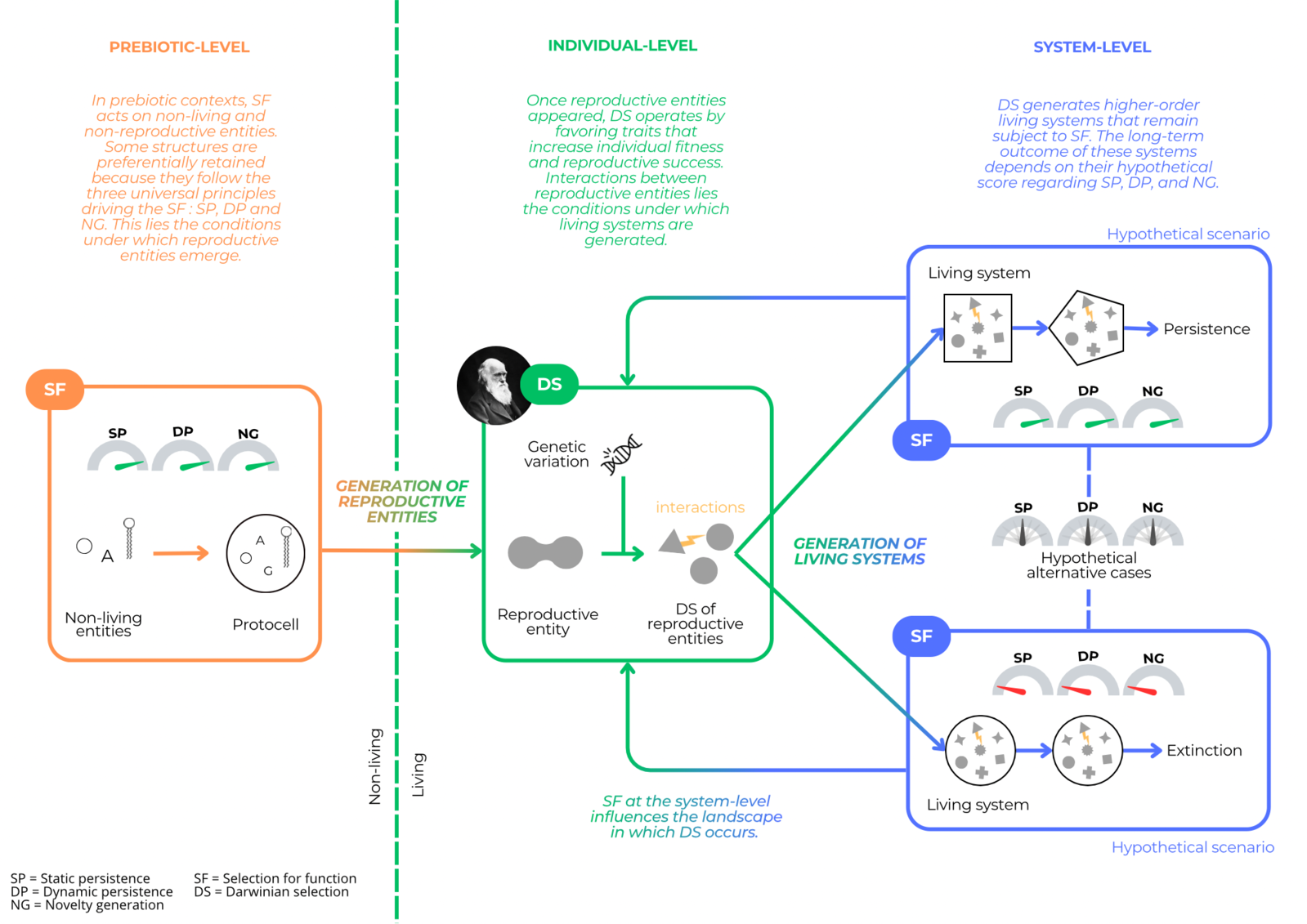
DS typically acts on replicating units such as genes or individuals. However, these units can generate higher-order structures—such as biofilms, tumors, or ecological communities—that may persist differentially without classical reproduction. In such cases, selection-like dynamics can emerge from differences in persistence among configurations, even in the absence of inheritance. These configurations can in turn shape the selective environment experienced by their components (see Table 1 and Figure 1).
Figure 1 – Selection for function (SF) in biological systems: a conceptual framework for the role of SF at different scales and its relationship with Darwinian selection (DS). Figure 1 provides a schematic comparison of DS and SF, emphasizing differences in how units are generated—through replication or dynamic assembly—and how variation is maintained.

SF draws on aspects of Darwinian reasoning but provides a complementary descriptive lens for systems that fall outside, or are only imperfectly captured by, classical lineage-based frameworks. While Darwinian selection relies on heritable variation and differential reproduction, SF emphasizes the differential persistence of functional organization. Importantly, SF does not introduce a fundamentally new evolutionary process; rather, it formalizes persistence-based filtering already implicit in several existing frameworks.
SF is therefore best understood as a complementary perspective, particularly relevant in systems where reproduction and inheritance are weak or absent. Importantly, we do not propose SF as a general theory of all biological evolution, but as a particularly useful framework for cases in which persistence, reassembly, or system-level organization are more readily characterized than discrete lineage-based inheritance. In systems where heritability is strong, DS remains the most efficient mechanism of cumulative adaptation. By contrast, SF becomes most relevant in contexts where lineage-based selection cannot yet operate effectively, such as prebiotic chemistry, early protocells, or dynamically assembled ecological systems.
SF is not a special case of classical Darwinian frameworks such as r/K selection, which remain fundamentally based on differential reproduction (Reznick et al., 2002). Instead, SF captures persistence-based aspects of evolutionary dynamics that are not always explicitly foregrounded in lineage-based models. It thus extends the range of systems to which selection-like reasoning can be meaningfully applied.
A key question is how systems lacking replication can nevertheless exhibit forms of improvement over time. In such systems, improvement does not rely on cumulative inheritance, but on the differential persistence of functional configurations combined with continuous generation of variation through reorganization, turnover, or stochastic assembly. As a result, improvement reflects the repeated filtering of newly generated configurations through processes of reorganization, turnover, or stochastic assembly, rather than relying primarily on the gradual accumulation of inherited traits (e.g., Wong et al., 2025). We further elaborate these mechanisms and provide empirical examples below.
Selection for function at the origin of replicative propensity
Building on Wong et al. (2023), we propose that SF provides a useful framework for interpreting pre-replicative systems in the early history of life, where configurations that enhanced persistence—via robustness, structural stability, or innovation potential—would tend to be preferentially retained, thereby laying the groundwork for the later emergence of DS based on heritable variation (see Figure 1). In prebiotic contexts, where inheritance was extremely weak or absent, SF is particularly relevant: selection acts not on lineages but on the persistence of chemical or structural configurations (see also Charlat et al., 2021, for related perspectives). This form of filtering can help stabilize networks below the error threshold—that is, the fidelity limit below which replicating systems cannot maintain their structural or informational integrity. Importantly, this constraint applies specifically to systems relying on template-based replication. In contrast, SF does not depend on replication fidelity but on the differential persistence of configurations. As a result, it is not subject to an error threshold in the strict sense, although instability may still limit the persistence of configurations. Importantly, SF does not guarantee the emergence of replication; it merely increases the lifespan of coherent configurations, some of which may incidentally support replicative behavior once heritable mechanisms become available. However, alternative scenarios remain equally plausible. For instance, rare and initially unstable structures capable of self-replication may have emerged and rapidly spread despite their lower persistence, eventually outcompeting more stable but non-replicating configurations. Given the current limits of our understanding of prebiotic systems, these different pathways should be viewed as complementary rather than mutually exclusive possibilities. Accordingly, SF should not be interpreted as a mechanism that generates evolvability: it merely preserves coherent configurations, while the emergence of evolvability remains governed by processes that produce heritable variation or select for long-term adaptability at higher levels. Rather than postulating fully formed replicators at life’s origin, we posit that functionally advantageous structures (e.g., autocatalytic networks, proto-membranes, or self-stabilizing assemblies) tended to persist longer than alternative configurations, thereby becoming increasingly represented among the set of coexisting structures without requiring reproduction. Their prevalence increased not through copying but because less stable variants disappeared more quickly. Experimental support comes from wet-dry cycling studies, where kinetically trapped molecular systems display memory-like behavior that preserves functional patterns across cycles without replication (Matange et al., 2025). In these experiments, the persistence of certain configurations does not depend on a population of multiple systems but arises from internal reorganization and kinetic filtering within a single system—consistent with dissipation-driven adaptation models (e.g., England, 2013). This mechanism illustrates that pre-replicative systems can exhibit differential retention of functional patterns even before population-level SF becomes possible. These pre-replicative dynamics rely on autocatalysis and resilience to ensure differential retention. Such mechanisms echo Ashby’s law of requisite variety (Ashby, 1956), biological insurance theory (Loreau et al., 2021), and the edge-of-chaos hypothesis (Kauffman, 1993), all of which emphasize compositional diversity in maintaining stability under change. Recent studies confirm that these features support compositional robustness (Brown et al., 2024). A crucial limitation of SF is that differential persistence alone cannot support cumulative evolutionary change unless variation is continually replenished. In systems lacking replication, such replenishment may arise through branching or fission-like processes (as in stochastic corrector models), through aggregation-dispersal cycles (sensu Wilson, 1980), or through ongoing stochastic reassembly of components, as observed in ecological communities or compositional protocells. These mechanisms generate new configurational variants without requiring template-based inheritance. In this view, SF primarily concerns the differential persistence of configurations, whereas the emergence of novelty depends on processes generating variation, reorganization, and change. SF filters coherent configurations, while branching, dispersal, or turnover generate the new variants upon which additional rounds of persistence-based filtering can act. Once reliable replication evolves, DS rapidly overtakes SF, but SF may play a key scaffolding role by maintaining coherent platforms long enough for such transitions to occur.
We suggest that this interplay between the ability to sustain system activity and the capacity to adjust functional configurations in response to perturbations is a prerequisite for evolvability. SF thus scaffolds the emergence of replication and heritability, complementing the major transitions framework (Calcott & Sterelny, 2011; Szathmáry & Maynard Smith, 1995). While that framework emphasizes cooperative replication control, SF highlights functional stability as a precondition. In this view, reproduction may have emerged gradually from robust systems, not as a distinct mechanism, but as a by-product of stable architectures. Replicating behavior may have accelerated trait retention and transitioned systems into the Darwinian domain. This interpretation aligns with generalized replicator-interactor models (Hull, 2001) and with Godfrey-Smith’s account of marginal or scaffolded reproduction (Godfrey-Smith, 2009), in which entities exhibit evolutionarily relevant continuity without full-fledged replication. More recent work has emphasized that what varies in such cases is not reproduction itself, but the fidelity of organizational transmission (e.g., Griesemer, 2000; Bourrat, 2025). Complementing these perspectives, Bourrat (2014) provides an explicit agent-based demonstration of how reproduction-like behavior can emerge from persistence dynamics and organizational scaffolding, thereby illustrating both the possibilities and limits of graded reproductive continuity. SF captures the selective retention of such partially inherited or dynamically assembled structures by focusing on persistence rather than reproduction.
Our framework also resonates with the classic distinction made by David Hull between replicators (entities that pass on structure through replication) and interactors, understood as entities that interact directly with their environment as cohesive wholes, in ways that influence the differential reproduction or persistence of the replicators they contain (Hull, 2001). Interestingly, SF suggests that in certain systems, especially prebiotic, somatic, or pathological, interactors may precede replicators. In such contexts, system components can acquire persistence and differential functional contributions because their organization enhances system-level activity, even in the absence of stable heredity. In other words, functional configurations that improve the system’s ability to maintain activity are retained long enough to bias which components persist, thereby generating a form of proto-selection prior to the emergence of genetic or template-based replication. This reversibility challenges the canonical Darwinian ordering and supports the view that selection-like processes may act on structured functional systems lacking inheritance as traditionally defined.
Tools like the Price equation (Price, 1970) support this view, allowing for trait-persistence covariance without strict inheritance. SF thereby broadens the descriptive scope of evolutionary theory to include filtering mechanisms based on persistence in dynamic systems. It also responds to MLS theory (Williams, 1966; Queller, 2011) which questions the possibility of adaptation without reproduction. Functional persistence offers a minimal yet rigorous criterion for selection-like dynamics in pre-replicative systems. While SF shares conceptual ground with MLS, it also applies to systems that lack replicators and therefore do not necessarily involve competition among discrete, lineage-forming groups. In SF, differential persistence can arise simply because some functional configurations maintain system-level activity better than others, without requiring antagonistic interactions or selective replacement between competing units (Table 1).
This raises a key question: does SF continue to shape evolution in systems where Darwinian mechanisms predominate? While Wong et al. (2023) mention its relevance to biological systems, they do not detail how it manifests across hierarchies, an issue we aim to explore.
Relationships between Darwinian selection and selection for function
SF does not oppose DS. In many cases, it is best understood not as a distinct causal mechanism, but as a complementary and often coarse-grained way of representing evolutionary dynamics at scales where lineage-based descriptions become impractical, diffuse, or ill-defined. At large spatial or temporal scales, such as ecosystems or Gaia-like systems, tracking reproduction would require an unfeasible level of detail; describing these systems in terms of persistence instead reflects a conventional but informative abstraction (Bourrat, 2021, 2023). This does not imply that SF reveals a novel trade-off between endurance and growth, as such dynamics are well captured by classical evolutionary theory. Rather, SF provides a complementary perspective by emphasizing how persistence-based filtering operates in systems where fitness is not easily defined at the level of individual replicating units, or where evolutionary dynamics span multiple temporal and organizational scales. In this sense, SF offers an alternative representation of evolutionary filtering, not a separate process, emphasizing system-level durability where lineage-based descriptions lose explanatory traction.
Many biological systems, whether they reproduce or not, exhibit the three properties described by Wong et al. (2023), namely static persistence, dynamic persistence, and novelty generation. While the presence of these properties does not in itself demonstrate that SF operates, it indicates that such systems possess features compatible with SF-like dynamics whenever differential persistence arises among their constituent configurations. Under such conditions, SF may provide a useful descriptive framework across multiple levels of organization, including communities, tumors, populations, and ecosystems.
Traits such as redundancy, robustness, and structural coherence can influence long-term evolutionary trajectories even when the system as a whole does not reproduce, provided that reproduction or turnover continues to occur among its lower-level components. In such cases, higher-level persistence results from differential replacement at the particle level rather than from reproduction of the collective itself (Bourrat, 2014). Thus, “absence of reproduction” here refers only to the absence of reproduction at the higher level, not to its absence in the constitutive population altogether. This aligns with MLS1 frameworks (Okasha, 2006; Calcott & Sterelny, 2011), in which individual-level traits contribute to group-level outcomes. In these cases, group persistence, rather than reproduction, can affect evolutionary change, a dynamic that SF formalizes. While DS governs replicators within systems, SF targets the persistence of configurations irrespective of their ability to replicate. The boundary between replicating and non-replicating systems is often blurred (Godfrey-Smith, 2009); processes such as speciation and extinction resemble replication at higher levels, as noted by Gould (2002). Heritability may also arise without genes, through phenotypic stability or statistical correlations (Goodnight, 2000; Bouchard, 2014).
Darwin himself acknowledged the persistence of non-functional traits and the possibility of group-level effects (Darwin, 1859, 1871), suggesting that selection could act on structural features of systems. Sterile worker castes in eusocial insects have been widely explained through inclusive fitness theory and MLS, reflecting the dominant role of Darwinian processes in shaping colony-level traits through reproduction and heritable variation. Eusocial insect colonies nevertheless provide a useful illustration of how SF and DS can interact across levels of organization. The persistence of functional organization within colonies—such as division of labor, redundancy, and collective regulation—also reflects selection-like filtering based on system-level stability. Importantly, such persistence does not occur in the absence of competition: colonies still compete for space, resources, and ecological opportunities, and these pressures shape which colony-level configurations are retained. In this sense, SF does not replace Darwinian explanations but complements them by highlighting how functional configurations contribute to the maintenance and resilience of the system over time.
SF is compatible with replicator-interactor models (Hull, 2001), the Price equation (Price, 1970), and ecosystem-level inheritance models (Bouchard, 2014; Doolittle & Inkpen, 2018; Ibanez, 2020), all of which allow for evolutionary change through trait persistence rather than gene copying. In this context, transmission may occur via ecological feedbacks or structural imprinting rather than formal genetic inheritance.
Importantly, SF helps interpret how traits or configurations that reduce short-term survival or reproductive output may nevertheless persist when they enhance the long-term stability or activity of the system as a whole. In such cases, persistence arises through SF-mediated differential stability rather than through classical fitness advantages. This is particularly relevant in systems vulnerable to cheating, such as microbial consortia, tumors or social groups. These cooperative mechanisms have been traditionally explained through kin selection or MLS frameworks. However, SF reframes them in terms of system-level robustness, emphasizing how such configurations persist through functional coherence even in the absence of direct fitness gains (Selosse & Rousset, 2011; Zanette et al., 2012; Olejarz et al., 2016; Foster & Ratnieks, 2001).
Crucially, SF differs from traditional group selection (Simon et al., 2013; Wynne-Edwards, 1962, 1986; Wilson, 1980, 1997) not by denying the role of differential survival, but by shifting the focus from group-level reproductive success to the functional persistence and proliferation of system configurations. SF operates whenever multiple system variants coexist long enough for differential persistence to bias which configurations remain available as platforms for further change. In contrast to classical group selection, reproduction in the strict biological sense (with a developmental process and discrete individuals) is not required, provided that the system generates a population of variants whose persistence differs.
This distinction extends the scope of evolutionary theory to include non-genetic domains such as prebiotic chemistry, ecological resilience, and planetary-scale processes (Wilson & Sober, 1989; Lion et al., 2011). By reframing fitness in terms of system coherence and durability, SF supports recent calls to broaden evolutionary concepts in contexts lacking clear genetic inheritance (Bouchard, 2014; Doolittle & Inkpen, 2018; Lenton et al., 2021).
Such a perspective is particularly important in the face of global change, where ecosystem survival may depend less on reproductive efficiency and more on resilience and persistence (Loreau et al., 2023). SF accounts for the endurance of traits not because they maximize short-term adaptedness, but because they contribute to system-level coherence and long-term stability. It also offers a lens to reinterpret apparent maladaptations: when classical models struggle to explain traits that reduce immediate individual performance, SF invites us to consider whether such traits enhance long-term robustness or asymptotic growth, a point emphasized in recent formal work (e.g., Bourrat et al., 2024). While we echo Williams (1966) in cautioning against overly permissive adaptationist reasoning, we argue that SF provides a rigorous conceptual framework for understanding persistent structure in evolving systems (see Box 2 for a discussion of how SF can be distinguished from broad adaptationist interpretations).
Box 2 - Profiles of biological systems and environments where
Darwinian selection and selection for function interact
The examples below are not intended as primary causal explanations of these phenomena, which are well accounted for by established Darwinian frameworks (e.g., kin selection, multilevel selection, reciprocal altruism), but rather illustrate how selection for function (SF) highlights persistence-related properties that may remain implicit in these approaches.
Rather than representing distinct processes, Darwinian selection (DS) and SF are best understood as complementary descriptive perspectives on evolutionary dynamics, often applied at different levels of biological organization. While DS emphasizes lineage-based reproductive success in a given environment, SF highlights system-level configurations that promote robustness, adaptability, or long-term viability, especially under uncertainty or in systems where reproduction is not well-defined.
The table below illustrates typical contexts in which these perspectives provide different but complementary insights. These distinctions are not exclusive: many biological traits or structures can be interpreted through both perspectives simultaneously.
|
Criteria |
Darwinian selection |
Selection for function |
||
|
Timeframe for benefits |
Short-term |
Long-term |
||
|
Scale of action |
Individuals and genes |
Populations, communities, |
||
|
Key traits favored |
Efficiency, specialization, |
Robustness, functional redundancy, buffering mechanisms, modularity |
||
|
Evolutionary advantages |
Fast adaptation, |
Multi-generational persistence, |
||
|
Associated costs |
Fragility, risk of collapse under disruption or environmental change |
Energy/time cost of redundancy, |
||
|
Illustrative examples |
Annual weeds, fast-growing bacteria, island specialists |
Microbial biofilms, seed dormancy, coral symbioses |
These examples are well explained by Darwinian frameworks; they are listed here to illustrate how SF provides an additional perspective on persistence-related properties. SF and DS are not mutually exclusive. In many systems, traits initially favored for reproductive success—such as seed dormancy or cooperative biofilms—also contribute to system-level robustness and persistence over longer timescales, and vice versa.
SF also allows us to interpret configurations in non-reproductive or marginal systems where Darwinian models are less applicable, providing a complementary descriptive perspective on long-term evolutionary dynamics across systems.
Examples illustrating how selection for function and Darwinian selection highlight different selective pressures operating at distinct organizational and temporal scales
To clarify the role of SF in the following examples, we explicitly distinguish (i) the focal configurations under consideration, (ii) how they are generated, and (iii) the processes by which differential persistence occurs independently of, or in interaction with, lineage-based selection. Rather than treating DS and SF as interacting mechanisms, we interpret them as complementary descriptive perspectives on the same underlying evolutionary process. DS captures short-term, lineage-based changes driven by heritable variation, whereas SF highlights the longer-term filtering of configuration-level persistence. These perspectives therefore reflect different organizational and temporal scales rather than two distinct processes acting jointly. These cases thus illustrate how a single evolutionary process can be viewed differently depending on whether one focuses on immediate lineage-level dynamics (DS) or on the long-term persistence of functional configurations (SF). All biological examples discussed below remain compatible with Darwinian causal explanations. Our aim is not to claim that SF replaces these explanations, but to show how a persistence-based perspective can highlight system-level organization and long-term configurational stability that are not always foregrounded in lineage-based accounts.
The paradox of sexual reproduction
Sexual reproduction entails numerous short-term costs at the individual level, including energy expenditure, increased exposure to predators, risks of sexually transmitted diseases, and the disruption of beneficial allele combinations adapted to the current environment (Lehtonen et al., 2012). From a purely Darwinian perspective centered on individual fitness and reproductive output, sexual reproduction is less efficient than asexual reproduction, particularly due to the so-called “twofold cost of sex” associated with producing non-reproductive males. Nonetheless, sexual reproduction is widespread across the tree of life (Trivers, 1983; Maynard Smith, 1978) and asexual lineages tend to be evolutionarily short-lived by comparison (de Vienne et al., 2013). This discrepancy has been historically acknowledged in evolutionary theory and is also compatible with formal frameworks such as the Price equation.
However, the apparent inefficiency of sex at the individual level is increasingly understood as being counterbalanced by longer-term benefits at the population or system level, which makes sexual reproduction a useful case for illustrating the kind of persistence-based patterns that SF seeks to foreground. Specifically, sexual reproduction contributes to population-level robustness and evolvability by generating genetic diversity. Through recombination, it produces novel allele combinations allowing populations to adapt better to changing environments and evolving antagonists, such as parasites (Auld et al., 2016; Morran et al., 2011). This ongoing recombination allows hosts to stay ahead in the evolutionary arms race against rapidly adapting pathogens (Hamilton et al., 1990; Thomas et al., 2019). Beyond parasite resistance, sexual reproduction also mitigates mutation accumulation, a threat to long-term population stability. Historically, two main hypotheses have addressed this benefit: the Red Queen hypothesis, which posits that sex allows hosts to keep pace with co-evolving parasites by generating genetic diversity; and the mutational load hypothesis, which suggests that sex helps purge deleterious mutations from the genome through recombination. These were once considered alternative explanations, but are now seen as complementary (West et al., 1999). Muller’s ratchet highlighted how asexual lineages can accumulate deleterious mutations irreversibly, while Kondrashov reframed the issue: the key problem is not irreversibility, but the higher equilibrium fitness load borne by asexual populations due to the accumulation of partially recessive harmful mutations (Muller, 1964; Kondrashov, 1985). In this context, sexual reproduction can be viewed not as a paradox, but as a trait potentially shaped by SF: a costly ‘strategy’ at the individual level that may contribute to the long-term maintenance of population-level functional diversity. In this example, the focal configuration is the mating system as a population-level organization of reproductive interactions. While its components are shaped by heritable traits and thus subject to DS, the system itself is continuously reassembled through interactions among individuals rather than transmitted as a lineage. Variation arises through changes in ecological conditions, demographic structure, and genetic architecture, rather than through direct inheritance of the system as a whole. SF captures how certain mating system configurations may persist because they stabilize population-level functioning (e.g., by maintaining genetic diversity or limiting mutational load), even when they entail individual-level costs. In this sense, SF complements DS by accounting for the differential persistence of system-level organization beyond strictly lineage-based dynamics.
While sexual reproduction promotes recombination and facilitates the purging of deleterious alleles, purging can also occur in asexual or selfing organisms, albeit with different levels of efficiency. Self-fertilization (selfing), for example, increases homozygosity, thereby exposing recessive deleterious alleles to selection more effectively than outcrossing. Therefore, the mutational advantage of sex is context-dependent and shaped by mating system diversity, rather than offering a universal superiority over asexuality. Importantly, sexual reproduction enables a broader evolutionary potential: by increasing genetic variability, it lays the foundation for the emergence of complex traits that may not yield immediate individual-level benefits but that enhance population-level robustness and long-term adaptability. In this way, sex can be interpreted as a system-level process whose consequences include maintaining population-level diversity and buffering against destabilizing fluctuations, features that are compatible with SF-like dynamics operating above the level of the individual (de Vienne et al., 2013).
While these benefits have long been recognized, they are difficult to fully capture within a strictly Darwinian framework, as they do not necessarily yield immediate fitness advantages to individuals. Although formal frameworks such as Price’s equation can account for selection dynamics beyond the individual, traditional DS does not operate directly at the population level in the classical genetic sense. Here we refer specifically to genetic heritability of fitness components, which does not apply straightforwardly to populations or species.
However, we do not deny that populations or species can exhibit forms of heritability in Jacquard’s and Bourrat’s broader statistical or organizational senses, which underlie models of species selection and macroevolutionary fitness. Our point is simply that the mechanisms generating heritable variation differ across levels, making population-level persistence better described through SF’s configurational lens than through classical organismal heredity.
Although Pricean and species-selection frameworks show how selection can act at the population or species level, classical presentations of DS have typically treated populations as contexts rather than as units bearing heritable fitness differences in their own right. As such, traits that enhance population robustness or long-term evolvability can be difficult to account for through individual-level selection alone. However, this difficulty reflects limits of standard fitness metrics rather than a fundamental inability to model such cases at the individual level. As several authors have shown, including Bourrat (2015b), 2015c), many phenomena that appear to require higher-level selection can in principle be recovered within an individual-level framework once fitness is defined over the appropriate temporal and environmental scales. Our claim is therefore not that individual-level selection cannot, in principle, account for traits enhancing long-term robustness, but that doing so often requires extending fitness measures beyond their usual short-term formulations. SF provides a complementary, coarse-grained description that makes this long-term perspective explicit by foregrounding persistence and configurational stability rather than short-term reproductive output. This limitation becomes particularly apparent in contexts involving rare or intermittent selective pressures, where traits such as robustness or bet-hedging confer benefits only over long temporal scales. In such cases, short-term individual-level selection may be insufficient to maintain these traits, as their advantages are only realized under infrequent conditions. SF provides a complementary perspective by capturing how configurations that enhance long-term persistence may be retained despite weak or episodic selection at the individual level. This view is consistent with theoretical work on the evolution of bet-hedging strategies under rare environmental scenarios (e.g., King & Masel, 2007).
SF helps clarify this apparent mismatch by highlighting how populations can persist when they exhibit internal configurations, such as genetic recombination regimes, that promote long-term stability, even when these traits are individually costly. This form of selection does not require differential reproduction among populations in the strict Darwinian sense, but it remains compatible with evolutionary theory insofar as it reflects the preferential retention of persistent configurations.
This broader evolutionary lens highlights how SF can complement DS: while DS acts on short-term reproductive success, SF draws attention to the conditions under which system configurations that persist longer may come to dominate if multiple variants coexist and differ in persistence over sufficient timescales. In this view, the persistence of sexual reproduction despite its immediate costs can be understood as a case where higher-level functional advantages outweigh lower-level inefficiencies, thereby ensuring the continuity and evolvability of populations across generations.
Dormancy
In unstable or unpredictable environments, many plant species have evolved the capacity to produce dormant seeds that can survive extended periods before germination. This ‘strategy’, often involving a mix of dormant and non-dormant seeds or seeds with variable dormancy durations, is known as bet-hedging (Philippi, 1993; Brown & Venable, 1986; Cohen, 1966). Dormancy functions as a system-level survival mechanism: by rendering seeds temporarily insensitive to favorable conditions (e.g., moisture, temperature or light), it prevents immediate germination under transient conditions. Sensitivity is re-established after variable durations, generating a distribution of germination timing across individuals. This heterogeneity ensures that some seeds germinate under favorable conditions, while others remain dormant, thereby buffering the population against environmental unpredictability. From an SF perspective, such distributions can be interpreted as configurations that enhance population-level persistence, even though no single individual expresses an “optimal strategy”.
A similar phenomenon, diapause or quiescence, is also found in various animal taxa, including insects and nematodes (Foley, 2001; Ten Brink et al., 2023; Gill et al., 2017). From a strict Darwinian perspective centered on individual fitness, such delays in reproduction may appear maladaptive, especially when immediate germination could yield short-term reproductive benefits. While dormancy can offer long-term buffering against environmental variability, such advantages can only influence evolutionary outcomes if alternative strategies coexist long enough for differences in persistence to matter. SF highlights this requirement for coexistence and differential persistence, without implying that it overcomes the short-term selective pressures that often favor immediate reproduction.
By creating a persistent seed bank, dormancy serves as a reservoir of delayed reproduction, allowing parts of a population to bypass lethal events such as droughts, floods, or harsh temperatures. This temporal spreading of germination reduces synchrony, mitigates intra-cohort competition, and enhances survival under adverse or fluctuating conditions (Finch-Savage & Leubner-Metzger, 2006). Though it entails individual-level costs such as slower reproduction or deferred germination, dormancy increases system-level robustness and evolvability, improving the population’s ability to persist through environmental uncertainty. In evolutionary theory, “bet-hedging strategies” such as dormancy are classically interpreted as maximizing geometric mean fitness over time, a quantity equivalent to the long-term population growth rate. This is a standard Darwinian result, not a signature of SF. Importantly, we do not suggest that dormancy cannot be explained by DS. The probability and duration of dormancy are often heritable traits shaped by individual-level selection under fluctuating environments. However, SF provides a complementary perspective by focusing on the persistence of the population-level distribution of dormancy durations. This distribution, continuously regenerated through individual-level processes, contributes to population stability across variable environmental conditions, even though it is not itself transmitted as a lineage. What SF emphasizes, instead, is the emergent system-level buffering produced when individually selected heterogeneity accumulates across generations. From this perspective, SF offers a complementary way of interpreting dormancy as a mechanism that enhances long-term persistence without relying on system-level reproduction.
From this perspective, dormancy exemplifies the interplay between individual-level DS and higher-level SF. While DS shapes dormancy traits at the individual level, favoring those that increase reproductive chances under variability, the cumulative, emergent effect across individuals and generations is a population-level buffering mechanism. Plants that produce seeds with heterogeneous dormancy durations can generate a distribution of offspring responses that increases the chances that at least some seeds survive in unpredictable environments. Although this heterogeneity is shaped by selection acting on individual plants, its cumulative effect influences which lineages persist across fluctuating conditions. SF highlights this emergent, lineage-level consequence without implying that selection acts directly at the level of the lineage or ecosystem.
Importantly, while this buffering does not result from classical group selection, it reflects how system-level stability can emerge from micro-level selection. Populations displaying higher internal diversity in dormancy duration are more likely to withstand stochastic environmental pressures. Such populations persist because their internal architecture can enhance long-term viability across fluctuating conditions, a pattern that SF makes particularly explicit at the system level, even though the underlying traits may themselves be maintained by DS.
Recent research has extended this view, emphasizing dormancy’s foundational role in the origin and persistence of life itself. By buffering biological systems against environmental noise, dormancy preserves functional integrity over time, thereby reinforcing evolutionary stability (Webster & Lennon, 2025). This supports the view that dormancy, while shaped by organism-level selection, can generate emergent system-level consequences that influence how lineages persist through environmental fluctuations. SF does not explain the origin of dormancy, but it provides a framework for interpreting how the cumulative effects of individually selected traits can bias which lineages endure over longer timescales.
Notably, dormancy is not restricted to multicellular organisms. In pathogenic bacteria, a comparable ‘strategy’, bacterial persistence, enables a subpopulation of cells to enter a dormant state, becoming transiently tolerant to antibiotics. These persister cells survive treatment and later resume growth, often facilitating the evolution of antibiotic resistance through subsequent mutations (Kussell et al., 2005; Levin-Reisman et al., 2019). Here again, dormancy provides a temporary refuge from selection, shaping evolutionary trajectories by preserving components that later re-engage with the environment.
These cases illustrate that non-reproductive mechanisms of resilience, such as dormancy, can influence evolutionary outcomes across diverse biological scales. By expanding the time horizon and stabilizing systems under uncertainty, such mechanisms exemplify SF: they enhance persistence not through immediate replication, but through delayed responsiveness and system-wide buffering. Dormancy, therefore, reinforces the idea that evolution is not solely driven by reproductive efficiency, but also by the capacity to endure.
Mutualistic symbioses
Mutualistic symbioses are widespread across the tree of life and involve close, long-term interactions between two or more organisms that yield reciprocal benefits (Bronstein, 2012). Although such relationships often incur significant costs for the individual partners, such as energy expenditure or resource allocation, they contribute substantially to system-level robustness and persistence, offering selective advantages at higher levels of biological organization. These long-term benefits, including enhanced survival, improved resource utilization, and increased ecological stability, typically outweigh short-term individual costs.
A canonical example is the mutualism between corals and symbiotic algae (zooxanthellae). The algae, residing within coral tissues, provide nutrients via photosynthesis, a critical advantage in nutrient-poor tropical marine environments. In return, corals offer protection, access to sunlight, and catabolic by-products such as nitrogen and phosphorus. This mutualistic architecture not only supports the survival of each species but also stabilizes the entire reef ecosystem, thereby sustaining marine biodiversity at large scales (Torres et al., 2021).
Such symbioses are not confined to marine ecosystems. Mycorrhizal fungi form mutualistic associations with plant roots, enhancing nutrient uptake (particularly phosphorus and nitrogen) and protecting against pathogens, while receiving carbohydrates produced by the plant through photosynthesis (Margulis, 1998; van der Heijden et al., 2015). This interaction underpins primary productivity in terrestrial ecosystems, enabling plants to bypass soil mineral limitations and contributing to ecosystem-level nutrient cycling and functional persistence. Similarly, gut microbiota in animals play essential roles in digestion, nutrient synthesis, immune regulation, and even neurological development, functions that increase host fitness and resilience (Yoo et al., 2020; Macke et al., 2017).
From a Darwinian perspective, such partnerships can be interpreted as cases where each partner gains individual fitness benefits. However, the persistence and recurrence of mutualisms across evolutionary timescales suggest a complementary layer of selection, aligning with SF. This framework highlights how certain configurations, despite individual costs, enhance collective robustness and interdependence, thereby contributing to long-term system-level viability.
The emergence and maintenance of mutualisms are not trivial and often require specific evolutionary conditions. Their initial establishment may arise through partner competition or spatial structuring, which shape selection pressures toward cooperation (Ledru et al., 2022). Once formed, the persistence of mutualistic relationships depends on regulatory mechanisms, such as “sanctions”, “rewards”, or enforcement of partner fidelity, that prevent “cheating” and stabilize interactions (Ferrière et al., 2007). These mechanisms emphasize the importance of maintaining systemic integrity. Mutualisms can collapse if one partner exploits the other, yet successful configurations often reinforce the resilience of the entire ecological system, as seen in coral reefs or forest mycorrhizal networks.
Such examples illustrate how, in addition to individual-level DS, SF may operate at the system level to stabilize and maintain cooperative structures that underpin long-term ecological stability. This perspective resonates with the concept of the holobiont, a composite biological system comprising a host and its symbiotic microbes. Although holobionts are sometimes proposed as evolutionary units (Roughgarden et al., 2018), this status remains controversial, since they do not reproduce as cohesive entities and often lack heritable variation in fitness in the strict Darwinian sense. Nevertheless, their emergent properties and functional synergies significantly contribute to robustness and adaptability across generations (Selosse et al., 2014). This perspective aligns with Lloyd’s account of units of selection (Lloyd, 2007), which emphasizes that a collective can function as an interactor, and thus be a genuine evolutionary unit, even in the absence of reproduction. It is also consistent with Bourrat’s analysis of how collectives can transition from being mere interactors to acquiring reproducer-like properties (Bourrat, 2021), thereby supporting evolutionary dynamics at higher organizational levels.
By shifting the focus from individual reproductive efficiency to systemic persistence, SF broadens the evolutionary lens, allowing for selection-like processes to act on emergent, functionally integrated systems. It shows how evolutionary pressures may act simultaneously across levels, from individual organisms to complex assemblies, to enhance long-term stability and adaptability (Bordenstein & Theis, 2015; Doolittle & Booth, 2017; Gilbert et al., 2012).
Microbial ecosystems
In many microbial ecosystems, including but not limited to holobiont systems, certain patterns of resilience and persistence in microbial communities can be interpreted through the SF framework, insofar as multiple community configurations coexist and differ in their persistence. These are often sustained by cooperative interactions and resource-sharing mechanisms that promote long-term stability, even when they incur short-term costs at the individual level (Agüera y Arcas et al., 2024).
A particularly vivid illustration comes from biofilms. These are structured microbial communities embedded in a self-produced extracellular matrix that shields the population from diverse environmental stresses, including physical abrasion, desiccation, pH fluctuations and antibiotic exposure. Although individual cells within a biofilm may experience reduced growth or reproduction, due to increased competition or limited nutrient diffusion, the collective structure of the biofilm enhances the survival of the community as a whole under adverse conditions.
Importantly, the membership of biofilms is dynamic: cells may join or exit, and lineages within them can turn over rapidly. Nevertheless, selection appears to act on the system as an emergent configuration, favoring robust collective traits rather than maximizing the reproductive output of any particular cell. Similar principles apply to soil microbial communities, where community-level functionality remains stable despite high individual turnover. While these mechanisms have traditionally been interpreted through kin selection or group-level enforcement models, they may also exemplify SF: persistence of the configuration is prioritized over individual efficiency, and system robustness emerges as the relevant target of selection (Joshi et al., 2021).
Beyond structural protection, biofilms facilitate resource sharing and coordinated behavior. A key mechanism is quorum sensing, whereby microbes regulate gene expression collectively in response to population density. While typically intraspecific, quorum sensing signals can also cross species boundaries, enabling inter-species communication and the emergence of cooperative responses that enhance the robustness of multispecies consortia (Wellington & Greenberg, 2019). For example, pathogenic bacteria embedded in biofilms may synchronize toxin production to coincide with high population density, thereby maximizing collective effectiveness while delaying individual-level benefits. Such strategies exemplify functional coherence at the system level, even when individual contributions are deferred or sacrificed.
Although rooted in intraspecific cooperation, these processes frequently involve inter-species cross-talk, which stabilizes long-term cooperative dynamics within microbial communities (Giaouris et al., 2015). The resulting trade-offs, between immediate individual fitness and delayed collective benefit, highlight how SF operates in microbial ecosystems by favoring configurations that sustain community-level adaptability in the face of fluctuating environments.
Over evolutionary timescales, these dynamics may even contribute to the emergence of novel collective traits, such as primitive reproductive structures observed in aggregative amoebae colonies (Li & Purugganan, 2011). Here again, selection favors functional persistence and coordinated behavior, not merely reproductive efficiency. These patterns reinforce the idea that evolutionary success in microbial systems can derive from the persistence and resilience of whole configurations, rather than from the differential reproduction of individual cells (Elumalai et al., 2024).
In sum, microbial ecosystems provide a powerful extension of the SF framework. They reveal how selection-like processes can act on emergent systems whose survival depends on integration, coordination, and buffering capacity, rather than classical Darwinian replication. Such systems illustrate that in the microbial world, as in multicellular organisms and ecological networks, SF can complement individual-level selection by making system-level persistence and organization more explicit.
Tumor evolution
The evolution of tumors offers a compelling example of how DS and SF can interact within pathological systems (Thomas et al., 2024). While classical models emphasize the proliferation of individual clones with advantageous mutations, tumor progression often depends on the emergence of complex, cooperative networks involving diverse cancerous and non-cancerous cells. These integrated systems, described as the tumor’s group phenotypic composition (GPC), enhance tumor-level resilience and adaptability (Tissot et al., 2016).
Such emergent configurations do not maximize the reproductive output of individual cells. Instead, they optimize system-level functions, such as immune evasion, metabolic cooperation, and niche construction, which enable the tumor to persist under stress, including therapeutic intervention. This reflects a form of SF operating at the tumor level, where traits enhancing collective robustness are favored, even when they compromise cellular proliferation. DS continues to shape traits like invasiveness and drug resistance at the cellular level, but the tumor’s long-term persistence hinges on its ability to maintain a functionally advantageous GPC. Tumors that succeed in establishing such configurations are more likely to resist treatment, escape immune surveillance, and colonize new environments. These features emerge not from individual cell competition alone, but from the functional integration of the tumor as a whole. This hybrid model highlights a nested dynamic: Darwinian processes among cells can reinforce systemic SF, favoring tumors that evolve towards higher-order organization and collective resilience. Over time, tumors become more than proliferative aggregates; they act as evolving systems, selected not just for cellular fitness, but for configuration-level robustness. This example underscores how an SF perspective can help interpret the outcomes of classical evolutionary processes when these outcomes depend on configuration-level robustness and persistence.
Genetic redundancy
The evolution of genetic redundancy, particularly through gene or chromosome duplications, provides a useful case for examining whether an SF perspective can also be informative at the genomic level. While duplications impose metabolic and regulatory costs, they frequently persist over long evolutionary timescales, suggesting they are maintained not for immediate fitness gains, but for their contribution to long-term system robustness (Nowak et al., 1997). It is important to note, however, that genetic redundancy is not paradoxical under classical Darwinian theory. A large body of work has already shown how duplications can be maintained or lost through standard mechanisms such as subfunctionalization, neofunctionalization, dosage effects, or buffering against expression noise (Nowak et al., 1997; Teshima & Innan, 2008). These models explain why redundancy can persist even when duplications entail short-term costs. In our framework, SF does not replace these explanations. Rather, it highlights the additional, configuration-level role that redundancy may play in promoting long-term robustness and functional stability, especially before divergence has produced clear individual-level benefits.
Although early formulations sometimes emphasized the expectation that redundant gene copies should eventually be lost, contemporary Darwinian theory provides many well-established mechanisms by which duplications can be maintained. Widespread gene duplication implies that such redundancy often confers selective advantages, especially when it enables subfunctionalization or neofunctionalization (Nowak et al., 1997; Krakauer & Nowak, 1999; Teshima & Innan, 2008). These processes support innovation and adaptability by creating functional buffers and evolutionary raw material.
In eukaryotes, relaxed selection on one copy can lead to pseudogenization, or, alternatively, to novel functions. In prokaryotes, gene redundancy can arise through mobile genetic elements (e.g., plasmids) and is maintained or lost depending on environmental pressures via horizontal gene transfer. These dynamics allow rapid functional shifts and modular adaptation to changing conditions.
Redundancy is not merely passive backup; it enables flexible system behavior, analogous to how species diversity stabilizes ecosystems by distributing functional roles (Loreau et al., 2021). In this light, gene duplication represents a trait potentially neutral or costly under Darwinian logic but plausibly favored by SF for its contribution to genome-level resilience. For instance, increased genome size or metabolic burden may represent short-term fitness costs, but preserve functional options, acting as evolutionary insurance (Adler et al., 2014; Lynch & Marinov, 2015).
This principle resonates with the Black Queen Hypothesis (Morris et al., 2012), which proposes that organisms may lose costly genes by relying on neighboring community members to perform essential functions, thereby promoting genome streamlining and ecological interdependence. Over time, duplicated genes often diverge and eventually yield classical Darwinian benefits, reinforcing the idea that SF can scaffold future fitness improvements.
In sum, genetic redundancy exemplifies the synergy between SF and DS: the former ensures robustness and preserves latent potential, while the latter exploits it. Together, they drive not just persistence, but evolvability, a central theme of this framework.
Evolutionary simulations
Simulations in evolutionary biology can provide a useful conceptual setting for examining how patterns of robustness, resilience, or long-term persistence might arise under different evolutionary pressures. Although these simulations are not designed to explore SF per se, some of their outcomes can be interpreted within the SF framework when multiple variants coexist and differ in persistence (Agüera y Arcas et al., 2024). These models show that systems incorporating redundancy, buffering capacity, and adaptive flexibility tend to be retained over time, even when they are less efficient in terms of replication or productivity.
This pattern underscores a key insight: evolutionary success is not solely tied to reproductive output. Traits or configurations that seem suboptimal under stable conditions may offer decisive advantages under fluctuating or stressful environments by preventing collapse and maintaining functionality. Such dynamics resonate with MLS theory, which posits that selection can operate at multiple hierarchical levels simultaneously. Within this framework, the outcomes can be interpreted through an SF lens, insofar as traits that enhance collective robustness contribute to the persistence of higher-level configurations, even when they reduce individual fitness.
Models exploring GPC (sensu Farine et al., 2015) and eco-evolutionary dynamics further illustrate how individual-level inefficiencies can be tolerated, or even favored, when they contribute to group-level resilience. In MLS1-type scenarios, group composition reshuffles across generations, and configurations that promote systemic stability persist, despite harboring individually maladaptive traits.
For example, simulations may reveal that mildly disadvantageous traits at the individual level are maintained because they support group integrity under spatial or temporal variation. This mechanism becomes especially apparent in spatially structured populations, where host-symbiont mutualisms evolve under selection regimes that preserve cooperation post-dispersal (Ledru et al., 2022). Here, the long-term stability of partnerships outweighs short-term gains from exploitation, reflecting how SF converges with MLS1 principles to prioritize system-level persistence. Such models clarify when higher-level selection processes can counterbalance individual-level pressures. In systems where short-term productivity risks destabilizing the whole, SF provides a conceptual and analytical framework for understanding how evolutionary dynamics can favor configurations that endure, not merely those that replicate fastest.
Evolutionary transitions in individuality
Evolutionary transitions in individuality (ETIs) provide another domain in which the SF framework may offer interpretative value. ETIs involve the emergence of higher-level units, such as multicellular organisms or eusocial groups, from previously independent entities, through the stabilization of cooperation and division of labor (Szathmáry & Maynard Smith, 1995; Okasha, 2006). While SF does not explain ETIs, it highlights how, when multiple organizational variants coexist and differ in stability, persistent configurations may come to dominate. In this sense, SF complements existing theories of ETIs by emphasizing the role of coexistence and differential persistence in shaping which collective structures endure.
Conclusion and future perspectives
The concept of SF, as introduced by Wong et al. (2023), provides a powerful framework for understanding how persistent, adaptable systems can emerge and stabilize, even prior to reproduction, notably in prebiotic contexts. This broader principle not only accounts for the evolution of functional complexity before heredity but also sets the stage for replication and DS. Within this expanded view, Darwinian dynamics can be seen as one configuration in which persistence and reproduction jointly shape evolutionary outcomes. SF does not select for functionality beyond persistence; rather, it emphasizes how differential persistence among coexisting configurations can bias which forms remain available for subsequent change. Any novelty that emerges in such systems results from the accumulation of changes filtered by persistence, not from SF selecting for novelty per se.
In this paper, we propose that SF remains operative in modern biological systems, complementing rather than replacing DS. While DS acts on self-replicating units (genes, cells, individuals) and operates through differential reproduction, SF can influence non-replicating higher-order systems—such as populations, communities, or ecosystems—whenever multiple configurations coexist and differ in their ability to maintain functional organization over time. This may involve persistence itself, but also properties such as resilience or the maintenance of favorable conditions for the viability and reproduction of their components. In such cases, features like robustness or functional cohesion may be retained insofar as they contribute to persistence, but SF does not presuppose that cohesion or long-term adaptability are selected in themselves; rather, such properties may emerge contingently when they contribute to the persistence of functional configurations. SF thus scaffolds the conditions under which DS can later emerge, but does not guarantee that replication will arise; it merely increases the persistence of coherent configurations, some of which may accidentally be compatible with replication.
This integrative perspective offers a complementary way of interpreting phenomena such as sexual reproduction, dormancy, mutualism, and genetic redundancy, without replacing established Darwinian explanations. By supporting the emergence and maintenance of robust configurations, SF helps create the structural conditions upon which DS can act, facilitating evolutionary innovation over time.
Rather than favoring short-term efficiency, SF enables the persistence of architectures that maintain coherence in fluctuating environments. In doing so, it interacts with classical selection to shape evolutionary trajectories in ways that neither process alone could fully explain. This cross-scale dynamic suggests a more nuanced paradigm, where traits that are initially costly may be maintained because they ultimately benefit both systems and individuals through enhanced stability and evolvability.
Empirically, this framework invites a reassessment of biological and clinical systems. For instance, in oncology, strategies that target the functional architecture of tumors, their systemic robustness, may be more effective than approaches focusing solely on clonal eradication (Thomas et al., 2025). In a broader context, SF highlights how traits such as functional redundancy, group-level buffering, or inter-species cooperation can contribute to the persistence of system configurations. These properties do not imply that dynamical stability or innovation are direct targets of SF; rather, such outcomes may emerge when configurations that persist longer also display greater stability or facilitate subsequent change. Importantly, this approach does not challenge the foundational role of NS, but seeks to broaden how evolutionary filtering may be described in cases where persistence is easier to characterize than discrete inheritance. By acknowledging non-genetic transmission, emergent properties, and cross-scale feedbacks, it offers a more complete and predictive understanding of biological evolution, one capable of bridging molecular, organismal, and ecological scales.
From a historical perspective, the classical reading of Darwin’s On the Origin of Species (Darwin, 1859) was shaped by the 19th century ethos of productivity and optimization. Yet today’s challenges (ecological limits, system collapse, the need for resilience) invite a broader lens. As Doolittle and others have proposed (Doolittle, 2024), evolution must also be understood as the differential persistence of stable configurations, not just the differential reproduction of efficient individuals. We therefore advocate an expanded evolutionary perspective that distinguishes not two different kinds of selection, but two different contexts in which selectionist processes can operate. When discrete replicators exist and reproduction generates heritable variation, selection manifests as classical DS driven by differential reproduction acting on genes, cells, or individuals. By contrast, in systems that lack well-defined replicators or structured heredity, selection-like filtering may primarily operate through differential persistence among coexisting configurations. SF refers to this latter case: a persistence-based selection process that arises when reproduction is absent or too loose to support standard Darwinian dynamics.
This is not a rejection of Darwinism, but a refinement, one that restores the systemic nuances of Darwin’s original vision, which already hinted at selection acting across levels of biological organization. By reconciling individual-level performance with system-level viability, this framework captures a broader spectrum of evolutionary success. It sheds light on long-standing paradoxes, connects with urgent medical and ecological questions, and offers a conceptual compass for the 21st century, where endurance may prove more valuable than speed, and where robustness becomes a key dimension of fitness.
Beyond traditional biological structures, SF may also provide explanatory value in contexts where classical Darwinian mechanisms are limited or absent. For instance, ecological assembly, i.e., the emergence of recurring patterns of species association or functional complementarity in ecosystems, may reflect non-replicative but persistent configurations shaped by functional integration. Similarly, convergent evolution may reflect recurring ecological or physiological constraints that limit the range of viable phenotypic solutions. In such cases, similar traits may evolve independently not because they realize stable system-level functions, but because they represent configurations that fall within the small subset of variants capable of persisting under comparable constraints. While such examples can often be approached with classical ecological or evolutionary models, they may also be fruitfully reinterpreted as outcomes of higher-level functional persistence, especially when heritability or reproduction is weak or absent at the focal scale (Box 3). Moreover, evolutionary biologists, including ourselves, often default to selection-based explanations, even in contexts where Darwinian dynamics apply only weakly or where additional non-selectionist processes may play a role. Frameworks such as dissipation-driven adaptation or low-rattling dynamics (e.g., England, 2013) illustrate that adaptive-like organization can arise without populations or selection, suggesting that SF should be viewed as one possible filtering process among others, rather than a universal explanatory principle. Our aim is not to dismiss these efforts, but to raise the question: even if Darwinian explanations can be formulated, should we ignore the possibility that persistence-based selection mechanisms, sensu Wong et al. (2023), may in some cases offer a useful complementary fit to lineage-based explanations?
We note that very recently Damuth & Ginzburg (2025) have introduced a related concept, which they call nonadaptive selection, defined as NS based on intrinsic structural properties that enhance the stability or persistence of entities. While their emphasis on persistence partly overlaps with our notion of SF, the two approaches place emphasis on different explanatory dimensions. Damuth and Ginzburg primarily frame persistence in terms of adaptation, whereas SF focuses on functional organization and its differential persistence, even when adaptive interpretation is unclear or secondary. Both frameworks, however, converge on the idea that robustness and persistence, rather than immediate reproductive output, can play a central role in evolutionary dynamics. In this respect, our proposal and theirs can be seen as complementary contributions to a broader research program exploring how persistence-based mechanisms extend classical DS.
In light of this convergence, we suggest that persistence provides a useful conceptual bridge between SF and classical natural selection, highlighting what these two perspectives share without erasing their differences. We hope that our paper contributes constructively to this broader debate about how various selectionist and non-selectionist processes shape the evolution of organized systems. We therefore view SF not as a replacement for Darwinian theory, but as a clarifying framework that helps articulate when persistence, rather than reproduction alone, becomes the most informative descriptor of evolutionary filtering at the focal scale.
Finally, one might ask whether persistence-based selection could, in principle, operate in systems that are unique at a given time, such as the biosphere itself. Some theoretical perspectives have suggested that complex adaptive systems may explore successive configurations across time, with more persistent configurations tending to occupy longer temporal intervals than less stable ones (e.g., Lenton et al., 2021). Interpreted cautiously, this raises the possibility that selection-like filtering could occur across successive system states rather than across coexisting entities. We emphasize, however, that such a diachronic interpretation lies beyond the operational scope of SF as defined here. In the present framework, SF requires multiple coexisting instantiations of a system to allow differential persistence to be meaningfully assessed. Whether and how persistence-based filtering could be rigorously extended to unique, planet-scale systems remains an open question, one that would require explicit formalization of temporal population structure and replacement dynamics. We therefore leave this possibility as a speculative extension, rather than a claim supported by the present analysis.
Box 3 - FAQ: Understanding the relationship between
Darwinian selection and selection for function
Q1: Doesn’t Darwinian selection already account for all evolutionary change?
A1. Darwinian selection (DS) explains evolutionary change whenever heritable variation affects differential reproductive success. However, in many systems—ecosystems, microbial consortia, tumor microenvironments, or prebiotic assemblies—lineage-based reproduction is weak, irregular, or undefined, making DS difficult to apply operationally.
Selection for function (SF) does not introduce a new evolutionary mechanism. It provides a coarse-grained description of evolutionary filtering that emphasizes persistence, functional organization, and stability rather than reproductive output.
Example: Classical bet-hedging models explain dormancy through survival-mediated maximization of long-term growth rate. SF offers a complementary view by emphasizing how dormancy contributes to configuration-level persistence and buffering over long timescales.
Q2: Is SF just another name for natural selection?
A2. No. DS and SF are not hierarchical subsets of one another.
They are two complementary ways of describing evolutionary filtering:
DS focuses on heritable variation and reproductive lineages.
SF focuses on differential persistence of configurations, especially when reproduction is weak or non-existent.
SF therefore extends evolutionary reasoning to systems where DS is difficult to formulate, without replacing DS where reproductive lineages are well-defined.
Q3: Can SF explain traits that seem inefficient or costly at the individual level?
A3. Yes—but not by contradicting DS. SF highlights that some traits reduce short-term adaptedness while enhancing:
long-term robustness,
asymptotic growth rate,
or system-level persistence.
Example: Biofilm formation reduces individual growth but increases collective stability, improving long-term persistence. Such cases remain compatible with DS when fitness is measured over appropriate timescales, but SF makes the system-level role of these traits explicit.
Q4: How does SF differ from group selection or multilevel selection?
A4. Unlike classical models of group selection, SF:
does not require group reproduction,
does not require intergroup competition,
does not treat collectives as lineages with well-defined parent-offspring relations.
Multilevel selection frameworks (MLS1/MLS2) define group fitness via particle or collective reproduction.
SF instead emphasizes the persistence of functional organization, regardless of whether the collective reproduces.
Example: Insect colony policing increases coherence and persistence of the colony’s functional organization, even when it does not increase reproductive output at the collective level.
Conclusion
SF can therefore be interpreted as a coarse-grained description of evolutionary filtering, applicable when tracking reproduction becomes impractical and persistence provides a more informative descriptor of system-level evolutionary success.
Beyond persistence alone, recent developments of the SF framework emphasize that evolving systems may also undergo forms of selective funnelling and state-space expansion (Wong et al., 2025), whereby persistent configurations progressively constrain, channel, or facilitate the emergence of future organizational states. In this perspective, SF is not limited to the differential retention of stable configurations, but may also contribute to the dynamic structuring of evolutionary trajectories and the exploration of novel functional possibilities. We view the exploration of these broader organizational and dynamical dimensions of SF as still being in its early stages, particularly in biological systems such as tumors, ecosystems, or microbial communities.
Acknowledgments
We would like to thank David Kennedy, Thierry Lefèvre, Aurora M. Nedelcu, Jácint Tökölyi, and four referees (Etienne Rajon, Richard Watson, Pierrick Bourrat and one anonymous reviewer) for their very constructive comments on the article. Preprint version 2 of this article has been peer-reviewed and recommended by Peer Community in Evolutionary Biology (https://doi.org/10.24072/pci.evolbiol.100877; Charlat, 2026).
Funding
FT is supported by the Hoffmann Family, the CNRS and the ANR EVOSEXCAN (ANR-23-CE13-0007).
Conflict of interest disclosure
The authors declare that they have no conflict of interest.
Data, script, code, and supplementary information availability
This article is a conceptual contribution and does not report original empirical data, statistical analyses, scripts, or code. No new data, scripts, or code were generated for this study.
Glossary
Darwinian selection (DS): Selection acting on reproducing lineages with heritable variation, leading to differential reproductive success.
Selection for function (SF): A persistence-based filtering process in which configurations that maintain functional organization tend to be retained longer than alternatives, independently of reproduction.
Evolution by natural selection (ENS): A general framework describing evolutionary change through differential retention of configurations over time. In this manuscript, ENS includes both reproduction-based (DS) and persistence-based (SF) descriptions of evolutionary dynamics.
Evolution: A change over time in the distribution or properties of configurations within a system.
Reproduction: The production of new units with transmission of structural or functional properties across generations.
Persistence: The maintenance of a configuration or organization over time.
Dynamic persistence: The maintenance of functional organization through ongoing processes and interactions, despite internal or external perturbations.
Structural persistence: The maintenance of system structure over time without requiring active processes.
Ecological persistence: The continued existence of a system as a result of interactions with its environment and other systems.
Function: The contribution of a component or configuration to the maintenance or performance of a system. In SF, this definition does not require that the effect was shaped by past selection.
Robustness: The ability of a system to maintain functionality despite perturbations.
Resilience: The capacity of a system to recover functional organization after perturbation.
Stability: The tendency of a system to remain in or return to a given state over time.
Evolvability: The capacity of a system to generate variation that can lead to sustained evolutionary change.
Homeostasis: The regulation of internal conditions that maintains system functionality within a viable range.
Complex adaptive systems: Systems composed of interacting components whose collective behavior emerges from local interactions and feedbacks.
Edge-of-chaos hypothesis: The idea that adaptive systems operate near a boundary between order and disorder, allowing both stability and flexibility.