

 CC-BY 4.0
Introduction
Crop growth simulation models are crucial for understanding and forecasting the intricate dynamics among climate, soil conditions, and agricultural management practices, which influence crop development and yield. These models provide valuable insights to address critical challenges in agriculture, including food security, sustainability, and the mitigation of the adverse effects of climate change (Dias & Inman-Bamber, 2020). In tropical and sub-tropical areas, sugarcane is a primary source of sugar, ethanol, and materials for electricity generation (Botha & Moore, 2013). With the growing demand for ethanol and electricity in the energy sector, there is potential to substitute for fossil fuels to reduce greenhouse gas emissions (Goldemberg et al., 2014). However, due to the diverse climatic zones involved in sugarcane production, regions engaged in this cultivation may experience shifts in temperature and precipitation patterns that could significantly impact future sugarcane productivity (IPCC, 2023). This underscores the urgent need for adaptation strategies and effective irrigation management for future sugarcane production.
Sugarcane exhibits adaptability to diverse climatic conditions worldwide, as documented by Rott (2018). In tropical and subtropical regions, including sections of South America, Africa, Asia, and the Caribbean, sugarcane is widely adapted in warm, humid climates with abundant rainfall. Conversely, in more temperate zones like the United States, South Africa, and Australia, sugarcane cultivation is confined to specific areas where temperatures support its growth, often necessitating irrigation systems to compensate for lower rainfall. The challenges presented by climate change have a notable impact on sugarcane production (Linnenluecke et al., 2018). While sugarcane may benefit from increased temperatures, alterations in precipitation patterns may also adversely affect sugarcane cultivation.
Extensive research has been conducted to evaluate the impact of climate change on sugarcane yield, accounting for factors such as atmospheric CO2 levels, temperature fluctuations, and precipitation changes. These investigations span diverse countries, including Brazil (Marin et al., 2013), Australia (Linnenluecke et al., 2020), South Africa (Jones et al., 2015), India (Sonkar et al., 2020), and Thailand (Pipitpukdee et al., 2020). The outcomes of these studies have revealed varying projections for specific climatic regions (Zhao & Li, 2015). These disparities stem from favorable conditions for C4 crops, such as rising temperatures and CO2 levels (Marin et al., 2013; Ruan et al., 2018), alongside unfavorable precipitation patterns (Knox et al., 2010; Santos & Sentelhas, 2012). Among others, two key adaptation strategies have been identified to address rainfall change under climate change: effective irrigation management (Santillan-Fernandez et al., 2016; Guo et al., 2021; Singels et al., 2023) and the development of drought-tolerant sugarcane varieties able to withstand heat and water stresses, thereby maintaining yield and productivity even under changing climatic conditions (Shrivastava & Srivastava, 2012).
Irrigation practices strongly influence the ecophysiological responses and productivity of sugarcane, particularly in regions with high evaporative demand or variable rainfall. Under adequate soil water availability, sugarcane maintains high stomatal conductance, supporting sustained canopy photosynthesis and biomass accumulation throughout the growing season (Carr & Knox, 2011). In contrast, water deficits during critical growth stages can reduce stomatal conductance and leaf expansion, accelerate leaf senescence, and limit internode elongation, ultimately decreasing yield (Venkataramana et al., 1986; Inman-Bamber & Smith, 2005). Water deficits during the tillering and grand growth phases often cause the greatest reductions in biomass and sugar content (Carr & Knox, 2011). Optimized irrigation management can durably mitigate these effects by preventing recurrent phases of stomatal conductance decline throughout the crop cycle, thereby stabilizing canopy photosynthetic activity and reducing cumulative productivity losses.
Limited research has been conducted on tropical islands due to the challenges in predicting future climates at low spatial resolution. However, initial studies have highlighted the potential for sugarcane to be adversely affected by future conditions in these areas, particularly precipitation patterns, which could lead to yield declines. This trend has been observed in islands such as La Réunion (Christina et al., 2024), Mauritius (Cheeroo-Nayamuth & Nayamuth, 2001), the South Caribbean (Singh & Maayar, 1998), and Fiji (Gawander, 2007). The tropical island of La Réunion (-21.15° / 55.50°) is susceptible to precipitation pattern alteration due to its highly variable spatial and temporal precipitation (Christina et al., 2021). With approximately 21,000 hectares of sugarcane cultivation, constituting about 55% of the total agricultural area (Levet, 2023), Reunion Island features a broad elevation range from sea level to 1000 meters above sea level, resulting in significant temperature and radiation variations. Reunion Island also exhibits notable spatial diversity in rainfall, with some areas receiving deficient precipitation (<300 mm.y-1) and others receiving substantial rainfall (>3000 mm.y-1). At present, only the western and southern parts of the island at low altitudes are irrigated. However, yield forecasts from previous studies suggest that irrigated areas will need to be adapted in the future (Christina et al., 2024).
The recent advancements in climate modeling, particularly the high-resolution climate projections conducted by Meteo France under the Building Resilience in the Indian Ocean (BRIO) project (Leroux et al., 2021), provide an excellent opportunity to assess the impact of climate change on future sugarcane yields in Reunion Island. The objectives of this study were i) to evaluate how climate change would affect sugarcane yield across various climatic scenarios on the entire tropical island of La Réunion and ii) to explore how managing sugarcane irrigation or drought-resistant varieties could help preserve or improve sugarcane yield in response to future climatic conditions.
Material and methods
Simulated areas in Reunion Island.
The research was conducted on La Réunion, a volcanic island located in the Indian Ocean at 21° 06’ 52” south latitude and 55° 31’ 57” east longitude. Reunion Island is broadly categorized into distinct climatic regions: the wet East Coast and the water-limited West Coast, as well as low- and high-altitude areas (Figure 1a, b). While lower altitude eastern and southern areas rely mainly on irrigation, all other areas primarily depend on rainfall (Christina et al., 2021, Figure 1d). The entire sugarcane cultivation region was divided into 3x3 km grid cells (Figure 1c) spanning from sea level to 1000 m above sea level. The choice of grid cells to be taken into account was decided by local stakeholders (sugar Tereos company and CTICS) based on the current and future areas they considered most relevant. Simulations were conducted in each grid cell, with an average plot size of 1 hectare. Each grid cell was assigned an average soil available water capacity, sourced from the GeoDE online atlas (https://geode.cirad.fr/), previously used by Christina et al. (2021). The sugarcane cultivation areas were further categorized into 13 uniform agroclimatic zones (Figure 1d) based on insights from the sugarcane company (Personal communication from Tereos company, the sugar industry on the island).
MOSICAS model description
The MOSICAS model (Martiné et al., 1999; Christina et al., 2021) simulates daily sugarcane growth at a field scale for specific management scenarios. The model is a deterministic thermo-radiative type model that considers water stress. It consists of growth and carbon balance modules linked to a water balance module. As the model does not account for the effects of elevated CO2 on plant processes, any changes in atmospheric CO2 concentration across the different climate scenarios will not be reflected in subsequent simulations. The growth of sugarcane is highest at an optimal mean daily temperature and decreases at temperatures below or above this level. The daily increase in leaf area is influenced by temperature and restricted by water stress and intra-specific competition. Temperature and water stress coefficients impact the conversion of photosynthetically active radiation into total dry mass based on a classic radiation use efficiency approach:
\(\Delta TDM = iPAR\ \times {RUE}_{MAX} \times \ {swdf}_{RUE} \times k_{T} \times k_{age}\)
Where ΔTDM is the daily increase in total dry mass (g m-2 d-1), iPAR the intercepted photosynthetically active radiation (MJ m-2 d-1) based on canopy leaf area index and interception coefficient, RUEMAX the maximum radiation use efficiency (plant parameter, g MJ-1), swdfRUE the soil water deficit factor, and kT and kage some function defining the effect of air temperature and maintenance respiration (see model description for details).
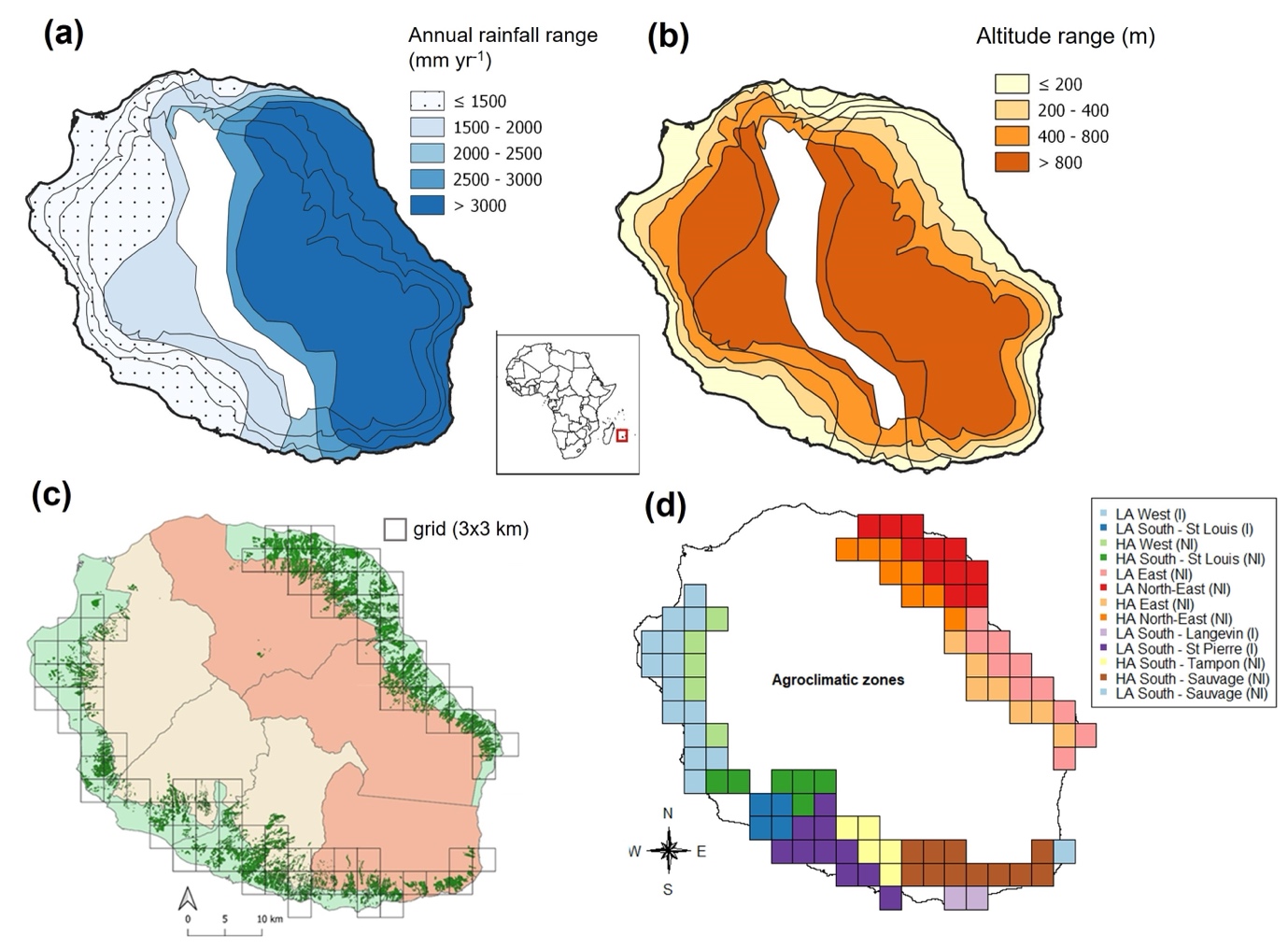
Figure 1 - Distribution in average rainfall patterns (a), altitude (b), and localization of the current sugarcane agricultural area (green, c) over the island. (d) present the subdivision of sugarcane areas into homogeneous agroclimatic zones (LA: low altitude, HA: high altitude, I: irrigated areas, NI: non-irrigated areas). The grid cells in (c) and (d) indicate the simulation units in this study.
The soil water deficit factor swdfRUE is calculated based on Brisson et al. (1992) and is controlled by two plant parameters, “sthydrue” (a parameter defining the sensitivity to water deficit) and “Ψcr” (the critical leaf water potential):
\({swdf}_{RUE} = \left( \frac{{swdf}_{rf}}{1.25\left( 0.94 + 0.26 \times \frac{\Psi_{cr}}{tp} \right)} \right)^{sthydrue} = 1 - WSI\)
Where tp is the potential transpiration rate (mm d-1), and swdfrf is the filling rate of the available soil water capacity in the soil explored by sugarcane roots (see the model description for more details). In the following study, the sugarcane water stress index (WSI) was defined as 1 - swdfRUE (0 indicating no stress and 1 indicating high stress).
The Ψcr parameter represents the critical value of leaf water potential defined as the leaf water potential at which stomata begin to close appreciably, so that CO2 uptake is no longer at its maximum. Physiologically, it corresponds to the onset of significant hydraulic limitation, where stomata progressively close to prevent hydraulic failure. The critical leaf water potential is crop‑specific (and sometimes cultivar‑specific) and reasonably ranges from -8 to -12 bars in sugarcane (Brisson et al., 1992). The sthydrue parameter is a shape parameter that controls how rapidly photosynthesis declines as water availability declines and allows for the representation of different transpiration efficiencies across varieties.
Subsequently, the allocation of total dry mass gain to root, millable stalks, and leaves is controlled by dynamic allometric fractions. Stalk water content remains constant at the beginning of growth and decreases with thermal time. The formulas governing cane growth and responses to water and temperature stresses used in this study are available in the “MOSICAS_model_description” file in the Gitlab repository (https://gitlab.cirad.fr/mathias.christina/mosicas). The model code and manual are open source (General Public License) and available on Gitlab.
An updated version of the MOSICAS model (v1.2, Christina, 2025b) was used in this study. The modified version used a new equation for the RUE-temperature response, following the work of the International Consortium for Sugarcane Modeling (Christina et al., 2025a). The authors proposed using the Wang-Engel formalism (Wang & Engel, 1998) in studies aimed at quantifying the impact of climate change on sugarcane growth. Consequently, the R570 sugarcane cultivar was re-parameterized using the maximum RUE and the cardinal temperature proposed by Christina et al. (2025a) and following the calibration procedure proposed in the same study to avoid compensatory effects. The model was calibrated using 29 ratoon crop trials conducted on Reunion Island from 1986 to 2016, sourced from the ECOFI database (Christina et al., 2020). The comparison between observed and simulated sugarcane variables was presented in Figure S1 and S2. In this study, sugarcane stalk fresh mass was defined as the sugarcane yield. The sugarcane water stress index (WSI) was simulated using MOSICAS (equation 2).
Climatic data and scenarios
In the BRIO project, Meteo France conducted high-resolution climate projections for the South West Indian Ocean. These projections were based on the main socio-economic development scenarios and adaptation and mitigation strategies (SSP). The simulations used the CM5 model from the National Center for Climate Research (CNRM) from 2015 to 2100. Three climatic scenarios were evaluated: i) RCP 2.6: Warming limited to 2°C, describing a world marked by strong international cooperation and sustainable development prioritization; ii) RCP 4.5: Warming limited to 3°C, describing a world characterized by the continuation of current trends; and iii) RCP 8.5: Warming up to 6°C, describing a world that focuses on the traditional and rapid development of developing countries, based on high energy consumption and C-emitting technologies. The climatic data were obtained from the CIRAD Meteor platform (https://smartis.re/METEOR) at the center of each grid cell (Figure 1). Daily climatic data included rainfall, global radiation, potential evapotranspiration (Penman-Monteith reference), minimum, mean, and maximum daily temperatures. Different climatic index were calculated during each simulated one-year crop cycle: average temperature (TMEAN, °C) sum of precipitation (sPPT, mm.y-1) and potential evapotranspiration (sETP, mm.y-1), the aridity index (AI) defined as sPPT/sETP, and two extreme climate index from Yao et al. (2025), the number of heavy rainfall events (defined as daily precipitation higher than 20 mm d-1) and the maximum number of consecutive dry days (CDDX, a dry day was defined as a day with lower than 1 mm d-1).
Model simulations and irrigation management
The sugarcane yield (fresh stalk mass, Mg ha-1) was simulated yearly from 2015 to 2100 in each grid cell under the three RCP scenarios. The sugarcane cultivar chosen for the simulation was the R570 cultivar for the following reasons: i) it is the main historically planted cultivar still grown in Reunion Island; ii) it is a robust cultivar that grows in all climatic areas; iii) it was the cultivar parameterized with the most available experimental data in previous studies (Christina et al., 2021). All sugarcane yields were simulated as ratoon in the MOSICAS model. For each year, two different harvest dates were used: the 15th of August and the 15th of November, representing the beginning and the end of the harvest season in Reunion. Different irrigation scenarios were defined:
1) Current irrigation regime: all areas on the island were rainfed except for the sugarcane areas in the west and south at low altitude (defined as “LA West”, “LA South – St Louis”, “LA South – St Pierre”, “LA South - Langevin”, and “LA South - Sauvage”, Figure 1d). In this case, the irrigated areas were irrigated with a fixed dose of 15 mm per week representing current practices (CTICS personal communication).
2) Automatic irrigation scenarios: all areas were subjected to automatic irrigation. In these scenarios, the irrigated dose was simulated each week to fill 20%, 40%, 60%, or 80% of the soil available water capacity. The automatic scenario with 80% filling of soil available water capacity was used to estimate the irrigation water demand.
Virtual variety simulation experiments
The use of more drought-resistant varieties as an adaptation strategy was explored through a virtual simulation experiment based on two key parameters controlling the photosynthesis response to water deficit (Ψcr and sthydrue). In a previous study using data from an international genotype x environment network trials, Jones et al. (2019) showed that RUEMAX was weakly influenced by varieties in no-stress environments (variation coefficient of 6.9%), whereas it was highly influenced by varieties in stressed environments under water deficit (variation coefficient of 20.7%). Consequently, we assumed that the variety response to water stress could explain 13.8% of the RUE variability (i.e., difference between the two environments) and, consequently, that swdfRUE could vary by ±13.8% accross varieties. To achieve this swdfRUE variability, we explored the necessary variability in sthydrue and Ψcr parameters under stressed environments (swdfr between 0.05 and 0.4) using an expanded grid method (with a 3% variation step). We found that a 13.8% variability in swdfRUE could be reached by variability of around 50% of both sthydrue and Ψcr (Figure S3).
We simulated the impact of decreasing both the sthdyrue and Ψcr parameters from 0 to -50% on future sugarcane yield under the current management regime in all simulation grids on the Island. To this aim, we simulated all combinations of decreasing sthdyrue and Ψcr at 0, 8.3, 16.7, 25, 33.3, 41.7, and 50% variations. To analyse the output, we classified the virtual varieties into eight water-stress-resistant (WSR) variety classes based on their WSI value responses to sthydrue and Ψcr.
Data analysis
All data analyses were performed using R 4.2 (R Development Core Team, 2025). The relative contribution of climatic drivers (TMEAN, sPPT, sETP, AI, and CDDX) to the explained yield variance, at the grid cell scale, was quantified using the Lindeman, Merenda, and Gold (LMG) method (relaimpo R package), which decomposes the model R2 coefficient, averaged over all possible predictor orderings, allowing robust assessment of predictor importance in the presence of collinearity. Then, the simulated variables were averaged for each grid cell and each year across the two harvest dates. The average variables across the island were calculated by weighting simulated yields in each grid cell by the proportion of cultivated area in that cell. Similarly, the variables were averaged per agroclimatic zone, weighted by the proportion of cultivated area in each grid cell.
Long-term trends in sugarcane yield and other variables were analysed using the non-parametric Mann–Kendall test to detect monotonic changes over time, and Sen’s slope estimator was applied to estimate the corresponding linear rate of change (trend R package). Three climatic periods were defined in each climate change scenario: i) the “current period” was defined as the average from 2015 to 2025, ii) the “2060 period” was defined as the average between 2050 and 2070, and iii) the “2090 period” was defined as the average between 2080 and 2100. Data smoothing for improved visualization was achieved using local polynomial regression curves (geom_smooth function).
Results
Change in temperature, evapotranspiration, and precipitation patterns
The long-term trend of average temperatures across the island increased by +0.008 (p<0.001), + 0.025 (p<0.001), and +0.051°C y-1 (p<0.001), in the RCP 2.6, 4.5, and 8.5 scenarios, respectively (Figure 2a). This increase was homogeneous across the island (Figure S4). Similarly, average ETP increased by +1.53 to +1.64 mm.y-1 (p<0.001), depending on scenarios (Figure 2c). The increase in ETP was higher in the East and South parts of the island compared to the western areas (Figure S5). On the contrary, annual rainfall was much more variable in the future across periods and scenarios, and no significant monotonic long-term trends were found (Figure 2b). It included periods of decreasing rainfall (e.g., RCP 4.5 and RCP 8.5 in the 2060 period) or constant regimes. Nonetheless, changes in rainfall relative to the current period were highly variable across the considered climatic areas (Figure S6, Table S1). In RCP 4.5 and RCP 8.5 scenarios, the south of the island was the most impacted (-8 to -20% accrosse scenario and period, compared to the current period, Figure S6). The northeast was also characterized by lower rainfall in the 2060 period but not in the 2090 period. The aridity index (sPPT/sETP ratio) tended to decrease in average across the island (Figure 2), but the trend was significant only in the RCP 8.5 scenario (p=0.011). In addition, the RCP 8.5 scenario was characterized by an increase in maximum consecutive dry days (CDDX, p = 0.002) and a decrease in heavy rainfall events (> 20 mm d-1, p = 0.005) on average across the island.
Relative importance analysis indicated that annual rainfall, CDDX, and aridity index were the main climatic drivers of projected sugarcane yield variability, accounting for 34%, 31, and 27% of the explained variance, respectively. The average temperature contributed 4% of the explained variance, whereas ETP contributed even less (3%). Together, these five annual climatic variables explained 75% of the total yield variability.
Change in yield, water stress, and irrigation demand under the current irrigation regime
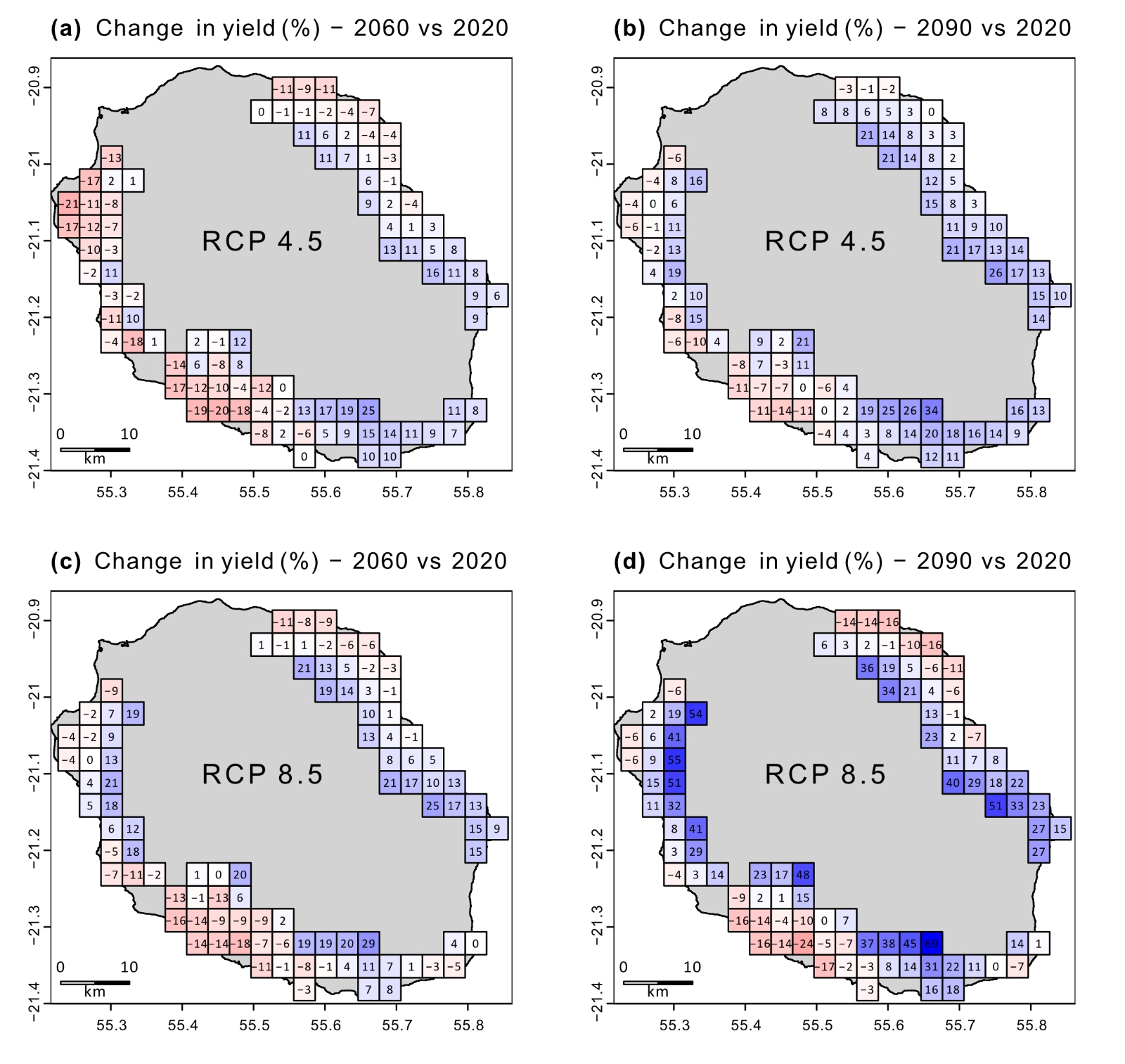
Under the current irrigation regime, the average sugarcane yield across the island was little affected by climate change scenarios (Figure 3a). However, yield variations were highly variable across agroclimatic zones (Figure 3b, Figure 4, Table S1). Despite some discrepancies between RCP scenarios and periods, the current irrigated areas in the South, West, and North-East tended to have lower sugarcane yields (Figure 3b, 4, S7), except for the “South - Langevin” and “South – Sauvage” areas. In these areas, long-term decreases were mainly significant in the RCP 8.5 scenario (Table S1). In particular, the low-altitude areas “South – St Pierre” and “South – St Louis” showed an average decrease in yield of -8 % and -4% by 2060 and 2090, respectively (averaged across the RCP 4.5 and 8.5 scenarios), corresponding to a decrease in yield of -9 and -5 Mg ha-1 (Figure S7). On the contrary, high-altitude areas in the East, North-East, and “South-Sauvage” showed significant increases in yields in the RCP 4.5 and 8.5 scenarios (Table S1). Average yield increase in these areas ranged from +11 to +27% by 2090 (Figure 3b), corresponding to increase in yield from +12 to +33 Mg ha-1 (Figure S7). More specifically, high-altitude areas in East and North-East showed an average increase in yield of +9% (+10 Mg ha-1) and +17% (+20 Mg ha-1) by 2060 and 2090, respectively (averaged across the RCP 4.5 and 8.5 scenarios). Finally, the low-altitude eastern areas were little impacted by RCP scenarios compared to the current period.
All three scenarios were characterized by a significant increasing water stress index (WSI) and irrigation water demand on average across the island (Figure 3c,e, Table S1), with an increase of 31 and 47% in WSI, and an increase of 15 and 24% in irrigation demand, averaged across RCP, in the 2060 and 2090 periods compared to the current one, respectively. In general, the agroclimatic zones that were most negatively affected in terms of yield were also those with the greatest increases in WSI and irrigation water demand (Figure 3d,f).
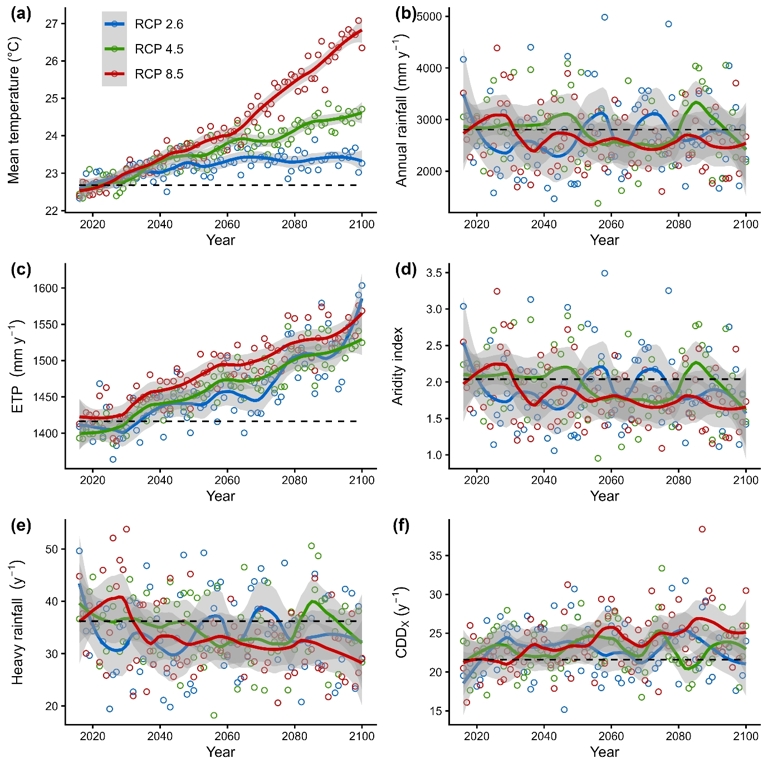
Figure 2 - Change in average daily temperature (a), annual rainfall (b), potential evapotranspiration (ETP, c), aridity index (d), heavey raindall events (> 20 mm d-1, e), and maximum number of consecutive dry days (CDDX, f) in Reunion Island cultivated areas from 2015 to 2100, considering three RCP scenarios. The dashed lines represent the current average from 2016 to 2025, and points represent the annual average across the island.
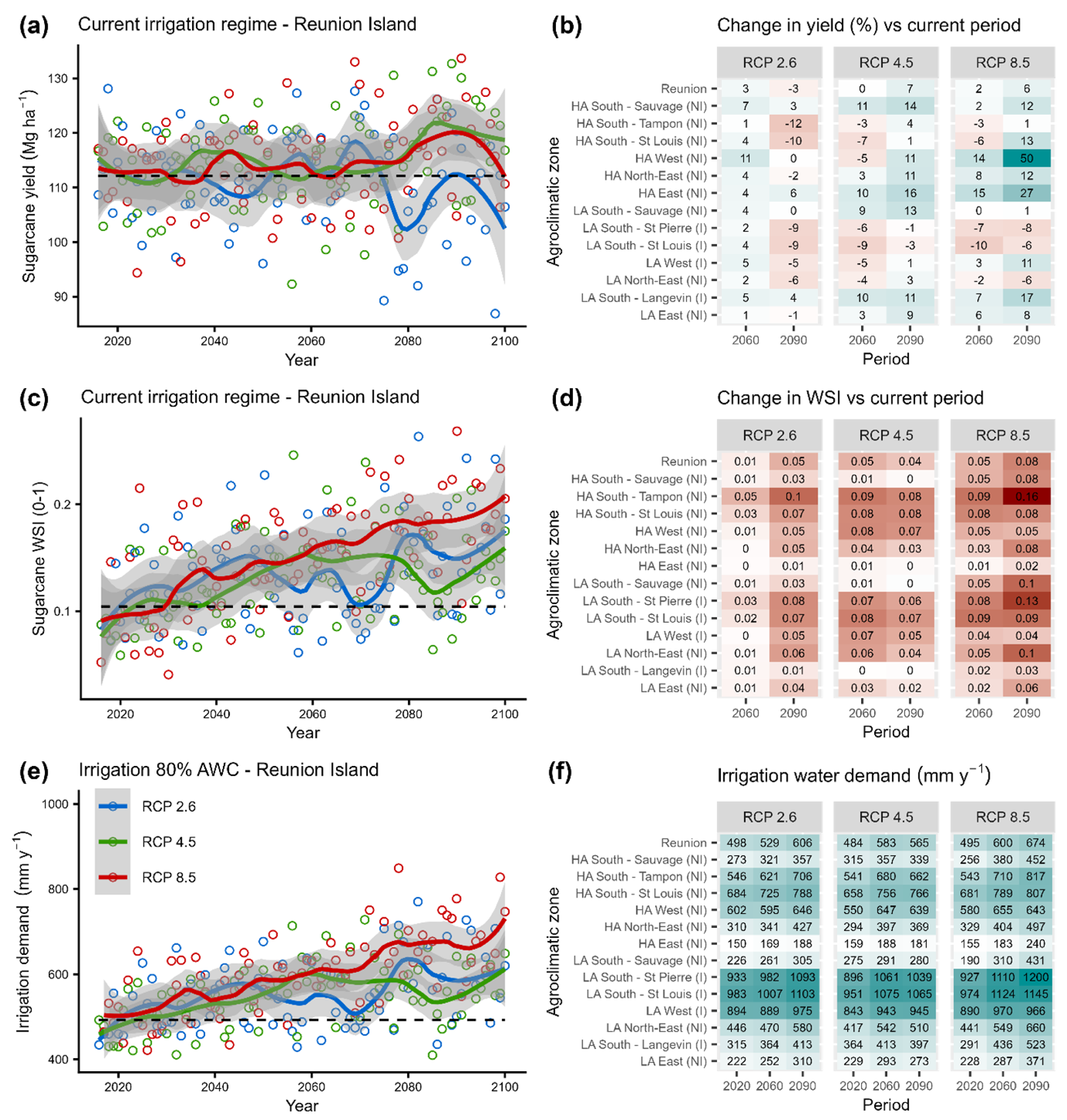
Figure 3 - Variations in sugarcane yield (a,b), water stress index (WSI, c,d), and irrigation water demand (e,f) under the current irrigation regime. The average annual changes across the island, depending on RCP scenarios, are presented from 2015 to 2100 (a,c,e). Simulations were performed with the R570 cultivar. The dashed lines represent the current average from 2016 to 2025. The average changes in yield and WSI in each agroclimatic zone between the 2060 or 2090 period and the current period are presented in (b,d). Average irrigation water demand per agroclimatic zone and RCP scenario is presented in (f). The current irrigation regime in each agroclimatic zone is indicated by I (irrigated areas) and NI (non-irrigated areas). The altitude range of the agroclimatic zones is indicated by LA (low altitude) and HA (high altitude). In (b,d,f), a gradient of colors was added to improve visibility. Changes in yield (b) expressed in Mg ha-1 are presented in Figure S7.
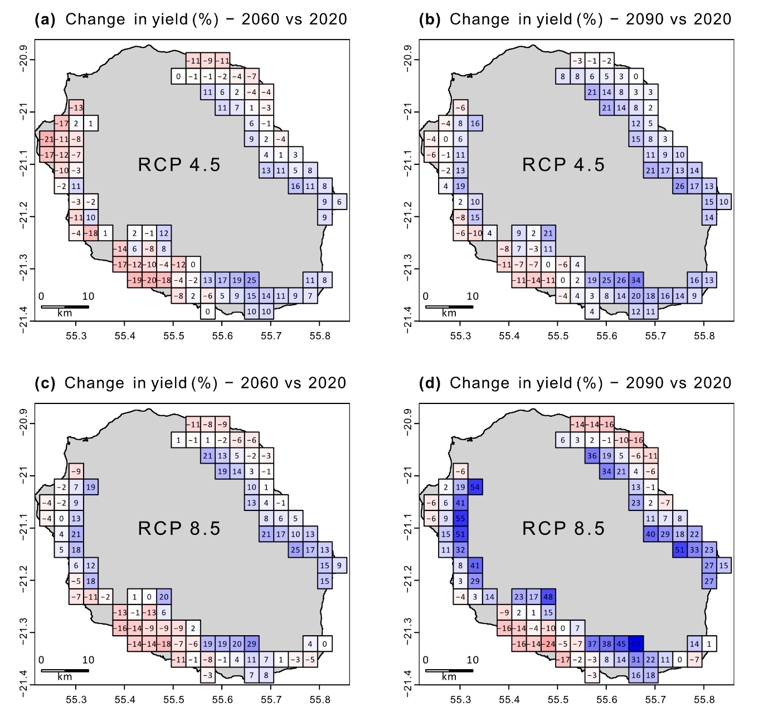
Figure 4 - Change in sugarcane yield (%) in each simulated grid cell across the island between the 2060 period (a,c) or the 2090 period (b,d) and the current 2020 period in the RCP 4.5 (a,b) and 8.5 (c,d) scenarios. Simulations were performed with the R570 cultivar. A gradient of color from decreasing (red) to increasing (blue) values was added. The map showing changes in yield expressed in Mg ha-1 is presented in Figure S8.
Change in yield under different irrigation management across the island
All currently non-irrigated areas showed an increase in yield in all scenarios, compared to the current period, as soon as an automatic irrigation of 20% of soil available water capacity (AWC) was applied (Figure 5, Figure S9). The highest increase in percentage was observed in non-irrigated areas at high altitude, particularly in the West and South – St Louis. The northeastern areas in low altitudes also showed increasing yield by 8 to 14% (+11 to 19 Mg ha-1, Figure S9) under 20% AWC automatic irrigation in the future, depending on climatic scenarios and periods, compared to the 0 to -6% decrease under the current irrigation regime (Figure 3b). Regarding current irrigated areas with fixed weekly dose, an automatic irrigation with 40% or 60% of AWC showed an increase in yield compared to current period, in all climate change scenarios. The highest increases with these automatic irrigations in currently irrigated areas were predicted in low-altitude areas of “St-Pierre” and “St-Louis”, as well as low-altitude western areas (Figure 5, Figure S9).
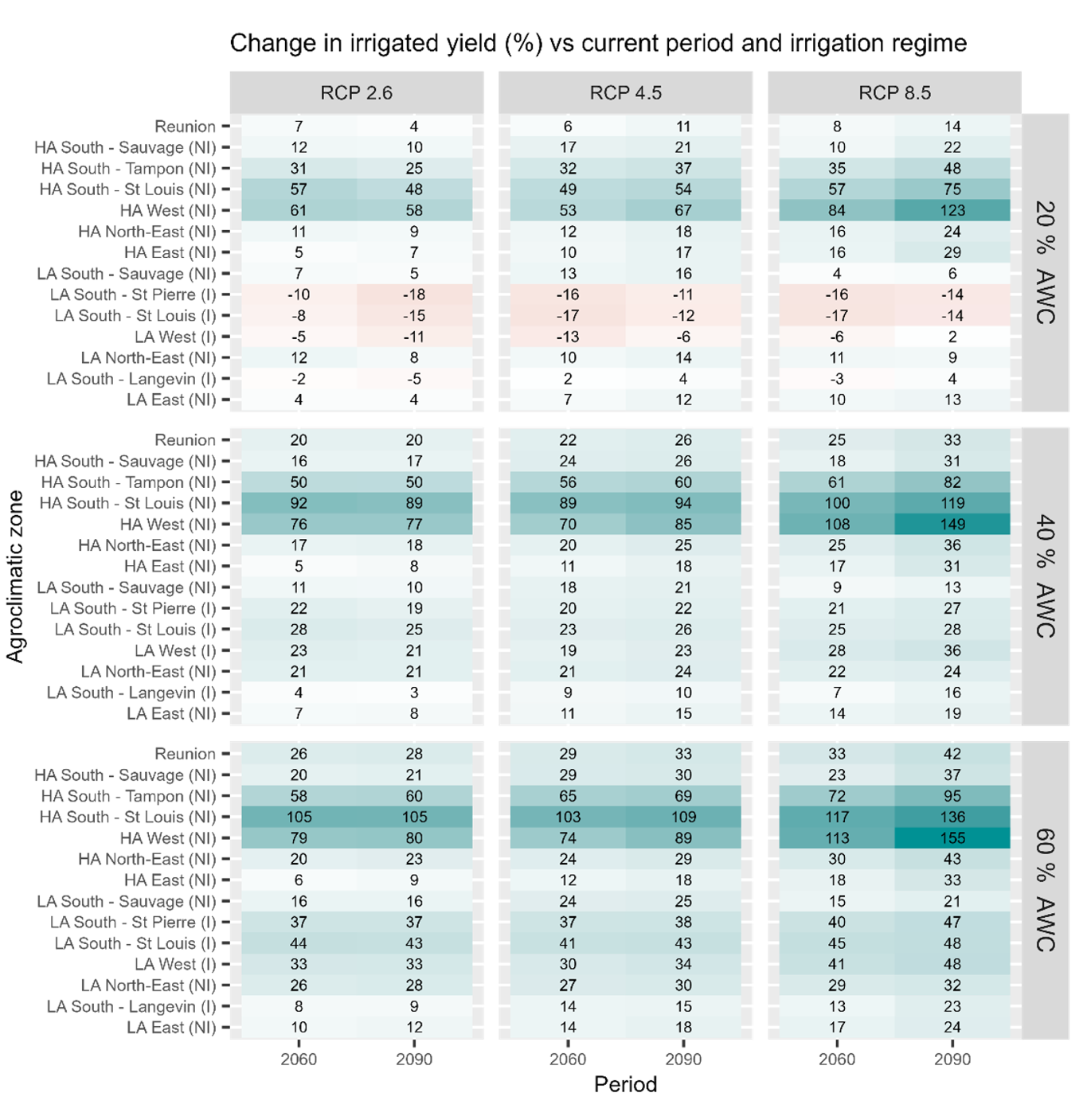
Figure 5 - Change in sugarcane yield under automatic irrigation regime filling weekly 20, 40, and 60% of soil available water capacity (AWC) in the 2060 and 2090 periods compared to the current period and current irrigation regime (fixed dose of 15mm w-1 in irrigated areas), under the three RCP scenarios, and depending on the agroclimatic zones. Simulations were performed with the R570 cultivar. The current irrigation regime in each agroclimatic zone is indicated by I (irrigated areas) and NI (non-irrigated areas). The altitude range of agroclimatic zones is indicated by LA (low altitude) and HA (high altitude). A color gradient was added to improve visibility. Changes in yield under the different irrigation regimes expressed in Mg ha-1 are presented in Figure S9.
Change in yield depending on cultivar water stress sensitivity
Based on the Ψcr and sthydrue parameters in the virtual experiment, eight sugarcane water-stress-resistant (WSR) varieties were defined (Figure 6a). The WSR0 variety corresponded to the current R570 variety used in this study, while the WSR7 variety corresponded to the variety with the lowest sensitivity to water stress. On average, in the current period, the WSI was lower by 8, 14, 20, 29, 36, 45, and 53% with WSR1, WSR2, WSR3, WSR4, WSR5, WSR6, and WSR7, respectively, compared to WSR0. Change in sugarcane yield compared to the current period and current variety increased with the increase in water-stress resistance in varieties (Figure 6c), and positive changes were reached on average on Reunion Island from the WSR2 variety in both the 2060 and 2090 periods in all three climate change scenarios. Among the main sugarcane areas facing a negative impact of climate change on yield (Figure 3b), positive changes in yield compared to the current period were observed in low altitudes in currently irrigated areas (LA West, LA South St Louis, LA South St Pierre) and in non-irrigated areas (LA North-East) from the WSR2 and WSR3 varieties (Figure 6c). Similar observations were made on areas in high altitudes facing a negative climate change impact on yield. On average across climate change scenarios, the simulation with the WSR7 variety, which showed the lowest sensitivity to water stress, increased sugarcane yield by 15% and 18% in 2060 and 2090, respectively, compared to the current period and current variety.
Discussion
Sugarcane response to climate change
Climate change poses a serious threat to sugarcane agriculture, but the expected consequences vary significantly across affected areas (Linnenluecke et al., 2018). Globally, projections show contrasting responses across climatic zones (Zhao & Li, 2015) due to the combination of favorable conditions such as increasing temperature and atmospheric CO2 (Marin et al., 2013; Ruan et al., 2018), and unfavorable rainfall patterns (Knox et al., 2010; Sonkar et al., 2020). In tropical regions, temperature increases are generally expected to remain within the optimal range for sugarcane carbon assimilation (Christina et al., 2025a), suggesting that future yield limitations will be increasingly linked to water availability rather than thermal constraints (Dias & Inman-Bamber, 2020). In this regard, our study used an improved model of carbon assimilation response to temperature (Christina et al., 2025a), allowing us to better isolate water limitations in future climates.
While average yields at the island scale were only slightly affected, large spatial contrasts emerged between agroclimatic zones. Areas projected to experience decreasing rainfall or longer dry periods showed increased water stress and yield reductions, whereas areas with more stable or favorable rainfall patterns showed yield increases. This spatial and temporal heterogeneity illustrates the strong sensitivity of sugarcane production to rainfall availability in Reunion Island. Relative importance analysis showed that water-deficit conditions, expressed through the aridity index together with annual rainfall and maximum consecutive dry days (CDDX), were the dominant climatic drivers of projected yield variability. These results highlight the importance of taking into account the increase in ETP in the future (through its role on aridity index) linked to temperature, as both rising temperatures and no rain period are expected to increase atmospheric evaporative demand through higher vapor pressure deficit (VPD), thereby enhancing potential transpiration rates (Hsiao et al., 2019). This stronger evaporative demand accelerates soil water depletion, shortening the duration during which soil water remains available to sustain canopy photosynthesis. The importance of precipitation distribution in the response of sugarcane, beyond annual precipitation, is therefore critical, as longer dry spells combined with elevated VPD intensify the rate at which soil water reserves are exhausted between rainfall events. The strong contribution of consecutive dry days emphasizes the importance of drought duration and rainfall intermittency. Prolonged intra‑seasonal water deficits during the formative and grand growth stages reduce green leaf area, hasten canopy decline, and limit stalk elongation and tiller survival, even when total seasonal water inputs are only moderately reduced (Rossler, 2013) because higher evaporative demand increases daily crop water use, amplifying the speed and severity of soil water depletion under otherwise comparable rainfall totals. Increasing VPD is now recognized as a major driver of plant physiological responses under climate change, inducing stomatal closure, constraining photosynthesis and growth, and increasing the risk of hydraulic failure, even independently of changes in total rainfall (Grossiord et al., 2020).
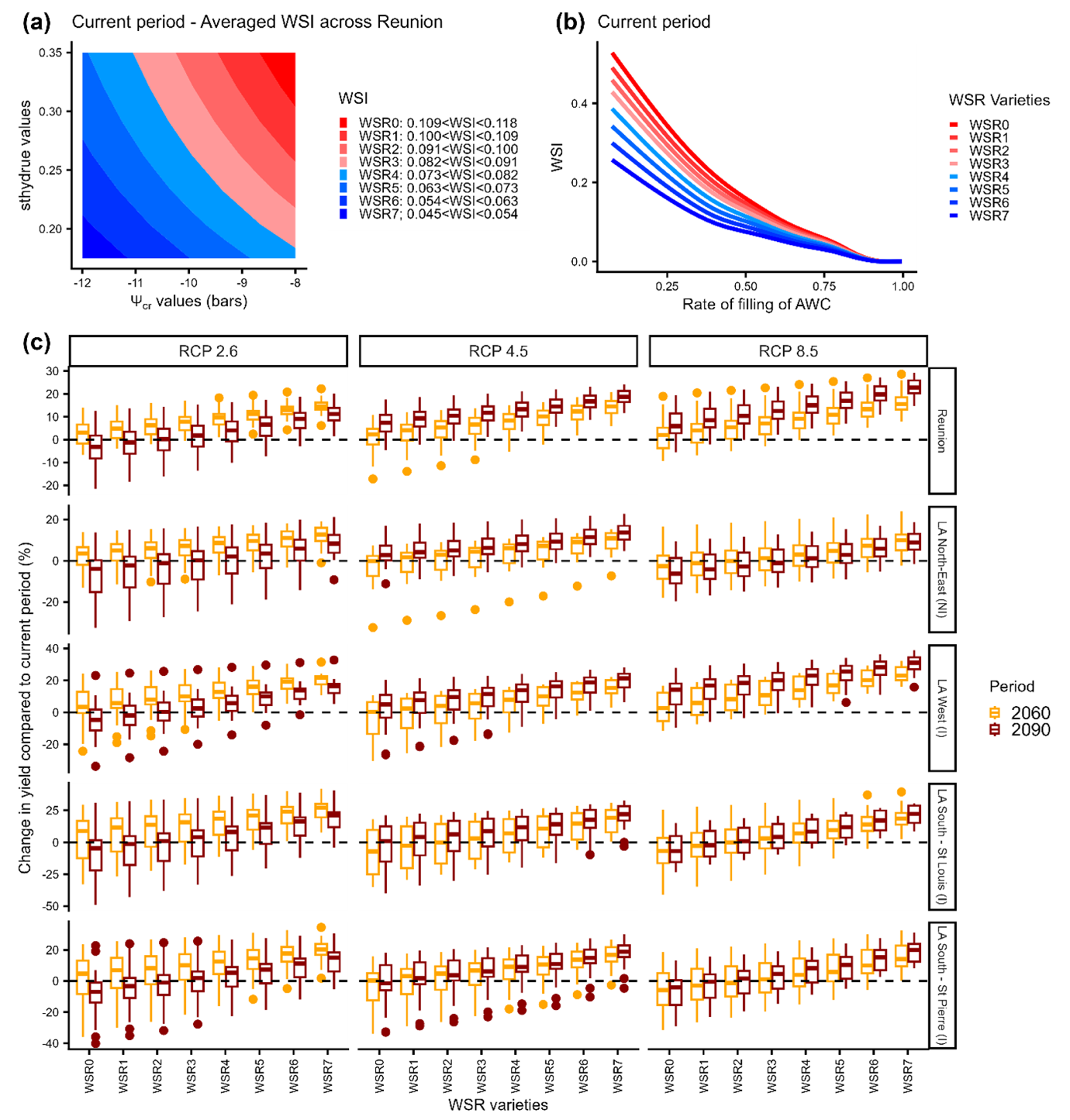
Figure 6 - Change in yield depending on virtual water-stress resistant (WSR) varieties. (a) represent the average sugarcane water stress index (WSI) depending on Ψcr and sthydrue parameter values in the current period and the categorization of Ψcr and sthydrue into WSR varieties. WSR0 represents the current R570 variety, while WSR7 represents the variety with the lowest sensitivity to water stress. (b) illustrate the change in average WSI across the different grid cells as a function of the average rate of filling of the soil available water capacity (AWC) for each WSR variety (WSR0 to WSR7). (c) Changes in sugarcane yield in the 2060 and 2090 periods relative to the current period, under the current irrigation regime, depending on the three RCP scenarios and WSR varieties. Changes are presented on average in Reunion Island and a few agro-climatic zones where irrigation was insufficient to cope with climate change under the current irrigation regime. Irrigation in agroclimatic zones is indicated by I (irrigated areas) and NI (non-irrigated areas). The altitude range of agroclimatic zones is indicated by LA (low altitude) and HA (high altitude).
Our study highlights the growing potential of higher-altitude areas for sugarcane production using the historic R570 variety in the model. This conclusion would still hold true if we also consider the use of new varieties adapted to these high-altitude conditions (Poser et al., 2020). Rising temperatures are expected to reduce thermal limitations in these zones while maintaining sufficient water availability in some regions, thereby increasing yields. This confirms the importance of considering future crop redistribution strategies within the island. Similar trends have been suggested in other tropical regions where warming may open new suitable production zones while increasing water stress in currently productive lowland areas. For instance, higher-altitude zones in the tropical islands of the Indian Ocean will become more conducive to sugarcane cultivation, even without irrigation (Nayamuth, 2005; Christina et al., 2024), as observed in the high-altitude areas in the Northeast and East in our study. In Brazil, the world’s leading sugarcane producer, climate change may also progressively favor expansion into the southern part of the country, where cooler temperatures have historically limited cultivation (Mombo et al., 2025), while current sugarcane areas may require additional irrigation (da Silva et al., 2021). Nevertheless, on Reunion Island, the expansion of sugarcane areas at higher altitudes may encounter technical difficulties (e.g., steep slopes) and potential conflicts with other systems, such as livestock farming.
Small islands are particularly vulnerable to the impacts of climate change, yet they are poorly investigated, especially in the Indian Ocean. Previous projections for tropical islands suggested significant yield decreases, such as 20-40% in the South Caribbean (Singh & Maayar, 1998) or 32-57% in Mauritius (Cheeroo-Nayamuth & Nayamuth, 2001), which are higher than the decrease predicted in our study. Compared with earlier projections performed using coarse climate models, the high-resolution BRIO projections used here (Leroux et al., 2021) suggest more moderate but spatially contrasting impacts. Consequently, ongoing research on tropical islands is still needed to provide updated local climate change projections and their impact on sugarcane yield. Despite scenario uncertainties, consistent trends emerge, including increasing irrigation demand, the growing relevance of irrigation in new areas, and the rising suitability of high-altitude zones. These results support the need for locally adapted adaptation strategies rather than island-wide uniform responses.
Irrigation management as an adaptation strategies
Among the adaptation levers identified in this study, irrigation management appears as a major short- to medium-term strategy to mitigate climate change impacts on sugarcane yield. Our simulations show that extending irrigation to currently rainfed areas could significantly reduce yield losses and even generate yield gains, particularly in high-altitude and northeastern areas that currently lack irrigation infrastructure.
These results reinforce previous studies showing that maintaining soil water availability during key growth stages is essential for sustaining canopy development, biomass accumulation, and final yield (Knox et al., 2010; Jones et al., 2015; Santillan-Fernandez et al., 2016). However, reduced precipitation and increased evapotranspiration due to higher temperatures are decreasing the availability of freshwater, leading to increased competition for this resource between agriculture, domestic, and industrial uses (Dvigun et al., 2022) and even more so in the context of a demand for improved water quality (van Grieken et al., 2013). This is particularly critical in island environments where water resources are limited and highly variable spatially and seasonally. In this context, irrigation with saline or brackish water is increasingly considered as an alternative to alleviate freshwater scarcity. However, salinity can negatively affect sugarcane growth, yield, and quality through both osmotic and ionic stresses (Morais et al., 2022). Nonetheless, sugarcane is generally classified as moderately salt-tolerant, and strong genotypic variability exists (Chiconato et al., 2019), suggesting substantial potential for breeding and selection.
Beyond simple irrigation expansion, improving irrigation efficiency will be essential in Reunion, as seen in many other regions (Shrivastava & Srivastava, 2012; Ribeiro et al., 2014; Guerrero-Carrera et al., 2015; Singels et al., 2023). Advanced irrigation technologies such as drip or subsurface irrigation can reduce water losses and improve water productivity (Gunarathna et al., 2018; He et al., 2021). However, their implementation in Reunion Island faces technical and economic constraints, including infrastructure costs, maintenance complexity (e.g., difficulties in managing buried drip lines during harvesting), and compatibility with sugarcane cropping systems (e.g., need to reconstruct the entire network during replanting). Beyond these technologies, our study highlights that dynamic irrigation scheduling strategies that match crop water demand throughout the season can yield greater water savings than fixed-dose irrigation strategies. On Reunion Island, irrigation is still mainly carried out using fixed systems (hence the baseline scenario used). Some growers adapt their irrigation to rainfall, but mainly by manually stopping irrigation when rain is expected. Our study illustrates how automatic irrigation planning (based on soil water content or rainfall) has great potential to limit yield losses in irrigated areas, while also reducing water use (Anjaly et al., 2024). Greater efficiency would allow irrigation to be allocated to areas currently not irrigated at a constant water volume, thereby limiting competition with other uses.
Importantly, our results raise questions about the economic and logistical feasibility of developing irrigation infrastructure in new agricultural areas. Future work should integrate agronomic, hydrological, and economic assessments to identify optimal irrigation expansion strategies under climate change scenarios. To address both societal and environmental constraints on water availability, future studies could assess irrigation requirements for a given new area under efficient irrigation and evaluate their impact on yield gains relative to associated costs. Crop models can be useful tools for these issues (Rehana & Mujumdar, 2013; Foster & Brozović, 2018), but they essentially simulate climate or soil-limited growth without taking into account certain limitations that will also be influenced by water availability, such as weed pressure, thus potentially overestimating yield gain following the implementation of irrigation.
Varietal adaptation strategies
Varietal improvement represents a complementary long-term adaptation strategy to irrigation management under climate change (Bhaskaran & Nair, 2014; Zhao & Li, 2015; Grandis et al., 2024). Our virtual variety simulations demonstrate that moderate improvements in drought tolerance could significantly reduce yield losses under future climate conditions, even without modifying irrigation practices. On Reunion Island, the breeding programme led by the eRcane institute has focused on creating varieties adapted to the different environments of La Réunion (Dumont et al., 2019) without specifically targeting improved drought tolerance. However, the recent establishment of a new breeding station under water-limited conditions (Dumont et al., 2022), as well as ongoing work showing variability in transpiration efficiency between Reunion varieties (Pilloni et al., 2025), opens the door to better consideration of these constraints in the breeding programme.
The simulated variety improvements were mainly associated with traits linked to leaf water relations, particularly lower critical leaf water potential thresholds and improved tolerance of photosynthesis to declining soil water availability. These traits allow plants to maintain photosynthesis and growth under moderate soil water deficits, thereby reducing the impact of drought episodes. Although not explicitly simulated in this study, traits such as rooting depth and root system architecture are also likely to play a key role by improving soil water exploration during dry periods (Inman-Bamber et al., 2012). Given that both water use efficiency and root depth may have a genetic basis (as seen in other crops, Hund et al., 2009), they represent relevant targets for breeding efforts to improve drought tolerance. Nonetheless, root phenotyping remains challenging in field conditions (Teramoto & Uga, 2022). Root traits remain poorly characterized at the varietal level under field conditions in sugarcane, and their characterization has mainly been conducted in controlled-environment experiments (Pierre et al., 2019). In addition, above-ground architectural traits that optimize light distribution may also have contrasting effects on drought response, depending on how they modulate evaporative demand and water use efficiency (Ponce de León & Bailey, 2024).
To translate these modeling insights into breeding programs, improving phenotyping approaches will be essential. New digital phenotyping tools, such as 3D and multispectral imaging, show strong potential for aboveground traits in other crops (Lazarević et al., 2022; Sarić et al., 2022). These strategies remain largely unexplored in sugarcane. Combining high-throughput phenotyping and crop modeling approaches could help accelerate the identification of drought-adaptive traits in sugarcane breeding programs.
Perspective for variety-specific modeling strategies regarding water stress response
To face the challenge of a changing climate, the focus will need to shift toward developing drought-tolerant cultivars and integrating drought-tolerance traits into crop models (Inman-Bamber et al., 2012). This approach is crucial for predicting crop performance under water-limited conditions and for guiding breeding strategies to maintain yields amid increasing climatic variability. Crop models, widely used for simulating genotype × environment (G × E) interactions (Jones et al., 2021), must evolve to incorporate varietal traits that determine physiological responses to water stress. In most crop models (e.g., APSIM-Sugar, Keating et al., 1999; DSSAT-Canegro, Jones & Singels, 2018; or MOSICAS, Christina et al., 2021), photosynthesis and transpiration are limited by the extent to which the root water supply meets the demand of the crop canopy. Consequently, genotypic trait variation related to water stress can be represented as either crop canopy demand or root water uptake capacity.
Traits that mediate the canopy’s ability to cope with water deficit, such as stomatal regulation of transpiration in response to evaporative demand, are essential under scenarios of short-term, transient drought (Vadez et al., 2024). Differences in sugarcane water use efficiency among genotypes may result from genetic variation in leaf internal CO2 concentrations (Jackson et al., 2016) or the plant’s ability to close its stomata during periods of high vapor pressure deficit (Inman-Bamber & De Jager, 1986). The APSIM-Sugar model introduced these mechanisms, in particular through the variety-specific response of transpiration efficiency to water stress (Inman-Bamber et al., 2016). More indirectly, the DSSAT-Canegro and MOSICAS models also enabled variety-specific transpiration efficiency by altering the sensitivity of carbon assimilation to the water stress index (Singels et al., 2010; Christina et al., 2021). Nevertheless, in these two models, canopy transpiration is limited only by root water uptake and potential demand (based on potential evapotranspiration), and does not allow for stomatal closure in response to high vapor pressure deficits.
Contrary to the change in canopy water demand with variety, the variety-specific root water uptake capacity response to water stress in crop models has been much less studied. In most crop models, root water uptake is calculated based on root length and soil-to-root conductance (Inman-Bamber et al., 2016; Singels et al., 2010; Christina et al., 2021), with various methods used to represent the latter. Therefore, an intuitive approach is to simulate, for each variety, different root length distributions between varieties and the response of these systems to water stress in a differentiated manner. However, to our knowledge, no study has focused on this aspect, specifically the importance of representing variability in root systems between sugarcane varieties. The primary reason is the limited amount of experimental data available in this regard. As previously mentioned, the root system architecture, despite its critical role in water uptake during dry periods, remains insufficiently studied at the varietal level under field conditions, even though some studies have reported phenotypic variability in root length (Set-Tow et al., 2020; Vengavasi et al., 2022). Nevertheless, several initial model improvements could be made. In particular, reduced water availability has been shown to increase root length and root front (Battie Laclau & Laclau, 2009). Improving the integration of these traits into sugarcane crop models and their variability across varieties could support the identification of ideotypes better adapted to future climates, enabling a more robust evaluation of breeding strategies.
Conclusions
This research provides insights into the impacts of climate change on sugarcane yield in Reunion Island and suggests adaptation strategies. Average yields across the island may experience minor fluctuations, but significant regional disparities are expected due to varying precipitation patterns. Specifically, the southern coast is projected to experience substantial yield declines, whereas high-altitude areas in the east are expected to benefit from increased yields. The study identifies measures to mitigate adverse effects, such as improving irrigation management and cultivating drought-resistant sugarcane varieties. The research also suggests high-altitude regions could become viable for sugarcane cultivation, indicating a strategic shift in agricultural zones that must be anticipated. Overall, integrating these adaptive practices offers a framework for maintaining and enhancing sugarcane productivity. These findings are highly relevant to policymakers and farmers across a wide range of tropical regions experiencing similar environmental conditions, underscoring the need for proactive measures to ensure sustainable agricultural practices in the face of climate change.
Acknowledgements
We are thankful to Météo France for sharing the climate change projection from the BRIO Project. Preprint version 3 of this article has been peer-reviewed and recommended by Peer Community In Plants (https://doi.org/10.24072/pci.plants.100002; Mathieu, 2026).
Funding
The research was supported by the CIRAD, France, the Conseil Regional de La Réunion, France, the French Ministry of Agriculture and Food, France, and the European Union as part of the CAPTERRE project (Feader - REU77071-1-000010 and Feder - 2024-1248-005756 programs).
Conflict of interest disclosure
The authors declare that they comply with the PCI rule of having no financial conflicts of interest in relation to the content of the article.
Data, scripts, code, and supplementary information availability
Scripts and code are available online: https://doi.org/10.5281/zenodo.15130335 (Christina, 2025a)
Supplementary information is available online: https://doi.org/10.5281/zenodo.15350078 (Christina et al., 2025b).