

 CC-BY 4.0
Introduction
Microbial activity is a primary driver of the deterioration of waterlogged archaeological wood. Understanding the microorganisms involved – particularly bacteria – is essential for elucidating how biological decay contributes to wood cell degradation and long-term preservation (Daniel & Nilsson, 1986). Microbes break down lignocellulosic structures through enzymatic processes that directly affect both the physical integrity of wooden artefacts and their archaeological interpretive value (Blanchette, 2000) and references therein). Identifying which microorganisms are active under specific environmental conditions can therefore improve our understanding of degradation rates, help predict preservation potential, and inform conservation strategies for submerged or waterlogged heritage sites. Beyond their role in decay, bacterial communities preserved in archaeological wood may also reflect environmental colonization histories or past ecological associations, meaning that comprehensive community profiling can support broader interpretations of microbial origin and site conditions in future studies.
Microbial degradation of wood occurs through different pathways depending on environmental conditions. In oxygenated environments, fungi – especially soft rot and white rot species – are the dominant decomposers, capable of breaking down both lignin and cellulose (Blanchette, 1995, Singh, 2012, Kipping et al., 2024). Under anoxic or low-oxygen conditions, however, bacteria become the primary degraders, employing distinct enzymatic mechanisms that target cellulose and hemicellulose but often leave lignin intact. Among these, so-called erosion bacteria are frequently associated with the decay of submerged wood. The term does not refer to a defined taxonomic group but rather to a characteristic microscopic decay pattern in which bacteria progressively erode the secondary cell wall (Björdal et al., 1999). Despite extensive microscopic documentation of this decay form, the precise taxonomic composition of the microorganisms responsible remains poorly resolved (Helms, 2008).
Traditionally, microbial degradation has been studied using a range of imaging techniques such as light microscopy, scanning electron microscopy (SEM), transmission electron microscopy (TEM), and confocal Raman imaging (Björdal et al., 1999, Pedersen et al., 2015). These methods reveal morphological changes in decayed wood and can distinguish between fungal and bacterial decay types: erosion, tunnelling, and cavitation (Blanchette, 2000). However, while they provide morphological evidence of microbial activity, they do not allow for taxonomic or functional identification of the microorganisms responsible.
Recent advances in molecular biology have transformed the study of wood degradation by enabling direct identification of microbial taxa. Shotgun metagenomic sequencing provides broad insights into both taxonomic and functional diversity within complex microbial communities and is widely applied in environmental microbiology (e.g. Jimenez et al., 2012, Nam et al., 2023), including investigations of microbial communities associated with wood biodeterioration (e.g. Schrader et al., 2025). In contrast, amplicon-based sequencing, particularly of the bacterial 16S rRNA gene, remains a widely used cost-effective method for profiling bacterial communities. As reference databases with high taxonomic resolution, especially as reference databases expand and bioinformatic pipelines improve, allowing for the accurate identification of bacteria involved in wood degradation, even in degraded or low-biomass samples (Chu et al., 2025).
Earlier efforts to characterize bacterial communities in waterlogged wood faced substantial challenges. Culture-based studies were limited by low recovery rates and biases against unculturable microorganisms (Helms et al., 2004, Helms, 2008), while early genetic studies struggled with incomplete reference databases, limiting taxonomic resolution (Landy et al., 2008). More recent studies (Beccaccioli et al., 2023, Kim et al., 2023, Chu et al., 2025) have demonstrated the diversity of bacterial taxa in archaeological wood and their likely role in degradation. However, results vary considerably between studies, underscoring the need for reliable and intercomparable molecular workflows that can produce consistent bacterial community data across different wood types and preservation conditions.
A critical first step in generating robust bacterial profiles is the extraction of DNA from the wood matrix. Despite the increasing use of genetic tools, few studies have systematically evaluated how different DNA extraction methods perform on waterlogged archaeological wood. DNA extraction efficiency strongly influences the accuracy of bacterial community profiling (Eriksen et al., 2020). Commercial extraction kits differ in their ability to lyse bacterial cells, remove PCR inhibitors such as humic substances and wood-derived compounds, and recover DNA of varying integrity and abundance (Marotz et al., 2017, Pearman et al., 2020). This is particularly relevant for waterlogged archaeological wood, where the extent of microbial degradation can be highly heterogeneous, ranging from well-preserved to heavily degraded wood within the same object (e.g. Björdal et al., 1999, Pedersen et al., 2015), and the recovered DNA may represent both living and historically active microbial communities. DNA recovered from such environments may therefore include extracellular or fragmented DNA that has persisted under anoxic conditions for extended periods, meaning that DNA-based community profiles can reflect both present and past microbial colonization. Consequently, extraction methods capable of recovering DNA across a range of fragment sizes are important to obtain representative bacterial profiles. Comparative studies across a range of substrates demonstrate that DNA extraction methods can influence downstream microbial profiles. For example, extraction protocols effects on community composition and yield have been documented in sediments and environmental samples (e.g. Marotz et al., 2017, Pearman et al., 2020), while studies using mock-up communities and controlled substrates similarly report variation in DNA recovery and taxonomic representation (e.g Shaffer et al., 2022, Yu et al., 2022). These findings emphasize the importance of selecting an appropriate and reproducible extraction protocol for waterlogged archaeological wood.
In addition to molecular performance, extraction protocols differ in hands-on time, workflow complexity, and the amount of plastic consumables required. These practical factors affect the feasibility, cost-effectiveness, and sustainability of large-scale or routine analyses. Multi-step protocols increase both contamination risk and plastic waste – important considerations in sustainable laboratory practice.
To address these gaps, the present study focuses specifically on bacterial communities in waterlogged archaeological wood, recognizing that this material may represent a mixture of historically active, environmentally derived, and potentially recent microbial communities, and aims to identify the most effective commercial DNA extraction kit for recovering bacterial DNA from waterlogged archaeological wood. We compared three commercially available extraction kits in terms of DNA yield, bacterial alpha- and beta-diversity, and taxonomic composition. Given the challenges of degraded, anoxic material, we also assessed practical factors such as processing time and cost. The ultimate goal was to determine which method provides the most reliable and comprehensive representation of bacterial communities associated with degraded archaeological wood.
Materials and Methods
Sampling
A waterlogged archaeological wooden pole (Corylus avellana) from a Neolithic fish-trap system (Figure 1A), was recovered during underwater excavations at app. 2 meters depth at the KoFIX site (54˚45’26”N 11˚52’06”E) near Nykøbing Falster in Guldborg Sund, southern Denmark. The pole was radiocarbon dated to 4121 ± 31 BP (Ua-92929), corresponding to 2866-2577 cal BC (95.4% probability) following calibration with IntCal20 calibration curve (Reimer et al., 2020). After site excavation, the pole remained exposed on the seabed for approximately two months before being raised and transported to the laboratory for further analysis.
The pole is presumed to have been preserved under anoxic and waterlogged conditions due to long-term burial in fine-grained, organic-rich gyttja sediments – conditions known to promote the survival of archaeological wood (Richards, 2012, Gregory, 2020). While the surrounding sediment and porewater chemistry were not analyzed directly in this study, the depositional environment and preservation state of the wood are consistent with such anoxic burial contexts.
Upon arrival at the National Museum of Denmark, the wooden pole was split longitudinally into two halves (Figure 1B), each containing both sapwood and heartwood. One half was documented and stored under waterlogged conditions in a refrigerated environment for future microscopy analysis. The other half was frozen at -20˚C for six months before use in this study. As this study was designed to evaluate DNA extraction protocols under realistic archaeological conditions, a single authentic waterlogged pole was selected to provide a representative natural substrate, including genuine wood structure, preservation state, and microbial composition. While this limits ecological generalization, it allows comparison of extraction performance under real-world archaeological conditions rather than using artificial mock communities.
From this frozen half, the outer surface of the wood was first carefully scraped away using a sterile scalpel to remove potential surface contamination. Five samples were collected from different locations along the radial section of the wood (Figure 1C). Sampling and subsequent DNA extractions were carried out in a dedicated ancient DNA clean laboratory at the National Museum of Denmark under a laminar flow hood following standard contamination control procedures. Each sample was homogenized individually with a clean pestle and mortar. Approximately 250 mg of homogenized wood from each location was then split into three equal aliquots, one assigned to each DNA extraction kit. For each kit, three independent extractions were performed from separate aliquots of the same homogenized sample material. To monitor contamination, three extraction blanks were included for each kit. This design yielded 5 locations x 3 extraction kits x 3 replicates, = 45 extractions, plus 9 blanks, for a total of 54 extractions (Figure 1B; Supplementary File S1 Sample_overview).
All material was kept at -20°C between sampling and DNA extraction.
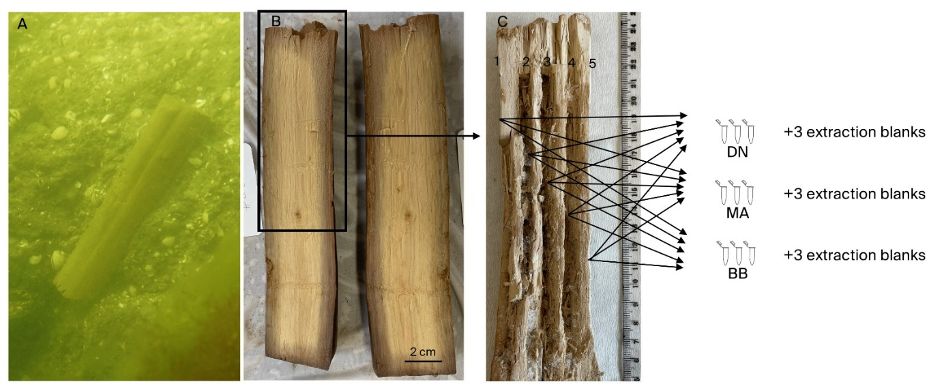
Figure 1 - A) A waterlogged wooden pole, which was part of a Neolithic fish trap was used in the experiment B) The pole was split longitudinally C) and five samples app. 18 cm long and app. 0.5 cm wide were collected from different locations (1-5) of one half. Each sample was homogenized and divided into three portions and processed with one of the three DNA extraction kits: DNeasy PowerSoil Pro (DN), MagAttract PowerSoil Pro (MA), and Bead-Beat Micro AX Gravity (BB). Each portion was extracted in triplicate, yielding 45 extractions (plus 9 blanks).
DNA extraction
To evaluate the efficiency and comparability of bacterial DNA recovery from waterlogged archaeological wood, three commercially available DNA extraction kits were selected that incorporate a bead-beating step. Mechanical disruption is widely used in environmental microbiology to enhance bacterial cell lysis and improve DNA recovery from complex matrices where microorganisms may be embedded within structured substrates or protected by resistant cell walls. Reliable DNA recovery from such matrices is essential for culture-independent identification of microbial communities associated with wood biodeterioration (e.g. Marotz et al., 2017; Schrader et al., 2025).
Although numerous DNA extraction approaches exist, including phenol-chloroform methods, enzymatic lysis protocols, and ancient DNA workflows optimized for highly fragmented material (Barnett & Larson, 2012, Yuan et al., 2012, Bag et al., 2016), the present study focused on widely used commercial environmental DNA extraction systems designed for reproducible use with heterogeneous substrates and routine laboratory workflows. These commercial kits incorporate mechanical bead-beating and differ in their purification formats (spin-column versus magnetic bead binding) as well as proprietary buffer formulations, allowing assessment of how commonly used extraction workflows influence DNA recovery from archaeological wood. Although commercial environmental DNA extraction kits employ silica-based DNA binding similar to ancient DNA workflows (e.g. Rohland & Hofreiter, 2007), specialized in ancient DNA protocols are optimized to enhance recovery of very short DNA fragments and may therefore improve detection of highly degraded microbial DNA, such approaches were beyond the scope of this comparison but represent an important avenue for future work.
The three kits tested were the Bead-Beat Micro AX Gravity (A&A Biotechnology, Gdansk, Poland; BB), the DNeasy PowerSoil Pro (Qiagen, USA; DN), and the MagAttract PowerSoil Pro DNA Kit (Qiagen, USA; MA). The BB and DN kits employ silica spin-column purification, whereas the MA kit uses magnetic silica-coated SPRI beads for DNA binding and washing, a workflow commonly implemented in automated extraction systems. All three kits include bead-beating lysis but differ in their purification workflows and inhibitor removal strategies, which may influence DNA recovery and downstream amplification performance when working with inhibitor-rich substrates such as waterlogged wood.
From each of the five locations (Figure 1C), approximately 250 mg of homogenized wood was weighed directly into each bead-beating tube provided with the respective kit. To monitor potential contamination, 250 µL of PCR-grade water (Thermo Fisher) was processed alongside the samples as an extraction blank. This resulted in 15 extractions and 3 extraction blanks per extraction kit.
DNA extraction followed the manufacturer’s protocols with minor modifications. For the Bead-Beat kit (BB), following bead beating, samples were incubated overnight at 37°C on a rotary stand in the dark. After incubation, 5 µL RNase A was added, and an additional spin step was included after the second microcolumn wash. For the DNeasy and MagAttract kits, 5 µL RNase A and 5 µL of Proteinase K were added according to the manufacturer’s protocol, together with the lysis buffer prior to sample incubation. Following bead beating, samples were also incubated overnight at 37°C on a rotary stand in the dark. DNA was eluted in 50 µL of elution buffer and were cleaned using the Zymo DNA Clean & Concentrator -5’ kit (Zymo Research) to remove potential co-extracted inhibitors and to concentrate the DNA prior to downstream analyses. The purified DNA was subsequently quantified with a Qubit fluorometer (Invitrogen, Carlsbad, CA, US) using the dsDNA High Sensitivity DNA Assay Kit (Thermo Fisher Scientific) following the manufacturer’s instructions. For each measurement, 2 µL of DNA extract was used, corresponding to a detection limit of approximately 0.005 ng/µL, and extraction blanks were quantified alongside the samples.
DNA quantification using qPCR
Quantitative PCR (qPCR) was performed on a subset of samples for each extraction kit (six wood samples plus three extraction blanks for one kit) to assess DNA amplification efficiency across extraction methods. Extract volumes were adjusted to achieve a uniform input of 5 ng DNA per reaction, corresponding to a final concentration of 0.5 ng/µL. Each measurement represents an independent extraction replicate rather than technical qPCR replicates of the same extract.
Amplification targeted the bacterial 16S rRNA gene V3-V4 region using the Illumina 16S metagenomic primers (Klindworth et al., 2013), which were also used for downstream amplicon sequencing:
Forward Primer: 5’-CCTACGGGNGGCWGCAG-3’
Reverse Primer: 5’-GACTACHVGGGTATCTAATCC-3’
qPCR reaction were performed in 10 µL reaction volumes containing 5 µL ™ PowerTrack ™SYBR Green Master Mix (Applied Biosystems), 0.5 µL primer mix (4 µM each primer; final concentration 0.2 µM each), 0.25 µL yellow sample buffer, template DNA adjusted to 5 ng per reaction, and nuclease-free water to volume. Amplifications were carried out on an Agilent AriaMx Real-Time PCR system.
Thermocycling conditions were: 95°C for 2 min, followed by 40 cycles of 95°C for 15 sec and 60°C for 60 sec, ending with 95°C for 15 sec. A melt curve analysis was performed after amplification to verify product specificity.
Amplification efficiency and data quality were evaluated by inspecting amplification curves and recording cycle threshold (Ct) values across extraction methods. PCR-grade water was included as a no-template control in each run. A five-point standard curve (0.125-2 ng/µL) was used to verify amplification performance.
Library construction and sequencing
Extracted DNA samples were sent to Novogene, UK for amplicon sequencing. The V3-V4 region of the bacterial 16S rRNA gene was amplified using primers 515F/806R (Ziesemer et al., 2015). PCR amplification and library preparation were performed by Novogene according to their standard amplicon sequencing workflow. Extraction blanks were included and sequenced alongside the samples to monitor potential contamination.
PCR products were purified using SPRI bead, and samples were prepared into libraries according to Novogene’s standard workflow. During this process, barcoded primers were used in the initial PCR amplification, and Illumina adapters were ligated to generate sequencing-ready libraries. Amplicon libraries were quantified and assessed for quality and fragment size using Qubit, qPCR and Bioanalyzer before pooling and sequencing on an Illumina NovaSeq platform using 250 bp paired-end (PE250) sequencing, targeting approximately 30,000 reads per sample.
Bioinformatic analysis
The retrieved sequence data (16S rRNA gene: 3.2M reads) were processed using DADA2 (Divisive Amplicon Denoising Algorithm 2, version 1.32.0; Callahan et al. (2016)) in R (version 4.4.1; (R Core Team, 2025)). Briefly, raw sequences were quality-filtered and trimmed, dereplicated, and denoised to infer amplicon sequence variants (ASVs). Reads containing ambiguous bases or more than two expected errors were discarded. After primer removal, reads were first truncated at low-quality tails (Phred ≤5) and subsequently truncated to a maximum length of 240 bp (forward reads) and 210 bp (reverse reads). PhiX contaminant reads were removed prior to downstream processing. Forward and reverse reads were merged, and chimeric sequences were removed resulting in 1.2M reads with an average of 26,065 (±10,202) reads per sample. Extraction controls were included to assess potential reagent contamination. Control samples were sequenced together with the wood extracts and screened for taxa commonly associated with kit or laboratory contamination (e.g. Chryseobacterium and Stenotrophomonas). When such taxa were detected at low abundance in the experimental samples (<2%), they were removed prior to downstream analyses. Samples with extremely low read counts (<1000 reads) after filtering were excluded from further analysis. A summary of taxa detected in extraction controls is provided in Supplementary file S1 ASV_controls. Taxonomic assignment was performed using the SILVA reference database (version 138; (Quast et al., 2013)). The resulting ASV table, along with the taxonomic annotation, was used for downstream analysis with the phyloseq package (McMurdie & Holmes, 2013). Extraction controls were screened for contaminant taxa but were not included in statistical analyses due to their low read counts and dominance by known reagent-associated taxa.
Bacterial community analyses were conducted using genus-level relative abundances, which were calculated by dividing ASV counts by the total number of reads per sample. No abundance filtering was applied prior to aggregation in order to retain rare taxa; instead ASVs were collapsed to genus level before downstream ecological analyses.
Non-metric multidimensional scaling (NMDS) plots were generated using Bray-Curtis dissimilarities calculated from square-root transformed relative abundance data to visualize patterns in community composition. To assess differences in community composition between extraction methods while accounting for spatial variability among sampling locations, a two-way crossed ANOSIM (Analysis of Similarities) was performed using the same Bray-Curtis dissimilarity matrix, restricting comparisons to within-location sample pairs. Alpha-diversity metrics (e.g., observed richness, Shannon index) were computed using phyloseq, and multivariate statistical analyses were performed with the vegan package (Oksanen et al., 2015).
PERMANOVA (Permutational Multivariate Analysis of Variance) with 999 permutations was used to assess the effects of extraction method and sampling location on community composition. Pairwise comparisons between levels of these factors were conducted using the pairwise Adonis package (Martinez Arbizu, 2020), applying Bonferroni correction for multiple testing. Figures were prepared using the ggplot2 package (v3.5.1) for general visualizations and the UpSetR R package (v1.4.0) to visualize shared and unique taxon compositions across different methods and sample locations.
Results
DNA quantification
To evaluate the performance of each DNA extraction protocol, quantitative assessment of DNA yield was conducted. Qubit fluorometer quantification measures total double-stranded DNA in each sample, which includes bacterial DNA as well as DNA from other microorganisms or extracellular material. Measuring DNA concentration is essential when comparing extraction kits, as higher yields generally improve the likelihood of successful downstream analyses such as amplification and sequencing.
The DNA concentrations obtained from each extraction protocol are presented in figure 2A and 2B. Qubit fluorometric quantification showed that the Bead-Beat Micro AX Gravity (BB) kit yielded the highest mean DNA concentration (4.0 ng/µL), followed by the MagAttract PowerSoil Pro (MA) Kit (3.4 ng/µL) and the DNeasy PowerSoil Pro (DN) kit (2.4 ng/µL). All three kits successfully extracted amplifiable bacterial DNA from the waterlogged wood samples, although some variability was observed among replicates within each kit (Supplementary File S1 Qubit_results).
qPCR reactions performed on a subset of samples supported these findings. The average number of amplification cycles required to reach the quantification threshold (Ct value) was lowest for the BB kit (mean Ct = 14), followed by MA (mean Ct = 16), and DN (mean Ct = 20) (Supplementary File S1 qPCR_results). Because qPCR was performed on a subset of samples as a supporting comparison of amplification efficiency, the results should be interpretated qualitatively rather than as a comprehensive quantitative comparison among all extractions.
Bacterial community composition
To assess the influence of extraction method on bacterial community composition, an ANOSIM (Analysis of Similarities) was performed using Bray-Curtis dissimilarities. ANOSIM was complemented by PERMANOVA to quantify the proportion of variance explained by the tested factors. The R statistic in ANOSIM reflects the degree of separation between groups, with values close to 0 indicating highly similar communities and larger values indicating greater dissimilarity. The highest R-value was observed between DN and BB kits (R = 0.519), indicating the largest separation between these extraction methods, whereas DN-MA (R = 0.136), and MA-BB (R = 0.128) showed very low dissimilarity.
A PERMANOVA test revealed a weak but statistically significant effect of extraction method on bacterial community composition (Pseudo-F = 2.04, p = 0.043; Table 1). However, pairwise comparisons between extraction methods were not significant after correcting for multiple comparisons (all p.adjusted > 0.3), and effect sizes were small (R² values ~0.04–0.06) (Supplementary File S1 Pairwise_PERMANOVA_results).
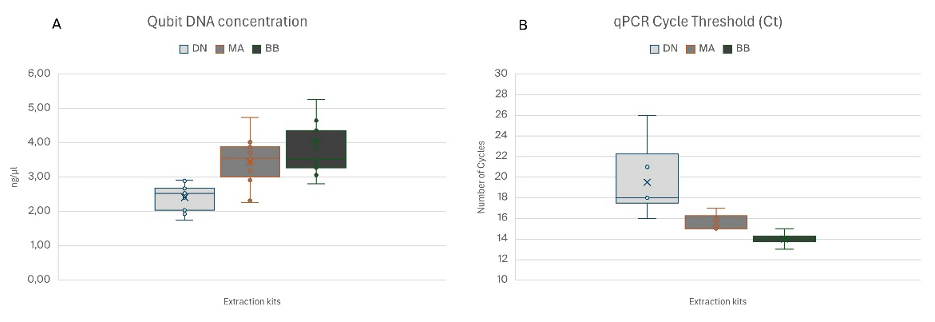
Figure 2 - DNA concentration. A) Qubit fluorometric measurements of DNA concentration (ng/µL) for each extraction kit. B) qPCR results showing average cycles threshold (Ct) values for 16S rRNA gene amplification. Lower Ct values indicate higher initial DNA quantities. Boxplots show the median and interquartile range, whiskers represent the full data range, and points represent individual samples. The Bead-Beat Micro AX Gravity kit (BB) showed the highest yield in both assays.
Non-metric multidimensional scaling (NMDS) ordination based on Bray-Curtis dissimilarities (Figure 3) showed that samples primarily clustered by sampling location rather than by extraction kit. PERMANOVA confirmed a strong and significant effect of sampling location on bacterial community composition (Pseudo-F = 12, p = 0.001). Pairwise comparisons between individual locations showed that most locations differed significantly from each other after p-value adjustment (p.adjusted ≤ 0.02), with effect size (R2 values) ranging from approximately 0.30 to 0.55. The strongest differentiation occurred between Outer 5 and Outer 1. In the NMDS plot, samples from Outer 5 appeared more dispersed and clearly separated from other locations in ordination space (Figure 3).
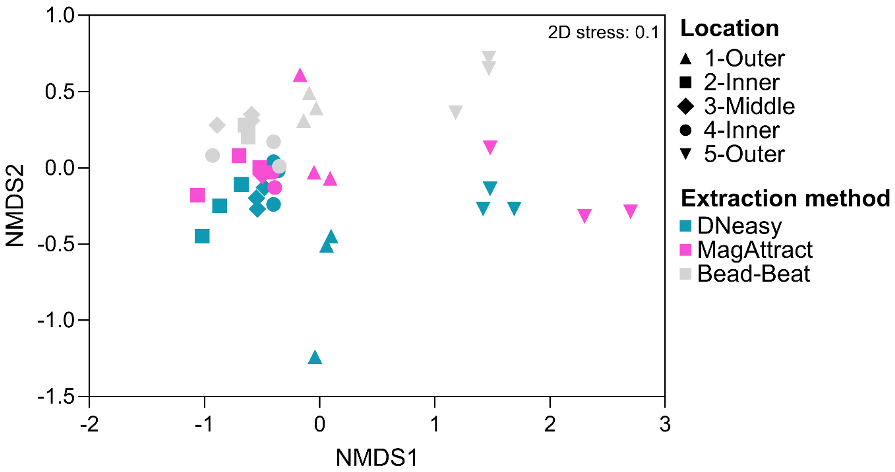
Figure 3 - Non-metric multidimensional scaling (NMDS) ordination based on Bray-Curtis dissimilarities of microbial community profiles across all samples. The plot visualizes community composition across five locations (shape) and three DNA extraction methods (color): DNeasy (teal), MagAttract (pink), and Bead-beat (gray). Shapes represent sample locations: triangle = Outer 1, square = Inner 2, diamond = Middle 3, circle = Inner 4, inverted triangle = Outer 5.
Table 1 - Summary of PERMANOVA results for the effects of sampling location and DNA extraction method on community composition.
factor | location | extraction method |
|---|---|---|
Overall permanova | Strong, highly significant effect (p=0.001) | Weak but significant effect (p=0.043) |
pairwise permanova | Many significant pairs (p.adj ≤ 0.02), large effect sizes (R² 0.3-0.55) | No significant pairs after correction, small effect sizes (R² ~0.04-0.06) |
effect size (r2) | Moderate to large | Small |
Interpretation | Location strongly structures communities | Method affects communities weakly and subtly |
Bacterial diversity across extraction kits and sampling location
To explore differences in bacterial diversity, two alpha-diversity indices - observed richness, and Shannon diversity – were calculated for all samples (Figure 4A (comparison by extraction kit) and Figure 4B (comparison by sample location)).
Across extraction protocol, alpha-diversity values were highly comparable, with only minor variation among kits. The BB, MA and DN kits produced similar levels of richness and evenness, although the MA kit showed slightly lower diversity than the other two extraction methods, though the differences were not statistically significant.
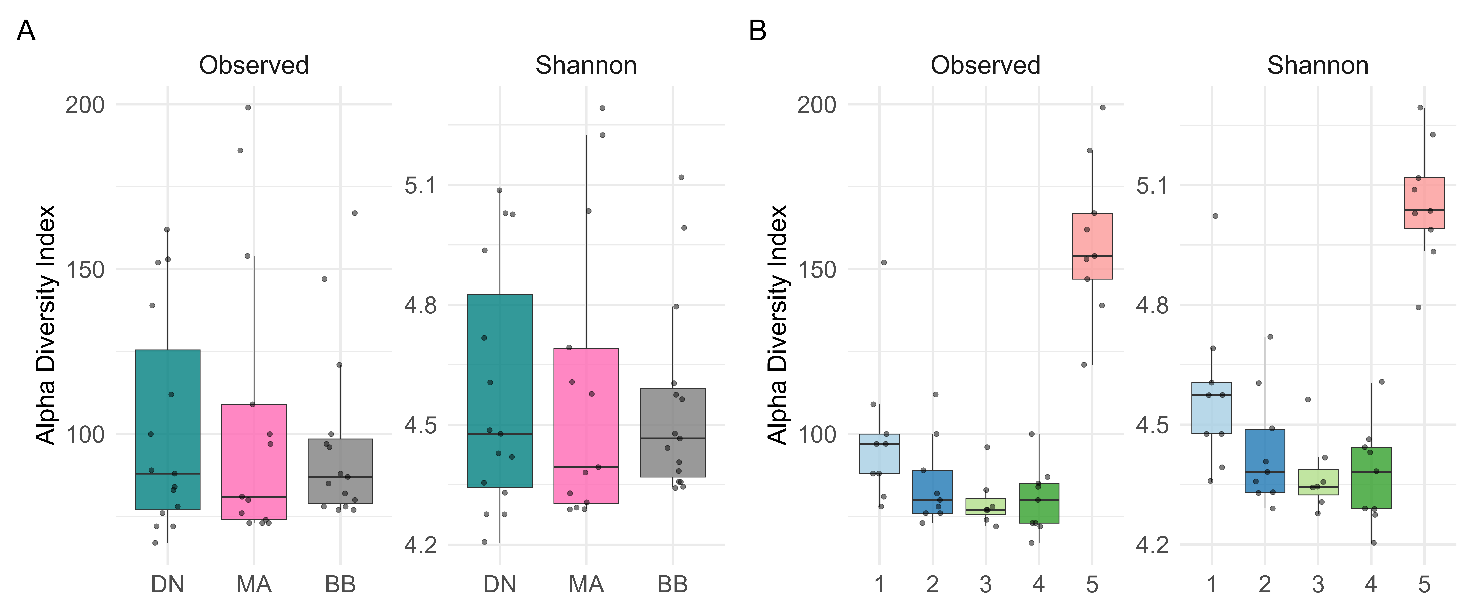
Figure 4 - Comparison of microbial alpha diversity indices (observed richness and Shannon diversity) across a) DNA extraction kits (Bead-Beat Micro AX Gravity (BB), MagAttract PowerSoil Pro DNA Kit (MA), and DNeasy PowerSoil Pro Kit (DN)) and b) sample location on the wooden pole (1-5; see figure 1B).
Sample location had a pronounced effect on bacterial diversity. As shown in figure 4B, Outer 5 consistently exhibited the highest diversity across both indices, whereas the other locations displayed comparable values.
Taxonomic overlap and spatial patterns
To assess overlap and uniqueness in taxonomic recovery between DNA extraction protocols, we compared the number of taxa (genus-level assignments) detected by each kit (Figure 5; Supplementary File S1 ASV_table). A total of 209 taxa (33.7%) were shared across all three kits, representing the core bacterial community consistently recovered regardless of extraction method. Each kit also retrieved a distinct set of taxa not shared with the others: BB recovered 96 unique taxa (15.5%), MA recovered 90 unique taxa (14.5%), and DN recovered 83 unique taxa (13.4%).
Pairwise overlaps between kits showed moderate taxonomic similarity: DN-MA shared 58 taxa (9.3%), BB-DN shared 32 taxa (5.2%), and BB-MA shared 29 taxa (4.7%).
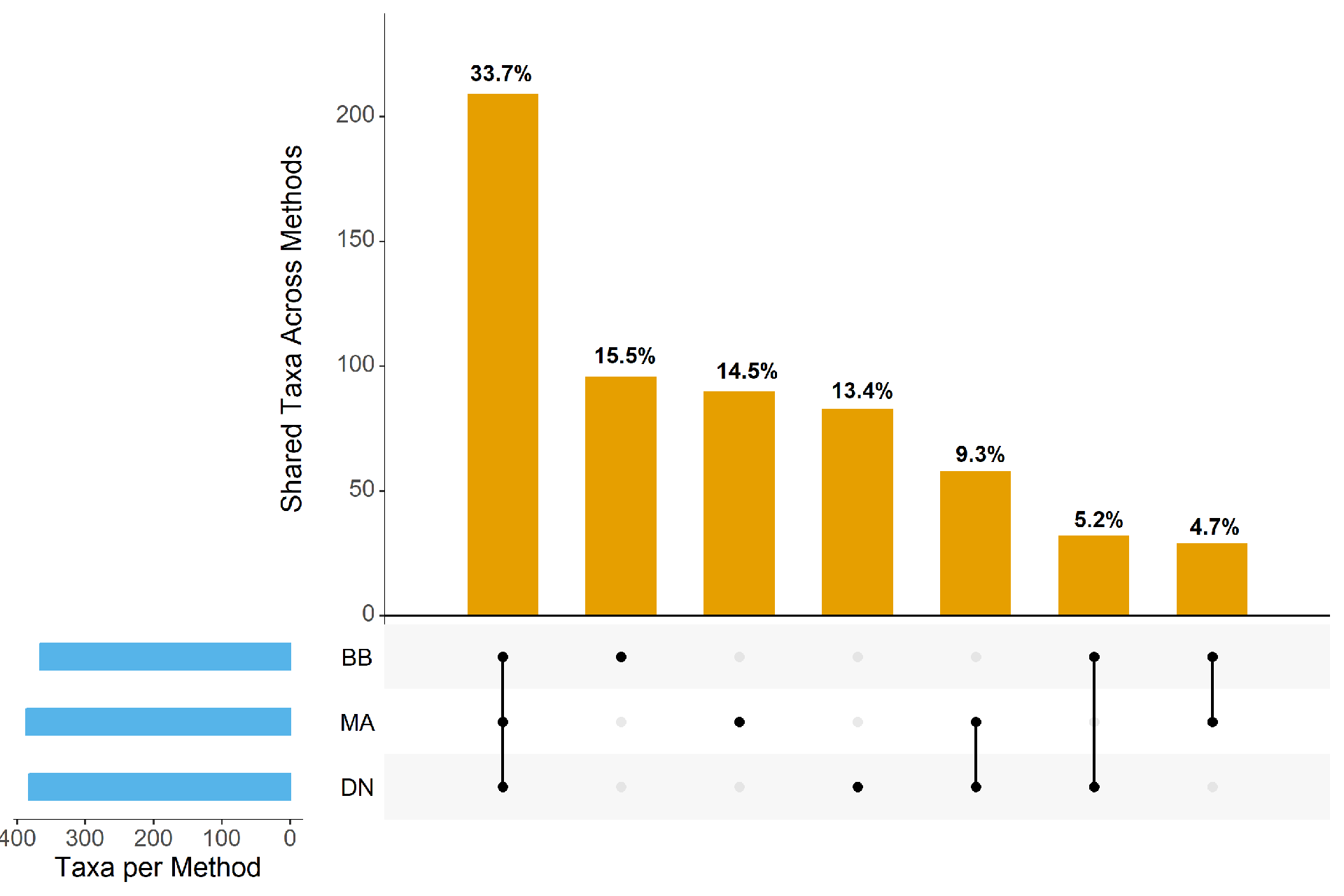
Figure 5 - Patterns of shared microbial taxa across different combinations of the three extraction methods (Bead-Beat Micro AX Gravity (BB), MagAttract PowerSoil Pro DNA Kit (MA), and DNeasy PowerSoil Pro Kit (DN)). The orange vertical bars indicate the number of shared taxa (genera) for each combination, as defined by connected black dots below. Percentage above the bars represent the proportion of total detected genera. The blue horizontal bars show the total number of genera recovered by each extraction method individually.
A similar comparison across the five sampling locations (Figure 6) showed that 15.8% of taxa (genera) were shared among all locations. Outer 5 contained the highest proportion of unique taxa (31.1%), followed by Outer 1 (9.3%). Locations 2, 3 and 4 contained 4.7%, 2.4% and 2.7% unique taxa, respectively. The strongest pairwise overlap occurred between locations 1 and 5 (6.6%), while all other overlaps ranged between 0-2%, suggesting increased spatial heterogeneity in bacterial community composition at the outermost sampling points.
A Principal Coordinates Analysis (PCoA) based on Bray-Curtis dissimilarities (Figure 7) further visualized these spatial patterns. The first two axes explained 52.2% of the total variation (PCO1 = 41.5%, PCO2 = 10.7%), with samples clustering distinctly by location. The PCoA also highlights the relative abundance of Sulfurimonas, identified through indicator species analysis as the most abundant taxon specific to Outer 5, with a mean relative abundance of 14.8 ± 6.7%.
In total, 128 taxa were identified as indicator taxa, defined as taxa significantly associated with specific sampling locations based on indicator species analysis (indicspecies Package in R). Outer location 5 had the highest number of indicator taxa (n = 95), including Sulfurimonas, Eilatimonas, Sneathiella, Kordiimonas, and Marivita. Outer 1 had 18 indicator taxa, such as Pseudarcobacter and Sulfitobacter. Fewer indicator taxa were associated with inner locations: 6 in location 2, 5 in location 3, and 3 in location 4, all with lower indicator values.

Figure 6 - Patterns of shared microbial taxa across the five sampling locations. Each vertical bar represents a unique combination of locations (1-5), and the height of the bar indicates the number of taxa shared by that combination, with the percentage above indicating the proportion of total detected taxa. The matrix below identifies the locations contributing to each combination (filled circles), and the horizontal bars to the left represent the total richness observed in each location.
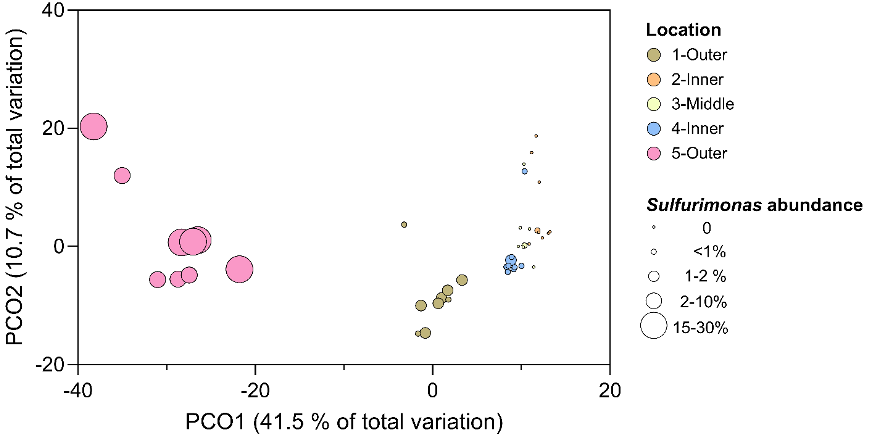
Figure 7 - Principal Coordinates Analysis (PCoA) plot based on Bray-Curtis dissimilarities of microbial community profiles across all samples, showing variation among samples across five locations (1 = Outer, 2 = Inner, 3 = Middle, 4 = Inner, 5 = Outer). The axes represent the first two principal coordinates, explaining 41.5% (PCO1) and 10.7% (PCO2) of the total variation, respectively. Bubble size indicates the relative abundance of the genus Sulfurimonas in each sample, ranging between 0-30%.
Discussion
This study evaluated the performance of three commercially available DNA extraction protocols - DNeasy PowerSoil Pro (DN), MagAttract PowerSoil Pro (MA) and Bead-Beat Micro AX Gravity (BB) - for recovering bacterial DNA from waterlogged archaeological wood. The analyses were conducted on a single wooden pole recovered from a submerged Neolithic fish-trap context in southern Denmark. By combining DNA quantification, amplicon sequencing, and ordination analyses, we assessed how extraction method and sample location influence bacterial community composition in this degraded substrate. Because the study is based on a single archaeological specimen, the results represent a controlled comparison of extraction performance under realistic conditions rather than a comprehensive assessment of all waterlogged archaeological wood, and broader generalization will require validation across additional samples.
DNA yield and protocol performance
All three protocols successfully recovered bacterial DNA from the waterlogged archaeological wood. The BB protocol consistently produced the highest DNA concentrations and required fewer amplification cycles in qPCR (Figure 2), suggesting efficient recovery of bacterial DNA from the wood matrix under the tested conditions.
Beyond yield, the kits differed in cost and processing time: DN was the most expensive and time-consuming protocol, while MA was moderately cheaper and somewhat faster. BB was the most economical option overall, even when accounting for the additional cleanup step required for BB extracts. However, protocol selection should balance practical considerations with data quality, including contamination monitoring and analytical reproducibility. In the present study, sequencing-based community analyses produced broadly comparable bacterial profiles across all three extraction methods, suggesting that practical factors such as cost, workflow complexity, and sample throughput can be considered alongside methodological performance when selecting an extraction protocol.
Influence of extraction protocol on bacterial community profiles
Despite variation in DNA yield, the overall bacterial community structure remained largely consistent across extraction protocols. Statistical analyses (ANOSIM and PERMANOVA) revealed only weak dissimilarities between kits (R = 0.128 - 0.519, R² ≈ 0.04-0.06), indicating that protocol choice did not substantially bias bacterial community composition. The presence of a shared bacterial core across all three methods demonstrates the robustness of amplicon-based profiling in degraded archaeological materials.
These findings are in line with previous studies (Salter et al., 2014, Eriksen et al., 2020, Shaffer et al., 2022), which show that extraction bias can occur, particularly in low-biomass samples, but that such effects are typically minor when community structure rather than total biomass is the focus. Consequently, practical parameters such as cost, workflow simplicity, and sample throughput may also influence protocol selection, provided that appropriate contamination controls and data quality assessments are implemented.
Spatial structure of bacterial communities
Spatial variation within the wooden pole exerted a far greater influence on bacterial composition than did extraction protocol. Diversity indices, ASV overlap, and ordination analyses consistently showed that sampling location strongly shaped community structure. The outermost region (location 5) exhibited the highest bacterial diversity and the largest number of unique ASVs (31.1%), whereas the middle regions (locations 2-4) were more taxonomically homogeneous.
These differences likely reflect environmental gradients such as oxygen availability, sediment contact, and the degree of wood degradation. Location 5 was sampled from the side of the pole that remained in direct contact with the surrounding sediment while lying on the seabed and was therefore likely maintained under relatively anoxic conditions. The higher diversity observed at this location may reflect the wood–sediment interface, where microbial communities from surrounding sediments can colonize the wood surface and where steep redox gradients support diverse metabolic niches. In contrast, other parts of the pole were more exposed to the water column during the approximately two-month period between excavation and recovery, which may have influenced microbial communities in those regions and potentially resulted in partial community restructuring or loss of strictly anaerobic taxa.
The partial overlap between the outer locations (1 and 5) likely reflects bacterial taxa associated with the wood surface itself, while differences in community composition between these locations may be driven by contrasting environmental conditions, including sediment contact and oxygen exposure. Minimal overlap among other locations (0-2%) indicates pronounced micro-scale heterogeneity within the same artifact. This emphasizes the need for spatial replication in archaeological microbial studies to accurately represent bacterial diversity and community dynamics.
Taxonomic patterns and functional implications
Among the dominant taxa, Sulfurimonas was particularly abundant at location 5, aligning with its known tolerance for low-oxygen, sulfur-rich environments. Its spatially restricted occurrence likely reflects localized redox conditions rather than direct involvement in wood degradation. Sulfurimonas and related sulfur-oxidizing bacteria may thus serve as environmental indicators of anoxic or sulfidic conditions rather than as agents of decay.
It remains difficult to determine which bacterial taxa contribute directly to wood biodeterioration based on 16S rRNA amplicon data alone. The approach used here focuses on community composition rather than functional potential, and taxonomic assignments cannot reliably distinguish bacteria actively involved in lignocellulose degradation from those reflecting the surrounding environmental conditions. Future studies incorporating functional approaches such as metagenomic sequencing or targeted assays of genes involved in lignin, cellulose, and hemicellulose degradation would help clarify the role of bacteria in wood decay processes.
Methodological considerations
Unlike benchmark studies employing mock communities (e.g. Shaffer et al., 2022), this work used archaeological material to evaluate DNA extraction protocol performance under realistic and complex conditions. Because this study was based on a single archaeological specimen, the observed microbial patterns should not be interpreted as representative of all waterlogged archaeological wood but rather as a controlled comparison of extraction methods applied to a realistic archaeological substrate. This approach provided insight into how extraction methods performed in the presence of potentially co-extracted PCR inhibitors, heterogeneous biomass typical of waterlogged archaeological wood. Because DNA recovered from such material may originate from both historically established and currently active microbial communities preserved in the wood, the resulting DNA profiles should be interpreted cautiously, as they reflect both past colonization and possible ongoing microbial activity. However, highly fragmented ancient DNA may be underrepresented due to fragment length requirements of the amplification approach used in this study.
Recommendations for future studies
1. Consider multiple factors when selecting extraction protocol. Among the protocols tested here, the BB protocol produced the highest bacterial DNA concentrations and may therefore be advantageous when input DNA is limited or when sufficient DNA is required for downstream analyses such as qPCR or sequencing. However, protocol selection should also consider additional factors including contamination control, removal of PCR inhibitors, technical reproducibility, processing time and cost.
2. Ensure spatial replication. Substantial intra-sample heterogeneity observed within the wooden pole highlights the importance of sampling from multiple locations within a single artifact to capture bacterial diversity and reduce location-specific bias. Future studies would benefit from replication across multiple artefacts and sites.
3. Consider homogenization strategically. Where the research objective focuses on bulk microbial community composition, homogenizing sample material can help integrate micro-scale variability and improve representativeness. However, homogenization removes spatial information about bacterial distribution within the wood and should therefore be avoided when spatial patterns are of interest.
4. Differentiate environmental indicators from degraders. Taxa such as Sulfurimonas may indicate local redox or sulfur conditions rather than active wood decay. Future work should target bacterial groups and functional genes associated with lignin, cellulose, and hemicellulose degradation to better link community composition with preservation processes. Previous studies of archaeological waterlogged wood have reported bacterial taxa affiliated with the Cytophaga-Flavobacterium-Bacteroides complex, as well as members of the Pseudomonas group, Cellvibrio, and Brevundimonas (Landy et al., 2008), while culture-based studies have shown that erosion bacteria represent a group of bacteria sponsible for cellulose degradation in waterlogged wood whose precise taxonomic identity remains largely unresolved (Nilsson et al., 2008).
5. Carefully consider bioinformatic filtering strategies. Amplicon sequencing of degraded environmental DNA can produce numerous low-abundance sequence variants due to PCR amplification artefacts and DNA fragmentation. Researchers should therefore carefully evaluate filtering thresholds and taxonomic aggregation strategies to avoid overinterpreting rare variants while preserving biologically meaningful diversity patterns.
Conclusion
This study compared three DNA extraction protocols for recovering bacterial DNA from a waterlogged archaeological wooden pole preserved under anoxic marine conditions. While all methods recovered a broadly overlapping bacterial core, the Bead-Beat Micro AX Gravity protocol yielded the highest DNA concentrations among the protocols tested. Sequencing of extraction controls and subsequent bioinformatic screening indicated only minor contributions of potential contaminant taxa, suggesting that differences among extraction methods primarily reflected variation in DNA recovery efficiency rather than contamination.
Despite yield differences, bacterial diversity and taxonomic profiles were highly comparable across protocols, indicating that extraction method had only a limited influence on community-level patterns. In contrast, bacterial composition varied more strongly across sampling locations, highlighting that spatial heterogeneity within a single artifact exerts a stronger influence on observed microbial patterns than methodological choice.
Overall, these findings show that waterlogged archaeological wood hosts distinct bacterial communities structured by environmental micro gradients. Accurate characterization therefore depends not only on appropriate extraction and sequencing methods but also on spatially informed sampling strategies. Future work integrating functional and metagenomic analyses will be essential for identifying bacteria directly involved in enzymatic breakdown of wood polymers and for linking microbial activity more explicitly to preservation and decay processes in submerged cultural heritage materials.
Acknowledgement
The authors would like to thank the Viking Ship Museum for providing access to the sample, and the other members of the ENDURE project team, especially Henning Matthiesen and Anders Kanstrup for their support and collaboration. Preprint version 5 of this article has been peer-reviewed and recommended by Peer Community In Archaeology (https://doi.org/10.24072/pci.archaeo.100692; Daly & Vinas-Caron, 2026).
Funding
The study was supported by the European Union (ERC, ENDURE, 101053993). Views and opinions expressed are however those of the authors only and do not necessarily reflect those of the European Union or the European Research Council Executive Agency. Neither the European Union nor the granting authority can be held responsible for them.
Conflict of interest
The authors declare that they comply with the PCI rule of having no financial conflicts of interest in relation to the content of the article.
Data, scripts, code and supplementary information availability
The raw sequencing data is available at European Nucleotide Archive, accession number: PRJEB100592. All metadata and supplementary tables are found in Supplementary File S1. Scripts and codes are available in Supplementary File S2. All can be downloaded at https://zenodo.org/records/17415649, Version v1.