

 CC-BY 4.0
Introduction
Agricultural practices must enable sufficient, high-quality agricultural production but are facing growing environmental problems. Many agricultural soils are already degraded or are being affected by erosion, salinisation, acidification, contamination, or compaction, which impairs future agricultural production (Kopittke et al., 2019). Biodiversity erosion is most pronounced in farmlands, as illustrated by the decline in bird populations across Europe (Rigal et al., 2023). Climate change is a further challenge that threatens agricultural production through extreme weather events (Rosenzweig et al., 2001). Agriculture is responsible for greenhouse gas emissions through the use of fertilisers, mechanisation, and the release of carbon from soils (Smith et al., 2007a, 2007b). Therefore, it is necessary to establish a transition toward more sustainable agriculture. Sustainability should not only be linked to one element, such as greenhouse gases, but also rely on a multiplicity of features, such as those described by Dönmez et al. (2024) (e.g. biodiversity, soil health, integrated pest management, and social responsibility). This transition is particularly necessary in croplands, which result in landscape simplification, high mechanisation, and synthetic fertiliser and pesticide use. Therefore, it is important to encourage the provision of ecosystem services (ES) within farming systems (Boeraeve et al., 2020). This implies a reliance on and development of biodiversity and ecological functions.
Agroforestry is one of the solutions that can be implemented to address this issue. It allows trees and other semi-natural habitats to be planted in connection with crops, creating so-called Silvoarable Systems (SAS; Eichhorn et al., 2006). As agricultural plot sizes have generally increased in temperate croplands, hedgerows are insufficient to significantly interact with the whole field. Thus, alley-cropping systems have emerged as a modern SAS, consisting of tree rows (associated with understory vegetation strips) separated by crop alleys in a mechanisation-friendly design (Kletty et al., 2023). Such agroforestry systems provide multiple benefits to farmers and the environment such as: biodiversity conservation, pollination improvement, enhancement of natural predators of crop pests, improvement of soil biodiversity and functioning, carbon storage, nutrient cycling and pollution improvement, erosion control, windbreaks, provision of food and fibre, and improvement of landscape cultural and aesthetic value (Eichhorn et al., 2006; Kletty et al., 2023; Tsonkova et al., 2012).
Among ES, biocontrol enhancement while implementing SAS is particularly desirable to farmers. The presence of trees modifies the ecological conditions in the fields, affecting biodiversity and ecological functioning in SAS and thus the associated ES. The presence of trees and associated semi-natural habitats shelters invertebrate predators. A spillover is possible from these habitats to crops, resulting in an edge effect that improves the provision of ES in crops (Clough et al., 2005; Holland et al., 2017). Because trees are in close proximity to crops in SAS, such an edge effect is expected to be particularly significant. In SAS, most studies have shown the positive effects of trees on natural enemies of crop pests or biocontrol, despite context-dependent results (Kletty et al., 2023). Some of this context dependency can be attributed to the implementation of agroforestry together with other more sustainable practices (e.g. cover crops, tillage, or pesticide reduction) or more sustainable models (e.g. organic farming or conservation agriculture). For instance, Boinot et al. (2019a; 2020) revealed interaction effects between agroforestry and the agricultural model implemented together, showing the benefits (less weeds and more natural predators) of agroforestry when associated with organic agriculture but not with conventional agriculture in their study. Information on biocontrol and natural predators of crop pests is still scarce, given the multiplicity of climate, species studied, and agricultural contexts of the studies. However, developing nature-based solutions for agriculture, such as agroforestry, imply a complexification of ecosystem functioning, and thus an increased level of knowledge to understand ecological processes, to help farmers in their choices, and foster such agricultural transitions.
In this study we investigated the effect of SAS on ground beetles (carabid beetles, Carabidae) to better understand how their communities respond to the presence of trees in crop fields. SAS was implemented along with conservation agriculture, an agricultural model based on no (or reduced) tillage, cover crop maximisation, and crop diversification in the system (FAO, 2017). The impacts of agricultural practices such as no-till and cover crop maximisation on biodiversity have been well studied but not their joint implementation in the long term, which constitutes conservation agriculture. The impact of agricultural practices on biodiversity in agroforestry systems is understudied and, to the best of our knowledge, no publication has addressed conservation agriculture in agroforestry systems (Kletty et al., 2023). Ground beetles are among the most studied and recognised invertebrates that prey on crop pests and they are sensitive to environmental conditions (Kromp, 1999). They play a key role in the food web and the provision of ES in farmlands (e.g. Serée et al., 2021). Their diet ranges from granivorous to carnivorous, through omnivorous, and are able to feed on both invertebrate pests and weeds. The inclusion of community-level or functional trait analyses is important to assess their role in ecosystem functioning. It has already been shown that agroforestry can change the functional characteristics of carabid communities without significantly modifying activity-density or species diversity (Staton et al., 2021). In a study on ground beetle functional traits in southern France, Boinot et al. (2019b) found during emergence after winter that tree rows were associated with larger species, less carnivorous, and overwintered more at the adult stage than in crop alleys. This shows that agricultural practices performed in crop alleys modify carabid communities compared to less perturbed tree rows. This may also indicate that the presence of trees in the field allows other species with different functional traits to be present in the vicinity of crops immediately after the winter. The presence of trees and the habitat complexity they bring may also enhance carabid species richness, varying according to their functional traits (Liu et al., 2015; Pardon et al., 2019).
Accordingly, we analysed ground beetles based on their activity-density (a proxy of abundance), diversity, functional traits, and community composition to identify differences by distance to tree rows. We predicted 1) a higher diversity of carabids in the tree rows than in the crop alleys, 2) different community compositions, and 3) ground beetles being smaller, more carnivorous, and less overwintering at the adult stage in the crop alleys than in the tree rows.
Material and Methods
Study site
The study site was located in Guînes (62, Pas-de-Calais, Northern France). It consists of three adjacent arable fields (Table 1) cultivated by the same farmer. These fields have been cultivated using conservation agriculture since 1997. Conservation agriculture is based on minimum tillage, maximum soil coverage, and crop diversification and aims to maximise soil health and related benefits (FAO, 2017). In 2009, flowered grassy strips were implemented in the studied fields, which were converted to tree rows in 2012 for two of these three fields (“Bien Assise” and “Odelette”). These two fields form alley-cropping systems with lines of trees inside the field. In the “Portelette” field, the study was performed along an old hedgerow in the limit with the Bien Assise field, while a few-year-old tree rows were implemented in the opposite part of the field. In all fields, tree rows are composed of a diversity of tree species composing a multiple strata structure. They all have a northeast-southwest orientation.
Table 1 - Experimental fields with GPS coordinates (WGS84) and respective crops for the two years of study.
|
Bien Assise 50.861565,1.853288 |
Odelette 50.859262,1.844619 |
Portelette 50.862452,1.850026 |
|
|
2021 |
Rapeseed |
Maize |
Wheat |
|
2022 |
Wheat |
Rapeseed |
Wheat (Triticale) |
The crops grown in the three fields during the two studied years were rapeseed (Brassica napus), maize (Zea mais), wheat (Triticum aestivum), and triticale (× Triticosecale). Given the similarity between wheat and triticale, both were analysed together and are indicated as “wheat”. The combination of three fields over two years of study, with three types of crops planted, makes it impossible to carry out an in-depth study of the independent effect of the field, year, or crop. Thus, we considered the variability linked to the plot, year, and crop as a single factor called field/year, and the study comprised six different field/years.
Data collection
Carabid beetles were sampled using pitfall traps 5 cm in diameter and 10 cm high containing a saline solution, a drop of soap (odourless washing-up liquid), and covered with a plastic roof raised a few centimetres by wooden sticks. These traps were set out for one week at each session, i.e. from 30/06/2021 to 07/07/2021 and from 07/06/2022 to 14/06/2022. The traps were placed at intervals from the tree rows in multiples of 10m. In the Bien Assise and Odelette alley-cropping plots, they were placed in transects of six pots between 0 and 20m from the nearest tree (Figure 1). Five transects per plot were carried out at 10m from each other between the same tree rows totalling 30 samples per plot and session. For the Portelette field, 10 ‘half’ transects spaced 10m apart were set up, consisting of traps placed 0, 10, and 20m from the hedgerow. Thus, 30 samples per session were collected from each plot. In 2021 in the Bien Assise plot, the size and density of the oilseed rape did not allow the planned sampling to be conducted. Instead, 10 traps were placed 10m apart in a tree row. At 10 and 20m in the crop alley, a trap was placed each time across from traps 1, 5, and 10 along the tree row. At the end of each week of pitfall trapping, the trapped carabid beetles were sorted and placed in 70° alcohol for subsequent identification. This identification was carried out using the determination keys of Coulon et al. (2015), Hůrka (1996), and Jeannel (1941; 1942).

Figure 1 - Disposition of pitfall traps along a transect in alley-cropping fields. 6 pitfall traps were placed between two tree rows 50m apart. 1 pot per transect was placed in each tree row, with the other 4 placed 10 and 20m apart in the crop alleys.
Trait data
The functional traits of the ground beetles were retrieved from the BETSI database. (https://portail.betsi.cnrs.fr/; Hedde et al., 2012). The following trait groups were selected: body length, diet, overwintering strategy, and wing development. These traits (except body length, which corresponds to numerical data) are coded in the database as the frequency of occurrence of the trait in the literature (e.g. a value of 80% for zoophagous indicates that 80% of the mentions of the diet for the considered species, in all the references examined to build the database and where diet was filled, are related to a zoophagous diet and 20% to other diet types. Please see Document S1 in supplementary material for more information). Missing data in the BETSI database were supplemented as far as possible by searching the bibliography (Coulon et al., 2015; Freude et al., 2004; Jeannel, 1941, 1942; Luff, 1998; Marie, 2012; Ribera et al., 1999; Tenailleau & Maillet-Mezeray, 2011). The traits were then refined: i) for the diet trait group, the traits selected were zoophagous and granivorous (the latter corresponding to the compilation of the ‘granivorous’ and ‘fructivore_carpophagous’ traits in the database; see Document S1); ii) for the overwintering stage trait group, the overwintering at adult stage trait was selected, being opposed to overwintering at the larval stage since no data for other overwintering stages are referenced ; iii) the macropterous trait was selected in the wing development trait group, being opposed to apterous or brachypterous traits (a species considered dimorphic, i.e. some individuals being apterous and others macropterous in the same species, is coded 50% apterous, 50% macropterous). All discrete traits (i.e. all except body length) were expressed as a percentage of the trait value occurrence in the literature and then converted to proportions (0 ≤ trait ≤ 1) for statistical analysis.
Data analysis
All statistical analyses were performed in R 4.5.0 (R Core Team, 2025). Communities can be described by the abundance of individuals, species richness, and evenness (describing the homogeneity of distribution of abundance across species), as well as by other diversity metrics through Hill numbers. Hill diversity q1 corresponds to the exponential of Shannon entropy, diversity order q2 corresponds to the inverse Simpson index, and diversity order q0 corresponds to species richness (Hill, 1973). Thus, from order q0, where the same weight is given to each species in the community independently of its abundance, the weight of common species increases along with Hill numbers. The most abundant species usually have the highest impact on ecosystem functionality, whereas rare species can indicate past, future, or spatial influences, and thus include the potentiality or resilience of the communities. Trait data were analysed using community weighted means (CWM), i.e. the mean of the value of the trait for each species weighed by the proportion of this species in the community. Analyses of activity-density (abundance proxy), different diversity-related indices and functional traits to test the effect of distance to trees were carried out using Linear Mixed Models (LMM) or Generalised Linear Mixed Models (GLMMs). The general model structure was Response ~ Distance + (1|Field/year), where Distance was considered as a fixed effect and field/year as a random effect. Models with year nested within fields were run to test whether they improved the simplest model. The same was done with the inclusion of the transect (i.e. the location of each trap independently of its distance to the tree rows) as a random effect. The model assumptions of the GLMMs were assessed using the DHARMa package (v0.4.7), including uniformity tests (Kolmogorov-Smirnov test). For activity-density, a negative binomial model with a log link (lme4 package v1.1-37) was used because the Poisson model presented overdispersion. Species richness (diversity order q0) displayed underdispersion and did not satisfy Poisson or negative binomial GLMM assumptions. Thus, a Conway-Maxwell Poisson GLMM with a log link was performed using the glmmTMB package (v1.1.14). Diversity orders 1 and 2 were analysed with gamma GLMMs with log link (lme4), and evenness with a beta GLMM with a logit link (glmmTMB). The values of evenness lie in the closed interval [0,1], while the beta distribution excludes 0 and 1. To avoid boundary issues, evenness values (y) were transformed as follows: y’= [y(N-1)+1/2]/N (Smithson & Verkuilen, 2006). CWM of functional traits are abundance-weighted averages of species-level fuzzy probabilities, so they do not arise from binomial sampling and do not satisfy the assumptions of beta regression (DHARMa uniformity tests failed). Such variables are weighted averages with low variance and are independent of the mean. This was modelled using Gaussian linear mixed models with variance structures (varIdent, nlme package v3.1-168) to account for heteroscedasticity (Zuur et al., 2009). The adequacy of the model was assessed using QQ plots and residual-versus-fitted plots. Data analyses of activity-density and diversity variables were also tested separately for large species (more than 10mm, according to Boetzl et al., 2024) or small-medium species. We tested whether the inclusion of the aspect according to the closest tree row (trap at south-east or north-west of the closest tree row in all fields) as a fixed effect improved the models (through lowest AIC, fit of the model, and similarity of distance to tree rows effect). We also tested whether the inclusion of within-field sample locations (transects) as a random factor improved the models (through lowest AIC, fit of the model, and variance explained by the transect). Multiple comparisons were performed using the multcomp package (v1.4-28), and estimated marginal means and their 95% confidence intervals are displayed in Figures 2 and 4 using the ggpredict() function from the ggeffects package (v2.3.1)
Carabid community composition was assessed using Non-metric Multidimensional Data Scaling (NMDS) and Adonis-type tests with Vegan package (v2.7-1). NMDS represents patterns of community dissimilarity among samples in a reduced number of dimensions (here, two), based on ranked distances between samples. Adonis was used to test the significance of differences among factors using distance-based partitioning of variance. These distances were calculated from the raw activity-density data for each species for each trap using the vegdist function in the Vegan package (Oksanen et al., 2001) with Bray–Curtis dissimilarity. Gower distance (method = "altGower") was also tested and produced very similar ordination patterns. Bray–Curtis dissimilarities were retained because they are well suited to abundance-based community data. Furthermore it is robust to the presence of rare species, which were not removed from our analyses.
Results
Activity-density and diversity
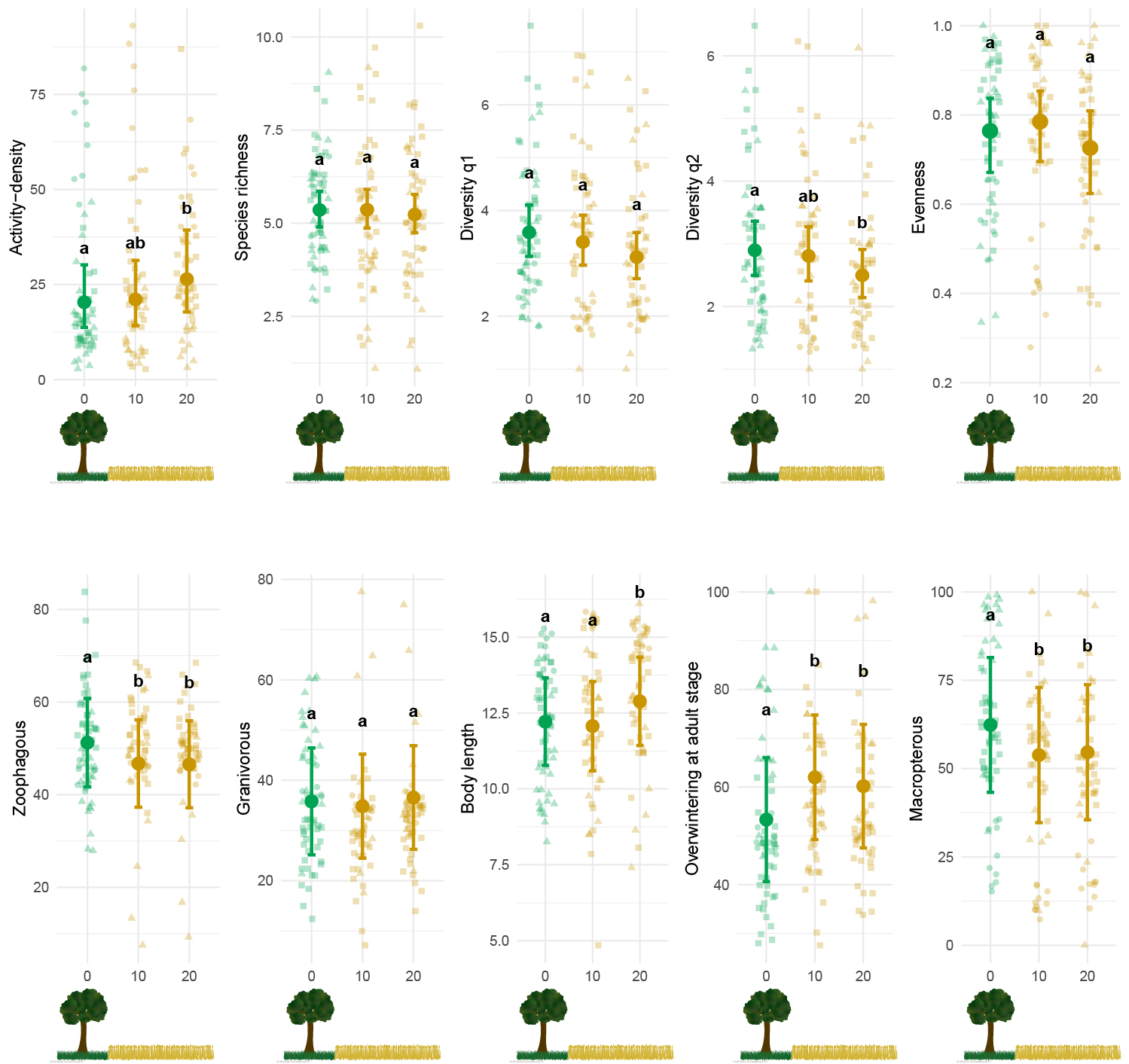
In total, 4,425 carabid beetles belonging to 41 species were identified. The ten most abundant/active species were each represented by more than 50 individuals, the most frequent being Pterostichus madidus (Fabricius, 1775) and Pterostichus melanarius (Illiger, 1798), with a total of 1502 and 1252 individuals respectively (Supplementary Table 1). There were significant differences in activity-density between the six field/years of the study, ranging from 14 to 58.4 individuals per trap on average. Similarly, some species were unevenly distributed between the plots, particularly among the most frequent species. For example, 1314 P. madidus were found in one plot in one year compared with 99 in the following year and between 0 and 75 in the other fields/years (Table S1). Similarly, for Brachinus crepitans (Linaeus, 1758), more than 150 individuals were found in a plot in each of the two years compared with 0–22 in the other field/years. The effect of distance to trees was analysed considering this high variability between field/years, which was included as a random effect in the models. The carabid activity-density was significantly influenced by distance from the tree rows (GLMM, χ²=8.15, df=2, p=0.017; Figure 2). It was higher at 20m than in the tree rows (p=0.023, z=2.64), with activity-density at 10m being intermediate but close to being significantly lower than at 20m (p=0.0599, z=2.27).

Figure 2 - Activity-density and diversity indices at different distances from tree rows. Raw observations are shown as squares (wheat), triangles (rapeseed) and circles (maize). Large points represent estimated marginal means from the GLMMs and vertical bars indicate 95% confidence intervals. Green indicates traps located within tree rows, whereas orange indicates traps located within crop alleys. Different letters indicate significant differences among distances according to Tukey post-hoc tests. As row aspect had no significant effect, data from both sides of the tree rows were pooled for the analyses. See Methods and Results for details.
Species richness (diversity order q0) was not significantly influenced by distance from the tree rows (GLMM: χ²=0.21, df=2, p=0.901; Figure 2). It ranged from 10 to 18 species for each of the three distances to tree rows for each field/year (10 pitfall traps).
Diversity order q1 may be affected by the distance to tree rows, but this effect was not significant in our dataset (GLMM, χ²=5.15, df=2, p=0.076). Such a possible effect would concern a lower diversity of order 1 at 20m than in the tree rows (p=0.064, z=-2.25; Figure 2).
Diversity order q2 was (almost marginally) significantly influenced by distance to tree rows (GLMM, χ²=6.11, df=2, p=0.047), with a lower diversity of order 2 at 20m than in the tree rows (p=0.0497, z=-2.35; Figure 2).
Diversity profiles for the different field/years according to distance to the tree rows (Figure S1) indicate that diversity values evolve similarly across diversity orders for each field/year, except for the field Odelette in 2022 (rapeseed), where diversity order 0 is higher in the tree rows than in the crop alleys (not significant, COM-Poisson GLMM p=0.806), while it is lower for higher diversity orders (gamma GLMM, not significant for q1 (p=0.121), significant for q2 with p<0.039).
Lastly, there was no significant difference in evenness as a function of distance from the tree rows (GLMM, χ²=4.87, df=2, p=0.087) but evenness at 20m might be lower than at 10m (p=0.073, z=-2.19; Figure 2)
For these different variables, considering the aspect (southeast or northwest of the tree rows) did not improve the models. The inclusion of transect as a random factor did not improve any of the models.
Community composition
Community composition was studied for each distance within each field/year. As the community compositions obtained between three traps (at 10 or 20m in the field) and 10 traps (in the tree row) were difficult to compare (special case in this field in 2021; see M&M Data collection), the data from the Bien Assise plot in 2021 were removed for the statistical tests on the communities but are presented for information purposes in the NMDS graph (Figure 3).
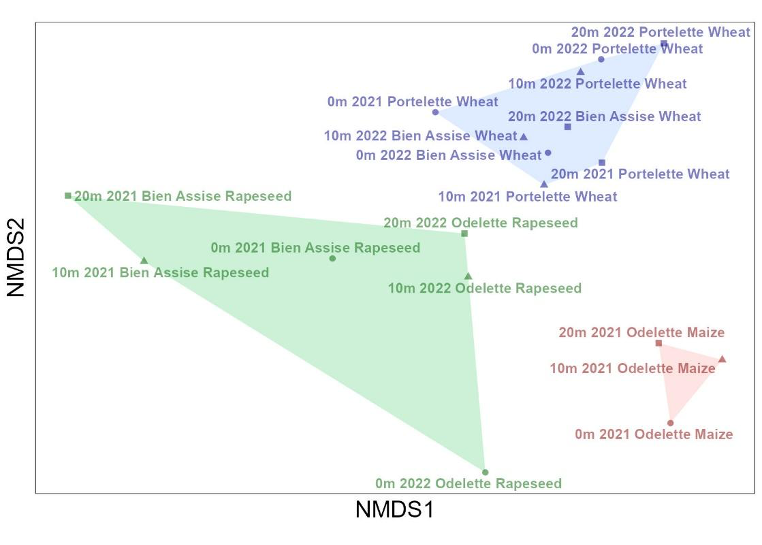
Figure 3 - Representation of ground beetle community composition with Non-metric Multidimensional Data Scaling (NMDS), according to field/year (with information on the crop type) and distance to tree rows. Convex hulls, points, labels and polygon colours are represented according to crop type.
According to the NMDS, the communities were mainly separated according to crop type, with wheat in the top right, maize in the bottom right, and oilseed rape in two-thirds of the bottom left (Figure 3). Even within the grassy strips of the tree rows, the communities were predominantly more similar to those in the crop alleys of the same field than to those in the tree rows near other crops. This effect of crop type on community composition was significant, even when considering the effect of distance from the tree rows (adonis with or without strata option, R²=0.533, p=0.001). At the species level, for the most common species, P. madidus was mostly found in maize (Odelette/2021), with 87% of the total activity-density for this species found in this field/year whereas P. melanarius was most ‘abundant’ in wheat crops (Table S1). B. crepitans was also found in rapeseed and maize crops and largely absent in wheat (Table S1). The effect of the plot was also significant in terms of community composition (Adonis with or without strata option including distance to tree rows, R²=0.388, p=0.011 or p=0.002, respectively). Crop and plot joint effect (field/year) explained 70% pf the variation (R²=0.697, p=0.001). While it was not possible to separate the effect of the crop from that of the field, graphically, the crop appeared to have the greatest impact on community composition (Figure 3).
In addition to this strong field-year effect, distance to tree rows also significantly influenced community composition when permutations were constrained within either crop type or field/year. However, distance explained only a small proportion of the variation (R² = 0.082, p = 0.016 and p = 0.001, respectively), indicating that its effect was modest compared with crop and field-year influences. A dispersion effect was not likely to be responsible for these results since no beta-dispersion was observed for distance to tree rows (beta-disper test, p=0.544) and location differences were graphically confirmed for crop or field variables. Activity-density variations according to distance to tree rows were visible for some species, especially B. crepitans which was essentially only found in tree rows, and Poecilus cupreus (Linnaeus, 1758) or Metallina lampros (Herbst, 1784) which were mostly found in crop alleys (Figure S2).
Functional traits
Among the group of diet-related traits, zoophagous diet showed significant differences as a function of distance from tree rows (Gaussian LMM with a varIdent variance structure, χ²=11.02, df=2, p=0.005), with 10 and 20m within crop alleys having a significantly lower value than those in tree rows (p=0.010, z=-2.92 and p=0.004, z=-3.16 respectively), with no difference between 10 and 20m (p=0.988, z=-0.15; Figure 4). The granivorous trait, on the other hand, showed no significant difference as a function of distance from the trees (Gaussian LMM with a varIdent variance structure, χ²=2.48, df=2, p=0.289).
Body length was significantly influenced by distance from the tree rows, with higher body length at 20m than at 10 and 0m (Gaussian LMM with a varIdent variance structure, p=0.025, z=2.61 and p=0.046, z=2.38 respectively; Figure 4).
Thus, carabid size influenced their activity-density according to distance to trees. Similar to the general results, the activity-density of large species (body length greater than 10mm) was higher at 20m from tree rows than at 10 or 0m (GLMM p=0.018, z=2.72 and p<0.001, z=4.34 respectively), whereas the activity-density of small to medium species was lower (but not enough data to run the model) in crop alleys than in tree rows. The evenness of carabid communities also differed according to distance to tree rows when separating large and smaller species whereas no significant difference was found for the whole community (Figure 2). The sub-community of large carabid species was less evenly distributed at 20m from trees than in tree rows (GLMM, p=0.014, z=-2.80) and possibly less at 20m than at 10m from trees (GLMM, p=0.061, z=-2.27).
In our study the ground beetles found were species overwintering more at the adult stage than at the larval stage (CWM>50, Figure 4). However, there were significant differences in the overwintering strategy according to the distance to the tree rows. Ground beetles in the tree rows were species overwintering significantly less at the adult stage (53.3%) than those in the crop alleys, either at 10 or 20m (58.3 and 56.6%; Gaussian LMM with a varIdent variance structure, p<0.001, z=4.39 and p<0.001, z=3.90 respectively).
Finally, wing development was very different between the tree rows and crop alleys (Figure 4). Indeed, the macropterous trait reached the value of 62.3% in the tree rows, which was much higher than the values in the crop alleys (49.3 and 50.1 % at 10 and 20m respectively; Gaussian LMM with a varIdent variance structure, p=0.001, z=-3.53 and p=0.005, z=-3.14 respectively).
Like for diversity variables, the inclusion of the transect or aspect did not improve any of the models.

Figure 4 - Community-weighted means (CWMs) of functional traits at different distances from tree rows. Raw observations are shown as squares (wheat), triangles (rapeseed), and circles (maize). Large points represent estimated marginal means from Gaussian linear mixed-effects models with heterogeneous variance structures, and vertical bars indicate 95% confidence intervals. Green indicates traps located within tree rows, whereas orange indicates traps located within crop alleys. Different letters indicate significant differences among distances according to Tukey post-hoc tests. As row aspect and its interaction with distance had no significant effect, data from both sides of the tree rows were pooled for the analyses. See Methods and Results for details.
Discussion
The analysis of ground beetles along a distance gradient from tree rows in our SAS combining agroforestry and conservation agriculture in Northern France revealed a higher ground beetle abundance or activity (activity-density) in crop alleys than in tree rows. In contrast, carabid diversity was higher in the vicinity of trees than in crop alleys (in agreement with prediction 1), particularly when considering diversity weighted toward the most common species (Hill diversity of order 2). Contrary to prediction 2, we did not observe major differences in the overall community composition with distance to the trees. Instead, community composition was primarily driven by field/year effects, most likely reflecting differences in crop type, whereas the distance to trees had a significant but much lower effect. Nevertheless, some species displayed marked variations in activity density along the distance gradient from tree rows. In line with prediction 3, we detected differences in functional traits among communities according to distance to trees. However, these patterns were contrary to our initial expectations. Larger species were more frequent in the middle of crop alleys (20m), whereas crop alleys as a whole were characterised by less zoophagous communities and a higher proportion of adult-overwintering species compared to tree rows.
Our results on activity-density were similar to those found by Martin-Chave et al. (2019), where organically grown lettuce crops (with reduced tillage and chipped wood covering the soil) led to higher ground beetle activity-density than the adjacent tree rows. However, Pardon et al. (2019) did not find any differences in a more conventional cereal-based cropping system. In contrast to our results, Boinot et al. (2019b) found a higher density of carabids in tree rows than in crop alleys but, after winter, using emergence traps. Boetzl et al. (2024) showed in their meta-analysis that there was a higher activity-density at distance from woody field edges for large carabid species and the opposite for small ones. This is consistent with our findings, which reinforces the need for functional trait analysis in ground beetle studies. Our results of high activity-density in the crop alleys may be explained by a higher food availability or other better ecological requirements, attracting large ground beetles in the crop alleys even if they have not overwintered there. Such favourable conditions could have been encouraged by the implementation of conservation agriculture with practices such as no-tillage and cover-cropping. Indeed, such practices modify soil characteristics and microclimate and hence habitat quality for invertebrates (Blanco-Canqui et al., 2015; Müller et al., 2022). This can directly impact ground beetles or indirectly by modifying the abundance of their prey (Kennedy et al., 2013). However, it is also possible that tree rows affect multi-trophic interactions. If tree proximity favours carabids’ predators, this could modify carabid abundance and related services (Carbonne et al., 2023). Previous studies have shown a correlation between a higher activity-density of ground beetles, but also larger body sizes, and a high predation rate for both crop pests and weed seeds (Blösch et al., 2023). Thus, good pest regulation by carabids in the middle of crop alleys can be expected.
Despite a moderate trend toward lower species richness (diversity order 0) at 20m from tree rows, we did not find any significant differences in species richness as a function of distance to trees. This indicates that the ecological conditions for ground beetles in agricultural fields, at least with trees nearby and conservation agriculture, allow diverse communities to develop despite agricultural activities. In accordance with our results, no or limited differences have been found in other studies for species richness according to distance to trees (Boinot et al., 2019b; Pardon et al., 2019). However, a meta-analysis by Boetzl et al. (2024) showed, in the broader context of distance to field edges, a species richness decrease of 4.2% each 10m from the field edge. We observed a downward trend in species richness as the distance to tree rows increased but a 5% decrease each 10m is not sufficient to reach statistical significance considering the high variability in our dataset and the maximum distance of 20m in our study. If tree rows act like field edges and, if there is a decrease in species richness in SAS which remains to be demonstrated, this would mean that with a design of 50m inter tree rows in our study, the lowest species richness should be at least 90% of that near the field edges. This appears to be a good condition for providing appropriate ES in the entire agroforestry field. These authors also showed that crop type was a major driver of the distance effects on carabid species richness. In our study, the potential effect of distance to tree rows on species richness may have been masked by the high variability of carabid communities among field/years, which largely reflects differences in crop type. Furthermore, Boetzl et al. reported the strongest effects in maize and vegetable fields, whereas the effects were weaker in cereal and oilseed crops. In our study, the crop type was mainly represented by cereal and oilseed with only one field one year containing maize. Crop type can modulate carabid community response through differences in growing seasons, farming practices, and vegetation structure, thereby affecting microclimate conditions (Holland & Luff, 2000). Maize and most vegetable crops are spring-sown with wide row spacing, whereas winter crops lead to denser vegetation and more soil coverage.
Diversity of order 1 tended to be lower at 20m from tree rows compared to inside the tree rows, although this pattern was not statistically significant. This result is related to the observed marginal decrease in community evenness in the most distant parts of crop alleys but with high variability among samples. In contrast, diversity of order 2 revealed a clear and significant effect of distance to tree rows, with higher values at tree rows than at 20m within the crop alleys. Because the Hill number q2 gives greater weight to the most abundant species, this pattern indicates that communities near tree rows were characterised by a more even distribution among dominant species, whereas communities in crop alleys, especially in the middle, were dominated by a small number of abundant taxa. Other diversity indices besides species richness have rarely been studied in agroforestry systems or in other agricultural studies (Müller et al., 2022). Contrary to the results of Belaoussoff et al. (2003) in their study on tillage disturbance, it may, however, bring valuable information, especially in studies like ours where possible but not significant differences appear in species richness variation across conditions.
Different species are present in ecosystems, forming communities that change over time and under different ecological conditions (Müller et al., 2022). Some species, such as Brachinus crepitans and Nebria brevicollis, were mostly found in tree rows whereas others, such as Poecilus cupreus, had higher activity-densities in crop alleys. However, there was no strict separation and the most common species were found in both tree rows and crop alleys. Furthermore, we found that changes in community composition were predominantly driven by crop type. This can be explained by the different ecological conditions created by different crop characteristics (e.g. winter vs. spring crops, cereals vs. Brassicaceae; Holland & Luff, 2000). However, the sampling in the tree rows showed community compositions that were more similar to those in the adjacent crop alleys than to community compositions in other fields/years, and thus crop types. Thus, tree rows and crop alley communities appeared to be highly connected despite the different ecological conditions. Firstly, this may imply that communities in crop alleys can rapidly recover after a local agronomic perturbation. Secondly, in the case of modifications of ecological conditions in the crop alleys (e.g. harvest, crop growing), adapted species immigration may be favoured by the vicinity of tree rows, and tree rows can also be a refuge for species facing newly unfavourable conditions in the crop alleys (Rand et al., 2006). Thus, in addition to the spillover from tree rows and other semi-natural habitats to crop alleys, a spillover from crop alleys to tree rows seems to occur. This is in line with the work of Rand et al. (2006), who theorised the importance of the spillover from agricultural to adjacent habitats and linked this to the high temporal variability in resource availability in crops. This also indicates that, despite the presence of woody conditions in tree rows, woody and non-agricultural carabid species would probably not be able to compete in such habitats.
We hypothesised that the presence of tree rows increases the gamma diversity of carabid species in agricultural systems. However, we cannot assert that species present in both tree rows and crop alleys would thrive without trees or their associated grassy strips at different times of the year. We indeed explored the effect of distance to trees but not the differences compared to conventional arable systems. We can only mention that the most common species in our study, Pterostichus madidus, was almost exclusively found in forest habitats and not in crops before agroforestry implementation (personal observation). The integration of an arable control without trees and an associated grassy strip would allow us to assess such questions and further understand the effect of SAS (Kletty et al., 2023).
Differences in community composition also affect the functionality of ground beetle communities. After winter, Boinot et al. (2019b) found that carabid communities in crop alleys were characterised by shorter body length, more carnivorous diet, and species overwintering less at the adult stage than in the tree rows. They have associated such trait differences with higher perturbations in crop alleys due to farming activities. Because such activities continue after winter, we expected to find similar functional traits in communities in crop alleys however, we found the opposite: greater body length, fewer zoophagous species, and fewer species overwintering at the adult stage in crop alleys than in tree rows. This could first be explained by a shift in communities and associated functional traits from early to late spring. After emergence, many species can move through the landscape to find appropriate ecological conditions. Thus, if species overwintering in seminatural habitats move after emergence, they can find a suitable microclimate and abundant food resources within fields, leading to a different community than the one overwintering there (Holland et al., 2016). The differences between our study and that of Boinot et al. can be explained by the specificity of the agricultural system. We have studied a SAS conducted in line with conservation agriculture. Conservation agriculture is an agricultural model that reduces perturbations in crops because of no tillage and maximisation of soil coverage. Boinot et al. explained their results by a selection of traits in crop alleys adapted to survive high perturbations, such as tillage, but most perturbations are lower or absent in conservation agriculture. Thus, such agricultural models have the potential to modify the functionality of animal communities in agroecosystems. For instance, Carbonne et al. (2023) showed an increase in granivorous carabids in conservation agriculture as well as the impact of alternative prey on functional efficiency and cascading effects on the trophic chain. Thus, it is likely that different environmental conditions in conservation agriculture modify community composition and species abundance, leading to different functional characteristics in the carabid communities.
The implementation of SAS, together with biodiversity-friendly agricultural models such as conservation or organic agriculture, could play a key role in obtaining these benefits. Using the large dataset of Dainese et al. (2019), Madin & Nelson (2023) showed that natural enemy activities in organic farming are highly dependent on landscape simplification but not in conventional farming. Similarly, Boinot et al. (2024) showed a synergistic effect between organic farming and hedgerows within a 1km radius of crop fields. In addition to the direct effects of organic farming or hedgerow length, they found a positive interaction between these factors on granivorous carabid abundance and economic semi-net margins. Organic farming and conservation agriculture are both agricultural models based on the maximisation of ecosystem functioning rather than perturbing practices: pesticides or tillage respectively. Hence, the results found for organic agriculture may also apply to conservation agriculture. Semi-natural habitats in or near fields may improve or even condition the provision of some ecosystem services in conservation agriculture. As such it would be beneficial to jointly implement conservation agriculture and agroforestry. Our study did not allow for a comparison of this joint conservation agriculture and agroforestry system with a conventional system. The benefits of agro-environmental management for biodiversity are known to be modulated by landscape complexity, with higher species richness of arthropods (and idem, specifically for pollinators) in landscapes with few semi-natural habitats but not in more complex landscapes (Batáry et al., 2010). Thus, agroforestry and the increase in landscape complexity it brings might also lower the benefits of implementing conservation agriculture and other alternative agricultural models. Whether such redundancy effects, complementary effects, or synergies occur (see Kletty et al., 2023) remains to be tested in future studies. In our study, we used a simple design without conventional practice control, arable control with conservation agriculture, or multiple sites in different landscapes to allow us to test the effect of landscape structure. Thus, future studies should compare conservation and conventional agriculture together with agroforestry versus arable systems. Performing studies in different landscape contexts, such as simplified versus complex landscapes, would be useful to provide results and recommendations appropriate to the surrounding landscapes (Batáry et al., 2010). Finally, our study has some spatial and temporal methodological limitations. The 10m spacing between pitfall traps may have induced autocorrelation in our results and lowered the statistical power of the analysis. We were able to perform only two field sessions in two different years and on three crop types growing in three fields. The lack of replications did not allow for the analysis of the independent effects of the year, field, or crop. A better understanding of these effects would improve our understanding of the factors affecting ground beetles in these systems. Thus, further studies on biodiversity are still needed and will help us understand ecosystem functioning and associated benefits in agroforestry and conservation agricultural systems.
Conclusion
In the studied silvoarable system (SAS) combining agroforestry and conservation agriculture we observed a high activity‑density of ground beetles, particularly within crop alleys. Although no clear differences in species richness or overall community composition were detected along the distance gradient from the tree rows, important structural differences among communities were detected. In particular, communities located in tree rows were more diverse in terms of effective diversity, whereas carabid assemblages within crop alleys, especially at 20m, were increasingly dominated by a limited number of abundant species.
These patterns indicate that tree rows and crop alleys do not host isolated carabid communities but rather form a connected system with strong ecological exchanges. Tree rows appear to function both as refuges and reservoirs for carabids, while the community structure within tree rows is simultaneously influenced by processes occurring in the crop alleys. Such bidirectional interactions likely promote the redistribution of individuals and functional traits across the field, contributing to more balanced dominance patterns near the tree rows.
Consistent with the observed differentiation in functional traits along the distance gradient, this structural diversification suggests a strong potential for carabid-mediated regulation of animal pests and weeds. Tree rows enhance habitat heterogeneity and microenvironmental conditions, thereby fostering the diversification of carabid communities and their associated functional or ecological traits. We can hypothesise that this is particularly important for strengthening predator resilience in response to agronomic or climatic disturbances and, ultimately, for improving the stability of ecosystem service provision to farmers.
However, the increased predator activity and diversity we observed are not necessarily sufficient to prevent substantial pest damage, as illustrated by the slug outbreaks observed in the studied system (APAD, 2024). This underscores the need for further experimental and observational studies to better understand the population dynamics, community interactions, and trophic relationships between pests and natural enemies in the SAS. Such research is particularly needed in systems where agroforestry is combined with conservation agriculture, a context for which empirical data remain scarce (Kletty et al., 2023), despite the considerable potential benefits associated with this suite of agroecological practices.
Acknowledgments
We are very grateful to the farmer Marc Lefèbvre for allowing us to perform this study, his collaboration, and his perseverance in improving the practices developed. We thank Laurène Pillier and Ambre Châline for their assistance during their internship. We thank the collaborators from the Fredon Hauts-de-France and Parc Naturel Régional Caps et Marais d’Opale for the fruitful exchanges throughout the project and their help in the promotion of the results. We thank the French Agence de l’Eau Artois-Picardie for their support and financial assistance. We thank the FGES at the Catholic University of Lille for the financial and material support that made this study possible. We extend our gratitude to Edward Stutters for his contributions to the correction of the English language. Finally, preprint version 5 of this article has been peer-reviewed and recommended by PCI Ecology (https://doi.org/10.24072/pci.ecology.100794; Borges, 2026). We are very grateful to the two reviewers, the reproducibility checker, and the recommender for their commitment, feedback, and comments which helped improve this work.
Funding
This work has benefited from the funding of the French Agence de l’Eau Artois-Picardie (11th intervention program, convention n°27255)
Conflict of interest statement
The authors declare they comply with the PCI rule of having no financial conflicts of interest.
Author contribution statements
BV, PD, SB, and CD designed the study and applied for funding. SM handled administrative and financial monitoring. FK, PD, SB, and SM performed the fieldwork. PD made the ground beetle identifications. FK conducted data analysis, drafted the manuscript, and implemented subsequent improvements. All authors approved the final version.
Data availability
Raw data, r-codes file and supplementary material are available on https://hal.science/hal-04976621 (Kletty et al., 2025).