

 CC-BY 4.0
Introduction
Globally, cigarette smoking remains the leading preventable cause of morbidity and mortality (World Health Organization, 2023). It is a public health priority to support smokers to quit. Pharmacological and behavioural support, delivered separately or in combination, can help improve the chances of quitting (Lancaster & Stead, 2005; Stead & Lancaster, 2012; Taylor et al., 2017); however, temporary slips or lapses are common and typically lead to a return to regular smoking (‘relapse’) (Brandon et al., 1990; Shiffman et al., 1996). Relapse is also common among individuals receiving skills-based relapse prevention treatment (Livingstone-Banks et al., 2019). Under certain conditions, however, the individual bounces back despite a few initial lapses (‘prolapse’) or lapses are avoided altogether (‘abstinence’) (Witkiewitz & Marlatt, 2007). Many studies which leverage mobile phones and Ecological Momentary Assessments (EMAs) in people’s daily lives to capture addictive behaviours at high sampling frequencies (i.e. studies conducted under a ‘high-resolution measurement paradigm’) have shown that they display characteristics of dynamical systems – i.e. systems which change over time in predictable though not necessarily linear ways (Chevance et al., 2021; Heino et al., 2021; Perski et al., 2023a). For example, several EMA studies have found that within-day fluctuations in factors such as cue exposure, stress and cravings are associated with imminent lapse risk at the within-person level (Businelle et al., 2016; Perski et al., 2023b; Perski et al., 2024b).
Arguably, scientific theories are one of humankind’s most powerful inventions as they help us predict, understand and influence empirical phenomena (Borsboom et al., 2021). For example, vetted theories can directly inform intervention development and the interpretation of study results. Popular addiction theories, including the Relapse Prevention Theory (Hendershot et al., 2011; Witkiewitz & Marlatt, 2004, 2007), which was later reconceptualised in the Dynamic Model of Relapse (Witkiewitz & Marlatt, 2004), propose that relapse occurs due to stable (e.g. level of dependence) and transient (e.g. cravings triggered by high-risk situations, self-efficacy) precipitants which cause momentary lapses. A lapse is avoided in high-risk situations if the person successfully mounts a coping response (e.g. self-talk, stimulus control). When a lapse occurs, however, this negatively impacts the precipitants (e.g. self-efficacy) and hence increases the risk of further lapses and subsequently full relapse – i.e. these factors are hypothesised to be connected via a feedback loop. However, like most psychological theories developed under a ‘low-resolution measurement paradigm’ (i.e. studies using cross-sectional or longitudinal designs with measurements taken several weeks or months apart) (Chevance et al., 2021; Molenaar, 2004), the Relapse Prevention Theory and the Dynamic Model of Relapse are yet to be updated with clear temporal and structural information about how quickly (e.g. minutes, hours, days) different lapse risk factors change over time and within individuals, and how long the time lags are in the hypothesised feedback loops. For example, it is unclear how self-efficacy changes after a smoking lapse and what consequences this has for other psychological state variables at subsequent time steps. Although a few studies have been conducted in which a cusp catastrophe model (i.e. a specific type of dynamical systems model) was fitted to data from individuals with Alcohol Use Disorder (Hufford et al., 2003; Witkiewitz & Marlatt, 2007), the Dynamic Model of Relapse has, to the best of our knowledge, not been updated with temporal information or undergone direct empirical tests using high-resolution measurements in the twenty years since its development (Perski et al., 2023a).
It has been argued that most psychological theories are ambiguously described or ‘weak’ – i.e. they exist as underspecified box-and-arrow diagrams and imprecise natural language descriptions (Eronen & Bringmann, 2021; Guest & Martin, 2021; Oberauer & Lewandowsky, 2019). They therefore do not strongly imply specific and testable hypotheses without first adding several auxiliary assumptions. For example, researchers interested in testing hypotheses implied by the Dynamic Model of Relapse must first specify key variables, including precise concept definitions and operationalisations, which are rarely communicated by the theory originators. This hinders the systematic development, testing, and refinement of theories and has contributed to psychology’s ‘reproducibility crisis’ (Eronen & Bringmann, 2021; Guest & Martin, 2021; Oberauer & Lewandowsky, 2019). A strong candidate approach for counteracting the abovementioned issues is the use of formal modelling – i.e. the translation of a theory’s (or multiple, integrated theories’) intricate structure into a mathematical framework (Borsboom et al., 2021; Guest & Martin, 2021; Oberauer & Lewandowsky, 2019; Smaldino, 2020; van Rooij & Blokpoel, 2020). The development of a formal model which acts as the theory’s ‘empirical interface’ allows interpreted observations generated from empirical studies to have clear implications for strengthening, weakening or changing the theory (Guest & Martin, 2021). Formal models are translated into computational models (i.e. computer code, typically written in R or Python), which enable interrogation of the model output under different conditions. As we have argued elsewhere, the addition of a dynamical systems lens to the formal modelling process (i.e. the use of formalisms which can accommodate recursive causal relationships) has the potential to narrow the gap between empirical observations generated under a ‘high-resolution measurement paradigm’ and available addiction and health psychology theories (Perski et al., 2024a). The use of formal and computational modelling to develop and refine system dynamics models can help bridge seemingly disparate processes which operate across different systems levels (e.g. individuals, neighbourhoods, cities) and time scales (e.g. from minutes and hours to months and years). Through improving understanding of how the relapse process unfolds within individuals and over time (e.g. identifying moments of high lapse risk), formal and computational modelling can help accelerate the development of adaptive interventions, including ‘just-in-time adaptive interventions’, which aim to provide the right type of support to individuals at the right time (Nahum-Shani et al., 2016; Perski et al., 2021). To date, few available just-in-time adaptive interventions have been underpinned by formal and computational models to guide decisions about when, where and how to intervene (Perski et al., 2021). In addition, our recent scoping review identified few attempts to represent health psychology theories, including relapse prevention theories, as formal and computational models (Perski et al., 2024a). Although there is an extensive literature on mathematical and computational models of smoking/smoking cessation – including agent-based models, microsimulation models, drift-diffusion models and reinforcement learning models – we lack models which account for the wide range of causal factors implicated in the relapse process (e.g. stressors, cigarette cues, self-efficacy) at the within-person level. Existing approaches typically focus on population-level smoking prevalence and policy effects (e.g. microsimulation and agent-based models) or on learning and decision-making mechanisms, often studied using forced-choice experimental paradigms (e.g. reinforcement learning and drift-diffusion models). See the Supplementary Materials 1 for a detailed overview of existing computational modelling approaches in smoking/smoking cessation and why these approaches cannot be used to address our research aims. In within-person models, traditional between-person characteristics which are known to predict relapse (e.g. age, gender, level of dependence, mental health status, occupational status) can be implicitly incorporated through varying the model’s initial conditions or parameter values. For example, if the theory at hand proposes that individuals have different probabilities of stressor exposure depending on their socioeconomic position, this can be incorporated into the formal and computational model’s structure (Perski et al., 2024a).
Therefore, the present study sought to begin to address the theoretical and modelling gaps identified in the relapse prevention and smoking cessation literatures. We aimed to develop an initial within-person system dynamics model of relapse in smoking cessation, drawing on the Theory Construction Methodology in general (Borsboom et al., 2021) and formal and computational modelling in particular (Perski et al., 2024a). The formalisation process itself makes two key contributions to theory development. First, it enables rigorous evaluation of whether a theory achieves its central goal of explaining the empirical phenomena it is intended to account for by testing whether its computational instantiation can “grow” the phenomena of interest (e.g. (‘relapse’, ‘prolapse’ and ‘abstinence’) through the interaction of the proposed mechanisms. This type of evaluation is difficult, if not impossible, to achieve using verbal descriptions of theories alone (Borsboom et al., 2021; van Dongen et al., 2025). Second, the formalisation process creates opportunities for theory refinement by requiring every explanatory principle to be specified precisely. This process exposes ambiguities and gaps in the theory that are often overlooked in verbal theory descriptions but become evident when implementing theories as formal and computational models (Robinaugh et al., 2024).
Methods
Guiding framework
As showcased in our recent interdisciplinary scoping review (de Ron et al., 2025), several roadmaps for the development of formal and computational models have been developed within engineering, neuroscience and public health (Hammond, 2015; Ljung & Glad, 1994; Wilson & Collins, 2019). Given our goal of theory development, we opted to use the Theory Construction Methodology (TCM) as guiding framework (Borsboom et al., 2021). The TCM comprises the following higher-level steps: 1) specifying the empirical phenomena which the theory seeks to explain; 2) formulating a ‘prototheory’ (i.e. a set of explanatory principles for the phenomena); 3) translating the prototheory into a formal model; 4) examining the formal model’s explanatory adequacy (i.e. evaluating whether the formal model is capable of generating the phenomena, either in a simulation study with plausible parameter values or through analytic derivations); and 5) examining the theory’s overall adequacy or ‘goodness’ (i.e. a broader evaluation of the theory according to several explanatory criteria (or ‘virtues’), including its explanatory breadth, parsimony, fit with empirical data and how it compares with alternative theoretical accounts). As the TCM is not prescriptive with regards to the precise methodology to be used within each step, we supplemented the TCM with additional formal and computational modelling guidance, drawing particularly from the agent-based (Hammond, 2015; Railsback & Grimm, 2019; Smaldino, 2020), participatory (Barbrook-Johnson & Penn, 2021; Crielaard et al., 2024), and computational modelling literatures (Wilson & Collins, 2019), in addition to a set of initial expert-derived ‘best practice’ recommendations developed by our interdisciplinary research team (Perski et al., 2024a). For example, the participatory modelling literature contains detailed guidance about ways to include stakeholders in the model development process, and the computational modelling literature contains useful information about conducting parameter checks.
Model development process
We used a participatory, iterative, multi-method approach (Barbrook-Johnson & Penn, 2021), including: i) an informal review of popular relapse theories and available computational models in smoking/smoking cessation; ii) two linked stakeholder interviews with researchers, people with lived experience, stop smoking practitioners, and policymakers (N = 15); and iii) formal and computational modelling, including a series of in silico simulations to better understand the consequences of the explanatory principles encoded in the system dynamics model. Theoretical and methodological details pertaining to each step are outlined below and in the Supplementary Materials. The iterative nature of the work (in addition to helpful reviewer comments) meant that we moved back and forth between the steps to revisit assumptions and modify the model structure. For example, in response to reviewer comments, we added an informal review of available computational models in smoking/smoking cessation.
1) Specifying the empirical phenomena
Empirical phenomena are, unlike data, “relatively stable, recurrent, general features of the world that we seek to explain” (Haig, 2013). Data provide evidence for the existence of phenomena. A large body of descriptive addiction research has already identified important empirical phenomena which require causal explanation – i.e. ‘relapse’, ‘prolapse’ and ‘abstinence’ (Perski et al., 2023a; Witkiewitz & Marlatt, 2007). We therefore opted to start from these (i.e. they became the explanatory targets of our system dynamics model), rather than identifying new, empirical phenomena. We formalised the empirical phenomena as within-person stochastic sequences of discrete smoking events over time, with the distributional characteristics informed by available time series data from high-resolution EMAs (Perski et al., 2024b). A distinction between discrete events or behaviours (i.e. ‘molecular’ behaviours) and extended behavioural patterns within individuals over time (i.e. ‘molar’ behaviour patterns) has previously been made in the literature (Tucker et al., 2023). As empirical phenomena are general features of the world (Haig, 2013), we focused on capturing the molar behaviour patterns (i.e. the distributional characteristics of the observed time series data) rather than any specific number or timing of the discrete lapse events (Haig, 2013).
2) Formulating a prototheory
The development of the prototheory involved several steps. First, we conducted an informal review of available relapse prevention theories to ensure that a range of perspectives and plausible explanatory principles were considered in the initial prototheory. Second, we generated practice-based evidence (Yücel et al., 2019) through conducting two in-depth, online, one-to-one stakeholder interviews held several months apart with researchers, people with lived experience, stop smoking practitioners, and policymakers (N = 15). Third, as suggested by an anonymous reviewer, we conducted an additional informal review of available computational models in smoking/smoking cessation. Below, we describe the methodological details pertaining to each step.
Informal theory review
An informal review of available relapse prevention theories was conducted to identify initial explanatory principles for the phenomena of interest. We did not deem it possible to conduct a systematic review given the wide theoretical scope (e.g. neuroscience, behaviour change, motivation, decision-making) and the limited resource within the current project. We selected relevant theories through identifying a substantive review paper which focused specifically on theories of relapse within the addictions (Brandon et al., 2007). This was supplemented with two additional theories identified through expertise within the author team – i.e. Control Theory and Value-Based Decision-Making (Berkman, 2018; Carver & Scheier, 1982). Control Theory and Value-Based Decision-Making were selected because they provide complementary dynamic accounts of psychological processes relevant to within-person lapse and relapse trajectories: self-regulation as an ongoing feedback process involving observed discrepancies between current and desired states and behavioural adjustment over time (Carver & Scheier, 1982) and context-sensitive decision-making through moment-to-moment changes in the subjective value of available behavioural options (Berkman, 2018). The inclusion of Control Theory and Value-Based Decision-Making (beyond the theories identified via the substantive review paper by Brandon and colleagues) was guided by their relevance to our central aims of developing a formal and computational representation of relapse dynamics, rather than an assumption that they represent the only relevant theoretical perspectives beyond those in the substantive review paper. We drew on the theoretical perspectives reviewed and used these to arrive at a first set of explanatory principles expressed verbally and visually through an initial conceptual map.
Stakeholder interviews
Second, we conducted two in-depth, one-to-one stakeholder interviews held several months apart with researchers, people with lived experience, stop smoking practitioners, and policymakers (N = 15). In the first interview, we elicited stakeholders’ mental models of when and why relapse, prolapse and abstinence occur when people try to stop smoking. This was followed by a discussion about the initial conceptual map generated based on the informal theory review. After the first interview, stakeholders’ mental models were analysed using reflexive thematic analysis. Next, we integrated the identified themes with the results from the informal theory review (and subsequently also with the informal review of computational models) into an updated prototheory expressed verbally and through the conceptual map.
The Consolidated Criteria for Reporting Qualitative Research (COREQ) checklist (see the Supplementary Materials 2) was used in the design and reporting of the qualitative interview study (Tong et al., 2007). We used one-to-one, online, semi-structured qualitative interviews.
Stakeholder identification
Stakeholders were identified across three main groups: 1) academic researchers, 2) policymakers and stop smoking practitioners (including medical professionals), and 3) people with lived experience of smoking lapse and relapse. Stakeholders from the first two groups were identified through a stakeholder mapping exercise (Schiller et al., 2013). We aimed to recruit individuals with diverse experiences gained through working with smokers across different contexts and using different methodological approaches (e.g. laboratory research, EMAs and wearable sensors, within-person statistical inference, intervention development and delivery). For example, individuals with expertise in EMAs were expected to provide valuable insights into the temporal dynamics of factors driving the lapse and relapse process (e.g. cravings, stress, etc). We aimed for a gender balance.
Sampling and recruitment
Stakeholders were recruited between July and November 2023 and were eligible to participate if they i) were aged 18+ years, and ii) were fluent English speakers residing in the United States, Finland, or the United Kingdom (a pragmatic decision based on the lead researcher’s academic affiliations). In addition, the stakeholders with lived experience were eligible to participate if they iii) currently smoked cigarettes and had tried to stop smoking at least once in the past 12 months OR used to smoke cigarettes regularly and had stopping smoking completely in the past 12 months. For the first two stakeholder groups, recruitment was by e-mail invitation only. The third stakeholder group was recruited through adverts placed on social media (i.e. Twitter and Facebook). We aimed to recruit up to six stakeholders from each group, striving for diversity of opinion and experiences and rich accounts from each stakeholder as opposed to a large number of stakeholders.
A total of 15 stakeholders participated in the two linked interviews between July 2023 and July 2024, of whom 9 (60%) were female. Stakeholders were researchers (n = 6), stop smoking practitioners or policymakers (n = 6) or people with lived experience of quitting smoking (n = 3). Of the stakeholders with lived experience, 100% were female, aged between 30-60 years, had at least some university/college education, were current cigarette smokers, were moderately motivated to stop smoking (assessed using the Motivation to Stop Scale; Kotz et al., 2013) and had made a serious attempt to quit in the past 12 months. During the interviews, we also learnt that none of the stakeholders with lived experience had sought/received professional support to stop smoking. Two stakeholders, one from the researcher group and one from the lived experience group, did not participate in the second interview due to illness and no longer being contactable, respectively.
Epistemological stance
We agree with Haig that, when it comes to psychological phenomena, both a strong social constructionist stance (i.e. phenomena are created rather than discovered) and a strong naïve realist stance (i.e. phenomena are simply looked for and discovered) are unconvincing (Haig, 2013). We therefore adopted a flexible realist stance, acknowledging that social processes influence the conceptualisation of psychological phenomena whilst also insisting that it is possible to arrive at observable, repeatable boundaries of psychological phenomena through scientific research. As such, we acknowledge our active role in the research, which involved translating lived experiences and natural language descriptions of psychological phenomena into repeatable, representational patterns which can be described using mathematical formalisms.
Measures and procedure
Interview 1
Interested stakeholders were asked to read the participant information sheet, which explained the purpose of the research. If they agreed to take part, stakeholders were asked to schedule a date and time for the interview. Prior to starting the interview, stakeholders were asked to provide verbal informed consent. The interviews were held via Zoom teleconferencing software. No one else was present during the interviews besides the stakeholder and the interviewer (OP). The interviews were audio recorded, automatically transcribed using Zoom’s built-in feature, and lasted between 60-90 minutes. The interviewer listened back to each interview and checked the transcripts for errors.
The interviews revolved around two tasks. In the first task, the interviewer provided a brief recap of the project aims and explained the difference between a conceptual map and formal model. Next, stakeholders’ mental models of when and why lapses occur when people try to stop smoking were elicited. Stakeholders with lived experience were asked to think back to when they last tried to quit smoking and explain what happened when they lapsed or successfully managed to avoid a lapse. They were encouraged to think about how they felt, what they were doing and what might have led to the event. The other two stakeholder groups were encouraged to think about theoretical perspectives, key research results and their experiences working with patients/clients. Lucidchart diagramming software was used to draw each stakeholder’s mental model and to facilitate in-depth discussion about key model components, explanatory principles and how the processes of interest unfold over time. OP did the drawings in ‘share screen’ mode. The drawings acted as field notes. In the second task, stakeholders were asked to provide feedback on the conceptual map (i.e. the initial ‘prototheory’) developed by the author team. They were asked to reflect on if they thought anything was missing from the conceptual map and if the current representation did or did not resonate with their knowledge and experiences. Prompts were used throughout the interview to encourage stakeholders to elaborate on their statements, including the expected temporal trajectories of the processes of interest (i.e. how fast or slow the model components were expected to change over time).
Interview 2
The stakeholders were recontacted to schedule a date and time for the second interview, which followed largely the same procedure as the first interview.
First, stakeholders were shown an updated version of the conceptual map in which the findings from the first interview had been synthesised and integrated. They were asked if they thought any components or relationships were missing from the conceptual map and if the current representation did or did not resonate with their knowledge and experiences. Next, an example of how the conceptual map had been formalised into a series of difference equations was provided, briefly explaining the underlying assumptions for one focal component (i.e. self-efficacy), including the range of values it could take in the formal model, its trajectory over time without inputs and the inputs that currently influenced it. This was with a view to ensuring that stakeholders had a brief understanding of the general workings of the formal model and subsequent simulations, visualised through the R Shiny app. Finally, the behavioural trajectories for three simulated individuals were visualised (i.e. ‘relapse’, ‘prolapse’ and ‘abstinence’) using the R Shiny app, along with the trajectories for the focal component (i.e. self-efficacy). Stakeholders were asked for their feedback on whether the trajectories looked plausible and if not, what patterns they would expect to see. If there was time left after looking at the self-efficacy trajectories, stakeholders could choose another component to look at and discuss before finishing up.
After having participated in the two linked interviews, stakeholders were thanked for their time and expertise and given the option of receiving a gift voucher (£20/$20/€20, depending on their country of residence), donating the gift voucher amount to a stop smoking charity or opting out from the reward altogether.
Data analysis
The interview transcripts were analysed using reflexive thematic analysis, also using the drawings of the stakeholders’ mental models as memory aids throughout the analysis. The methodology by Braun and Clarke (Braun & Clarke, 2019) was used, focusing on both latent and semantic meanings, including: (1) familiarising with the data, (2) generating initial codes, (3) searching for themes, (4) reviewing the themes, (5) defining and naming the themes, and (6) producing the report. The data were coded by OP with the comment function in Microsoft Word using a combination of deductive codes based on the key components identified in the informal theory review and inductive, bottom-up codes. A proportion (20%) of the interview transcripts from the first interview was double coded by MK. Any discrepancies were resolved through discussion. Due to good correspondence between the codes, we did not conduct double coding for the second interview. The codes from the interviews were grouped into themes, which were refined through discussion with the wider author team. We did not strive for theoretical saturation but aimed instead to capture a diverse range of experiences and perspectives.
Reflexivity
The interviewer (OP) has a PhD in health psychology, worked as a post-doctoral researcher at the time of the interviews and is an experienced mixed-methods researcher (e.g. has attended training in qualitative methods, has published several articles using qualitative methods). OP identifies as female and does not smoke cigarettes. OP had established a collaborative relationship with some of the stakeholders prior to the study; however, she felt that good rapport was built with all stakeholders. The stakeholders knew the interviewer’s reasons for conducting the research and key assumptions about viewing smoking cessation as a within-person process which unfolds over time.
Participant checking
Participant checking was built into the study design, with stakeholders asked to comment on whether they felt that their views and experiences were well represented in the narrative and formal model in the second interview.
Ethical approval
Ethical review for this study was provided by Tampere University’s Ethics Committee. Stakeholders provided verbal informed consent prior to participating in the study.
Informal computational modelling review
Third, as suggested by an anonymous reviewer, we conducted an additional informal review of available computational models in smoking/smoking cessation. The aim of this second review was not to build the conceptual map from scratch, but rather to examine whether any important mechanisms had been overlooked. In particular, we aimed to capture novel research findings which may not yet have been incorporated into published addiction theories. Although this was not a systematic review, we aimed to make the literature search as transparent and systematic as possible. For methodological details, see the Supplementary Materials 1.
3) Translating the prototheory into a formal model
We translated the prototheory into a formal system dynamics model (i.e. a series of difference equations). The modelling framework comprises a linear, time-invariant system followed by a non-linear decision component. In parallel, we instantiated the formal model in a computational model using R code. We built an R Shiny application to help visualise the system behaviour. The R Shiny application can be accessed via: https://gbovy3-olgaperski.shinyapps.io/COMPLAPSE_app/. The code underpinning the formal and computational model is available via: https://doi.org/10.5281/zenodo.22900184 (Perski, 2026); the development repository is hosted at https://github.com/OlgaPerski/Project_COMPLAPSE.
The development of the formal and computational model was highly iterative and involved regular discussion between OP and JA followed by check-ins with the entire author team. OP described an explanatory principle from the prototheory (e.g. “cigarette cue exposure rapidly causes cravings to smoke, which subsequently diminish”) and JA used his knowledge of standard modelling frameworks to suggest appropriate equations (e.g. a motif of a decaying stimulus). Where detailed information could not be gleaned from the available literature or the stakeholder interviews about, for example, standard motifs, functional forms or time scales, we drew on our expertise in smoking cessation and mathematical modelling (see details about and justifications for the many decisions that were made in the Supplementary Materials 3). OP wrote the equations and R code and simulated the system behaviour using different functional forms, time lags, initial conditions and parameter values and discussed the equations further with JA if questions remained. Once an initial model structure had been developed, to ensure that each part of the model was working as expected, we switched all components “off” (i.e. set the parameter values to 0) and progressively built up the model through combining the components. The equations were iteratively refined to better align with the verbal descriptions of the explanatory principles. Next, we modified the formal and computational model according to feedback elicited as part of the second stakeholder interview (see the Supplementary Materials 4).
4) Examining the formal model’s explanatory adequacy
We conducted a series of in silico parameter checks and ‘local’ sensitivity analyses to explore the initial dynamic model’s explanatory adequacy (i.e. an evaluation of whether the formal model can generate the phenomena of interest within a simulation environment). We used guidance from the agent-based and computational modelling literatures (Hammond, 2015; Railsback & Grimm, 2019; Wilson & Collins, 2019). First, we generated 1,000 near-random sets of parameter values using Latin hypercube sampling, drawing on information from the stakeholder interviews to narrow the parameters’ plausible ranges. We simulated the system behaviour using the generated parameter sets. Next, we compared the distribution of discrete lapse events in the 1,000 simulations with the expected distributions for the three phenomena of interest (i.e. relapse, prolapse, abstinence) using the discrete Kolmogorov-Smirnov Test, which tests the hypothesis that the data are sampled from the same, unspecified distribution. We subsequently identified plausible parameter sets for each of the three phenomena of interest (Buckley et al., 2022; Railsback & Grimm, 2019). Second, we conducted a series of ‘local’ sensitivity analyses, which involved systematically varying a selected parameter whilst holding the other parameters constant at the middle of their plausible range (Railsback & Grimm, 2019). Interested readers can conduct their own ‘global’ sensitivity analyses using the openly available R Shiny application, varying one or more parameters at a time via the graphical user interface.
5) Examining the model’s overall adequacy
We have begun to evaluate the theoretical model’s predictive success in a linked study involving the collection of EMAs in people’s daily lives and fitting the formal model to data from each individual (outside the scope of the present study). It is important to note that no empirical validation of the model is presented here. However, although empirical model fitting is an important avenue for future work, predictive success is not the only way to evaluate a formal model’s value or ‘goodness’ (Borsboom et al., 2021; Edmonds et al., 2019). Formalisation also contributes by clarifying assumptions and exploring the implications of different explanatory principles.
Results
1) Specifying the empirical phenomena
At time \(t\), the selected strategy, \(ST\), is represented by a random variable which can take one of three discrete values:
\(ST(t) \in \{ smoke\ a\ cigarette,\ do\ nothing,\ use\ a\ regulatory\ strategy\}\)
Next, we define the three empirical phenomena in terms of selecting the strategy to smoke a cigarette, with the following probability distributions:
Abstinence: \(\Pr(ST,t) = 0\)
Prolapse: \(\Pr(ST,t) = 1\ is\ monotonically\ decreasing\ for\ t > 0\)
Relapse: \(\Pr(ST,t) = 1 > 0\ \forall t > 0\)
where \(\Pr\) means ‘probability’ and \(\forall\) means ‘for all’. See Figure 1 for visual examples of within-person stochastic sequences of smoking events which match the three different probability distributions. For example, for behaviour patterns categorised as ‘abstinence’, the probability of smoking a cigarette is 0 for all timepoints greater than 0. For behaviour patterns categorised as ‘prolapse’, there is a decreasing probability of smoking a cigarette over time, resulting in an initial period with a higher probability of smoking followed by a reduced probability as time progresses.
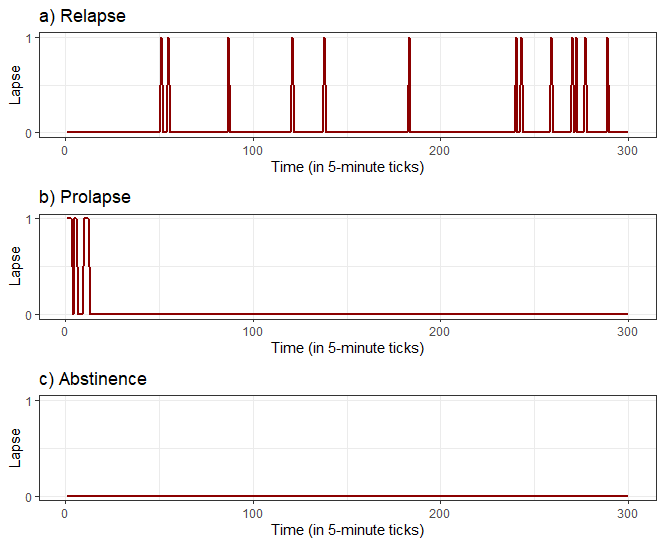
Figure 1 - Translation of the empirical phenomena into the simulation benchmarks. The x-axis represents time; the y-axis represents discrete smoking events (0 = no smoking; 1 = smoking).
2) Formulating a prototheory
3) Translating the prototheory into a formal model
Informal theory review
The theories/theoretical perspectives, key explanatory principles and components identified in the informal theory review are summarised in Table 1.
Table 1 - Theories, key explanatory principles and components identified in the informal theory review.
Source | Theory/theoretical perspective (key reference) | Explanatory principles | Key components |
Classical conditioning (Carter & Tiffany, 1999; Childress et al., 1999) | Smoking after the quit date tends to occur in situations and contexts which were previously paired with smoking. Exposure to smoking-related stimuli leads to cravings. | cue-reactivity; cravings; exteroceptive cues; interoceptive cues | |
Instrumental conditioning (Kassel et al., 2003; Koob & Le Moal, 1997; Robinson & Berridge, 2000; Solomon & Corbit, 1974) | Smoking is motivated by the drive to relieve or modulate negative affect. Opponent-process models propose that chronic drug use resets reward thresholds, which in turn modifies the reinforcement potential of further drug use. Reward allostasis models argue that initial drug use produces a neurobiological reduction in the hedonic set point, which makes additional drug use and other positively valenced stimuli more rewarding. Continued drug use, however, produces a more enduring increase in the hedonic set point, such that positive stimuli become less rewarding. | withdrawal; negative reinforcement; opponent processes; reward allostasis; pathological craving/compulsion | |
Negative affectivity (Kenford et al., 2002; Pomerleau et al., 1978) | Individuals with higher levels of negative affectivity are less likely to achieve and sustain abstinence. The association between negative affectivity and smoking is moderated by stressors and coping skills. | negative affectivity: neuroticism: depression-proneness; stressors; coping skills | |
Task persistence/distress tolerance (Quinn et al., 1996) | Individuals differ in the degree to which they can tolerate psychological and physical distress and persist in tasks that cause such distress, including smoking cessation. | persistence; effort; distress tolerance | |
Cognitive and social learning (Bandura, 1977) | Individuals’ expectations (conscious or unconscious) about behavioural outcomes and their beliefs about their ability to perform a given goal-oriented behaviour influence their motivation to engage in those behaviours. | outcome expectancies; motivation; self-efficacy; social learning | |
Behavioural economics models (Bickel & Marsch, 2001) | An individual who ceases drug use has chosen the delayed benefits of abstinence (e.g. long-term health) over the immediate reward of drug use. Over time, as cravings increase or when an opportunity to use drugs arises, the momentary preference may shift to drug use, resulting in lapse and relapse. | discounting of delayed reinforcers; preference reversal | |
The resource-depletion model of self-control (Muraven & Baumeister, 2000) | Self-control requires overriding or inhibiting urges, thoughts, and behaviours that conflict with longer-term goals (e.g. the goal to be healthy), social norms, or other behavioural rules. According to the theory of ego depletion, people have limited capacity for self-control in any given day and the capacity for self-control also varies between individuals. | inhibition/suppression of urges, thoughts and behaviours; ego depletion; cessation fatigue; motivation | |
Dual process models (Tiffany, 1990) | Drug taking behaviour becomes largely automatised in the experienced user. When trying to abstain, cravings occur when the individual is exposed to stimuli associated with drug use. Relapse occurs when controlled processing is insufficient to interfere with automatic drug use action plans. An extreme example is the “absentminded lapse”, when the individual is not initially aware that they have used a drug. | controlled cognitive processing; automatic drug use action plan; absentminded lapse | |
Relapse prevention theory and the dynamic model of relapse (Marlatt & Gordon, 1985; Witkiewitz & Marlatt, 2004) | The process of potential relapse is precipitated by a high-risk situation, including inter- and intrapersonal conditions (e.g. negative affect, conditioned stimuli). Failure to execute adequate coping responses leads reduced self-efficacy, increased positive expectancies about the substance, and increased lapse risk. The probability of progressing to a full relapse depends on an individual’s response to the initial lapse (i.e. the “abstinence violation effect”). The dynamic model of relapse proposes that lapse and relapse occur due to the interaction of “tonic processes” (i.e. distal risks, such as family history and dependence; cognitive processes, such as self-efficacy and outcome expectancies; and physical withdrawal), high-risk situations (i.e. contextual factors), and phasic processes (i.e. coping behaviours, affective state, substance use behaviours, and the abstinence violation effect). The general direction of causality is from the tonic processes to the phasic processes, with feedback loops between the two sets of processes. | family history; nicotine dependence; self-efficacy; outcome expectancies; physical withdrawal; high-risk situations; coping responses; affective state; substance use; abstinence violation effect | |
Relapse proneness (Shiffman et al., 1986) | Relapse proneness is the summative effect of slowly evolving background variables (e.g. stress, personality traits, dependence) and acute events (e.g. specific stressors and other high-risk situations). A lapse occurs when total relapse proneness at any time surpasses a certain threshold, and relapse occurs when it surpasses an even higher threshold. | chronic stress; personality traits; nicotine dependence; high-risk situations | |
Author team | Control theory (Carver & Scheier, 1982) | Individuals achieve higher-level goals (e.g. the goal to be healthy) by setting lower-level sub-goals (e.g. to quit smoking). Behaviour is regulated via a negative feedback loop, whereby behaviour is compared against the goal through monitoring by the self or others. Self-regulation is required whenever there is a discrepancy between the actual behaviour and the desired goal state. | higher-level goals; lower-level goals; monitoring of behaviour; negative feedback loop |
Author team | Value-based decision-making (Berkman, 2018) | Individuals assign subjective value (or utility) to different behavioural options, which ultimately influences the momentary decision-making. Self-control is a form of value-based choice wherein different behaviours are assigned a subjective value based on their expected costs (e.g. punishments, effort, time, identity threat) and benefits (e.g. norm conformity, rewards, attitude) and a decision is made through a dynamic integration process. | subjective value; primary and secondary rewards and punishments; effort; time; norm conformity; identity threat; personality; attitude; belief; executive function; delay discounting; diminishing marginal utility; endowment |
Stakeholder interviews
Six themes were developed and were labelled “self-concepts, goals and motivation”, “nicotine dependence and withdrawal”, “situational cues and automaticity”, “pro-active and in-the-moment regulatory strategies to prevent lapses”, “erosion of self-efficacy after lapses” and “momentary strategy preference reversal”. Additional quotations are found in the Supplementary Materials 2.
Self-concepts, goals and motivation
All stakeholders directly or indirectly mentioned the role of higher-level goals – which are either consistent or inconsistent with smoking – as drivers of the momentary motivation to stay quit and the momentary motivation (or craving) to smoke. Examples of higher-level goals which are consistent with smoking include enjoying oneself or not feeling stressed or anxious. The stakeholders also mentioned higher-level goals which are inconsistent with smoking, including being healthy or saving money.
“I absolutely have wanted to stop smoking. Every time it’s the same reason, because I think it’s stupid. It’s a waste of money and it smells bad. And I know absolutely it’s not good for your health. I know that.” – Stakeholder 14
A few stakeholders mentioned that often, different higher-level goals are held simultaneously, which gives rise to conflicts.
“we’ll often have people who are motivated, but not 100% motivated. They know they should stop, but they enjoy it.” – Stakeholder 11
Some stakeholders mentioned that the quality of the motivation not to smoke (i.e. whether it is primarily driven by internal wanting or external pressures, such as peer or family influence) impacts which higher-level goal(s) is acted upon.
“They are feeling external pressure to quit from their friends and from the social environment in general, when all the legislation is tightening and it’s getting more expensive to smoke.” – Stakeholder 5
Some stakeholders expanded on the role of social influence: they emphasised that one’s social identities or self-concepts (e.g. the self as parent, child, friend, partner) act as strong sources of the formation of different higher-level goals – and by extension – the motivation not to smoke. They described how individuals simultaneously hold multiple self-concepts. Depending on the dynamically changing context, different self-concepts and higher-level goals become salient to the individual. Many stakeholders highlighted the dynamic nature of the motivation not to smoke, which can plummet in social contexts where self-concepts which are congruent with smoking are salient.
“people probably vary in how many identities they have, and how many of those are health protective. Someone who’s not a teacher and they’re not a parent or a role-model, and maybe their strongest identity is being a risk-taker. It might then be really hard for them to find an identity which is incongruent with their smoking” – Stakeholder 4
Nicotine dependence and withdrawal
Many stakeholders described nicotine dependence and unpleasant withdrawal symptoms – including cravings, irritation and anxiety – as key factors driving the transition from initial abstinence to lapse and relapse. They emphasised that the withdrawal symptoms gradually dissipate during the first few weeks of cessation if the person manages to stay quit. After this initial period, cue-driven cravings become more important drivers of lapse and relapse.
“Many people lapse well after their withdrawal symptoms have been brought under control.” – Stakeholder 3
A few stakeholders mentioned that when an individual experiences a lapse, this leads to a temporary reduction in the withdrawal symptoms but that a lapse also negatively impacts the self-efficacy (i.e. confidence in one’s ability to stay quit). This is further described under the theme ‘The erosion of self-efficacy after lapses’.
“if they have a lapse, I think it’s going to decrease the withdrawal symptoms because of the nicotine, but also decrease the self-efficacy.” – Stakeholder 10
Situational cues and automaticity
All stakeholders emphasised that the momentary exposure to stressors (e.g. interpersonal conflict, time pressure) and stress reactivity (i.e. the individual’s reaction to stressors) increases the risk of lapsing. Between-person differences in, for example, socioeconomic position and neighbourhood characteristics were thought to influence how regularly an individual is exposed to different momentary stressors. In addition, the accumulation of stressful moments over the course of the day or several days was thought to lead to strong cravings, which influence the decision to smoke despite having made a commitment to quitting. It was implied in stakeholders’ accounts that the stress-craving-smoking link largely stemmed from the higher-level goal to not feel stressed or anxious and having previously learnt to use smoking as a coping strategy when feeling stressed. A few stakeholders mentioned that unpredictable life events during a quit attempt can cause lapses.
“I was very stressed. I didn’t sleep properly the night before, and I think I had a bit of an argument with my boyfriend, everything together, and at some point, I just felt very overwhelmed.” – Stakeholder 8
“As soon as they feel stressed, their coping strategy normally would be to go for a cigarette, because of feeling the urge to smoke. And now it’s about replacing that with something else.” – Stakeholder 7
All stakeholders mentioned the role of learnt cue-craving-behaviour associations in the relapse process, including objects, persons, activities and locations. They described a range of cues, such as coffee, alcohol or being at work or in a pub/bar, noting individual differences in which cues are most strongly associated with smoking. Sensory cues, such as seeing smoking paraphernalia or seeing/smelling a cigarette, were considered to signal both the opportunity and social permissibility to smoke. Some stakeholders also highlighted the difficulty in separating physical from social cues, as these often co-occur and reinforce one another.
“These occasions where people are used to smoke, for example, after their lunch or at the coffee breaks. They might be drivers for lapse.” – Stakeholder 6
“it’s the interaction between physical and social context. It could be with friends in a pub, or with friends in any other context [...] And maybe if I’m going out for a drink with my family, maybe it doesn’t apply. So it’s really a combination of factors.” – Stakeholder 2
Some stakeholders noted that lapses can occur through strictly automatic processes, with the cue-behaviour association bypassing any conscious cravings. They described situations in which cues directly trigger smoking; however, this only appeared possible when cigarettes were readily available. In situations where cigarettes were not readily available, conscious cravings were thought to influence the decision to obtain cigarettes. Hence, stakeholders’ accounts imply that automaticity is constrained by cigarette availability.
“So it doesn’t necessarily operate via cravings. If the cue is present and cigarettes are available, it will directly lead to a lapse, without going via cravings.” – Stakeholder 2
“So I actually kind of decided, I’m going to have a cigarette. And that took me to get out of the house, and go and buy some, because I don’t keep them at the house.” – Stakeholder 8
Pro-active and in-the-moment regulatory strategies to prevent lapses
All stakeholders emphasised the role of self-regulatory capacity, primarily in terms of the use of momentary strategies to manage stress or cravings to smoke. The use of regulatory strategies, including planning strategies in advance (e.g. what types of strategies to use, when) and being able or having the possibility to mount such strategies in the moment (e.g. when experiencing stress or cravings), was described as critical for maintaining abstinence.
“When it comes, you need to be prepared what to do in order not to lapse. If you have decided beforehand that, if the urge comes in this situation, I will do this in order not to lapse, then it’s much easier to depend on that, rather than if you have to start thinking about potential solutions when you’re already having the strong urge.” – Stakeholder 13
Many stakeholders also highlighted the protective role of pro-active behavioural and pharmacological support, which can help mitigate withdrawal symptoms, buffer against situational cues and help sustain high motivation not to smoke.
“the fast-acting nicotine products, like the spray or an e-cigarette, would help to reduce the momentary, cue-induced cravings.” – Stakeholder 4
Erosion of self-efficacy after lapses
Most stakeholders highlighted the importance of having confidence in one’s ability to stay quit (i.e. self-efficacy), as this influences the motivation not to smoke. Both concepts were described as dynamic and changing within individuals over time. Stakeholders described the negative consequences of momentary lapses on the self-efficacy, with feelings of guilt or regret leading to a loss of confidence in one’s ability to stay quit. This erosion of self-efficacy can in turn reduce the motivation not to smoke, which, through a negative feedback loop, leads to further lapses and subsequent relapse.
“in terms of the psychological aspect of it, they will regret it. So they will feel less motivated to stop. They will start doubting themselves, and feel like maybe they should remain smokers” – Stakeholder 7
Momentary strategy preference reversal
Many stakeholders described the smoking and quitting process as a sequence of momentary decisions to smoke (or not to smoke). When an individual forms a resolution to abstain from smoking, the momentary preference for not smoking outweighs the preference for smoking. However, exposure to stressors, cigarette cues or social contexts in which smoking is encouraged can temporarily reverse these preferences, leading individuals to reevaluate smoking as being more desirable than not smoking. Some stakeholders noted that the moment of preference reversal is often experienced as a distinct, deliberate decision to smoke.
“Broadly speaking, when you decide to quit, when you seek treatment, your motivation not to smoke is higher than your motivation to smoke, and so you form a resolution to not smoke anymore. But when you encounter any of these triggers, that leads to a temporary change in your valuation of smoking, and you decide to smoke in the moment.” – Stakeholder 3
“you’re trying to protect people from that switch. From “I’m not smoking” to “fuck it, go on then, I’m going to smoke”.” – Stakeholder 4
Some stakeholders noted that rationalisation is often used to justify the decision to smoke. Through framing the lapse as “just one cigarette”, the person temporarily reevaluates the costs and benefits of smoking, such that smoking momentarily becomes more appealing than abstaining. For example, the cost of smoking to one’s salient self-concept which is incongruent with smoking (e.g. being a good parent) may be momentarily downplayed.
“The rationalisation that it’s one last time can be a way of convincing yourself that all things considered, it’s better for you to smoke now than to not smoke.” – Stakeholder 3
“And you sort of reason with yourself that because of this, and this, and this, I’m allowed to smoke.” – Stakeholder 13
Informal computational modelling review
See the Supplementary Materials 1 for an overview of the identified computational modelling efforts in smoking/smoking cessation and the key model components.
Synthesis of the informal theory review, the stakeholder interviews and the informal computational modelling review
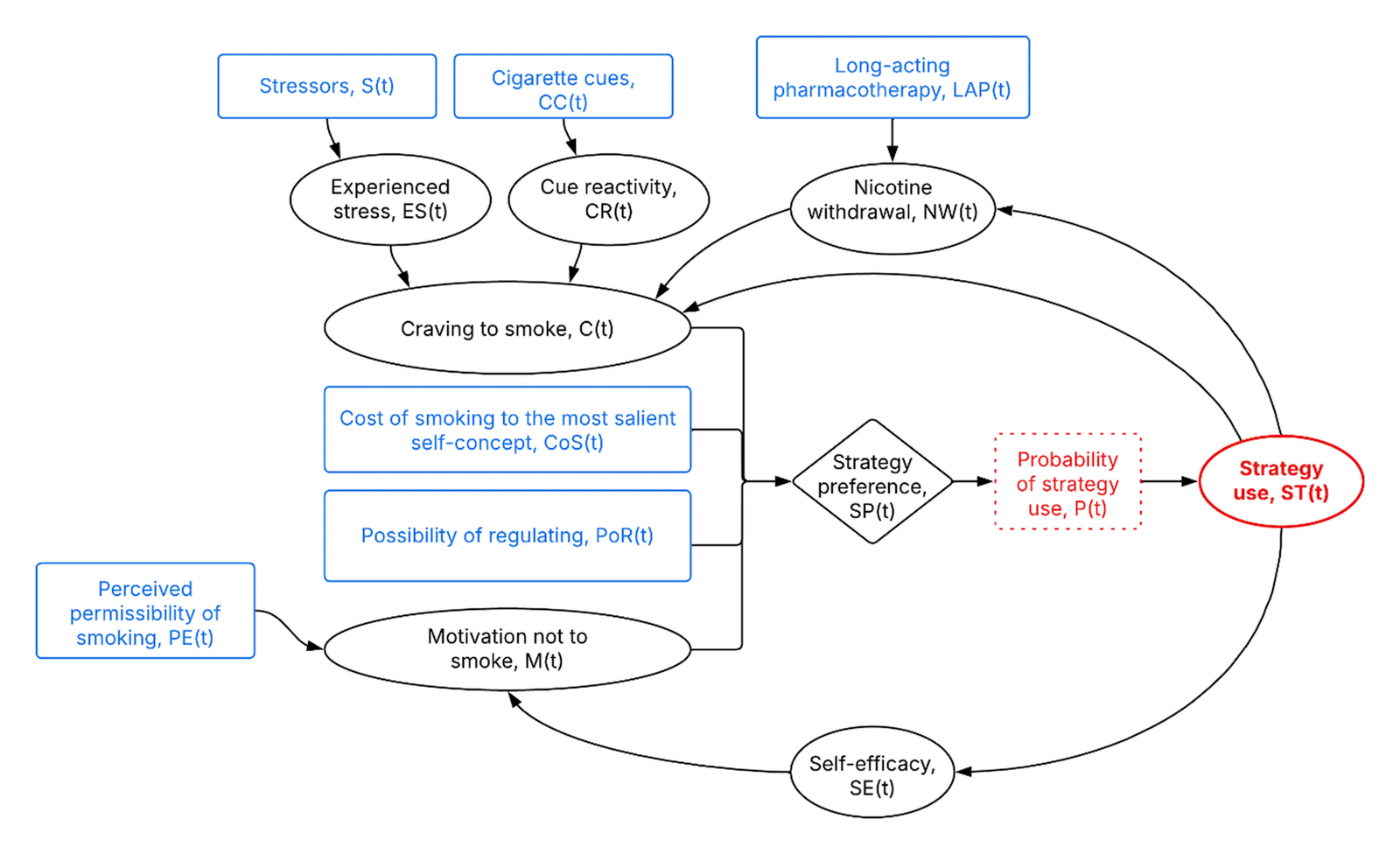
We used a triangulation approach to decide which components to retain across the three knowledge sources (i.e. the informal theory review, the informal computational modelling review, and the stakeholder interviews) and to reconcile potentially competing perspectives. Components identified in each source were compared to assess the extent of corroboration. Components were retained if they were identified in at least two of the three knowledge sources, reflecting a prioritisation of components supported by convergent evidence from multiple perspectives (see Table 2). See Figure 2 for a visual overview of the prototheory, described below in narrative form, with the retained model components in italics. To account for the most rapidly fluctuating model components (e.g. cigarette cues, the craving to smoke), the temporal unit of the system dynamics model was set to five minutes (see the Supplementary Materials 3 for detailed descriptions of the equations and assumptions regarding the selected functional forms and time lags). To illustrate the parameterisation approach, we provide the example of self-efficacy below.
Table 2 - Model components retained.
Model component [its functional role within the model] | Definition and related concepts | Informal theory review | Informal computational modelling review | Stakeholder interviews |
Probability of strategy use, P [output] and Strategy use, ST [output] | The enactment of a behavioural option (selected probabilistically from three options) which aims to manage the craving to smoke (i.e. smoke a cigarette, use a regulatory strategy, do nothing). Related concepts: behaviour; cigarette smoking; self-regulation; modification of thoughts, feelings, and behaviour in the service of a personal goal; situation selection; nicotine replacement therapy | ✓ | ✓ | ✓ |
Strategy preference, SP [state variable; integration process] | The subjective value ascribed to the different behavioural options which can help manage the craving to smoke (i.e. smoke a cigarette, use a regulatory strategy, do nothing). Related concepts: utility of different strategies; utility function; subjective value of different strategies | ✓ | ✓ | ✓ |
Self-efficacy, SE [state variable] | The confidence in one’s ability to achieve the lower-level goal not to smoke (i.e. a mental representation of the action to avoid smoking). Related concepts: confidence; beliefs about capabilities | ✓ | ✓ | |
Motivation not to smoke, M [state variable] | The motivation to strive towards the lower-level goal not to smoke (i.e. a mental representation of the action to avoid smoking). Related concepts: desire to avoid smoking | ✓ | ✓ | ✓ |
Craving to smoke, C [state variable] | The motivation to strive towards the lower-level goal to smoke (i.e. a mental representation of the action to smoke). Related concepts: desire to smoke; urge to smoke; wanting to smoke; feeling tempted to smoke | ✓ | ✓ | ✓ |
Cost of smoking to the most salient self-concept, CoS [input] | A rapid mental check-in with one’s self-concepts (i.e. a mental representation of the self as belonging to a valued social role or group for whom smoking is part/is not part of the expected behavioural repertoire) to assess if smoking would be damaging to the most salient self-concept at that moment in time. Related concepts: identity threat; identity; social identity; role-identity; social belonging; group affiliation; social influence | ✓ | ✓ | |
Possibility of regulating, PoR [input] | A rapid mental check-in of whether using a regulatory strategy to manage the craving to smoke is feasible at that moment in time. Related concepts: receptivity; availability; opportunity | ✓ | ✓ | |
Perceived permissibility of smoking, PE [input] | The feeling or thought that smoking is permissible or acceptable in a given moment, ranging from encouraged to forbidden. Related concepts: social conformity beliefs; social influence; social acceptance of smoking; perceived norms; normative beliefs; subjective norm; injunctive norm | ✓ | ✓ | ✓ |
Stressors, S [input] | Momentary exposure to stressful events (e.g. interpersonal conflict, job demands, adverse life events). Related concepts: cue reactivity; instrumental conditioning; negative reinforcement; internal cue; stressful event; stress-related craving | ✓ | ✓ | ✓ |
Experienced stress, ES [state variable] | Exposure to stressors leads to feelings and thoughts about the amount of stress one is experiencing in a given moment. Related concepts: cue reactivity; instrumental conditioning; negative reinforcement; internal cue; stressful event; stress-related craving | ✓ | ✓ | |
Cigarette cues, CC [input] | Momentary exposure to specific objects or events which have, through repetition, become automatically associated with the possibility of smoking (e.g. smoking paraphernalia, cigarette adverts, the presence of someone who smokes, being offered a cigarette, alcohol, cannabis). Related concepts: cue reactivity; classical conditioning; external cue; cigarette availability; cigarette advert; descriptive norm | ✓ | ✓ | ✓ |
Cue reactivity, CR [state variable] | Exposure to cigarette cues leads to feelings and thoughts about smoking. Related concepts: cue reactivity; classical conditioning; external cue; cigarette availability; cigarette advert; descriptive norm | ✓ | ✓ | |
Nicotine withdrawal, NW [state variable] | A group of symptoms that occur in the first few weeks or months after stopping or decreasing the use of nicotine, including the craving to smoke which lingers in the background. Related concepts: withdrawal symptom; background craving | ✓ | ✓ | ✓ |
Long-acting pharmacotherapy, LAP [input] | The use of one or more pharmacotherapies which reduce nicotine withdrawal or block the reinforcing effects of nicotine (e.g. varenicline, bupropion, transdermal nicotine patch). Related concepts: nicotine replacement therapy, pharmacology | ✓ | ✓ | |
Narrative overview of the prototheory
Individuals have multiple valued self-concepts which act as strong sources of goal formation and motivation to strive towards higher-level (e.g. being healthy, not feeling stressed or anxious, having fun) and lower-level goals (i.e. behaviours, such as the goal to smoke) (Carver & Scheier, 1982; stakeholder interviews). The self-concepts and higher-level goals are either consistent or inconsistent with the lower-level goal to smoke. For example, the self-concept as a parent may be linked to the higher-level goal to be healthy, which is inconsistent with the lower-level goal to smoke. When a person attempts to quit smoking, conflicts arise between different self-concepts and higher-level goals (e.g. a clash between the higher-level goals to not feel stressed or anxious and to be healthy, with the former being consistent and the latter inconsistent with the lower-level goal to smoke) (Berkman, 2018; stakeholder interviews). In addition, the momentary physical and social context influences the salience of different self-concepts and goals (described further below). We represent the self-concepts, higher- and lower-level goals and motivation through the cost of smoking to the most salient self-concept, the motivation not to smoke (an indicator of the importance of the lower-level goal not to smoke) and the craving to smoke (an indicator of the importance of the lower-level goal to smoke). The cost of smoking to the most salient self-concept is conceptualised a rapid, automatic mental comparison of the act of smoking with the most salient self-concept at that moment in time, which may be consistent (i.e. low cost to the self-concept) or inconsistent (i.e. high cost to the self-concept) with smoking. We opted not to explicitly represent higher-level goals as a separate construct in the current formalisation. Instead, higher-level goals are assumed to mediate the influence of self-concepts on lower-level goals and are therefore implicitly represented through the cost of smoking to the most salient self-concept, motivation not to smoke, and craving to smoke. This abstraction was made to reduce model complexity.
Quitting smoking leads to nicotine withdrawal, including cravings to smoke (Brandon et al., 2007; Witkiewitz & Marlatt, 2007; stakeholder interviews). Without any lapses, the nicotine withdrawal declines over time. The use of long-acting pharmacotherapies (e.g. nicotine patch, varenicline, bupropion) can attenuate background but not cue-driven cravings to smoke (described further below). If the person lapses, the nicotine withdrawal is briefly reduced but worsens in the next few hours (stakeholder interviews).
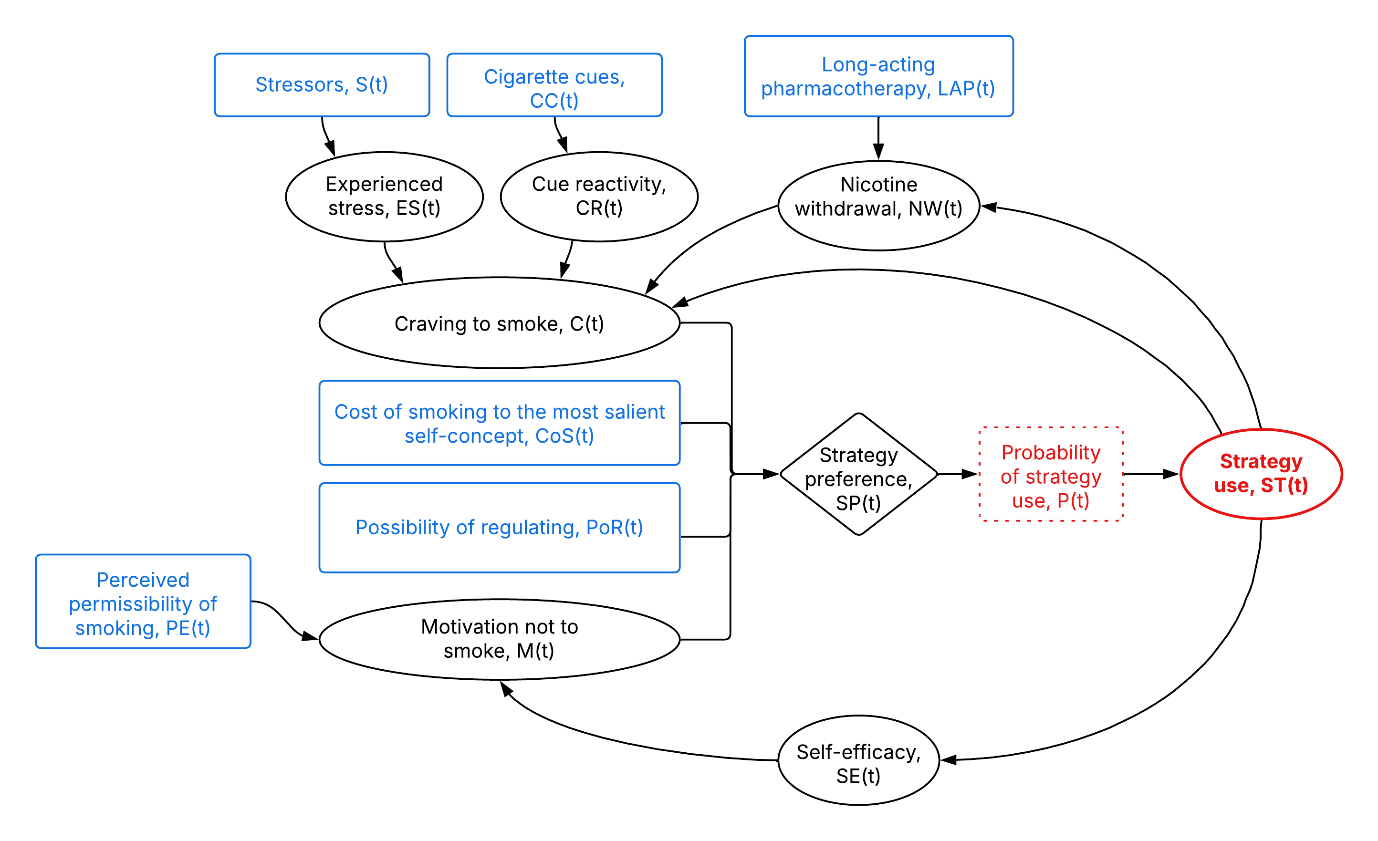
Figure 2 - Visual overview of the prototheory. The figure summarises the key processes theorised to drive transitions from abstinence to prolapse or relapse. The blue rectangles represent inputs, the black ovals represent state variables and the red oval and rectangle represent outputs. The black diamond represents a state variable that involves an integration process (i.e. the estimation of a strategy preference via a softmax function). The arrows indicate that the value of the source variable contributes to the process by which the subsequent variable is updated/generated. The prototheory includes two key feedback loops: (1) a self-efficacy feedback loop, whereby the strategy use (i.e. smoke a cigarette, do nothing, use a regulatory strategy) influences the self-efficacy and thereby future strategy use, and (2) a nicotine withdrawal feedback loop, whereby strategy use influences nicotine withdrawal, which in turn affects future strategy use.
Rapid onset stressors (e.g. interpersonal conflict) followed by experienced stress (i.e. feelings and thoughts about the amount of stress one is experiencing) and cigarette cues in the person’s environment (e.g. the presence of other smokers, cigarette adverts) have, through repeated couplings with cigarette smoking and its rewarding effects, become automatically associated with strong cravings to smoke (Brandon et al., 2007; Witkiewitz & Marlatt, 2007; stakeholder interviews). As we consider each cause to act independently, we represent the craving to smoke as the weighted sum of the nicotine withdrawal, the experienced stress, the cue reactivity (i.e. the person’s reactivity to any cigarette cues) and recent strategy use (described further below). Although the nicotine withdrawal declines over time, as stressors and cigarette cues fluctuate over the course of the day, the craving to smoke fluctuates more dramatically than the nicotine withdrawal (stakeholder interviews). In addition, social influence – i.e. the perception of how acceptable it is to smoke (represented as the perceived permissibility of smoking) – causes momentary changes in the motivation not to smoke (Brandon et al., 2007). For example, the perception that it is acceptable or encouraged to smoke immediately reduces the motivation not to smoke. The motivation not to smoke is also temporarily impacted by the self-efficacy (described further below). In the computational models reviewed, social influence was commonly included in the agent-based models (but not the other model types), where it was conceptualised as peer influence or susceptibility to social influence (Chao et al., 2015; Lakon et al., 2025). However, we opted to conceptualise social influence as the perceived permissibility of smoking (stakeholder interviews).
When noticing the craving to smoke, a mental calculation occurs whereby a strategy preference is formed (i.e. the subjective value ascribed to the different available behavioural options which can help manage the craving to smoke, which include smoking, using a regulatory strategy or doing nothing) (Berkman, 2018; stakeholder interviews). For example, if the craving to smoke is sufficiently high and the cost of smoking to the most salient self-concept at that moment is low, the person forms a preference for smoking. In the event of a goal conflict (i.e. the craving to smoke is high and the motivation not to smoke is high) and the person has the possibility of regulating (i.e. believes that it is feasible to try to regulate at that moment), they form a preference for using a regulatory strategy (e.g. an emotion-focused strategy, a cognitive strategy). If a regulatory strategy is used, it may help the person achieve their smoking consistent higher-level goals through a means other than smoking (e.g. a deep breathing exercise may help the person feel less stressed and anxious). In the computational models reviewed, the most commonly used approach was to represent and model discrete choices over time using probabilistic choice functions, often grounded in a utility framework (Chao et al., 2015; Lin et al., 2025). Another commonly used formalism was to use a drift-diffusion modelling framework (Biernacki et al., 2023; Copeland et al., 2023; Gao et al., 2022; Weigard et al., 2018), which is suitable for choice modelling in the context of experimental paradigms (e.g. computerised decision-making tasks). We therefore opted for a probabilistic choice function, with the strategy selected probabilistically from the three behavioural options. The strategy use differentially impacts the system dynamics further downstream (as specified above). For example, a lapse negatively impacts the self-efficacy and, in turn, the motivation not to smoke at the subsequent time step. If there are no lapses, however, the self-efficacy increases over time due to feelings of mastery (Witkiewitz & Marlatt, 2007; stakeholder interviews).
Illustration of the parameterisation approach
We formalise the self-efficacy to abstain from smoking as:
\(SE(t) = \iota_{1}SE(t - 1) - \iota_{2}St_{smok}(t - 1)\)
where \(\iota_{1}\) > 1 is a growth parameter and \(\iota_{2}\) > 0 represents the impact of a recent lapse on the self-efficacy.
In line with standard psychological response scales, we assume that self-efficacy can take values from 0 to 10. Without any lapses, the self-efficacy gradually increases over time until it reaches the maximum possible value due to feelings of mastery. We formalise the growth of the self-efficacy as an exponential (rather than linear) function. In addition, we assume that a lapse has a rather immediate, negative impact on the self-efficacy (i.e. in the next 5 minutes).
4) Examining the formal model’s explanatory adequacy
Figure 3 shows the results from the in silico parameter checks. The initial within-person system dynamics model can indeed generate the representational patterns of relapse, prolapse and abstinence (i.e. their distributional characteristics, rather than the precise timing of the discrete lapse events), thus providing an early sense-check of its explanatory adequacy. This exercise enabled us to explore the range of dynamics that our model can produce given a set of plausible – rather than optimal – parameter sets (see the Discussion).
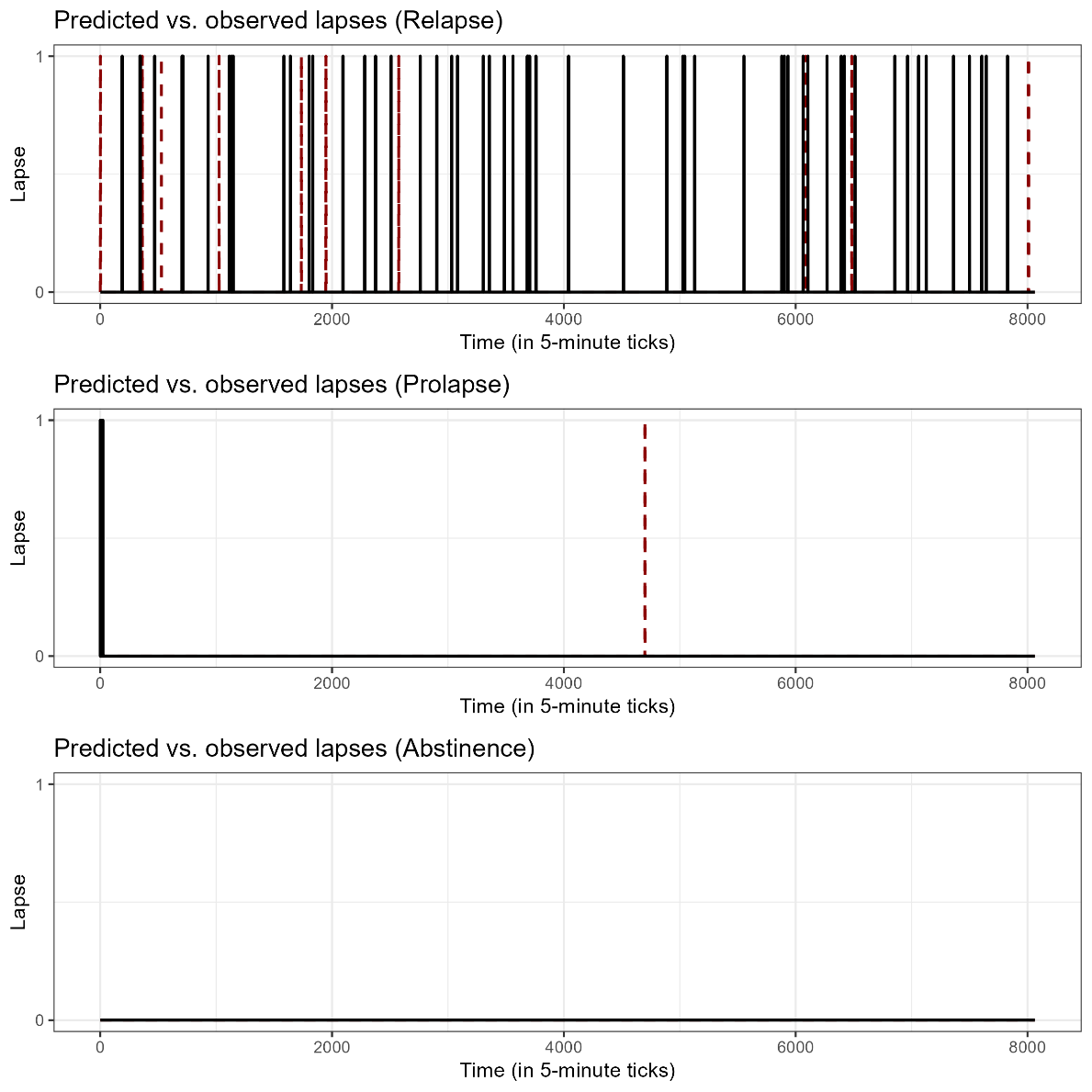
Figure 3 - Results from the parameter checks. The x-axis represents time; the y-axis represents discrete lapse events (0 = no lapse; 1 = lapse). The dashed red lines represent the model predictions*; the black solid lines represent the simulation benchmarks (i.e. the three representational patterns of relapse, prolapse and abstinence; referred to as “observed lapses” here to distinguish them from the model predictions). *First, 1,000 near-random sets of parameter values were generated using Latin hypercube sampling. Next, the model outputs were simulated using the 1,000 parameter sets (i.e. 1,000 models were run). We then compared the distribution of lapses in the 1,000 simulations with the expected distributions (i.e. the three simulation benchmarks) using the discrete Kolmogorov-Smirnov Test, which tests the hypothesis that the data are sampled from the same, unspecified distribution. We subsequently identified plausible parameter sets for each of the three phenomena of interest, which are displayed here. For simulation benchmarks with multiple plausible parameter sets, we selected the first one.
Next, we conducted local sensitivity analyses in which we systematically varied a parameter of interest whilst holding all other parameters constant at the middle of their plausible range. In Figures 4-5, we present the results when systematically varying 1) the magnitude of the cue reactivity and 2) the growth rate of the self-efficacy. The sensitivity analyses show that, at different parameter values, each of the two model components can itself cause a qualitative shift from, for example, prolapse to relapse whilst holding all other parameters constant. For example, Figure 5 shows that, at lower values of the growth rate of the self-efficacy, the person experiences relapse. At higher values, however, the person bounces back after a few initial lapses (i.e. ‘prolapse’). It should, however, be noted that exponential growth functions are highly sensitive to growth rate parameters, such that even small changes can substantially alter the speed with which self-efficacy approaches its upper or lower bounds. The sensitivity analysis in Figure 5 illustrates that varying this parameter alone can lead to qualitatively different behavioural trajectories. Future work will focus on identifying empirically calibrated (and hence, more realistic) parameter values.
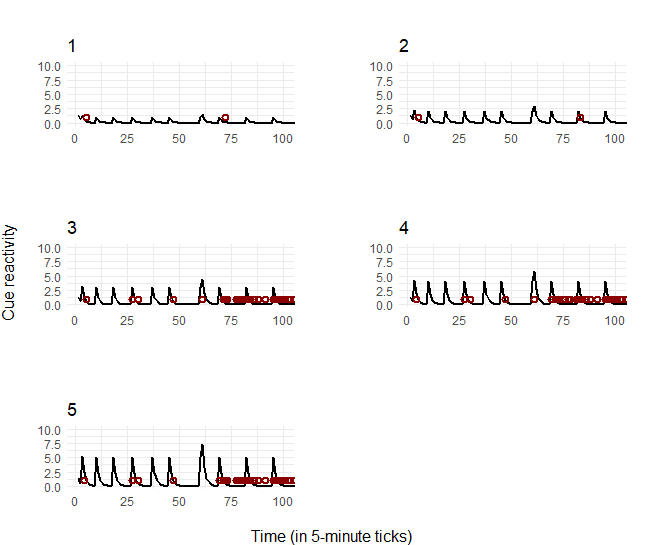
Figure 4 - Local sensitivity analyses in which the magnitude of the cue reactivity \({(\zeta}_{2})\) is systematically varied, holding all other parameters constant at the middle of their plausible range. 1) \(\zeta_{2}\) = 1; 2) \(\zeta_{2}\) = 2; 3) \(\zeta_{2}\) = 3; 4) \(\zeta_{2}\) = 4; 5) \(\zeta_{2}\) = 5. The black lines represent the cue reactivity (range: 0-10); the red circles represent lapses.
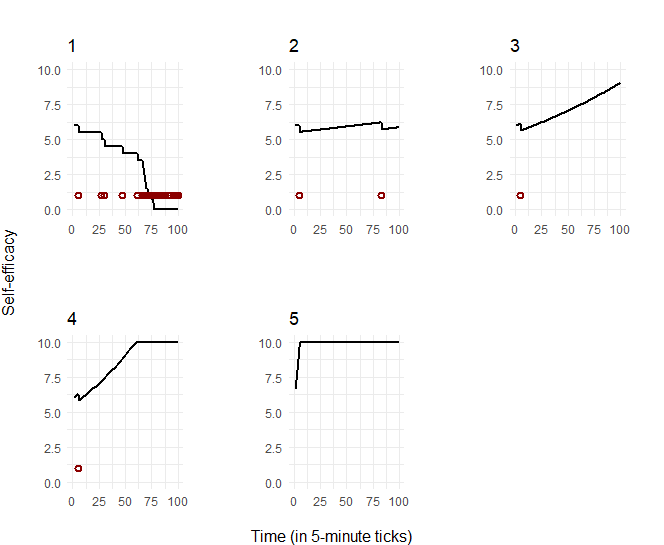
Figure 5 - Local sensitivity analyses in which the growth rate of the self-efficacy \((\iota_{1})\) is systematically varied, holding all other parameters constant at the middle of their plausible range. 1) \(\iota_{1}\) = 1.0005; 2) \(\iota_{1}\) = 1.0015; 3) \(\iota_{1}\) = 1.005; 4) \(\iota_{1}\) = 1.01; 5) \(\iota_{1}\) = 1.1. The black lines represent the self-efficacy (range: 0-10); the red circles represent lapses.
Discussion
We used formal and computational modelling to develop an initial within-person system dynamics model of relapse. In computer simulations, we found that the initial model can indeed produce the empirical phenomena it set out to explain, thus providing an early indication of its explanatory adequacy. However, it should be noted that the final step of the TCM (i.e. evaluating the theory’s overall adequacy or ‘goodness’), including the assessment of model fit to empirical data, remains to be undertaken before the theory can be regarded as adequate.
Limitations
First, there is a trade-off between model complexity and realism on the one hand, and feasibility and pragmatism on the other. Therefore, modellers typically need to manage challenges such as computational speed and tractability (Hammond, 2015). We opted not to explicitly formalise certain theoretically important components (i.e. the higher-level goals) in this initial version due to the existing complexity. Instead, they were implicitly represented through the cost of smoking to the most salient self-concept, motivation not to smoke, and craving to smoke. However, in line with the TCM, theory development is an iterative process which involves multiple cycles. As evidenced here, articulating precise temporal information regarding the within-person relapse process is highly time consuming and challenging. We intend to improve the system dynamics model in subsequent iterations.
Second, the informal (as opposed to systematic) reviews of relapse prevention theories and available computational modelling efforts, and the small number of stakeholders involved (N = 15), constitute another limitation. For example, involving a larger and more diverse group of stakeholders in longer sessions (i.e. the two linked sessions were each 30-90 minutes in duration) may have identified additional theoretical components and allowed for more in-depth exploration of plausible functional forms and time lags. In addition, we did not conduct a systematic review of the existing EMA literature specifically to inform the development of COMPLAPSE. However, members of the author team recently conducted a systematic review and meta-analysis of within-person associations between psychological and contextual factors and lapse incidence in smokers attempting to quit, which included 61 EMA studies (Perski et al., 2023a). This review highlighted important challenges in interpreting findings from existing EMA studies, particularly regarding the sampling frequency/temporal resolution selected by research teams, which appeared to be driven primarily by pragmatic considerations rather than by theoretically expected rates of change in different constructs. Nevertheless, the psychological and contextual factors identified in this literature broadly align with the constructs represented in COMPLAPSE. Future work should build on this foundation by systematically evaluating how formal models can inform EMA study designs, and how EMA data can be used to refine and validate computational models of relapse dynamics.
Third, there are no recommended reporting guidelines for formal and computational models in psychology. Despite being focused on increased precision and clarity, formal modelling requires numerous decisions to be made. Due to the highly iterative nature of the modelling process, documenting considerations and decisions is challenging and time consuming. We aimed to make our development process as transparent as possible, drawing on Open Science practices and clearly stating that the purpose was to contribute to dynamic theory development. However, it would be useful for formal modellers within psychology to come together to jointly develop open-ended pre-registration and reporting forms, similar to those developed within cognitive science (Crüwell & Evans, 2021).
Implications for researchers, clinicians and patients
The dynamic theoretical model can immediately be used by other researchers to inform empirical studies and develop alternative dynamic explanations used for comparison with the current model iteration. In addition, clinicians and patients stand to benefit from this type of model in the near future. For example, clinicians have already begun to include high-resolution measurements and within-person dynamic modelling in their workflows to inform the delivery of personalised interventions (Burger et al., 2022; Scholten et al., 2022). In the near future, the dynamic theoretical model could, for example, be embedded in primary care or dedicated stop smoking services and be used to inform adaptive intervention delivery for each client, with the potential to increase smoking cessation success rates and reduce the disease burden and human suffering caused by cigarette smoking.
Avenues for future research
We opted to work with well-established empirical phenomena (‘relapse’, ‘prolapse’ and ‘abstinence’). However, in discussions with the stakeholders and when translating the phenomena into representational patterns, we learnt that their definitions and boundary conditions were much more unclear than implied by their widespread use. This illustrates one of the key contributions of the formalisation process: it forces theoretical concepts to be specified precisely and thus exposing shortcomings that remain hidden in verbal descriptions of theories. Future work would benefit from identifying repeatable boundary conditions for lapse and relapse phenomena using a bottom-up approach (Baretta et al., 2024).
Similarly, the theory formalisation process has highlighted several areas where further theoretical and empirical work is needed. In particular, future iterations would benefit from more explicit consideration of the role of chronic vs. acute stressors and acute stressors vs. cigarette cues. For example, effects may be additive or interactive, which could be explicitly tested in model comparisons which can help adjudicate between different theoretical explanations (Perski et al., 2024a).
In addition, we conducted several ‘local’ sensitivity analyses in which selected parameter values were systematically varied. However, the theory formalisation process opens up a broader set of opportunities for theory development. Once a theory is implemented as a formal and computational model, it becomes possible to move beyond sensitivity analyses and evaluate alternative dynamic explanations. These may include explanations involving innovations from the computational modelling literature in modulated reward thresholds during withdrawal (Baker et al., 2020; Montemitro et al., 2024; Pergadia et al., 2014), the conceptualisation of the level of nicotine dependence as time-varying or more sophisticated representations of social influence. Such alternatives can be explicitly formalised and tested and contrasted by examining how well they reproduce the phenomena of interest (Railsback & Grimm, 2019).
Related to the above point, the within-person modelling approach allows between-person, trait-level characteristics (e.g. age, gender, nicotine dependence level, socioeconomic position) to be represented indirectly via variation in the model’s initial conditions or parameter values. However, future iterations would benefit from making the between-person dimension more explicit, for example through extending the model into a multilevel formulation in which trait-level characteristics are represented as higher-order parameters which moderate within-person dynamics. Such an approach would enable a more explicit integration of within- and between-person processes and may help explain why individuals exposed to similar moment-to-moment circumstances can nevertheless follow markedly different relapse trajectories. This extension may be particularly valuable in light of emerging computational and neurobiological models suggesting that, for example, reward valuation and motivational processes vary both across individuals and within individuals over time (Baker et al., 2020; Montemitro et al., 2024; Pergadia et al., 2014).
Although it is promising that the initial dynamic model can produce the empirical phenomena of interest, its overall adequacy or ‘goodness’ remains to be evaluated. In an ongoing EMA study with smokers attempting to stop, we are drawing on the hypothetico-deductive method to evaluate the model’s predictive success. We are collecting EMAs in people’s daily lives and will subsequently fit the formal model to each individual’s dataset, optimising the parameter values using a standard algorithm. In contrast to the parameter checks conducted here (which were focused on exploring if the model could theoretically produce the broader patterns of relapse, prolapse and abstinence, as defined by their distributional characteristics), we expect a more precise fit to each person’s dataset to be obtained (i.e. matching the timing of lapses). This is due to being able to incorporate real-world measurements of key input variables, such as the stressors and cigarette cues, and using an optimisation algorithm to estimate the parameter values.
Formal and computational models have the potential to underpin just-in-time adaptive interventions (Nahum-Shani et al., 2016; Perski et al., 2021). Future work is needed to explore when and where different real-time interventions could be delivered to prevent relapse. A benefit of having translated the formal model into R code is the ability to simulate the system dynamics under conditions of different momentary interventions and use the results to inform experimental work, drawing on methodology from the control systems engineering toolbox (i.e. system identification experiments) (Freigoun et al., 2017; Hekler et al., 2018; Rivera et al., 2007).
Conclusion
Drawing on the Theory Construction Methodology, we used a participatory, iterative, multi-method approach to develop an initial within-person system dynamics model of relapse in smoking cessation. We have illustrated the model development process and discussed the next steps, including the evaluation of the model’s predictive success.
Acknowledgements
The authors would like to thank the stakeholders for their time and contributions to the dynamic model development: Emily Hébert, Matt Field, Dario Baretta, Felix Naughton, Erica Cruvinel, Taina Tilman, Helene Le, Hanna Ollila, Otto Ruokolainen, Dayyanah Sumodhee, Kerry Johns, Eveliina Hirvonen, Patrick Sandström and two anonymous stakeholders.
Preprint version 10 of this article has been peer-reviewed and recommended by Peer Community In Psychology (https://doi.org/10.24072/pci.psych.100472; Ballou, 2026).
Funding
OP was supported by a Marie Skłodowska-Curie Postdoctoral Fellowship from the European Union (Grant Agreement number: 101065293) and a Starting Grant from the European Research Council (Grant Agreement number: 101219875). JA was funded for part of this work by the Medical Research Council MR/X003264/1, MC_UU_00022/3) and Chief Scientist Office (CSO; SPHSU18). Views and opinions expressed are however those of the author(s) only and do not necessarily reflect those of the European Union. The European Union cannot be held responsible for them.
Conflict of interest disclosure
The authors declare that they comply with the PCI rule of having no financial conflicts of interest in relation to the content of the article, and have no non-financial conflicts of interest.
Data, scripts, code, and supplementary information availability
Supplementary information is available online: https://osf.io/ymsrx/ The R Shiny application can be accessed via: https://gbovy3-olgaperski.shinyapps.io/COMPLAPSE_app/ The code underpinning the formal and computational model is available via: https://doi.org/10.5281/zenodo.22900184 (Perski, 2026). The development repository is hosted at https://github.com/OlgaPerski/Project_COMPLAPSE.
Appendix