

 CC-BY 4.0
Introduction
Phylogenetic comparative methods (PCMs) allow researchers to study trait variation while accounting for shared evolutionary history (Felsenstein, 1985; Grafen, 1989). These methods range from phylogenetic generalised least squares (PGLS; Freckleton et al., 2002), phylogenetic path analyses (Gonzalez-Voyer & von Hardenberg, 2014) to phylogenetic generalised linear mixed models or meta-analyses (e.g. Hadfield & Nakagawa, 2010; Mizuno et al., 2025; Nakagawa & Santos, 2012). Before fitting such models, researchers need two matched objects: a dataset with species names and a phylogenetic tree with tip labels representing the same species names. Yet this apparently simple prerequisite, matching species names, is often a stumbling block in a comparative workflow, because using scientific species names (binomial strings) as keys causes mismatches that can remove species from the analysis.
The name-matching problem often becomes visible only when the data and the tree are brought together. A species may be present in both sources, but fails to match because one source writes the name as “Parus major”, whereas another uses the tip label “Parus_major”. In many cases, the two sources may use different names for the same or corresponding taxon, for example, because of an older genus name, a synonym, or a different taxonomic authority. Also, species may be absent from the tree. These cases could have different biological and practical implications, yet they may have similar effects if simple filtering is applied to remove mismatched species, thereby reducing the number of species in the analysis. For PCMs, this loss matters not only because the retained species set has less information and power, but also because non-random species loss could alter both the composition of the analysed dataset and its phylogenetic structure (Marcondes, 2019).
Several R (R Core Team, 2025) packages address parts of this problem. Taxonomic tools, such as taxize (Chamberlain & Szöcs, 2013), taxadb (Norman et al., 2020), Taxonstand (Cayuela et al., 2012), and bdc (Ribeiro et al., 2022), help users validate, standardise, or clean species names; the underlying Global Names Architecture provides language-agnostic name-parsing and verification services that several of these tools draw on. Its name parser is described by Mozzherin et al. (2017). Tree-retrieval tools, such as rotl (Michonneau et al., 2016), rtrees (Li, 2023), clootl (Miller et al., 2026), fishtree (Chang et al., 2019; Rabosky et al., 2018), and datelife (Sánchez Reyes et al., 2024), help users obtain phylogenies. PCM helper functions, such as geiger::treedata() (Harmon et al., 2008; Pennell et al., 2014) and caper::comparative.data() (Orme et al., 2025), help align data and trees for analysis. However, these tools are not designed to provide a single workflow that takes raw species names, from several data objects and produces aligned comparative objects together with an explicit, auditable record of name-matching decisions. The gap is therefore not the absence of useful tools, but the lack of a transparent conduit connecting between name reconciliation, tree preparation, and downstream PCM analysis (Table 1).
Here, we present \(\texttt{prepR4pcm}\), an R package for preparing species-level data and phylogenetic trees for PCMs. The package connects three steps that are often handled separately: name reconciliation, tree preparation, and final data-tree alignment. First, it reconciles species names through a staged procedure that combines exact matching, name normalisation, synonym lookup, and optional fuzzy matching. Second, it records each decision in a reconciliation object, allowing users to inspect which names matched, changed, left unresolved, or corrected manually. Third, it applies the reconciliation to return a data frame and a pruned tree containing the same species set, ready for common comparative workflows, including PGLS, phylogenetic mixed models, and phylogenetic meta-analysis. When users do not yet have a suitable tree, prepR4pcm can also retrieve trees from several sources, record name substitutions, check the alignment between the tree and species-level data, and format tree-source citations to credit the original references.
Table 1 – Existing R tools for taxonomic name handling and phylogenetic tree retrieval relevant to phylogenetic comparative methods. The first three columns identify each tool and place it in context. Tool = R package or function; Role = the main task the tool was designed to perform; Coverage = the main names, taxa, tree sources, databases, or input objects covered by the tool. The remaining columns summarise features relevant to preparing data and trees for PCMs. Tree = accepts or works directly with a user-supplied ape::phylo tree; Prov. = records provenance or an audit trail for name-matching, tree retrieval, or alignment decisions; Fuz. = supports fuzzy matching for likely spelling errors; Syn. = supports synonym lookup or accepted-name resolution; Map = supports taxonomy mapping tables or crosswalks between naming systems; Fetch = retrieves a tree from an external source; Multi = can return, handle, or compare more than one tree, such as posterior samples or alternative phylogenies. ✓ = full support; ∼ = partial or context-dependent support; – = absent.
| Tool |
Role |
Coverage |
Tree | Prov. | Fuz. | Syn. | Map | Fetch | Multi |
|---|---|---|---|---|---|---|---|---|---|
| taxize |
Taxonomic name resolution |
Multiple online taxonomic databases |
– | – | ∼ | ✓ | – | – | – |
| rgnparsera |
Name parsing and verification |
Global Names services and linked name sources |
– | ∼ | ✓ | ✓ | ∼ | – | – |
| taxadb |
Local taxonomic name resolution |
Local copies of multiple taxo nomic databases |
– | – | – | ✓ | – | – | – |
| Taxonstand |
Plant name standardisation |
Plant names, originally against The Plant List |
– | ∼ | ∼ | ✓ | – | – | – |
| bdc |
Biodiversity data cleaning |
Occurrence records and associated taxonomic names |
– | ∼ | ∼ | ✓ | – | – | – |
| rotl |
Taxonomy and tree retrieval |
Open Tree of Life taxonomy and synthesis tree |
∼ | – | – | ✓ | – | ✓ | – |
| Rtrees |
Megatree assembly |
Taxon-specific megatrees, including birds, mammals, fishes, plants, and others |
∼ | ∼ | – | – | – | ✓ | ✓ |
| clootl |
Avian tree retrieval |
Bird trees mapped to eBird/-Clements taxonomy |
∼ | – | – | – | – | ✓ | ∼ |
| fishtree |
Fish tree retrieval |
Ray-finned fish phylogenies from the Fish Tree of Life |
∼ | – | – | – | – | ✓ | ✓ |
| datelife |
Dated-tree synthesis |
Published dated phylogenies across taxa |
∼ | ∼ | – | ∼ | – | ✓ | ✓ |
| geiger::treedata |
Data–tree alignment |
User-supplied comparative dataset and tree |
✓ | – | – | – | – | – | – |
| caper::comparative.data |
PCM data-object creation |
User-supplied comparative dataset and tree |
✓ | – | – | – | – | – | – |
| prepR4pcm |
Audited PCM preparation pipeline |
User datasets and trees, with optional tree retrieval |
✓ | ✓ | ✓ | ✓ | ✓ | ✓ | ✓ |
aR wrapper for Global Names Architecture services (Mozzherin et al., 2017); taxize also uses the Global Names Verifier internally. This table compares broad workflow features rather than the quality, completeness, or taxonomic authority of each tool.
Package description
Overview and design
\(\texttt{prepR4pcm}\), was designed around three principles: conservative matching, transparent records, and reproducible outputs. These principles apply to both main parts of the package: reconciling species names among data objects and trees, and preparing trees for downstream PCMs.
First, \(\texttt{prepR4pcm}\) is conservative. It gives priority to high-confidence matches and does not replace them with weaker matches later in the workflow. Exact and normalised matches are attempted before synonym lookup and optional fuzzy matching. Names are not changed without being recorded, and uncertain matches are left for user review.
Second, the package is transparent. Each reconciliation returns a reconciliation object that records what happened to each name. This object stores the original and matched names, the match type, a score, a short explanation, the settings used in the run, and any manual overrides. Users can print the object for a summary or extract the full mapping table for inspection and reporting.
Third, the package is reproducible. The reconciliation object stores the settings used in the run, together with the package, database, and tree-source information where relevant. This design helps users repeat a workflow, compare alternative reconciliation runs, and report how the final data and tree objects were produced.
The package uses ape (Paradis & Schliep, 2019) for phylogenetic tree handling, cli for user messages, rlang for tidy evaluation, and tibble for data frames. Synonym matching uses taxadb (Norman et al., 2020) when this suggested dependency is available.
Matching cascade
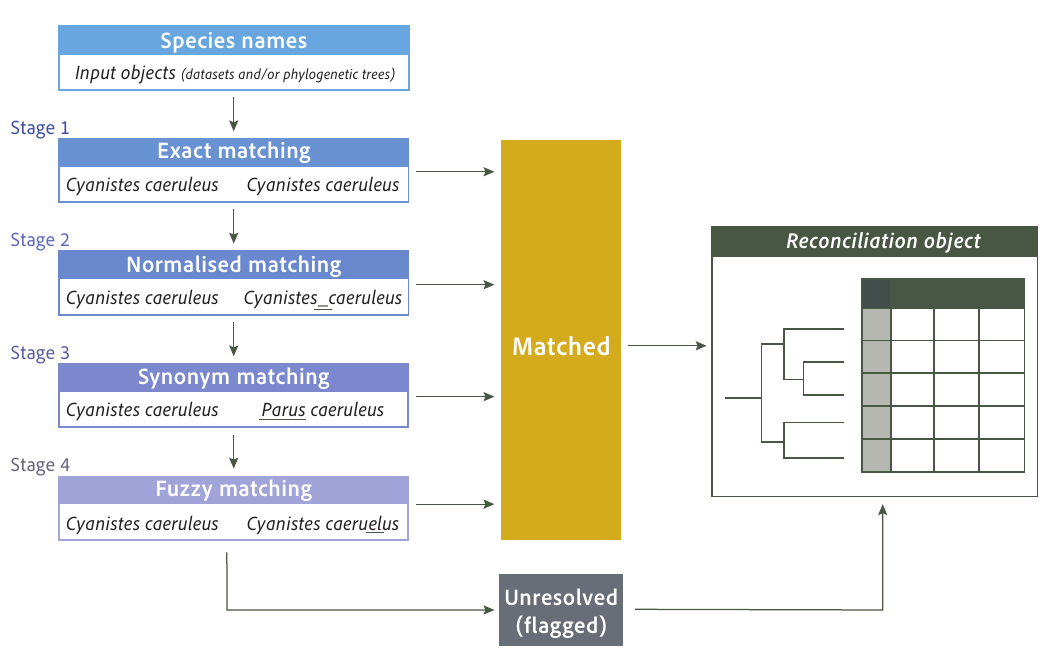
The core of \(\texttt{prepR4pcm}\) is a “four-stage matching cascade” (Figure 1). The cascade starts with the safest matches (exact name matching), then moves to those that require more interpretation. At each stage, only names that remain unmatched advance to the next. Thus, an exact match is never replaced by a weaker match later in the pipeline.
Stage 1: Exact matching.. The package first compares names exactly as written. These matches receive a score of 1.0 (ranging from 0 to 1).
Stage 2: Normalised matching.. The package then standardises names before matching them again. This step deals with common formatting differences, such as spaces versus underscores, inconsistent capitalisation, repeated spaces, authority strings, and Open Tree of Life suffixes. Infraspecific names are handled according to the rank argument. With rank = “species” (the default), infraspecific rank markers such as subsp., ssp., var., and f., together with the following epithet, are removed so that trinomials are reduced to binomials before matching. For example, Parus major major becomes Parus major. With rank = “subspecies”, trinomials are retained and recognised infraspecific rank markers are standardised; for example, ssp. is converted to subsp. Placeholder names such as Genus sp. are retained during normalisation rather than assigned to a named species. They can therefore match an equivalent placeholder in another source. Otherwise, they continue through any enabled later matching stages and remain available for user review if unresolved. These operations standardise name strings; they do not make taxonomic decisions about whether two names represent the same biological entity. Normalised matches receive a score of 1.0 because the underlying names are identical after these deterministic transformations, but they are labelled as “normalised” because the original strings differed.
Stage 3: Synonym matching.. Names that remain unmatched can be checked against local taxonomic databases through taxadb. This step is useful when the dataset uses one accepted name and the tree uses a synonym or an older name. Where possible, the package records which source was used. Synonym matches receive a score of 0.95 because they depend on the selected taxonomic authority. The name_resolved and match_source fields record the accepted name and taxonomic authority used to establish the match. When resolve = “flag”, indirect synonym matches that require both names to be resolved through the authority are flagged for user review.
Stage 4: Fuzzy matching.. Finally, the package can suggest near matches for likely spelling errors. Fuzzy matching compares the genus and species epithet using a component-based string distance. It is useful for finding typographical errors, but it can also suggest wrong matches. For this reason, fuzzy matching is optional, and uncertain matches are flagged for review rather than silently accepted. Fuzzy matches receive a component-based similarity score. By default, matches with scores of at least 0.90 are retained, with uncertain matches flagged for user review. The match type records that the result was obtained through fuzzy matching.

Figure 1 – The four-stage matching cascade in \(\texttt{prepR4pcm}\). Species names from input objects, such as datasets and phylogenetic trees, are passed through a conservative matching cascade. Exact matches are identified first, followed by matches after name normalisation, synonym-based matches, and optional fuzzy matches for likely spelling errors. The example species names illustrate the intended distinction among matching stages: identical spelling for exact matching (Cyanistes caeruleus), formatting differences for normalised matching (Cyanistes_caeruleus), synonymy or older nomenclature for synonym matching (Parus caeruleus), and a likely typographical error for fuzzy matching (Cyanistes caeruelus). Names matched at any stage, as well as names retained as unresolved or flagged cases, are stored in the reconciliation object so that the process can be inspected, reported, and reproduced.
The reconciliation object
The central output of \(\texttt{prepR4pcm}\) is a reconciliation object. This object records how names were matched, changed, left unresolved, or corrected by the user. It is produced not only when a dataset is reconciled with a tree, but also when users reconcile two datasets, two trees, several datasets against one tree, or one dataset against several trees. Thus, the same object structure is used across data–data, data–tree, tree–tree, multi-dataset, and multi-tree workflows.
A reconciliation object has four main components. The \$mapping table records the names from the input objects and the outcome for each name. The exact columns depend on the workflow, but the table includes information such as original names, matched names, match status, match type, score, source, and notes. The \$meta list stores the settings used in the run, together with timestamps and version information. The \$counts table summarises how many names were matched, changed, or left unresolved. The \$overrides table records manual changes made by the user.
The reconciliation object separates reconciliation from application. Users can first inspect the name-matching decisions, then decide whether to accept them, add corrections, or rerun the reconciliation with different settings. The object has print(), summary(), and format() methods. Printing gives a short summary of match coverage. The function reconcile_mapping() returns the full mapping table, which users can inspect, save, or include as supplementary material.
This mapping table is the main difference between a simple alignment and an auditable reconciliation. Standard PCM helper functions are useful for making data and trees ready for analysis, but they are not designed to record all name-matching decisions. \(\texttt{prepR4pcm}\) keeps this record, so users can see which names matched, which names changed, which names remained unresolved, and which names were corrected by hand before the final data and tree objects are created.
Curation, augmentation, and multi-input workflows
Because the reconciliation object keeps the matching decisions separate from the final aligned objects, users can curate the result before applying it. Automated matching should not be the final word in every case. Taxonomy changes, spelling errors, and species splits and lumps often require human judgement. Species splits and lumps are particularly challenging because they can create one-to-many or many-to-one relationships between taxonomies, which cannot generally be resolved by name matching alone. Users therefore need to decide how these taxa should be treated, and these decisions should be explicitly recorded as part of the reconciliation. \(\texttt{prepR4pcm}\) therefore provides tools for curation after the first reconciliation.
Users can correct individual matches with reconcile_override() or apply many corrections with reconcile_override_batch(). They can also use reconcile_crosswalk() to apply a taxonomic crosswalk: a table that links names in one taxonomy to names in another. For example, a crosswalk between BirdLife-based names and Jetz et al. / BirdTree tip labels can show which BirdLife names correspond to tip labels in Jetz et al. bird phylogeny (Jetz et al., 2012; Tobias et al., 2022).Some studies need to deal with species that are present in the data but absent from the tree. reconcile_augment() can add such species to a tree for exploratory analyses, for example, by placing an unresolved species with a close relative. Internally, \(\texttt{prepR4pcm}\) can also delegate grafting to the V.PhyloMaker/U.PhyloMaker suites when the required backbone and genus-family information are available (Jin & Qian, 2019, 2022, 2023). This step should be treated as a modelling assumption rather than an observed result. Users should therefore report which species were added and repeat the analysis with and without augmented tips.
Alternatively, users may substitute a closely related tree tip for which no data are available with a data species absent from the tree. In \(\texttt{prepR4pcm}\), this can be recorded using reconcile_override() and applied using reconcile_apply(). This relabels the surrogate tip while preserving its phylogenetic position and branch lengths, leaving the numerical covariance values unchanged apart from their labels. Because this assumes that the focal species occupies the surrogate’s phylogenetic position, the choice should be biologically justified and clearly reported.
The package also supports studies with more than one dataset or more than one tree. reconcile_data() reconciles two data frames, reconcile_merge() joins reconciled datasets, reconcile_multi() reconciles several datasets against one tree, and reconcile_to_trees() reconciles one dataset against several trees. These functions are useful when users want to compare alternative trees or combine trait datasets from different sources.
Tree retrieval and dating
Many users begin with a trait dataset without a suitable phylogenetic tree. pr_get_tree() helps in this situation by retrieving a candidate phylogeny from public sources. At present, the package supports five backends: rotl, rtrees, clootl, fishtree, and datelife. These back-ends differ in taxonomic coverage, tree sources, and whether they return a single tree or a set of trees.
Before a backend is called, pr_normalize_names() standardises the input species names. This step helps avoid failures caused by simple formatting differences. When taxonomic name resolution changes an input name, the package records the replacement, linking the user’s original name to the resolved name. The package also checks that the reported matched and unmatched names remain tied to the user’s input list.
Table 2 – The 31 available functions in \(\texttt{prepR4pcm}\) package, organised by functionalities. Functions prefixed reconcile_ enable the matching and alignment pipeline; functions prefixed pr_ enable tree retrieval, dating, comparison, and supporting utilities.
|
Function |
Family |
Description |
|---|---|---|
|
reconcile_tree |
Reconciliation |
Reconcile a data frame against a phylogenetic tree |
|
reconcile_data |
Reconciliation |
Reconcile two data frames |
|
reconcile_trees |
Reconciliation |
Reconcile two phylogenetic trees |
|
reconcile_to_trees |
Reconciliation |
Reconcile one dataset against a list of trees |
|
reconcile_multi |
Reconciliation |
Reconcile multiple datasets against one tree |
|
reconcile_apply |
Alignment |
Produce matched data frame and pruned tree |
|
reconcile_merge |
Alignment |
Join two reconciled datasets |
|
reconcile_override |
Curation |
Manually correct an individual match |
|
reconcile_override_batch |
Curation |
Apply batch corrections from CSV or data frame |
|
reconcile_crosswalk |
Curation |
Convert a taxonomy crosswalk to overrides |
|
reconcile_augment |
Augmentation |
Graft missing species onto a phylogenetic tree for exploratory analyses |
|
reconcile_mapping |
Inspection |
Extract the full mapping tibble |
|
reconcile_summary |
Inspection |
Generate a detailed summary report |
|
reconcile_plot |
Inspection |
Plot match composition (bar or pie chart) |
|
reconcile_suggest |
Review |
Suggest fuzzy candidates for unresolved names |
|
reconcile_review |
Review |
Interactively accept/reject flagged matches |
|
reconcile_diff |
Review |
Compare two reconciliation runs |
|
reconcile_splits_lumps |
Review |
Detect taxonomic splits and lumps |
|
reconcile_report |
Reporting |
Produce self-contained HTML report |
|
reconcile_export |
Reporting |
Write aligned data, tree, and mapping to disk |
|
pr_get_tree |
Tree retrieval |
Fetch a tree from external sources / backends: rotl/rtrees/clootl/fishtree/datelife (manual selection or auto) |
|
pr_get_tree_status |
Tree retrieval |
Probe which backends are installed and reachable |
|
pr_date_tree |
Dating |
Add DateLife calibration to an existing topology |
|
pr_cite_tree |
Citations |
Format citations for the sources of phylogenies used (select formats: text/Markdown/BibTeX) |
|
pr_tree_compare |
Comparison |
Pairwise Jaccard, Robinson–Foulds, and bipartition-matched branch-length tree agreement |
|
pr_phylo_cor |
Correlation |
Build the phylogenetic correlation matrix from a tree for metafor/MCMCglmm |
|
pr_tree_cache_dir |
Cache |
Get or set the cache directory |
|
pr_tree_cache_status |
Cache |
List cache entries |
|
pr_tree_cache_clear |
Cache |
Wipe the cache |
|
pr_normalize_names |
Utility |
Standardise scientific-name formatting |
|
pr_extract_tips |
Utility |
Extract tip labels from a phylogenetic tree |
Multi-tree support depends on the backend. For example, some sources can return posterior samples of trees, whereas others return a single tree. The function pr_date_tree() can add time calibration to a topology using datelife where suitable information is available. The function pr_cite_tree() formats citations for tree sources in plain text, Markdown, or BibTeX.
Reporting, comparison, and export
Users can inspect a reconciliation with reconcile_summary() or write a self-contained HTML report with reconcile_report(). The function reconcile_suggest() proposes near matches for unresolved names, whereas reconcile_diff() compares two reconciliation runs. Finally, reconcile_splits_lumps() flags cases in which one taxonomy treats a name as one species and another treats it as several species, or vice versa.
Once users are satisfied with the reconciliation, reconcile_apply() returns the two objects required for most PCMs: a data frame and a pruned tree with the same set of species. reconcile_export() writes the aligned data, tree, and mapping table to disk. For tree comparisons, pr_tree_compare() summarises overlap in tip sets and differences in topology. For phylogenetic meta-analysis, pr_phylo_cor() builds a phylogenetic correlation matrix that can be used in packages such as metafor (Viechtbauer, 2010). Together, these functions move users from raw species names to auditable, aligned comparative objects (Table 2).
Worked examples
Example 1: Reconciling a dataset with an existing tree
We first demonstrate the core workflow using a subset of AVONET bird morphological data (Tobias et al., 2022) and a subset of the Jetz et al. bird phylogeny (Jetz et al., 2012), both bundled with the package. This example is deliberately simple, but it illustrates a common problem in comparative workflows. AVONET uses spaces in species names, whereas the tree uses underscores. Exact matching therefore fails, even when the biological species are the same.

The output of table(mapping$match_type) shows that all retained species were matched through normalisation:

In this example, reconcile_tree() compares 919 data names with 657 tree tips. It matches 657 data names to tree tips, all through normalised matching, because the main difference is formatting. The remaining 262 species names from the AVONET data object are unresolved because they are present in the AVONET subset but not in the tree subset. Although fuzzy matching is enabled in the code, no retained species are matched by fuzzy matching in this example. After reconcile_apply() is run, both the data frame and the tree contain the same 657 species.
This example illustrates why an audit is useful. A simple final count would tell us that 657 species were retained. The reconciliation object tells us more: it shows that the retained species matched after a formatting change, that no exact matches occurred, and that 262 data rows were removed because they had no matching tree tip in this example.
The same audit trail becomes more important in less tidy examples. The reconciliation object can also record synonym matches, fuzzy suggestions, manual overrides, unresolved names, taxonomic sources, database versions, and user-supplied corrections. Users can inspect this information with reconcile_mapping(), summarise it with reconcile_summary(), or generate an HTML report with reconcile_report().
Figure 2 shows two outputs from this workflow: the match composition and a schematic preview of the HTML report. Together, these outputs show both the numerical result of reconciliation and the record of decisions that led to the final data–tree pair.

Figure 2 – Example outputs from a \(\texttt{prepR4pcm}\) reconciliation workflow. (a) Match composition for the worked example using an AVONET data subset containing 919 species names and a subset of the Jetz et al. (2012) phylogeny containing 657 tip labels. In this example, 657 data names were matched to the 657 tree tips through normalised matching, mainly because AVONET uses spaces in binomials, whereas the tree uses underscores. The remaining 262 species names in the AVONET data subset were unresolved data-only names, meaning that they were present in the data subset but absent from the tree subset. (b) Schematic preview of the HTML reconciliation report generated by \(\texttt{prepR4pcm}\). The report summarises run metadata, source objects, taxonomic authority, match-type counts, unresolved names, and examples of names resolved through normalised matching.
Example 2: Retrieving trees before reconciliation
The first example assumes that the user already has a phylogenetic tree. In many projects, however, users begin with a trait dataset but without a suitable tree. In this case, \(\texttt{prepR4pcm}\) can retrieve a candidate tree before the reconciliation step. The code below retrieves a posterior sample of fish trees and formats the relevant citations.
Tree-retrieval backends use optional packages that are not installed automatically with \(\texttt{prepR4pcm}\). This example requires the fishtree package. Also, the optional rotl package is used for taxonomic name-resolution preflight when available; if it is absent, that preflight is skipped. Users can run pr_get_tree_status() to check which backends are installed and obtain installation instructions.

The retrieved tree object can then be used in the same way as a user-supplied tree. Users can pass it to reconcile_tree() and inspect the resulting reconciliation object. They can then use reconcile_apply() to create aligned data and tree objects.
Notably, the package code, documentation, and worked vignettes are available at https://github.com/itchyshin/prepR4pcm. The vignettes demonstrate data–tree reconciliation, tree retrieval, multi-tree workflows, tree comparison, bird and mammal trait workflows, and phylogenetic meta-analysis, which are also available at the pkgdown website (https://itchyshin.github.io/prepR4pcm/).
Bundled data
Importantly, \(\texttt{prepR4pcm}\) includes small example datasets for vignettes, worked examples, and tests. These datasets are not intended to replace the full published datasets. Rather, they provide realistic examples in which species names do not always match perfectly.
The bird data examples include an AVONET data subset (Tobias et al., 2022), a NestTrait subset (Chia et al., 2023), a plumage lightness subset (Delhey et al., 2019), a Jetz et al. tree subset (Jetz et al., 2012), a subset of the complete avian phylogeny mapped to the eBird/Clements Checklist v2025 (Clements et al., 2025; McTavish et al., 2025), and a BirdLife to BirdTree taxonomy crosswalk distributed with AVONET (Jetz et al., 2012; Tobias et al., 2022). These objects support the worked example above and the bird-trait vignette.
The mammal examples include subsets from the Amniote life-history database (Myhrvold et al., 2015), PanTHERIA (Jones et al., 2009), and TetrapodTraits (Moura et al., 2024), along with a mammal tree used for demonstration (Upham et al., 2019). Users who rely upon these example datasets in their published work should cite the original data providers and, where needed, replace the example objects with the full original datasets.
The examples are useful because they are not perfectly clean. Some species names differ in formatting, some datasets follow different taxonomies, and some species are present in one source but not another. They therefore show the kinds of problems that users often face in real PCM workflows.
Discussion
Preparing data for PCMs often begins with an important yet underreported step: matching species names between a dataset and a phylogenetic tree. Researchers usually report the final number of species analysed, but they may not report how many species were lost during matching, which names failed to match, or how ambiguous names were resolved. These missing details make it difficult to reproduce the analysis or to assess whether the final species set could affect the results.
\(\texttt{prepR4pcm}\) makes this step visible. The package reconciles names, records the decisions, and returns aligned objects for downstream analysis. The key outputs are not only a pruned tree and a matched data frame but also a reconciliation object that can be inspected, saved, shared, and reported. This object records exact matches, normalised matches, synonym matches, fuzzy suggestions, unresolved names, and manual corrections. It also allows users to report how many names were matched at each stage, which names remained unresolved, which decisions were corrected manually, and which taxonomic authority or database version was used. The full mapping table can be archived as supplementary material so that readers can trace how the final species set was obtained.
The same idea applies to tree retrieval. When users retrieve trees using \(\texttt{prepR4pcm}\), the package records the tree source and the name substitutions made along the way. This record helps users write a clearer methods section and provides a more complete audit trail for the analysis. In this sense, \(\texttt{prepR4pcm}\) treats name matching, tree preparation, and final data alignment as parts of one workflow rather than as separate preprocessing steps.
Several limitations remain. Fuzzy matching can produce incorrect matches, so users should review fuzzy suggestions before accepting them. Tree augmentation also requires care. Here, tree augmentation means adding species that are present in the dataset but absent from the phylogenetic tree. Such additions may be based on genus-level placement, a close relative, a taxonomic crosswalk, or information from another more detailed published tree. These choices are assumptions, not observed phylogenetic relationships. Users should therefore report which species were added, how they were added, and what source or rule was used. They should also inspect the resulting tree visually, because plotting the augmented tree is often a useful sanity check. Where possible, analyses should be repeated with and without augmented species, and sometimes with alternative augmentation strategies.
Synonym matching also depends on the coverage and version of the taxonomic database used. Users should always report the authority, database version, and any manual changes made during reconciliation. Future versions will expose Global Names services as alternative backends, including rgnparser for the parsing step (Mozzherin et al., 2017) in pr_normalize_names() and the Global Names Verifier for synonym resolution against a larger set of sources, alongside the existing taxadb-based path.
By making reconciliation and related decisions explicit, \(\texttt{prepR4pcm}\) helps users move from raw species names to analysis-ready comparative objects. More importantly, it helps users show how they got there. This audit trail should make PCM workflows easier to verify, repeat, and report.
Author contributions
Author Statement
Conceptualization: SN, BJ, SPH. Data curation: SN, AM, SO. Formal analysis: SN, AM, SO. Funding Acquisition: SN, ML. Investigation: All. Methodology: SN. Project administration: SN, ESAS, SPH. Supervision: SN, ESAS, ML. Validation: All. Visualization: AM. Writing - Original Draft: SN. Writing - Review & Editing: All.
Acknowledgements
We thank the developers of the upstream R packages that prepR4pcm wraps or builds on. Preprint version 3 of this article has been peer-reviewed and recommended by Peer Community in Evolutionary Biology (https://doi.org/10.24072/pci.evolbiol.101496; Kupczok, 2026).
Statements
Conflict of interest: The authors declare no conflict of interest. Funding: SN was supported by the Canada Excellence Research Chair (CERC-2022-00074) and NSERC Discovery Grant (RGPIN-2025-04813). Peer review: The peer review history and recommendation are available at https://doi.org/10.24072/pci.evolbiol.101496. Data, scripts and code availability: The data, analysis scripts and package source code are archived together as prepR4pcm version 1.0.3 on Zenodo. Nakagawa et al. (2026) provides the archive record (https://doi.org/ 10.5281/zenodo.22961118). The development repository is available at https://github.com/ itchyshin/prepR4pcm.
Use of generative AI
Generative AI tools, including Claude Code (Anthropic) and Codex (OpenAI), were extensively used during software development to assist with code drafting, refactoring, documentation, and test development. These tools were not used as independent sources of scientific evidence. AI-assisted code was checked by the authors through unit tests, worked examples, vignettes, manual inspection, and comparisons with expected outputs. The authors take full responsibility for the accuracy of the package, analyses, and manuscript.