
Section: Statistics & Machine learning
Topic:
Statistics
On Nonparanormal Likelihoods

Corresponding author(s): Hothorn, Torsten (Torsten.Hothorn@R-project.org)
10.24072/pcjournal.814 - Peer Community Journal, Volume 6 (2026), article no. e105
Get full text PDF Peer reviewed and recommended by PCI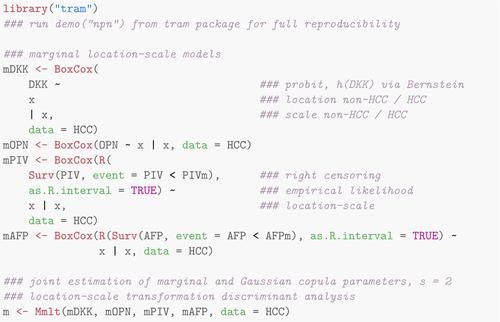
Nonparanormal models describe the joint distribution of multivariate responses via latent Gaussian, and thus parametric, copulae while allowing flexible nonparametric marginals. Some aspects of such distributions, for example conditional independence, are formulated parametrically. Other features, such as marginal distributions, can be formulated non- or semiparametrically. Such models are attractive when multivariate normality is questionable but interpretability paramount. Most estimation procedures perform two steps, first estimating the nonparametric part. The copula parameters come second, treating the marginal estimates as known. This is sufficient for some applications. For other applications, e.g. when a semiparametric margin features parameters of interest or when standard errors are important, a simultaneous estimation of all parameters might be more advantageous. We present suitable parameterisations of nonparanormal models, possibly including semiparametric effects, and define four novel nonparanormal log-likelihood functions. In general, the corresponding one-step optimisation problems are shown to be non-convex. In some cases, however, biconvex problems emerge. Several convex approximations are discussed. From a low-level computational point of view, the core contribution is the score function for multivariate normal log-probabilities computed via Genz’ procedure. As a demonstration for the versatility of the theoretical and computational framework, we present a series of nonparanormal models for transformation discriminant analysis when some biomarkers are subject to limit-of-detection problems. Possible empirical gains of full maximum likelihood estimation compared to two-step approaches are illustrated in a simulation study targeting semiparametric efficient polychoric correlation analysis where a theoretical benchmark is available.
Type: Research article
Keywords: Methodology (stat.ME), Computation (stat.CO), FOS: Computer and information sciences
Hothorn, Torsten 1
 CC-BY 4.0
Hothorn, T. On Nonparanormal Likelihoods. Peer Community Journal, Volume 6 (2026), article no. e105. https://doi.org/10.24072/pcjournal.814
@article{10_24072_pcjournal_814,
     author = {Hothorn, Torsten},
     title = {On {Nonparanormal} {Likelihoods
}},
     journal = {Peer Community Journal},
     eid = {e105},
     year = {2026},
     publisher = {Peer Community In},
     volume = {6},
     doi = {10.24072/pcjournal.814},
     language = {en},
     url = {https://peercommunityjournal.org/articles/10.24072/pcjournal.814/}
}
PCI peer reviews and recommendation, and links to data, scripts, code and supplementary information: 10.24072/pci.statml.100138
Conflict of interest of the recommender and peer reviewers:
The recommender in charge of the evaluation of the article and the reviewers declared that they have no conflict of interest (as defined in the code of conduct of PCI) with the authors or with the content of the article.
[1] Covariance Prediction via Convex Optimization, Optimization and Engineering, Volume 24 (2023) no. 3, pp. 2045-2078 | DOI
[2] Efficient Estimation of Semiparametric Multivariate Copula Models, Journal of the American Statistical Association, Volume 101 (2006) no. 475, pp. 1228-1240 | DOI
[3] Making the Joint Likelihood of Gaussian Copula Models, Peer Community in Statistics and Machine Learning (2026), 100138 | DOI
[4] Asymptotically Exact and Fast Gaussian Copula Models for Imputation of Mixed Data Types, Proceedings of The 13th Asian Conference on Machine Learning (Proceedings of Machine Learning Research), Volume 157, PMLR, 2021
[5] Dependent Censoring Based on Parametric Copulas, Biometrika, Volume 110 (2023) no. 3, pp. 721-738 | DOI
[6] Nonparanormal Adjusted Marginal Inference (with Discussion), Biometrics, Volume 82 (2026) no. 2, p. ujag065 | DOI
[7] Copula based Cox Proportional Hazards Models for Dependent Censoring, Journal of the American Statistical Association (2023) | DOI
[8] Copula Models and Diagnostics for Multivariate Interval-Censored Data, Emerging Topics in Modeling Interval-Censored Survival Data, Cham, 2022, pp. 141-165 | DOI
[9] CVXR: Disciplined Convex Optimization, 2026 | DOI
[10] A Primer on Copulas for Count Data, ASTIN Bulletin , Volume 37 (2007) no. 2, pp. 475-515 | DOI
[11] Numerical Computation of Multivariate Normal Probabilities, Journal of Computational and Graphical Statistics, Volume 1 (1992) no. 2, pp. 141-149 | DOI
[12] mvtnorm: Multivariate Normal and t Distributions, 2026 | DOI
[13] Biconvex Sets and Optimization with Biconvex Functions: A Survey and Extensions, Mathematical Methods of Operations Research, Volume 66 (2007) no. 3, pp. 373-407 | DOI
[14] Joint Count TransformationModels with Covariate dependent Correlations, Ecology (Accepted for publication) (2026) | DOI
[15] High-Dimensional Undirected Graphical Models for Arbitrary Mixed Data, Electronic Journal of Statistics, Volume 18 (2024) no. 1, pp. 2339-2404 | DOI
[16] Copula Graphical Models for Heterogeneous Mixed Data, Journal of Computational and Graphical Statistics, Volume 33 (2024) no. 3, pp. 991-1005 | DOI
[17] Multivariate Ordinal Regression Models: An Analysis of Corporate, Statistical Methods & Applications, Volume 28 (2019) no. 3, pp. 507-539 | DOI
[18] mvord: Multivariate Ordinal Regression Models, 2026 | DOI
[19] copula: Multivariate Dependence with Copulas, 2026 | DOI
[20] Extending the Rank Likelihood for Semiparametric Copula Estimation, The Annals of Applied Statistics, Volume 1 (2007) no. 1, pp. 265-283 | DOI
[21] mlt: Most Likely Transformations, 2026a | DOI
[22] Multivariate Normal Log-likelihoods in the mvtnorm Package, 2026b | DOI
[23] Most Likely Transformations, Scandinavian Journal of Statistics, Volume 45 (2018) no. 1, pp. 110-134 | DOI
[24] Diagnostic Performance of Alpha-Fetoprotein, Protein Induced by Vitamin K Absence, Osteopontin, Dickkopf-1 and Its Combinations for Hepatocellular Carcinoma, PLOS One, Volume 11 (2016) no. 3, e0151069 | DOI
[25] Multivariate Models and Multivariate Dependence Concepts, Chapman and Hall/CRC, New York, U.S.A., 1997 | DOI
[26] Asymptotic Efficiency of the Two-stage Estimation Method for Copula-based Models, Journal of Multivariate Analysis, Volume 94 (2005) no. 2, pp. 401-419 | DOI
[27] On the Estimation of Polychoric Correlations and Their Asymptotic Covariance Matrix, Psychometrika, Volume 59 (1994) no. 3, pp. 381-389 | DOI
[28] A Scalable Sparse Cholesky Based Approach for Learning High-dimensional Covariance Matrices in Ordered Data, Machine Learning , Volume 108 (2019), pp. 2061-2086 | DOI
[29] Efficient Estimation in the Bivariate Normal Copula Model: Normal Margins are Least Favourable, Bernoulli, Volume 3 (1997) no. 1, pp. 55-77 | DOI
[30] Multivariate Conditional Transformation Models, Scandinavian Journal of Statistics, Volume 49 (2022), pp. 116-142 | DOI
[31] Existence and Uniqueness of the Maximum Likelihood Estimator for a Multivariate Probit, Journal of the American Statistical Association, Volume 87 (1992) no. 419, pp. 805-811 | DOI
[32] Some Statistical Heresies, Journal of the Royal Statistical Society: Series D (The Statistician), Volume 48 (1999) no. 1, pp. 1-40
[33] The Nonparanormal: Semiparametric Estimation of High Dimensional Undirected Graphs, Journal of Machine Learning Research, Volume 10 (2009) no. 80, pp. 2295-2328
[34] Post-Regularization Inference for Time-Varying Nonparanormal Graphical Models, Journal of Machine Learning Research, Volume 18 (2018) no. 203, pp. 1-78
[35] Coordinatewise Gaussianization: Theories and Applications, Journal of the American Statistical Association, Volume 118 (2023) no. 554, pp. 2329-2343 | DOI
[36] Sparse Semiparametric Discriminant Analysis, Journal of Multivariate Analysis, Volume 135 (2015), pp. 175-188 | DOI
[37] Copula Link-Based Additive Models for Right-Censored Event Time Data, Journal of the American Statistical Association, Volume 115 (2020) no. 530, pp. 886-895 | DOI
[38] Gaussian Copula Marginal Regression, Electronic Journal of Statistics, Volume 6 (2012), pp. 1517-1549 | DOI
[39] Efficient Sieve Maximum Likelihood Estimation of, Journal of Statistical Theory and Practice, Volume 7 (2013) no. 2, pp. 285-303 | DOI
[40] bizicount: Bivariate Zero-Inflated Count Copula Regression Using R, Journal of Statistical Software, Volume 109 (2024) no. 1, pp. 1-42 | DOI
[41] Efficient and Feasible Inference for High-dimensional Normal Copula Regression Models, Computational Statistics & Data Analysis, Volume 179 (2023), 107654 | DOI
[42] Empirical Likelihood, Chapman and Hall/CRC, New York, U.S.A., 2001 | DOI
[43] Normalizing Flows for Probabilistic Modeling and Inference, Journal of Machine Learning Research, Volume 22 (2021) no. 57, pp. 1-64
[44] A General Algorithm for Covariance Modeling of Discrete Data, Journal of Multivariate Analysis, Volume 165 (2018), pp. 86-100 | DOI
[45] Multivariate Normal Maximum Likelihood with Both Ordinal and Continuous Variables, and Data Missing at Random, Behavior Research Methods, Volume 50 (2018) no. 2, pp. 490-500 | DOI
[46] On Logarithmic Concave Measures and Functions, Acta Scientiarum Mathematicarum, Volume 34 (1973), pp. 335-343
[47] R: A Language and Environment for Statistical Computing, https://www.R-project.org/, 2026 | DOI
[48] Likelihood-based Modeling of Covariate-Specific Time-Dependent, Statistical Methods in Medical Research, Volume 35 (2026a) no. 6, pp. 1325-1346 | DOI
[49] Transformation Discriminant Analysis for Constructing Optimal Biomarker Combinations, Statistics in Medicine, Volume 45 (2026b) no. 15–17, e70665 | DOI
[50] Count Transformation Models, Methods in Ecology and Evolution, Volume 11 (2020) no. 7, pp. 818-827 | DOI
[51] Distribution-Free Location-Scale Regression, The American Statistician, Volume 77 (2023) no. 4, pp. 345-356 | DOI
[52] Smooth Transformation Models for Survival Analysis: A, Statistical Methods in Medical Research, Volume 35 (2026) no. 5, pp. 980-997 | DOI
[53] Joint Regression Analysis of Correlated Data Using Gaussian Copulas, Biometrics, Volume 65 (2009) no. 1, pp. 60-68 | DOI
[54] Ordinal Graphical Models: A Tale of Two Approaches, Proceedings of the 34th International Conference on Machine Learning (Proceedings of Machine Learning Research), Volume 70, PMLR, 2017
[55] Regularized Rank-based Estimation of High-dimensional Nonparanormal Graphical Models, The Annals of Statistics, Volume 40 (2012) no. 5, pp. 2541-2571 | DOI
[56] Sparse Boosting for High-dimensional Survival Data, Statistics in Medicine, Volume 37 (2017) no. 5, pp. 789-800 | DOI
[57] Missing Value Imputation for Mixed Data via Gaussian Copula, Proceedings of the 26th ACM SIGKDD International Conference on Knowledge Discovery & Data Mining, Association for Computing Machinery, New York, NY, USA, 2020, pp. 636-646 | DOI
Cited by Sources: