

 CC-BY 4.0
Introduction
While worldwide pesticide consumption continues to rise (FAOSTAT, 2025), there is growing evidence of their impact on biodiversity, ecosystem functioning and human health (Frank, 2024; Wan et al., 2025). Climate change is expected to further exacerbate this issue by increasing pressures from insect pests and pathogens (Chaloner et al., 2021; Deutsch et al., 2018). Reducing pesticide use and associated risks has therefore become a major global policy objective. The European Union has set the target of halving pesticide use, risks and reliance on the most hazardous substances under the Farm to Fork Strategy (https://food.ec.europa.eu/horizontal-topics/farm-fork-strategy_en) while the UN Convention on Biological Diversity has adopted a similar goal of a 50% reduction in risks from pesticides and hazardous chemicals by 2030 (CBD, 2022a).
Assessing progress toward these targets relies on the definition of pesticide risk indicators, and indicator choice remains the subject of much debate (CBD, 2022b, 2022c; Möhring et al., 2023). A comprehensive pesticide risk indicator should integrate both exposure and toxicity. Exposure arises not only from the quantity, frequency, and method of pesticide application, but also from the physicochemical properties of active substances (Mamy et al., 2015) and their metabolites (Mitra et al., 2024), which determine their mobility, persistence, and potential to contaminate air, soil, and water. Toxicity, in turn, should reflect the toxicological properties of active substances that drive the sensitivity of non-target organisms, including humans. Its assessment should cover a broad range of species and exposure pathways, recognizing that effects may vary greatly across taxa (Stark et al., 2004) and exposure mode (Shekhar et al., 2024). Ideally, toxicity estimates should also consider potential cocktail effects resulting from mixtures of substances (Rizzati et al., 2016).
The Convention on Biological Diversity, and the European Commission have proposed two indicators for evaluating pesticide risk dynamics, i) the Predicted Environmental Concentrations of pesticides (PECs, CBD, 2022b) and ii) the Harmonized Risk Indicator 1 (HRI-1, European Commission, 2019). Both have been criticized for failing to accurately account for differences in eco-toxicological properties among the various active substances. Indeed, the first one acts as a contamination indicator and is based on the use of active substances, physio-chemical properties and environmental data allowing to assess the fate of active substances used. The second is based on the use of active substances and a classification of active substances into four categories intended to reflect risk and EU policies to reduce this risk, but not necessarily reflecting toxicity on non-target species. Other indicators, as the Number of Doses Unit (NODU, i.e. pesticide mass applied standardized by the pesticide mass authorized on a given crop) or the Treatment Frequency Index (TFI, i.e. number of approved doses of pesticides used per hectare) can also be used to indicate pesticide use but fail to account for environmental fate or toxicity, which can vary widely across active substances (Möhring et al., 2019).
Several pesticides indices have been recently developed incorporating toxicity value as the Pesticide Toxicity Index, Pesticide Load Index or Total Applied Toxicity index (TAT, Bub et al., 2023; Kudsk et al., 2018; Nowell et al., 2014). Among them, the Pesticide Load Index is a composite index that quantifies potential environmental, biodiversity, and human health burdens (Kudsk et al., 2018; Samsøe-Petersen et al., 2012). The Pesticide Load Index has been adopted as an official indicator for measuring pesticide risk reduction targets and is used as the basis for a risk-based pesticide tax in Denmark since over a decade (Kudsk et al., 2018; Samsøe-Petersen et al., 2012). It has therefore been widely implemented and thoroughly tested to compare quantitative and risk-based pesticide use indicators in different contexts such as the production of winter wheat and potato in Swiss (Möhring et al., 2019) or the evaluation of pesticide reduction thanks to green technology (Kuhn et al., 2022). However, although it requires relatively little data and enables a combined assessment of ecotoxicity and human health risks together with the potential for environmental contamination of pesticides, this approach has rarely been applied to evaluate or compare pesticide use trends. To date, it has only been used to identify the most toxic pesticides in the European Union (Gensch et al., 2024) and to assess the temporal trends of pesticide use in two countries, Denmark and the United Kingdom (Kudsk et al., 2018; Lewis et al., 2021), which together provide a valuable benchmark for comparison with other regions.
France has the largest agricultural area and is the largest producer in the agricultural sector in Europe, with an annual output of around 96 billion euros. It is also the largest user of pesticides in the European Union (3.7 kg/ha versus 2.7 kg/ha in Europe, FAOSTAT, 2025). Pesticides have widely contaminated the French environment (Froger et al., 2023; Mamy et al., 2025; Perrot et al., 2024) to such an extent that concerns are growing about their impact on human and environmental health (Fritsch et al., 2022; Lejeune et al., 2024; Nougadère et al., 2020; Pelosi et al., 2021). The costs of pesticides to French society were estimated to be between €327 million to – €8.205 billion (Alliot et al., 2022). On the other hand, the French Government has set an ambitious goal to reduce pesticide use in France by 50% before 2030 (https://agriculture.gouv.fr/strategie-ecophyto-2030). Initially, the evolution of pesticide risks in France was assessed and showed a stable trend between 2008 and 2022 using the NODU (Garnault et al., 2024). In 2022, the European Union proposed to all its member states that they use HRI-1 as a common indicator (Garnault et al., 2024). HRI-1 showed a decrease of 36% between 2011 and 2022 in France but its use is still being debated (Garnault et al., 2024) as this indicator does not take into account the measured toxicity of active substances. More recently, pesticide use was also assessed by using the Total Applied Toxicity (TAT) that accounts for the toxicity of the active substances regarding various taxa (Perrot et al., 2025). This study showed that temporal trends in pesticide risk strongly differ among taxa, from decreasing for aquatic plants, pollinators, terrestrial vertebrates, and soil organisms to increasing for aquatic invertebrates, but that high-risk areas were the same for all taxa. However, this indicator may offer a partial coverage of pesticide related risks by accounting for biodiversity impacts, but ignoring impacts on human health and on the persistence of environmental contamination by pesticides.
Consequently, monitoring trends in pesticide use in France is potentially biased because it does not take into account the simultaneous risk to different compartments (humans and biodiversity) or the persistence and changing patterns of pesticide dispersion in the environment. We therefore investigate trends of pesticide risks in France over 11 years, taking into account environmental toxicity, fate and human health risks, using the Pesticide Load Index. The Pesticide Load Index allows to jointly evaluate the pesticide pressure on human health and biodiversity while considering the persistence, the mobility and bioaccumulation of pesticides in the environment. We calculated the Pesticide Load Index for 2977 commercial pesticide products sold in France from 2012 to 2022, totalizing 293 different active substances. Then we evaluated the temporal and spatial variation in pesticide risks in France, using detailed panel data on pesticide use at county level from 2012 -2022. Finally, we identified the crops associated with high risks to humans, biodiversity and the environment according to the Pesticide Load Index.
Methods
Pesticide data
To assess the temporal and spatial variation in the Pesticide Load Index in France, we used the ‘French national database of sales of plant protection products by authorized distributors’ (NDS-D, https://ventes-produits-phytopharmaceutiques.eaufrance.fr/). The data includes quantities of pesticide products purchased per French county (n =91, the four county of “Ile de France” were grouped together because of the small area) from 2008 to2022 (the last year of data available), this for each commercial products whose active substance is subject to the Diffuse Pollution Levy (https://www.legifrance.gouv.fr/). Active substance composition of each commercial product was obtained from to the “E-phy” database (https://ephy.anses.fr/) provided by the French Agency for Food, Environmental and Occupational Health & Safety (ANSES). “E-phy” database also provides methodological descriptions (method of use, target crop) for each commercial product and also the recommended dose. This led to a total of 312 active substances for 3394 different commercial products.
Pesticide Load index calculation
The Pesticide Load Index is based on the Pesticides Properties Database (PPDB, Lewis et al., 2016) that provides for each active substance information on human toxicity ecotoxicity for various species and information on the persistence the environment that all can strongly differ among active substances (Chiaia-Hernandez et al., 2017; Froger et al., 2023) from regulatory laboratory experiments assessments. The Pesticide Load Index per pesticide product is computed as the sum of the Ecotoxicity Load, Human Health Load and Fate Load. Those three sub -indices are computed based on the properties of the active substances of each pesticide product and their concentrations. More specifically, the Ecotoxicity Load is based on eleven median lethal dose/concentrations and no observed effect concentrations – eight relating to acute ecotoxicity on birds, mammals, fish, daphnia, algae aquatic plants, earthworms and bees and three relating to chronic ecotoxicity on fish, daphnia and earthworms. While ecotoxicity load was initially thought to vary depending on the method of pesticide application (spraying or seed coating, Kudsk et al., 2018), recent studies show that aquatic and terrestrial organisms are exposed to pesticides in similar ways regardless of the application method (Bailly et al., 2025; Pelosi et al., 2021; Stehle et al., 2023). For this reason, we do not differentiate ecotoxicity load based on the application method. The Fate Load takes into account degradation half–life in soil, the bioaccumulation factor and mobility and risk of leaching by the SCI-GROW index. SCI-GROW is a screening model used by the EPA’s Office of Pesticide Programs to estimate pesticide concentrations in vulnerable groundwater. It generates exposure values for assessing environmental and human health risks, based on pesticide fate properties, application rates, and monitoring data from sandy, shallow-water sites (Lewis et al., 2016). The Human Health Load is based on indicated risk phrases and formulation of the product. Ecotoxicity Load and Fate Load can be expressed at active substance or commercial product levels and the Human Health Load and consequently the Pesticide Load index only at commercial product levels. We use the “PesticideLoadIndicator” R-Package (version 1.3.1) in R version 4.3.0 (R Core team, 2020) for its computation (Möhring et al., 2021a). See (Möhring et al., 2021b) for a detailed description of the indicator and its computation.
We then compute the Pesticide Load Index (PLI) at the national (temporal trend) and county levels (spatial trend) as follows:
\({PLI}_{\frac{county}{France}\ = \ c,\ \ \ year\ = \ y}\ (Load\ units)\ = \ \sum_{i\ = \ 1}^{n}{{quantity}_{product\ = \ p,\ \frac{county}{France}\ = \ c,\ \ \ year\ = \ y}(kg)*{Load}_{product\ = \ p}(\frac{Load}{kg})}\)
where PLI_(county/France=c, year=y )^ is the Pesticide Load Index for county c and year y measured in Load units. quantity_(product=p, county/France=c, year=y) depicts the respective quantity of pesticide product p in this year and county measured in kilograms, and Load_(product=p) depicts the Pesticide Load of the applied product per county in Load units per kilogram product. For the case of the national level analysis c= 1 (“France” is the only geographic region). We calculate PLI on 3302 commercial products on 3394 available in the NDS-D database. Information needed to calculate PLI and the sub-indices were incomplete in the PPDB for 92 commercial products. These 3302 commercial products encompass 297 actives substances and 99% of commercial products mass.
Crop occupation
We used the “Agreste” database (https://agreste.agriculture.gouv.fr/), the French agricultural statistics database, to identify spatial associations between crops and the Pesticide Load Index and its sub-indices. The database provides agricultural land use per county for crops or crop types belonging to different agricultural sectors: arable crops, vegetables, orchards and viticulture from 2008 to 2020. The crops were grouped into eight crop categories that represent the main agricultural crop types in France: cereals (43.3% of the crop area), corn (both forage and seed corn, 18.1%), oilseed rape (7.9%), vineyards (4.8%), sunflower (3.8%), legumes (2.9%), beet (mainly sugar beet, 2.4%), vegetables (1.8%), and orchards (1.0%) that we then associated to Pesticide Load Index and its sub-indices.
Statistical analysis
Data preparation
To characterize the temporal trend of the Pesticide Load Index in France between 2008 and 2022, we first evaluated how incomplete data on seed coating prior to 2012 affected temporal trends. Indeed, the reporting of sales of seed coating products was made mandatory by French law in 2012, making the data potentially incomplete in previous years. To account for this, we identified the pesticide used for seed coating via the “E-Phy” database. Among the 3302 different commercial products in the database, 193 products were used as seed coating applications. In the following, we assess the bias that seed treatments may introduce on the temporal trend of the Pesticide Load Index and decide whether or not to remove them.
To do so, we compared the temporal trend of the Pesticide Load Index and its three sub-indices (human health, ecotoxicology, and fate loads) from 2008 to 2022 accounting for all commercial products present in the sales database or by considering only commercial products that were not used as seed coatings (see Figure S1 for comparison of temporal trends of Pesticide Load Index accounting for all pesticide products or by considering only pesticide products with no seed coating application). These analyses revealed that the Ecotoxicity Load index, and therefore the Pesticide Load Index prior to 2012 were biased because of the missing seed coating data but not the Human Health and Fate Loads (see Figure S1). We thus restricted the analyses to the period 2012-2022. After this restriction, 2977 commercial products were considered for the analysis representing 293 active substances. List of active substances are available in Table S1.
Temporal trends
In a first step, we computed trends of the Pesticide Load Index at the national level. We first assessed the contribution of the three sub-indices (Ecotoxicity load, Human Health Load and Fate Load) and pesticide type (insecticide, herbicide, fungicide, etc.) to the Pesticide Load Index. We also identified the active substances contributing the most to the Pesticide Load Index and associated sub-indices. For the Human Health Load and consequently for the Pesticide Load Index too, as they are calculated at commercial product level, we attribute the contribution of each active substance to these indices according to their mass proportion in a given commercial product. Then we tested the significance of temporal trends of the Pesticide Load Index and its sub-indices using Mann‒Kendall trend tests. We further conducted a robustness check, by dividing the Pesticide Load Index by total French crop area obtained by the ‘Agreste’ database to assess if changes in trends were driven by changes in crop area. Since crop area data are not available for 2021–2022, we are using the 2020 crop areas to standardize the Pesticide Load Index for those years. An additional analysis is conducted for the Human Load and Fate Load indices. Since these sub-indices are not biased by missing data on pesticides used in seed coating (Figure S1) we also perform a temporal trend analysis over a broader time frame, from 2008 to 2022, using the same method as before.
In a second step, we aimed to disentangle whether Pesticide Load Index trends were driven by changes in the mass of commercial products sold or by shifts in the toxicity of the commercial products used. We started by estimating the annual mass of commercial products sold at the national scale and assessed temporal trends using Mann‒Kendall trend tests. For liquid formulations, we assumed a density of one liter of product equals one kilogram of products, as the actual product specific densities were not available. We then estimated the average load of commercial products per year. For each class of pesticides (herbicide, insecticide and fungicide), we estimated its associated toxicity using the Pesticide Load Index, Ecotoxicity Load, Human Health Load and Fate Load. Load is estimated as the residuals of the linear relationship between the annual mass of commercial products for a given class (used as explanatory variable) and the annual Pesticide Load Index (or Human health, Ecotoxicology, and Fate loads) values (used as dependent variable). The residuals of these models (hereafter referred to as “residuals pesticide load”, or “residuals human load”, etc.) indicate whether the commercial products used had a higher or lower load than expected. We investigated if product load change through time using Mann‒Kendall trend tests.
In a third step, we aimed to identify which pesticide types (herbicide, fungicide and insecticide) contributed to changes in the Pesticide Load Index. To do so, we sequentially excluded each pesticide type from the calculation of the Pesticide Load Index and re-estimated its temporal trend. By comparing these modified trends with the original Pesticide Load Index, we quantified the contribution of each pesticide type to the overall increase or decrease.
Spatial patterns
To investigate the spatial patterns of the Pesticide Load Index and its sub-indices across France, we initially generated county-level maps over the time period: 2012-2022. First, we averaged Pesticide Load Index and these sub-indices over the period 2012-2022 per county and mapped them. Secondly, we assessed if sub-indices (Ecotoxicity load, Fate Load and Human Health Load) had similar spatial distribution. To assess this, we computed Spearman correlation between the different sub-indices. Furthermore, we explored relationships between Pesticide Load Index (and sub-indices) and the cultivated area for different crops using partial least squares (PLS) regression, a multivariate approach capable of handling multiple predictors and collinearities (Carrascal et al., 2009). To disentangle links between the Pesticide Load Index (and its sub-indices) and specific crops, we used PLS with the Pesticide Load Index (or each of its sub-indices) as the response variable and the areas of eight crop groups as explanatory variables. To ensure that changes in crop area were not driving our results, we also realized an additional analysis by dividing the Pesticide Load Index by crop area per county obtained by the “Agreste” database. We removed counties of the “Ile de France” region (including Paris) as the crop area was very small. This did not modify the number of active substances or commercial products considered in the analysis. All analyses were conducted in R (version 4.3.0), leveraging the “plsRglm” package for PLS regression, “GGally” for correlation matrix visualization, and “trends” for supplementary trend assessments via the Mann-Kendall test.
Results
Pesticide Load Index: national level
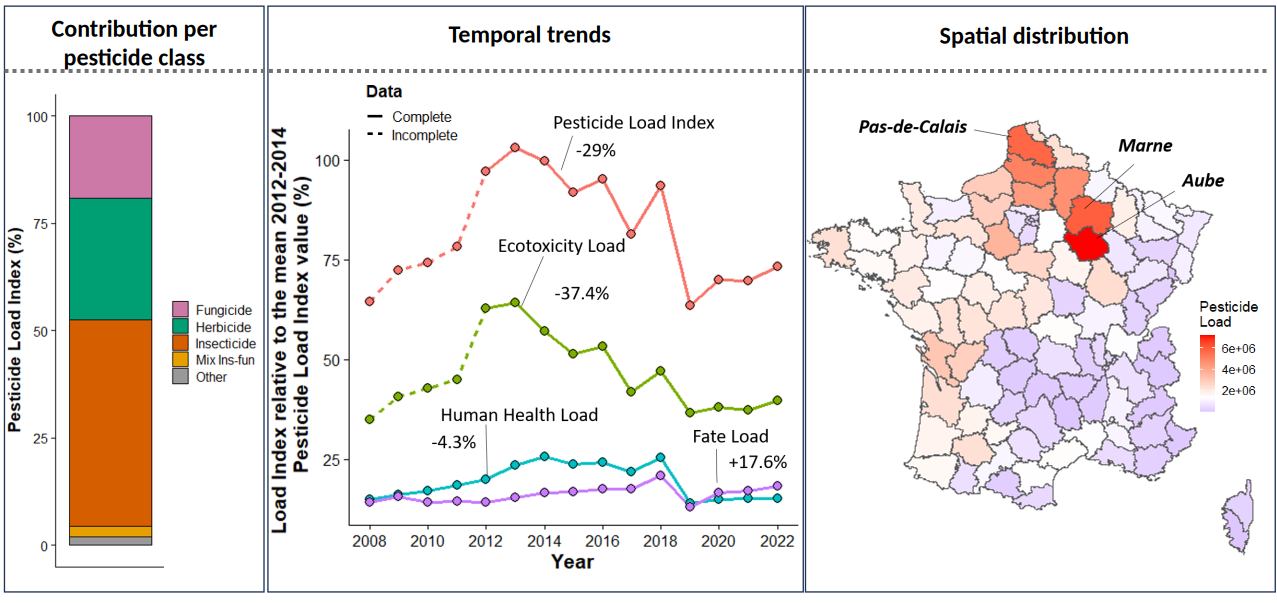
Over all years and counties, Ecotoxicity Load was the main contributor to the Pesticide Load Index (mean = 56.2% varying between 50.4% and 64.6% according to years, Figure 1A), followed by Fate Load (20.2%, 14.8-25.1%, Figure 1A) and Human Health Load (23.6%, 20.1-27.2%, Figure 1A).
Insecticides were the main contributor to the Pesticide Load Index (47.6%, 38.8-59.1%) followed by herbicides (28.9%, 22.6-35.6%), fungicides (19.0%,14.6-25.7%), mixes of insecticides and fungicides (2.6%, 0-6.5%) and other products (including molluscicide, nematicide, rodenticide and soil sterilant, 1.9%, 1.0-3.0%, Figure 1B). Looking at pesticide mass, the main contributors were herbicides (51.0%, 46.0-53.9%), followed by fungicides (27.4%, 24.1-34.7%), insecticides (11.3%, 7.9-16.1%), others products (10.0%, 5.4-17.5%) and mixes of insecticides and fungicides (0.2%, 0.1-0.5%, Figure 1C). Fungicides and herbicides had similar contributions to the Human Health Load (43.0%, 35.0-52.1% and 45.7%, 39.1-53.9%, respectively) followed by other products (5.7%, 1.1-9.5%), insecticides (5.5%, 3.6-7.8%) and mixes of insecticides and fungicides (0.1%, 0-0.3%, Figure 1.E). For the Ecotoxicity Load the role of insecticides was even larger (80.7%, 70.9-87.9%), followed by herbicides (7.5%, 5.5-9.4%), fungicides (6.3%,4.3-9.6%), mixes of insecticides and fungicides (4.6%, 0-11.8%) and other products (0.7%, 0.2-1.5%, Figure 1D). Herbicides were the main contributor to the Fate Load (68.1%, 60.8-77.2%) followed by fungicides (26.4%, 20-30.3%), mixes of insecticides and fungicides (0.4%, 0-1.6%) and others products (0.3%, 0-0.5%, Figure 1.F). The commercial products and active substances that contribute the most to the Pesticide Load Index and its sub-indices are presented in Figure S2.
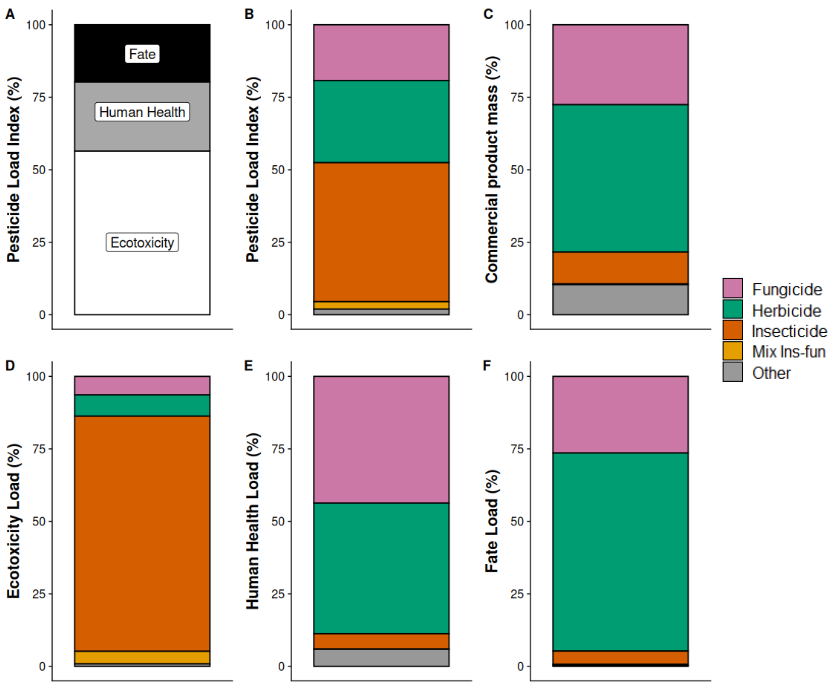
Figure 1 - Contribution of sub-indices and different pesticide class to (A-B) Pesticide Load Index as well as contribution of different pesticide class to (C) commercial product mass and the three sub-indices (D) Ecotoxicity Load, (E) Human Health Load and (F) Fate Load. Pesticide Load Index, commercial products and these sub-indices are an average over the 11 years (2012 to 2022).
Temporal trends of the Pesticide Load Index
We found that the Pesticide Load Index decreased significantly in France over the period 2012-2022 (Figure 2A). When comparing the mean of the Pesticide Load Index between the periods 2012-2014 and 2020-2022, we observed a decrease of 29.0%. This decrease was similar for mass of herbicide (-26.4%) or fungicide (-30.5%) products. However, trend tests were only significant for the Pesticide Load Index (see Table S2 for associated statistics). No change was observed for the mass of insecticide products (Table S2). Standardization of Pesticide Load Index by total crop area did not modify the results as French total crop area only decreased by 1.9% during the study period (see Figure S3 for plots showing temporal trends of the Pesticide Load Index and its sub-indices standardized by total crop area).
This reduction of the Pesticide Load Index was mainly explained by a reduction of the Ecotoxicity Load (- 37.4%,) and the Human Health Load (-34.4%) while the Fate Load increased (+13.2%, Table S2, Figure 2.D-F). However, the trend was significant for Ecotoxicity Load only (Table S2). Additional analyses on a larger period (2008-2022) have shown no change for Human Health Load (-4.3%) and higher increase for Fate Load (+17.6%, Figure S1, Table S2).
The reduction in Pesticide Load Index was mainly related to a reduction of insecticide contribution. Indeed, when we removed insecticides from the Pesticide Load Index calculation, the Pesticide Load Index only decreased by 15.3% between 2012-2014 and 2020-2022 compared to the 29% decrease when all pesticide classes were accounted for. When fungicides were removed from the calculation, the Pesticide Load Index reduction showed almost no change (- 26.2% compared to initial decease of 29%). While when herbicides were removed, the Pesticide Load Index reduction was higher (- 39.1%), indicating that the contribution of herbicides to the Pesticide Load Index had increased during the study period.
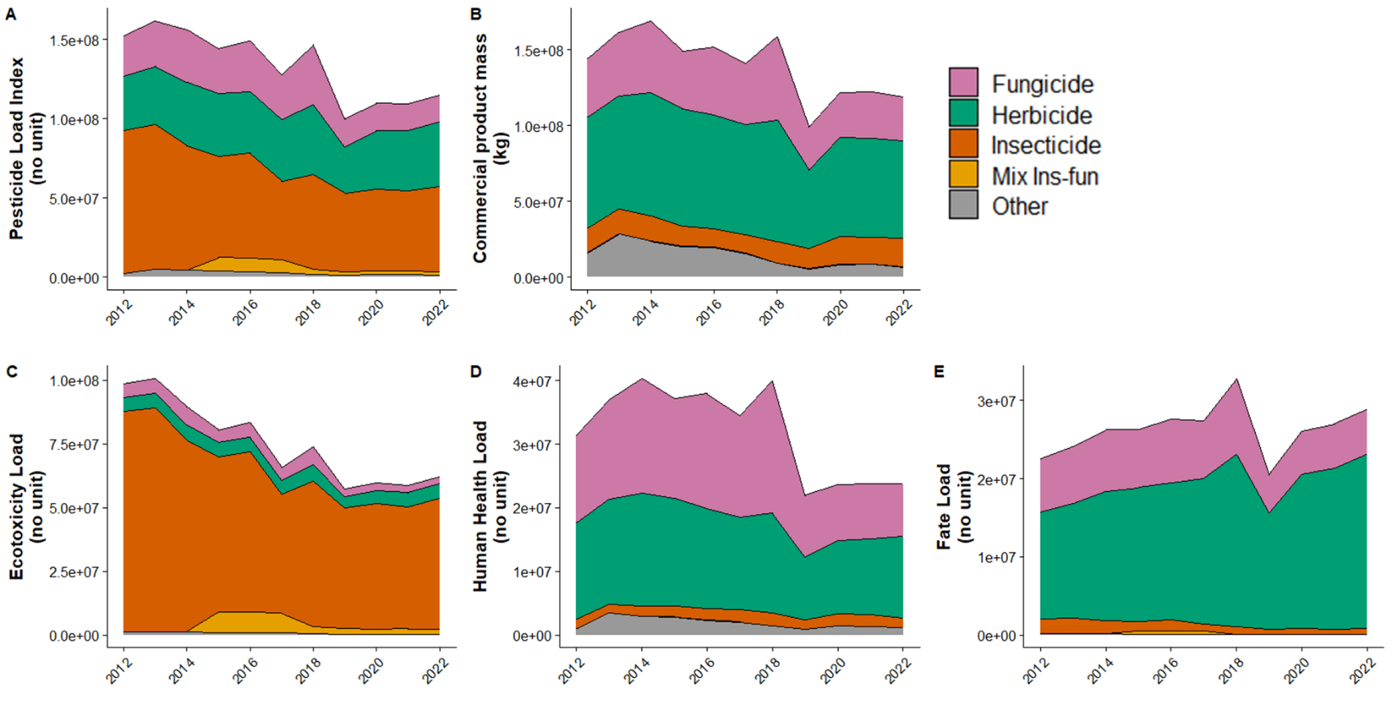
Figure 2 - Temporal trends of (A) Pesticide Load Index, (B) commercial product mass and the three sub-indices (C) Ecotoxicity Load, (D) Human Health Load and (E) Fate Load.
Reduction of insecticide contribution to the Pesticide Load Index was explained by a reduction of their residual Load (here after “load”), while herbicide load increased and no change was observed on fungicide load (Table S2, Figure S4A). When we split the Pesticide Load Index per active substance, we observed that the decrease of insecticide load was mainly explained by the reduction of organophosphate chlorpyriphos insecticides and imidacloprid, a neonicotinoid (Figure 3.A). A similar pattern was observed for the Ecotoxicity Load (Table S2, Figure S4B & Figure 3.B). Human Health Load did not exhibit any temporal trend (Figure 2D). We found no temporal trends in the residual Load of any pesticide class for this sub-index (Table S2, Figure S4C). Turning to the Fate Load, we found that its increase (Figure 2E) was explained by an increase of herbicide residual Fate Load (Table S2, Figure S4D). This increase of herbicide residual Fate Load was mainly explained by the increasing use of pendimethalin and prosulfocarb (Figure 3D).
Spatial trends of the Pesticide Load Index
Pesticide Load Index maps showed a strong spatial heterogeneity in pesticide risk across France, with higher load in Northern and in Western parts of France (Figure 4.A). Aube, Pas-de-Calais and Marne had the highest Pesticide Load Index (Figure 4.A). Spatial patterns of Ecotoxicity, Human Health and Fate Load Indices showed similar patterns (Figure 4.B-D). Indeed, high spatial correlation was observed among these indices (Figure S5). Similar results were observed when we standardized the Pesticide Load Index or its sub-indices by the total crop area indicating that changes in crop area over the study period did not affect our results (see Figure S6).
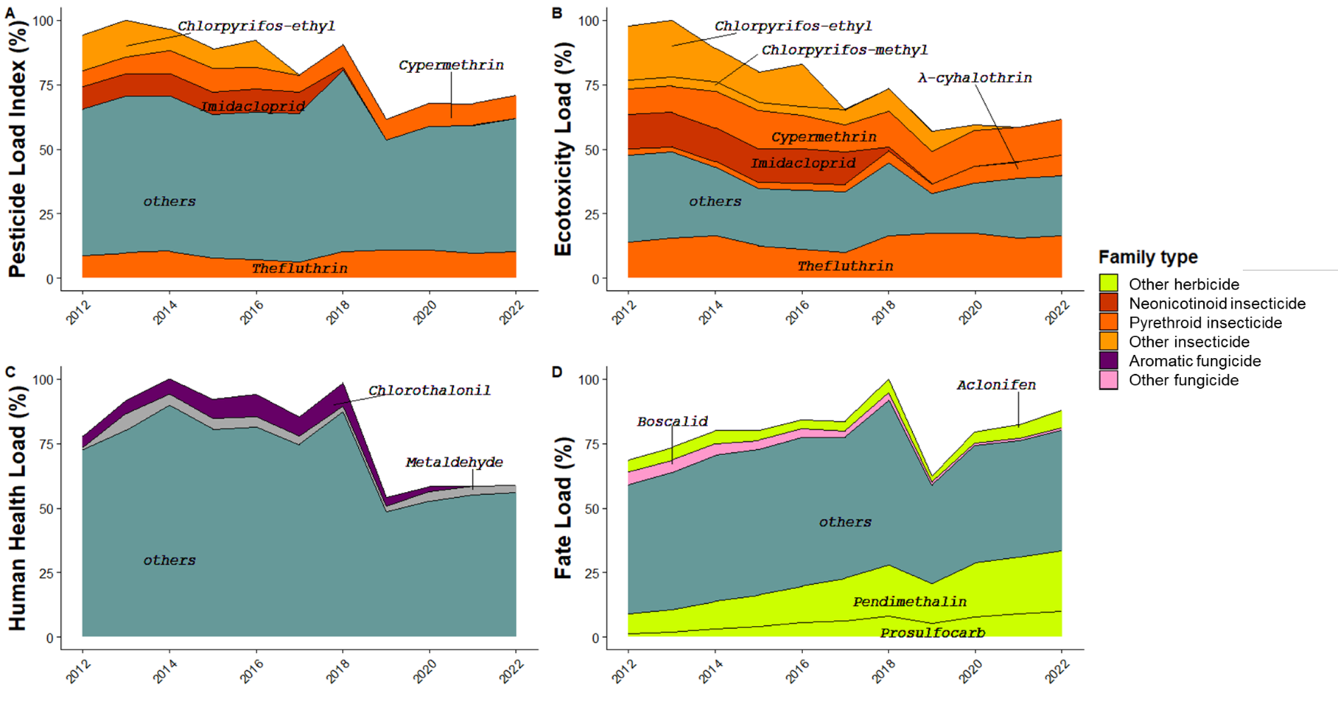
Figure 3 - Temporal trends of (A) Pesticide Load Index, (B) Ecotoxicity Load, (C) Human Health Load and (D) Fate Load Indices by active substances. In these graphs, only active substances that represent 10% for the Pesticide Load Index and the Ecotoxicity Load index, 7% for Human Health Load and 6% for Fate Load, for at least one year per index are presented. The other pesticides (those representing less than 10%, 7%, and 6%, respectively, of any yearly values) were grouped into the category “others” and fill in grey.
Partial least square regressions performed on the Pesticide Load Index and Ecotoxicity sub-index showed a positive correlation with the production area of beet crop, vineyard, cereal and vegetable (Figure S7IA and S7IB). The Human Health Load was positively correlated with the cultivated areas of vineyard and oilseed rape (Figure S7ID), and the Fate Load sub-index with the cultivated area of cereal and oilseed rape (Figure S7IC). Importantly, when indices are standardized by crop area, lower correlation was observed between cereal area and Pesticide Load Index or Ecotoxicity Load while higher correlation was observed with vineyard for these same indices and the Human Load (Figure S7II). The spatial distributions of these crops are presented in Figure S8.
Discussion
Comparison of temporal trends with other countries
Our results show that pesticide risk measured by the Pesticide Load Index has been reduced in France by 29.0% over the period 2012-2022 (Figure 2). This is mainly because of a reduction of the Ecotoxicity Load while the Fate Load has increased and the Human Health Load showed no change (Figure 2). Pesticide Load Index temporal trends were so far only evaluated in one other country; Denmark with a similar decrease (~20% between 2012 and 2017, Nielsen et al., 2023). However, France shows higher risk levels than Denmark. The Pesticide Load Index per hectare in the French counties varied between 3.5-5.6, compared to Denmark that varied between 1.9-2.4 (Nielsen et al., 2023). This difference of Pesticide Load Index per hectare was consistent with a European study (Gensch et al., 2024) that showed higher Pesticide Load Index levels in France compared to Denmark. This difference mainly came from a stronger Ecotoxicity Load contributing to 56.2% of the Pesticide Load Index in France, while the contribution was about 40% in Denmark (Kudsk et al., 2018). Human Health and Fate Loads have a higher contribution (~30% for both) to the Pesticide Load Index in UK compared to France with 23.6 and 20.2% (Kudsk et al., 2018). In addition, France uses more active substances per hectare than Denmark (3.7 versus 1.4 kg/ha, FAOSTAT, 2025) which may explain why the Pesticide Load Index is higher in France than in Denmark. Moreover, France had greater use of insecticides than Denmark, which explains for the Ecotoxicity Load higher contribution (see below).
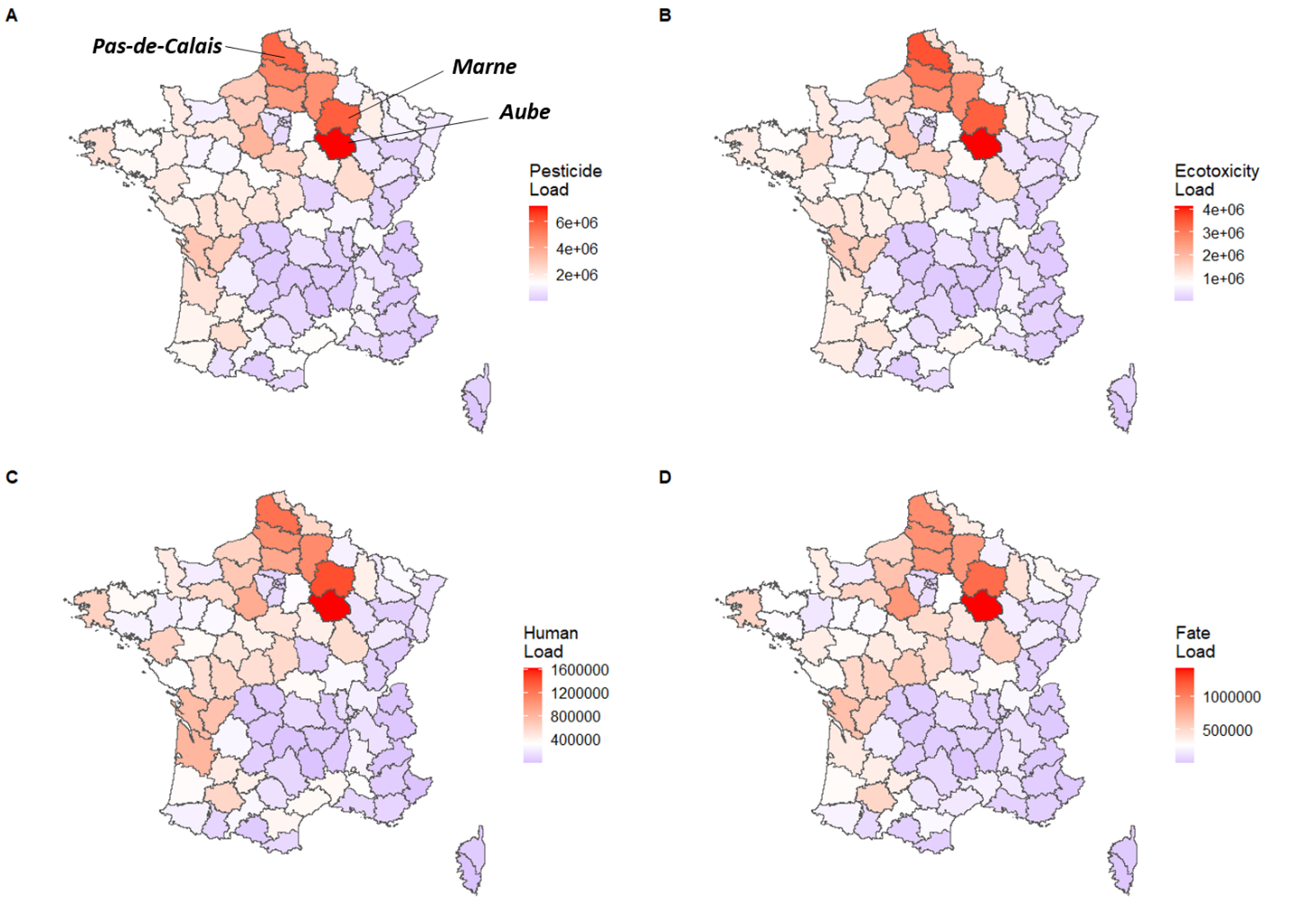
Figure 4 - Spatial variation of (A) Pesticide Load Index and the sub-indices: (B) Ecotoxicity Load, (C) Human Health Load and (D) Fate Load. A gradient from blue to red indicates counties from lowest to highest load. Load is averaged per county between 2012-2022. Pesticide Load Index and its sub-indices have no unit
Contributors to the Pesticide Load Index
Insecticides were the strongest contributor to the Pesticide Load Index in France, representing 47.6% of it (and a striking 80.8% of the Ecotoxicity Load Index, Figure1), while such insecticide contribution was about 25-28% in Denmark and 7-10% in UK (Kudsk et al., 2018; Lewis et al., 2021). This was despite their low contribution to the commercial product mass sold in France (11% in average, Figure 2). Such a strong contribution of insecticides to pesticide pressure despite their lower share in the mass of products used was already demonstrated in the UK where insecticide represented only 1% of active substance mass (Lewis et al., 2021). In Denmark, insecticides contribute ~13% of the pesticide use (estimate from TFI) but ~25% of the Pesticide Load Index (Kudsk et al., 2018). This high contribution of insecticides in France was mainly explained by the use of the imidacloprid neonicotinoid, cypermethrin and tefluthrin which are all pyrethroid insecticides, as well as chlorpyrifos methyl and ethyl, organophosphate insecticides (Figure 3). Out of these five active substances, three were recently banned. Chlorpyrifos methyl and ethyl, the main contributors to Pesticide Load Index at the European scale, were banned in 2020 because of their strong toxic effect on aquatic invertebrates or bees and because of their adverse effects on human health (Gensch et al., 2024; Ubaid Ur Rahman et al., 2021). Imidacloprid was also banned in 2018 because this strong adverse effect on pollinators and for a large number of other groups such as insects, both aquatic emergent insect and terrestrial, vertebrates such as birds or deer (Berheim et al., 2019, Mamy et al., 2025; Perrot et al., 2025). The two active substances still approved, both pyrethroids, are highly toxic to aquatic and terrestrial invertebrates but also to fish (Bub et al., 2023; Perrot et al., 2025). Fungicides and herbicides were the main contributor of the Human Health Load (respectively 43% and 46%) in France (Figure 1) as observed in UK (~ 65 and 30%) and Denmark (~ 46 and 42%, Kudsk et al., 2018; Lewis et al., 2021). The active substances contributing the most to the Human Health Load were chlorothalonil and metaldehyde (Figure 3). Only chlorothalonil was banned in 2019 in Europe with the possibility of selling off inventory in France until 2022 (European Food Safety Authority, 2019). Chlorothalonil and metaldehyde are both potentially carcinogenic for humans (Rumbeiha, 2014; Soleimani et al., 2024). Herbicides mainly contributed to the Fate Load (68%, Figure 1) as observed in Denmark (Kudsk et al., 2018) but not in the UK where insecticides, especially clothianidin, was the main contributor to the Fate Load (Lewis et al., 2021). However, clothianidin was only used in small amounts in France (Perrot et al., 2024). The two herbicides that contributed the most to the Fate Load in France were pendimethalin (19%) and prosulfocarb (7%, Figure 3). Pendimethalin is the pesticide with the strongest bioaccumulation in Europe (Kudsk et al., 2018) with high persistence (Lewis et al., 2016) and prosulfocarb is highly volatile and commonly found in many compartments with no initial use, such as watercourses (Devault et al., 2022).
Spatial distribution of the Pesticide Load Index
Pesticide pressure was spatially heterogenous across France, with higher pressure in the North and West of France, for all sub-indices (Figure 4). Spatial heterogeneity was also found in the UK and Denmark (Kudsk et al., 2018; Lewis et al., 2021). The spatial pattern of pesticide pressure we found was also observed using other pesticide indicators such as the total mass of active substances (Rigal & Perrot, 2025), the TAT (Perrot et al., 2025), the TFI (https://solagro.org/nos-domaines-d-intervention/agroecologie/carte-pesticides-adonis), or recent pesticide risk maps for people living close to agricultural areas (Galimberti et al., 2025). This pattern was explained by a concentration of crops with a high pesticide use in the same area (Figure S7). In our study, a high Pesticide Load Index was associated with a high share of a cultivated area of beets, vineyard, oilseed rape, and vegetable, all high pesticide-input crops (Figure S7). Indeed, oilseed rape and vines have been identified as the two crops that use the highest amounts of insecticides and fungicides, respectively (Fouillet et al., 2022; Guinet et al., 2023; Lechenet et al., 2017), while beets, and potatoes (vegetable) are known to strongly rely on pesticide use in France (Guinet et al., 2023; Lechenet et al., 2017).
Comparison of temporal trends with others indicators in France
The decrease in the Pesticide Load Index by an overall 29% over the study period contrasts with indices used to monitor pesticide use in France such as the NODU that shows no temporal change (-0.4%) or HRI-1 that showed a stronger decrease (-36%) over approximately the same period. For NODU, pesticides with small amount used, as insecticides, have a very low contribution to this index (~4%, Garnault et al., 2024) partly explaining the difference with the Pesticide Load Index or HRI-1 (~16%, Garnault et al., 2024). On the contrary, pesticides used in large quantities such as glyphosate, the most widely sold herbicide in France (Garnault et al., 2024), are the main contributor of HRI-1 (Garnault et al., 2024) but only 1.7% for Pesticide Load Index in the current study. Recent drops in masses of herbicide and fungicide commercial products may explain why a higher decrease was observed in HRI-1 than in the Pesticide Load Index. The decrease in the Pesticide Load Index is coherent with the decreases of pesticide risk for pollinators, vertebrates and soil invertebrates observed with the TAT index over the same period (Perrot et al., 2025), all of which were included in the calculation of the Ecotoxicity Load (Kudsk et al., 2018).
Limitations
Several limitations should be accounted for when using the Pesticide Load Index as methodological choices can influence the results. For example, greater weight was given to bees than to birds in the calculation of the Ecotoxicity Load index (see other examples in Kudsk et al., 2018). Further, toxicity values came from laboratory experiments on a limited number of taxa, although pesticide toxicity tends to remain similar within phylogenetic clades (Guénard et al., 2011). Similarly, the persistence or mobility of pesticides in the environment has been studied under controlled conditions, which may differ from real-world conditions (Froger et al., 2023). In addition, toxicity of metabolites was not considered in the Pesticide Load Index (Ji et al., 2020). Finally, the Pesticide Load Index did not account for potential cocktail effects, although the funnel hypothesis predicts that additive toxicity is a prevailing concept for larger amounts of contaminants considered together (Warne & Hawker, 1995). As such, an increase or decrease in the Pesticide Load Index does not necessarily translate to an increase or decrease in the impact of pesticides on biodiversity and human health, and in the environmental contamination. Such relationships should be investigated in the field, as done recently in Peru where pesticide contamination was related to human cancer risk (Honles et al., 2026). Furthermore, the sales data may not reflect actual use by farmers. The practice of carrying over pesticide stocks from one year to the next could skew the calculations but a previous study shows that this NDS-D accurately reflects actual pesticide use (Martin et al., 2023). However, despite these limitations and based on the current knowledge, the Pesticide Load Index remains a simple and relevant tool to inform public policies on multiple aspects of pesticide risks.
Implications for public policy
Using the Pesticide Load Index allows identification of the active substances with the highest potential impact on biodiversity (cypermethrin, thefluthrin), and those leading to long-term environmental contamination (pendimethalin, prosulfocarb) and human health (metaldehyde) according to the indicator (Figure 3). Further, we showed that a combined reduction of insecticides, herbicides and fungicides is required to reduce the Pesticide Load Index in a balanced way, as they are main contributors of Ecotoxicity, Fate and Human Health Loads, respectively. It also helps to identify counties (for example, Aude and Marne) and high-risk crops (for example, beet and vineyard) where specific pesticide reduction policies could be implemented (Figure 4, S7).
Our results highlight that pesticide risks in France are driven by the most intensive crops, leading to spatial hotspots. They further strongly suggest that the largest changes in pesticide risks are related to regulatory changes, such as the ban of neonicotinoids in France. Further causal analyses are needed to clarify in how far these changes affect farmers plant protection decisions (substitution effects), cropping decisions, farmer income and consumer prices. Our results further suggest that these changes in trends are not indicative of a larger shift in crop protection practices or farming systems that would be needed to realize potential long-term benefits (Möhring et al., 2025). Tackling the challenge of temporal and spatial hotspots of risks and reaching a long-term transformation of plant protection and production systems would require a holistic strategy that goes beyond pesticide bans alone (Möhring et al., 2025). This could, for example, include the combination of regulatory measures, such as bans, with economic incentives, information on targeted applications, novel technologies, and the design of novel farming practices and systems (Jacquet et al., 2022; Möhring et al., 2023). Our results indicate that such a shift has not been reached, despite massive investments in the French Ecophyto programs over the last decade.
Conclusion
Our study, using the Pesticide Load Index, shows a 29% decrease in pesticide risks in France between 2012 and 2022, primarily due to a reduction in ecotoxicity risk. The risk to human health has shown no statistically significant change, while the environmental risk (persistence of pesticides, leaching…) increased by 13.2% (2012-2022 period). Despite several limitations, the Pesticide Load Index is a relevant tool to identify the most toxic and persistence pesticides (in the case of France primarily insecticides for toxicity and herbicides for persistence). The Pesticide Load Index also identified the areas where reducing pesticide use should be prioritized, here particularly northern France. Despite the overall reduction in pesticide risk observed with the Pesticide Load Index, further studies must be conducted to confirm the link between the risk measured by this index and the impact on biodiversity, human health, and the environmental contamination, to ensure that a reduction in the indicator actually reflects a reduction of the impacts. Further, causal studies on the drivers of changes in risks are required to make public policy recommendations.
Acknowledgements
We would like to thank the two reviewers of this manuscript for their valuable comments which greatly helped to improve the manuscript. Preprint version 3 of this article has been peer-reviewed and recommended by Peer Community In Ecotoxicology and Environmental Chemistry (https://doi.org/10.24072/pci.ecotoxenvchem.100285, Faburé, 2026).
Data, scripts, code, and supplementary information availability
Data and script are available here: https://www.data.gouv.fr/datasets/datasets-from-pesticide-load-index-shows-ambiguous-development-of-pesticide-risks-in-france (Perrot et al., 2026b).
Supplementary materials are available here: https://hal.science/hal-05423936 (Perrot et al., 2026a).
Conflict of interest disclosure
The authors declare that they comply with the PCI rule of having no financial conflicts of interest in relation to the content of the article.
Funding
TP was supported by FRB. FRB is funded by the French Ministry of Research and its founding members BRGM, CIRAD, CNRS, IFREMER, INERIS, INRAE, IRD, LVMH, MNHN, OFB and the University of Montpellier to implement its research programs. The FRB has received additional funding from the LPO to implement the research program on the impacts of neonicotinoids on biodiversity and ecosystem services. The FRB guarantees that public or private funders will not intervene in the conduct or results of the research.