
 CC-BY 4.0
Introduction
It is 7 p.m., and it has been already more than ten minutes since you sat down comfortably on your couch, playing the same video game you promised yourself you would stop playing to. How do you explain this situation? What made playing that video game so attractive? Is it that the video game is highly appealing (i.e. has strong expected subjective value), or is the low physical effort associated with the seated posture rewarding in some way?
Sedentary behavior is defined as any waking behavior in a reclining, sitting, or lying position that requires less than 1.5 metabolic equivalent task of energy expenditure, such as playing a smartphone video game seated on the couch (Sedentary Behaviour Research Network, 2012). Despite its many negative health consequences, people spend a significant amount of their waking hours in sedentary behavior (Diaz et al., 2016). The purpose of the present study is to provide some insight into the reasons why individuals engage in excessive leisure time sedentary behavior.
1.1. Higher-order goals: their key role in the rewarding value of sedentary behavior
When people reflect on their sedentary behavior, they typically refer to the higher-order goal that they are pursuing when sitting, rather than to the body position itself – for example, people are more likely to discuss ‘playing a video game’, than the seated posture in which they typically engage in the behavior of ‘playing a video game’ (Gardner et al., 2019). To date, previous work has mostly suggested that people sit for long periods of time because the activities that typically incur sitting time – such as working, socializing or relaxing (Palmer et al., 2019) – are highly motivating, rather than because sitting itself is appealing (Ten Broeke et al., 2023). In other words, sitting may not be rewarding per se, but may be rather represent an incidental component of pursuing a higher-order goal.
Consistent with this idea, a large body of research shows that people engage in leisure-time sedentary behavior because they assign a positive value to the higher-order goal that they usually accomplish while sitting or lying down (Ten Broeke et al., 2023). For example, people report positive affective attitudes (Rhodes & Dean, 2009) or intrinsic forms of motivation (Gaston et al., 2016) for watching television or playing video games. With regard to video games, individuals often assign a positive value to their higher-order goal because they perceive it as being intrinsically pleasurable, fun, and interesting (Przybylski et al., 2010).
1.2. Effort minimization may contribute to the rewarding value of sedentary behavior
Attributing the rewarding value of sedentary behavior solely to the attractiveness of higher-order goal-directed activities (i.e. the pleasure of playing a video game) may however overlook the motivational pull of low-effort behaviors. While effort can be broadly defined as the energy utilized to perform an action and can be categorized as either physical or cognitive (Halperin & Vigotsky, 2024), its role in the regulation of movement-based behaviors has been highlighted by the Theory of Effort Minimization in Physical Activity (TEMPA) (Cheval & Boisgontier, 2021). Anchored within an evolutionary perspective, TEMPA argues that an attraction to minimizing physical effort may explain the rewarding value assigned to sedentary alternatives. In turn, the reward paired with the low effort involved by sedentary behavior may promote the repetition of such behavior through reinforcement learning processes.
Consistent with this idea, the low effort related to sedentary behavior due to body position (i.e. sitting or lying down) has been shown to be perceived as attractive through experimental studies (Cheval et al., 2021; 2020a) and, more indirectly, through large-scale epidemiological studies (Cheval et al., 2020b). In addition, neuroscientific studies have shown that, all else being equal, humans usually favor options associated with low (versus high) physical effort (Prévost et al., 2010) – although the value of effort can depend on tasks, individuals and contexts (Cheval et al., 2025; Inzlicht et al., 2018). Finally, a recent laboratory study showed that people tend to choose stimuli that make them more likely to sit than stand (Parma et al., 2023), confirming that people choose the options that require the least effort.
In summary, according to TEMPA, individuals are inclined to sit because sitting is low-effort, and thereby inherently rewarding. The sum total rewarding value assigned to any sedentary behavior is thus expected to be influenced not only by the value assigned to the higher-order goal that the behavior may serve, but also by the low level of effort involved in performing these behaviors in a seated position. As such, when individuals engage in a higher-order goal, the rewarding value of these activities is expected to be enhanced when performed in an effort-minimizing manner, rather than in a more effort-demanding way. All else being equal, one would expect the rewarding value of a higher-order activity to be enhanced when performed in a low-effort position, as opposed to a more physically active position (e.g. standing; Mansoubi et al., 2015). For example, performing an action while standing may incur a greater effort cost (relative to when sitting), so may in turn lessen the rewarding value of the behavior being performed. On the opposite, performing an action while sitting may incur a lower effort cost (relative to when standing), so may in turn increase the rewarding value of the behavior being performed. To date, however, the role of the physical effort in the rewarding value associated with sedentary behavior has been largely neglected, with most studies focusing on the rewarding value of the higher-order goal that individuals pursue while sitting (e.g. Ten Broeke et al., 2023).
1.3. The present research
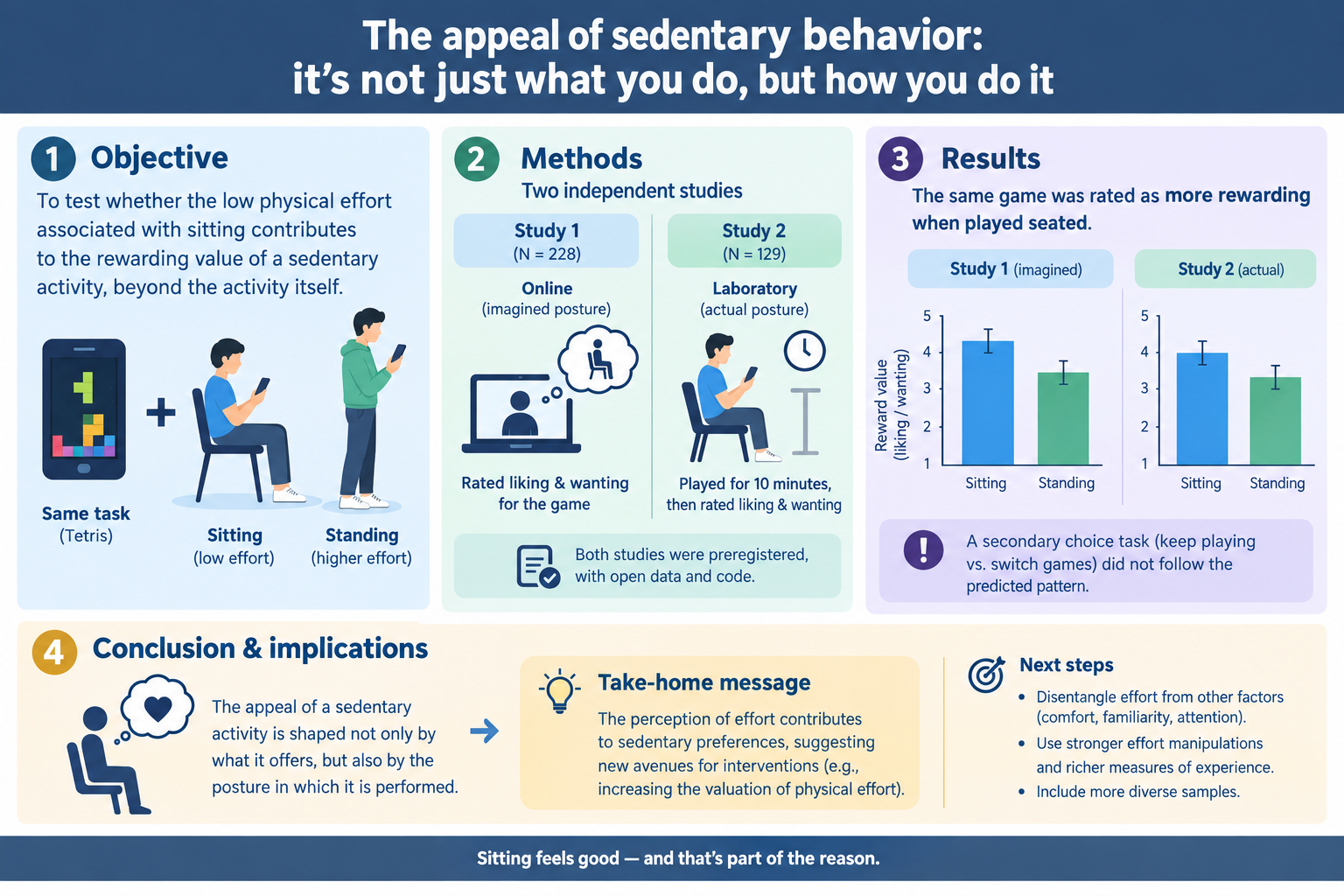
Despite converging evidence on the role on effort minimization in the regulation of movement-based behaviors, little research has examined the extent to which people are motivated to engage in sedentary behavior because of the lack of physical effort required. As such, to extend previous work, the aim of the present research was to examine the influence of the physical effort dimension on the rewarding value assigned to the higher-order goal of leisure-time sedentary behavior. We examined whether manipulating body position (i.e. sitting vs. standing) while engaging a behavior typically performed while sitting (i.e. playing a smartphone video game) would affect the attractiveness of that behavior.
This research consisted of a preliminary study and two independent studies (see Figure S1 for an overview). The preliminary study was undertaken to develop the materials and select the video games to be included in the main studies (more details are available in the Supplementary Material). Study 1 then examined whether asking participants to imagine playing a popular smartphone video game (i.e. Tetris ®) while sitting or standing affected the forecasted rewarding value assigned to that video game (i.e. anticipated level). Study 2 then examined whether actually playing a smartphone video game while sitting or standing would influence the experienced reward value assigned to that video game (i.e. experiential level).
To assess the rewarding value assigned to the smartphone video game, our primary outcomes were measures of explicit liking and wanting (Tibboel et al., 2015). According to the incentive sensitization model (Berridge & Robinson, 1998), liking – a hedonic dimension defined as a sense of pleasure experienced from reward – and wanting – a motivational dimension characterized by the incentive salience paired with reward – both play a key role in reward processing. Liking and wanting were assessed using self-report questionnaires (Tibboel et al., 2015) after participants had imagined (Study 1) or had actually played (Study 2) the video game. Our secondary outcome was participants’ behavioral decision regarding the smartphone video game in a free-choice task. Specifically, participants had to decide whether they would prefer to continue playing the same smartphone video game or to play a different smartphone video game. In Study 1, the decision was imagined with participants knowing that it would have no real consequences, whereas in Study 2 participants expected that the decision made would be carried out.
We hypothesized that imagining (Study 1) or actually (Study 2) playing a smartphone video game while sitting (vs. standing) would be associated with a greater rewarding value assigned to this video game, as reflected by higher scores on liking and wanting (primary outcomes) (H1). In addition, we expected that, compared to participants in the imagined (Study 1) or actual (Study 2) standing condition, participants in the sitting condition would be more likely to choose to keep playing this video game, rather than opting for the alternative smartphone video game offered in the free-choice task (secondary outcome) (H2).
Both studies were preregistered (see the following link: https://zenodo.org/records/11525348) and data and codes are also available at the same link. Study 1 was approved by the Ethics Committee of the university in which this study was conducted (IRB00012476-2022-16-02-158). was approved by the Leiden University Psychology Research Ethics Committee (2023-03-30-P.tenBroeke-V2-4563).
Study 1
Using a between-subject, preregistered online design, Study 1 aimed to examine whether imagining oneself playing a popular video game (i.e. Tetris) in either an imagined seated or standing position could influence the forecasted wanting and liking of that game (primary outcomes), as well as a hypothetical subsequent behavioral choice: to continue playing this game versus switching to another popular video game (i.e. Brick Breaker) (secondary outcome). This first study was conducted as a proof-of-principle study to determine whether imagined physical effort could even influence participants’ evaluation of a video game, before running Study 2 that was more time-consuming as participants were actually asked to play the video game.
2.1. Methods
2.1.1. Participants and procedure
Sample size was a priori calculated using the pwr package in R. Considering a medium effect size (Cohen’s d = .45), the sample size necessary to reach sufficient statistical power was N = 210 (105 participants per experimental condition for a power of 90% and an α-rate of .05, two-tailed). This effect size was selected based on previous literature which examined the effect of manipulating physical effort on reward-related processes (Parma et al., 2023). We used two-tailed tests because of the exploratory nature of Study 1 – as well as to account for the so-called effort paradox that could have led individuals to actually value more the higher-order task when they played standing (vs. sitting) because of justification-based mechanisms that effort can also elicit (Inzlicht et al., 2018). To compensate for potential problems during data collection, we planned to recruit a total of 230 participants. Participants were recruited by word-of-mouth under the supervision of the first author [SM] from the same French university as in the preliminary study, without any compensation for their participation. They were asked to participate to a short survey on their preferences toward video games. Participants were blinded to study hypotheses and were not recruited from the department in which authors were affiliated. A total of 259 participants fully completed the five-minute online questionnaire, of whom 228 were included in the present analyses, based on preregistered exclusion criteria (i.e. not being a student, did not consent to the use of their data for study purposes) (mean age = 22 ± 4 years, 71% female, 62% undergraduate students).
Participants were randomly assigned (1:1 ratio, with a counterbalanced assignment) to an “imagined sitting” condition (N = 116) or an “imagined standing” condition (N = 112). In the “imagined sitting” condition, participants were told: “Imagine that during a scientific experiment you would be asked, for example, to play Tetris on a smartphone for 10 minutes, while sitting”. In the “imagined standing” condition, participants were told: “Imagine that during a scientific experiment you would be asked, for example, to play Tetris on a smartphone for 10 minutes, while standing”. They reported their forecasted liking, wanting and their hypothetical choice between Tetris and Brick Breaker (see below for details). All participants were sitting in a quiet environment when completing the questionnaire. This 10-minute duration corresponded to the mean duration of sedentary bouts observed among young adults in observational studies (e.g. McVeigh et al., 2016).
2.1.2. Measures
Liking and wanting. Liking was assessed using the following item: “How much do you expect that you would like playing this smartphone video game?” (Tibboel et al., 2015). Wanting was assessed using the following item: “How much do you expect that you would want to play this smartphone video game?” (Tibboel et al., 2015). We used analog scales ranging from 0 (“I would truly not like it” for liking ; “I would truly not want to play” for wanting) to “(I would truly like it” for liking; “I would truly want to play” for wanting) 100. In contrast with the preliminary study, we used a 100-point visual analog scale – instead of a 9-point Likert scale – to increase the granularity in participants’ responses.
Behavioral decision. Regarding this secondary outcome, participants were presented with a hypothetical choice. In the sitting condition/standing, they were given the following instructions: “Imagine that, after playing Tetris for 10 minutes while sitting/standing you would now be offered the choice between keep playing Tetris for 10 minutes while sitting or playing Brick Breaker for 10 minutes while sitting. What would you choose to do?”. The answer was given by choosing between two response options – “I would choose to continue playing Tetris for 10 minutes while sitting” versus “I would choose to play playing Brick Breakers for 10 minutes while sitting”.
Additional variables. Participants’ physical activity profile (Grimby et al., 2015), anticipated perceived effort associated with sitting and standing (using a 100-point visual analog scale ranging from “No physical effort” to “A lot of physical effort”), affective attitudes toward the video game and previous experience with Tetris and Brick Breaker were also assessed. See Supplementary materials for more details. Some planned exploratory analyses are described below and in the Supplementary Material.
2.1.3. Statistical analyses
As preregistered, to examine whether the imagined body position (i.e. sitting or standing) while playing a video game influenced the forecasted liking and wanting, we computed two-tailed t-tests. To examine the hypothetical choice between continuing to play the original video game (i.e. Tetris) or choosing the alternative game (i.e. Brick Breaker), we computed chi-squared tests to compare the proportions of choices across the experimental conditions (i.e. “imagined sitting” vs. “imagined standing”).
A set of planned exploratory analyses were also conducted and are reported in the Supplementary material 3.
2.2. Results
Descriptive statistics stratified by experimental condition are reported in Table 1.
2.2.1. Forecasted liking and wanting (primary outcomes)
As predicted (H1), compared to the “imagined standing” condition, participants in the “imagined sitting” condition reported a higher forecasted score on liking, with a medium to large effect size (t(226) = 5.50, p < .001, d = 0.73). Specifically, the mean score on liking for participants in the “imagined sitting” condition was 65.15 ± 22.66, versus 48.15 ± 24 in the “imagined standing” condition” (Figure 1A). As predicted (H1), the pattern of results was similar for forecasted wanting: compared to the “imagined standing” condition, participants in the “imagined sitting” condition reported a higher forecasted score on wanting, with a medium to large effect size (t(226) = 4.69, p < .001, d = 0.62). Specifically, the mean score on wanting for participants in the “imagined sitting” condition was 55.69 ± 25.05, versus 40.72 ± 23.06 in the “imagined standing” condition” (Figure 1B).
2.2.3. Hypothetical choice (secondary outcome)
Contrary to our hypothesis (H2), we found that participants in the “imagined standing” condition were significantly more likely to choose to continue playing Tetris, than to choose the alternative game Brick Breaker (i.e. 62% vs. 38% for Tetris and Brick Breaker, respectively) compared to participants in the “imagined sitting” condition (53% vs. 47% for Tetris and Brick Breaker, respectively) – χ2 (1) = 4.07, p = .044.
Table 1 - Descriptive statistics and demographics for Study 1, stratified by experimental condition. Note. SD: standard-deviation; PA: Physical activity.
|
Sitting condition (N = 116) |
Standing condition (N = 112) |
|
|---|---|---|
|
Forecasting liking |
|
|
|
Mean (SD) |
65.15 ± 22.66 |
48.15 ± 24.00 |
|
Min |
0 |
0 |
|
Max |
100 |
100 |
|
Forecasting wanting |
|
|
|
Mean (SD) |
55.69 ± 25.05 |
40.72 ± 23.06 |
|
Min |
0 |
0 |
|
Max |
100 |
100 |
|
Gender |
|
|
|
Women |
89 (77%) |
74 (66%) |
|
Men |
25 (22%) |
33 (29%) |
|
Non-binary/third gender |
2 (2%) |
4 (4%) |
|
Missing |
0 (0%) |
1 (1%) |
|
Age |
|
|
|
Mean (SD) |
21.73 ± 3.95 |
21.49 ± 3.73 |
|
Min |
18 |
17 |
|
Max |
40 |
43 |
|
Missing |
19 |
12 |
|
Education level |
|
|
|
Bachelor students |
71 (61%) |
71 (63%) |
|
Master students |
40 (34%) |
33 (29%) |
|
PhD students |
4 (3%) |
4 (4%) |
|
Other |
1 (1%) |
4 (4%) |
|
Physical activity level |
|
|
|
Competitive PA |
10 (9%) |
9 (8%) |
|
Regular PA |
37 (32%) |
40 (36%) |
|
Some light PA |
49 (42%) |
49 (44%) |
|
Sedentary |
20 (17%) |
14 (13%) |
2.2.4. Planned exploratory analyses
In planned exploratory analyses, we observed that, in the “imagined sitting” condition, the more participants anticipated standing to be effortful compared to sitting, the higher their forecasted liking and wanting scores for sitting were. Conversely, in the “imagined standing” condition, the more participants anticipated that standing would require effort relative to sitting, the lower their forecasted liking and wanting scores for sitting were (Figure S3). Other exploratory analyses were not significant.
2.3. Interim discussion
Participants who were asked to imagine themselves playing a popular video game (i.e. Tetris) while sitting reported a higher forecasted liking and wanting for that video game, relative to participants who were asked to imagine themselves playing the same video game while standing. Planned exploratory analyses suggested that the anticipated levels of effort associated with the sitting versus standing position may alter this result – in the “imagined sitting” condition, the more participants expected standing to be effortful compared to sitting, the more they anticipated they would like and want to play Tetris. Contrary to our expectations, participants who imagined playing the video game while standing were more likely to choose to continue playing this game (rather than switching to the alternative game, Brick Breaker) than participants who imagined themselves sitting. However, Study 1 focused only on an imagined and hypothetical situation and could not directly examine the actual experience of body position. To address this limitation, in Study 2, we extended our approach to assess the effect of the actual experience of playing the video game in a sitting versus standing position on its rewarding value.

Figure 1 - Descriptive statistics and distributions on liking and wanting, depending on the experimental condition (Study 1). Note. Mean and standard deviations are displayed, with individual points and density plots.
Study 2
The design of Study 2 was identical to that of Study 1, except for three features. First, the imagined situation was replaced by the actual experience of playing the video game either sitting or standing. As such, Study 2 was conducted in person, laboratory-based settings. Second, the questionnaires were adapted to capture not only the forecasted (i.e. assessed before the behavior is experienced) but also actual liking and wanting of the video game (i.e. assessed after the behavior is experienced). Third, participants believed that their decision to continue or switch to the other video game would be followed through (i.e. actual consequences rather than hypothetical consequences as in Study 1). We hypothesized the same pattern of effects as in Study 1 for liking and wanting. Regarding behavioral choices, we kept the same hypothesis (i.e. higher odds of choosing the other video game in the standing vs. sitting condition) as we felt that evidence from Study 1 alone was not enough to change our prior.
3.1. Methods
3.1.1. Participants and procedure
Sample size was a priori calculated using the pwr package in R. Considering a medium effect size (Cohen’s d ~ .5), the sample size necessary to reach sufficient statistical power was N = 140 (70 participants by experimental condition for a power of 90% and an α-rate of .05, one-tailed independent-samples t-test). To compensate for potential problems during data collection, we had planned to recruit a total of 150 participants. Note that in Study 2, to reduce our targeted sample size and because we were now more confident in the directionality of effects on primary outcomes, we used one-tailed tests (these one-tailed tests were pre-registered).
Participants were recruited from a Dutch university, under the supervision of the second author (PtB). Participants were excluded from the study if they did not comply with the instructions (e.g. did not remain standing during the 10-minute trial period), did not consent to the use of their data for the purposes of this study, reported physical impairments that limited their ability to stand for prolonged periods, or reported the use of psychotropic medications or illicit drugs. A total of 154 participants fully completed the laboratory-based experimental procedure, of whom 129 were included in the present analyses, based on preregistered exclusion criteria (mean age = 22 ± 4 years, 75% female, Table 2).
Participants were randomly assigned (1:1 ratio, blinded to study hypotheses) to an “actual sitting” condition (n = 65) or an “actual standing” condition (n = 64). In the “actual sitting” condition, participants were told: “During this study, we will ask you to play a video game called “Tetris” on a smartphone, while sitting, for 10 minutes.”. Later during the experiment, participants played the smartphone video game Tetris while sitting on a designated chair located on an X marked spot in the experiment room. In the “actual standing” condition, participants were told: “During this study, we will ask you to play a video game called “Tetris” on a smartphone, while standing, for 10 minutes.” Later during the experiment, participants played the smartphone video game Tetris while standing on the X marked spot in the experiment room (the chair would be removed).
3.1.2. Measures
Forecasted and actual liking. Forecasted liking was assessed before the 10-minute period during which participants played Tetris while sitting or standing. Questions were the same as in Study 1 (i.e. “How much do you expect that you would like playing this smartphone video game?”) and were translated from French to English by the research team. Actual liking was assessed after the 10-minute playing period using the following item: “To what extent did you like playing Tetris during the trial period?” (Tibboel et al., 2015). Responses were provided on a visual analog scale ranging from “(I truly did not like it) 0” to “(I truly liked it) 100”.
Forecasted and actual wanting. Forecasted wanting was assessed before the 10-minute period, using the same item as in Study 1 (i.e. “How much do you expect that you would want to play this smartphone video game?”). Actual wanting was assessed after the 10-minute playing period using the following item: “To what extent did you want to play Tetris during the trial period?” (Tibboel et al., 2015). Answers were provided on a visual analog scale ranging from “(I truly did not want to play) 0” to “(I truly wanted to play) 100”.
Behavioral choice. Choice was assessed after the 10-minute period with the following item: “You now have the choice to keep playing Tetris for 5-10 minutes while sitting, or to play Brick Breakers for 5-10 minutes while sitting. Which game do you choose to play?” The answer was given by choosing between two response options – “I choose to keep playing Tetris for 5-10 minutes while sitting” versus “I choose to play Brick Breakers for 5-10 minutes while sitting”.
As in Study 1, usual physical activity, anticipated perceived effort associated with standing, and previous experience with Tetris and Brick Breaker were also assessed. We also added the Physical Effort Scale (PES) as this newly validated scale captures individual differences in the valuation of physical effort (Cheval et al., 2024), as well as intentions to reduce sedentary behavior.
Table 2 - Descriptive statistics and demographics for Study 2, stratified by experimental condition. Note. SD: standard-deviation; PA: Physical activity.
|
Sitting condition (N = 65) |
Standing condition (N = 64) |
|
|---|---|---|
|
Forecasting liking |
||
|
Mean (SD) |
69.11 ± 15.53 |
63.75 ± 14.64 |
|
Min |
33 |
19 |
|
Max |
100 |
91 |
|
Forecasting wanting |
||
|
Mean (SD) |
65.18 ± 18.76 |
61.50 ± 17.45 |
|
Min |
26 |
19 |
|
Max |
100 |
100 |
|
Actual liking |
||
|
Mean (SD) |
75.62 ± 17.02 |
67.19 ± 21.95 |
|
Min |
24 |
12 |
|
Max |
100 |
100 |
|
Actual wanting |
||
|
Mean (SD) |
72.17 ± 22.76 |
65.55 ± 20.57 |
|
Min |
20 |
15 |
|
Max |
100 |
100 |
|
Gender |
||
|
Women |
48 (73%) |
48 (75%) |
|
Men |
16 (25%) |
14 (22%) |
|
Non-binary /Third gender |
1 (1%) |
2 (3%) |
|
Age |
||
|
Mean (SD) |
21.54 ± 3.40 |
21.74 ± 3.67 |
|
Min |
17 |
18 |
|
Max |
32 |
36 |
|
Education level |
||
|
Bachelor |
51 (78%) |
44 (69%) |
|
Master |
12 (18%) |
18 (28%) |
|
Other |
2 (3%) |
2 (3%) |
|
Physical activity level |
||
|
Competitive PA |
6 (9%) |
12 (19%) |
|
Regular PA |
29 (45%) |
19 (30%) |
|
Some light PA |
20 (31%) |
21 (33%) |
|
Sedentary |
10 (15%) |
12 (19%) |
3.1.3. Statistical analyses
As in Study 1, descriptive statistics were first computed, followed by t-test models to examine whether the body position (i.e. sitting or standing) while playing a video game influenced the forecasted and actual liking and wanting. Chi-squared tests were conducted to examine the choice between continuing to play the original video game (i.e. Tetris) or choosing the alternative game (i.e. Brick Breaker).
In additional analyses, t-test models were first computed to test whether the difference between forecasted and actual liking and wanting was greater (i.e. greater forecasting error) in participants in the standing compared to sitting position. Indeed, because physical effort might be perceived as lower than anticipated in the standing position, we expected that individuals in the “standing” condition would report a greater difference between forecasted and actual liking and wanting (greater forecasting error) than participants in the sitting condition. Second, consistent with Study 1, the moderating role of anticipated effort of standing, participants’ physical activity profiles, and previous experiences with Tetris were tested as potential moderators of the effect of body position on the forecasted and actual liking and wanting. The intention to minimize sedentary behavior and the tendencies to approach (vs. avoid) physical effort, assessed with the PES (Cheval et al., 2024) were also tested as potential moderators.
3.2. Results
Descriptive statistics stratified by experimental condition are reported in Table 2.
3.2.2. Liking and wanting (primary outcomes)
Forecasted liking and wanting. As predicted (H1), compared to the “standing” condition, participants in the “sitting” condition reported a higher forecasted score on liking, with a small-to-medium effect size (t(127) = 2.02, p = .023, d = 0.35). Specifically, the mean score on liking for participants in the “sitting” condition was 69.11 ± 15.53, versus 63.75 ± 14.64 in the “standing” condition” (Figure 2A). The pattern of results was similar for forecasted wanting, but the differences were not significant. Compared to the “standing” condition, participants in the “sitting” condition reported a higher forecasted score on wanting, (t(127) = 1.16, p = .125, d = 0.20). Specifically, the mean score on wanting for participants in the “sitting” condition was 65.18 ± 18.76, versus 61.50 ± 17.45 in the “standing” condition” (Figure 2B).
Actual liking and wanting. As predicted (H1), compared to the “standing” condition, participants in the “sitting” condition reported a higher score on liking, with a small effect size (t(127) = 2.44, p = .008, d = 0.43). Specifically, the mean score on liking for participants in the “sitting” condition was 75.62 ± 17.02, versus 67.19 ± 21.95 in the “standing” condition (Figure 3C). The pattern of results was similar for actual wanting. Compared to the “standing” condition, participants in the “sitting” condition reported a higher score on wanting, (t(127) = 1.73, p = .043, d = 0.31). Specifically, the mean score on wanting for participants in the “sitting” condition was 72.17 ± 22.76, versus 65.55 ± 20.57 in the “standing” condition” (Figure 3D).
3.2.3. Behavioral choice (secondary outcome)
Contrary to our hypothesis (H2), we found no significant differences regarding the likelihood to continue playing Tetris or to choose the alternative game Brick Breaker for participants in the “standing” (i.e. 45% vs. 55% for Tetris and Brick Breaker, respectively) compared to participants in the “sitting” condition (52% vs. 48% for Tetris and Brick Breaker, respectively) – χ2 (1) = 0.38, p = 0.536.

Figure 2 - Descriptive statistics and distributions on forecasted and actual liking and wanting, depending on the experimental condition (Study 2). Note. Mean and standard deviations are displayed, with individual points and density plots.
3.2.4. Planned exploratory analyses
Results of the first exploratory analyses showed no difference in the size of the error between forecasted and actual liking or wanting between participants in the standing compared to sitting position. Results neither revealed a moderating effect of perceived effort, participants’ physical activity profile or intentions to minimize sedentary behavior, knowledge or previous experience with Tetris on observed associations.
3.3. Interim discussion
People reported higher liking of a video game when playing it in a seated position versus when playing the same game while standing. Crucially, whereas Study 1 focused on effects of imagined body position, we showed that actual body position also had an effect on the reported liking and wanting associated with the video game. However, in contrast to our hypothesis (and findings from Study 1), we found no evidence that the actual body position had an effect on the decision to continue playing the same video game (i.e. Tetris) or to switch to an alternative game (i.e. Brick Breaker).
General Discussion
The high prevalence of leisure-time sedentary behavior suggests that such behavioral options are rewarding. Two experimental studies manipulated the body position (i.e. sitting versus standing) in which individuals played a smartphone video game and examined how it could influence the rewarding value assigned.
In Study 1, our results revealed that participants who imagined themselves playing Tetris while sitting reported higher scores on forecasted liking and wanting, relative to participants who imagined themselves playing Tetris while standing. These results suggested that the forecasted rewarding value assigned to playing Tetris in a seated position partly depends on the low physical effort associated with playing the video game. This finding is consistent with research across decision sciences, including economics, neurosciences and psychology, that emphasizes the intertwined roles of value and effort in shaping expected rewards for behavior (Rangel et al., 2008). In this framework, a high value assigned to the higher-order goal and a low anticipated effort both increase the value of that behavioral option – a concept recently formalized regarding movement-based behaviors (Maltagliati et al., 2022). Despite potential prediction errors, anticipating a low effort, such as playing a game while sitting, increases the attractiveness of this activity beyond its inherent appeal. Planned exploratory analyses provided further support for the effects of perceived effort on forecasts about the video game. In the “imagined sitting” condition, the more participants perceived that standing required effort, relative to sitting, the more they expected they would like and want to play Tetris while sitting. On the contrary, in the “imagined standing” condition, the more participants perceived that standing required effort, relative to sitting, the less they expected they would like and want to play Tetris while standing. In other words, the more people anticipated playing Tetris to be associated with effort, the less rewarding they expected playing Tetris would be.
In Study 2, conducted among an independent sample, we replicated the effect of body position (i.e. sitting vs. standing) on the forecasted liking, but not on forecasted wanting (although the effect was in the expected direction). Crucially, Study 2 also showed that actually playing the video game in the sitting (vs. standing) position had an effect on experienced liking and wanting: compared to participants in the “standing” condition, participants in the “sitting” condition reported higher liking and wanting after having actually played the video game. In contrast to Study 1, planned exploratory analyses in Study 2 did not provide support for the moderating effect of perceived effort in these evaluations. One explanation for the discrepancy in results between Study 1 and 2 may be that the strength of the manipulation in terms of the relative difference in effort between conditions was too small – as we chose a non-sedentary activity (i.e. standing) that is considered of light intensity and that was not evaluated with a high effort cost, especially by young and healthy people (see also Cheval et al., 2019). The latter point may be reinforced by the fact that the sample in Study 2 was slightly more physically active than the sample in Study 1. Future studies should use stronger and more rigorous effort manipulations in order to shed further light on this pattern of results.
Overall, the fact that body position influences the reported rewarding value of the activity is consistent with an effort minimization account. Notably, our findings are consistent with TEMPA, which argues that body position influences how we evaluate activities (Cheval & Boisgontier, 2021), as well as with empirical evidence showing that both perceived and actual physical effort can shape the evaluation of neutral stimuli (Cheval et al., 2022). Our findings also with neuroscientific evidence showing that individuals generally prefer options that require little physical effort and that effort partly offsets the rewarding value assigned to a behavioral option (Prévost et al., 2010). These tendencies have been observed in experimental tasks in which the effort to exert was purely instrumental (e.g. usually handgrip press) and depended on a set of artificial instructions (e.g. pressing the handgrip allows the viewing of an erotic image for 3 seconds) whose relevance is limited to laboratory settings. Here, we extended this pattern to an everyday behavior that has intrinsic motivational properties (i.e. pleasure, excitement, challenge) (Przybylski et al., 2010) and whose completion is associated with a well-learned body position (i.e. sitting while playing Tetris; Gardner et al., 2019).
However, contrary to our hypothesis (H2), in Study 1, participants in the “imagined standing” condition were more likely to keep playing Tetris (vs. Brick Breaker) than participants in the “imagined sitting” condition, when exposed to a free-choice hypothetical situation (Study 1). Although speculative, this unexpected finding could be explained by processes of effort justification – a mechanism that aims to reduce cognitive dissonance by assigning greater reward value to outcomes that require greater effort to obtain (Aronson & Mills, 1959). For example, this process of effort justification has been proposed in previous studies to explain why expecting to expend more energy to obtain a reward may counterintuitively increase the value of that behavior (Parma et al., 2023). This pattern of results may also reflect a “commitment bias”, defined as the tendency to remain committed to past behaviors regardless of prior experience (Staw, 1976). Specifically, with respect to effort, previous research has shown that the more effort individuals exert, the more likely they are to continue consuming the option that previously required effort – a phenomenon referred to as the sunk-cost effect (Arkes & Blumer, 1985). In our case, this bias may have been activated in the “imagined standing” condition after individuals had anticipated effort from remaining standing, leading individuals to continue playing Tetris. Importantly however, this effect on behavioral decision was not replicated in Study 2 – potentially because expended effort was too low in the standing condition to trigger such effort justification-related mechanisms. It should be mentioned that the cost to task switching or the need for novelty may have influenced this pattern of findings, and therefore, future studies should replicate and extend these findings using more validated behavioral measures.
4.1. Conceptual and practical implications
Our research complements prevailing theories that often overlook the role of physical effort in understanding sedentary behavior. Here, we have shown that the effort dimension of a given behavior – as indirectly manipulated through body position – significantly affects its rewarding value, with effects ranging from small to large depending on the aspect measured (i.e. forecasted and actual wanting and liking). Crucially, even a subtle change in body position (sitting versus standing) can alter the rewarding value of a behavior. Despite the modest nature of the manipulation in terms of physical effort, our results suggest its potential and future studies using stronger and more rigorous effort manipulations may shed further light on this effect. Especially, it will be crucial to determine whether this alteration in terms of assigned reward stems from effort-related processes and/or from other experience-based variables (e.g. habitualness, discomfort). Still, our findings encourage future research to consider the importance of effort in understanding higher-order behavior regulation, its interactions with abovementioned constructs, as well as it highlights the relevance to evaluate the intrinsic value of the higher-order value being performed against effort. Moreover, it is surprising that we did not detect a significant effect of individuals’ tendencies to approach (vs. avoid) physical effort on participants’ evaluation of the video game, depending on the experimental condition. While these tendencies have proven to be associated with more global measures of movement-based behaviors (Maltagliati et al., 2025), future research is needed to better understand how inter-individual differences in effort processing can shape the value assigned to more specific behaviors.
Our research addresses the overlooked role of physical effort in understanding the rewarding value of sedentary behavior and provides insights with potential clinical implications. Understanding how physical effort influences different behaviors, from sedentary behavior to higher-intensity activities, is critical to addressing health problems associated with sedentary lifestyles. People are often drawn to low-effort postures and find activities more enjoyable when sitting, even for short periods of time. This tendency poses a challenge in promoting active lifestyles and combating growing levels of sitting time. Future research should explore methods to increase the rewarding value of physical effort in order to reduce the pervasive attraction toward less effortful alternatives. Alternatively, decreasing the value of higher-order goals that are performed while seated and/or increasing the value of higher-order goals that are could be performed while standing, moving, might be relevant.
4.2. Limitations and strengths
Our studies have several limitations. First, we used one-item self-reported data to measure the rewarding value of the video game, which may provide an inaccurate estimate of participants’ actual rewarding value associated with this game. Second, we do not know to what extent the differences in wanting and liking associated with a particular behavior (e.g. playing a video game) due to body position may subsequently affect the likelihood of engaging in that behavior in everyday life. Future studies that manipulate body position in ecologically valid contexts may allow the examination of not only how body position influences the maintenance of that behavior, but also how the rewarding value of that behavior evolves over time. Third, the rewarding value of sedentary behavior comes from the combination of higher-order goals and low physical effort, such as sitting or lying down. In our current study, however, we modified effort while keeping the goal aspect constant. To thoroughly test our hypotheses, future research should manipulate both the physical effort and goal value dimensions, for example by asking participants to engage in a boring or unpleasant task (e.g. passively looking at a blank wall) sitting vs. standing. Fourth, the main studies were conducted in two different countries (i.e. in France and in the Netherlands), which makes direct comparisons between studies difficult – especially given the differences in experimental procedures (i.e. online procedure in Study 1 vs. laboratory-based procedure in Study 2). Fifth, we did not assess other performance-related metrics in the game (e.g. difficulty, cognitive load or scores when playing Tetris), which may yet be conflated with effort-related perceptions. Following the same reasoning, we did not control for other experiential states while participants were asked to (imagine) playing a video game sitting/standing (e.g. boredom, sense of control, discomfort). As such, future studies should encompass a broader perspective on users’ experience when engaging in the higher-order behavior to better disentangle effort-related processes from other experiential facets. In the same perspective, we did not adjust for task-posture familiarity, which may influence participants’ experience while playing the video game sitting vs. standing. Lastly, in the behavioral choice task, participants in the standing condition were now asked to decide between two video games, while sitting, whereas participants in the sitting condition were asked to decide between two video games, while they were already seated. This difference between experimental conditions in terms of changes vs. non-changes in body posture may have also biased observed findings. Using a washout could allow to reduce this limitation in future research.
Study limitations are offset by several strengths: the . the careful selection of rewarding video games through a preliminary study, as well as the preregistration of the study, its hypotheses and planned analyses.
Conclusion
We showed that the rewarding value of sedentary behavior may be due, in part, to the low level of physical effort paired with such body position (i.e. sitting or lying down). So, if you often find yourself immersed in a smartphone video game and have a hard time getting up from the couch, it may not be because of the content of the game alone, but also because of the sedentary position you are in.
Acknowledgments
Preprint version 3 of this article has been peer-reviewed and recommended by Peer Community In Health and Movement Sciences (https://doi.org/10.24072/pci.healthmovsci.100195; Brevers, 2026).
Funding
M.S and D.R are suppported by the National Institutes of Health (Grant Number: R01AG72445). B.C. is supported by the Chaires de recherche Rennes Métropole (23C0909).
Conflict of interest disclosure
The authors declare that they comply with the PCI rule of having no financial conflicts of interest in relation to the content of the article.
Data, scripts, code, and supplementary information availability
Data, scripts, codes, supplementary information are available online: https://zenodo.org/records/11525348 (https://doi.org/10.5281/zenodo.23397152, Maltagliati, 2026).