

 CC-BY 4.0
Introduction
In 1916, George Whipple noted that “Health is more than the absence of disease. It is something positive, and involves physique and vitality, and it is mental as well as physical. The inherent difficulty at the present time is the absence of scientific methods of measuring this positive element in health” (p 195-196 Whipple, 1916). Subsequently, Pearl (1928) suggested that “[v]itality lies in events or actions rather than in static structures. The essence of life lies in its dynamics and not in its statics” (p 98). Vitality, he suggested, lies in the “intensity of actions” which “differed between individuals in a group and within the individual over time” (p 98). A few years later, Hoskins (1931) proposed that “the general ‘vitality’ of any given subject” could be measured by a “mathematical ‘homeostatic index’ based on “the response to “quantitative distorting factors” (emphasis in original, p 682). Hoskins and later Cannon (1935) called this indicator of vitality, homeostatic efficiency.
From these early insights has grown a strong focus in studies of health and well-being in animals and humans on biological functions that confer a positive state beyond the absence of disease. Two broad themes of research in this area address 1) factors that expand the capacity to manage environmental perturbations and 2) the subsequent expression of that capacity. The first includes work on the influence of environmental enrichment, ecologically appropriate complexity (Newberry, 1995), and positive affective experiences (Mellor, 2015) that “broaden and build” (Fredrickson, 2001) the repertoire of skills and competences possessed by animals and humans (Špinka & Wemelsfelder, 2011; White, 1959). Expression is addressed through studies on functional (intrinsic) capacity, resilience, and their opposites including frailty, allostatic load and the physiology of aging (reviewed by Cohen et al., 2025).
The conceptual basis of positive health and well-being and approaches to their assessment in animals are under rapid development (Rault et al., 2025). This paper examines the potential for Hoskins’ and Cannon’s concept of homeostatic efficiency which they described as an indicator of vitality to contribute to the topic. It provides an overview of broad concepts in biology that characterize animals as complex adaptive systems that harvest energy and information by harmonising activities with environmental dynamics. The animal’s relationship with its environment is examined from an ecological perspective that draws attention to the subjective dimension of perception of environmental perturbations. Historical perspectives of organismal regulation are described to clarify the relationship of homeostatic efficiency with allostasis and homeorhesis. Positive and negative aspects of the efficiency of organismal regulation are addressed. It is suggested that deviations from trajectories in outputs of homeostasis such as daily milk yield can be influenced by positive as well negative dimensions of organismal regulation. Deviations from trajectories may therefore reflect the capacity of the animal to harness resources and master its environment as well as to minimize disturbances to homeostasis. Thus, deviations may indicate not only resilience in the face of adversity but also vitality in everyday life. Positive contributions to homeostatic efficiency for example from using environmental resources to broaden and build capabilities suggest that resilience has deficiencies as a rubric for describing variability in trajectories. From this perspective, vitality describes the strength and capacities of processes to create and maintain homeostatic order in the face of environmental perturbations. In accord with widespread usage, resilience describes the strength of processes of organismal regulation to maintain or regain trajectories in the face of adversity. An approach is described to test the utility of homeostatic efficiency as a measure of the costs of allostatic adaptation. The relationship of homeostatic efficiency to well-being is examined. Finally, some limitations and further directions are addressed. Some suggestions are made for further work to clarify the biology of vitality and methods for its assessment. Methods to disentangle positive processes from recuperative activities that restore normality would be very valuable. Many concepts are described only briefly and interested readers are encouraged to explore the references for more detailed accounts.
Harnessing energy and information
Two properties of the environment that organisms use to sustain life are energy and information (O’Connor et al., 2019). From these resources organisms construct order within their structures and functions (Prigogine, 1969) through a process of self-organization termed autopoiesis (Varela et al., 1974). In accord with thermodynamic theory, this order has a tendency to decrease over time (Schrödinger, 1944). To counter the tendency to disorder (entropy), organisms must dissipate energy (Prigogine, 1969). The application of information theory to biology in recent decades has led to the description of information as also being essential for the generation and maintenance of order through a process Friston et al. (2010) termed active inference. Information in this biological context is a property of the environment the organism can sense and act on, for example via a glucose receptor on a bacterium or the eye of a vertebrate. In this framework for describing biology, expectations of the information content of the environment are embedded in the structures and functions that make up every organism (Campbell, 2016). In a cyclical manner, active inference updates expectations such as the presence of nutrients near a microorganism or the imminent arrival of the feed truck in a cow barn (as described in animals by Kristiansen & Fernö, 2020). Updating expectations through cycles of sensing and acting enables dynamic attunement of the organism with its ever-changing environment (Campbell, 2016; Linson et al., 2018; Lyon, 2015). So important is utilization of information by organisms that some authors have concluded life is fundamentally a cognitive process whereby a capacity to predict patterns in the environment improves access to resources and reduces exposure to harms (e.g. Ball, 2023; Goodwin, 1978; Lyon, 2025). The active inference model of information processing has led to an information-theoretic account of stress (Peters et al., 2017) that aligns with more conventional characterizations of poor prediction and control of the environment as leading to stress (e.g. Boissy et al., 2007; Weiss, 1972). Adaptations during the organism’s life update its map (model) of information and resource dynamics in the environment (Conant & Ashby, 1970). Success in predicting and accessing these resources influences the organism’s functional integrity as discussed later and help tune the organism to its environment as discussed next.
Organism – environment relationship
The dissipation of energy and reduction of uncertainty not only tune the organism to the dynamics of its environment, they also generate new information and material resources for other organisms. This dynamic interplay between organism and environment was described by Von Uexküll (1926) as a function-circle and subsequently by Patten (1982) as constituting a fundamental unit of biology, the environ. Patten described the outputs of the environ as its effectance on other organisms and the ecological networks it participated in. Patten’s effectance was a precursor of Niche Construction Theory and the Extended Evolutionary Synthesis (EES) (Laland et al., 2015). The EES recognized that organisms make hard physical changes as ecosystem engineers as well as soft cultural (and other informational) changes to the environment. For a newborn, these prior acts of environmental modification constitute an ecological inheritance (Jablonka & Lamb, 2007). An example in livestock is the cultural inheritance of grazing territories termed hefts by some hill sheep flocks in Scotland and England (Monk & Hinch, 2026). The ecological view represented a shifted in the concept of the animal - environment relationship towards a model of co-construction between a dynamic niche and the prospective actions of the organism (Fultot & Turvey, 2019; Wemelsfelder, 1997). From the ecological perspective, it was realized that the environment could no longer be fully described in objective terms but included subjectively sensed attributes that could be unique to a species, a genotype, or an individual. The subjective dimension undermined the Newtonian viewpoint that scientists could provide an objective description of the animal’s external world (Mazzocchi, 2008). Mancin et al. (2026) characterize these two sources of environmental influence on the animal as white box (known) and black box (unknowable, unknown or unmeasured). From the ecological perspective, the animal and its environment are conjoined through the subjectivity of perception and action as a black box source of variation in the animal’s expressed characteristics.
Gibson (1977) described aspects of the niche that afford opportunities for action as affordances. Gibson’s proposal was expanded to suggest that action is afforded not only by macroscopic physical structures like the stem of a nipple drinker or a handle on a cup but also by molecular properties that provide opportunities for action for example by the immune system (Tauber, 2017). Phylogenetic and ontogenetic constraints create some limits to the repertoire of affordances an organism can “grasp”. A property of affordances proposed by Gibson (1977) was their potential “for good or ill” (p 67). This quality linked affordances to the concept of valence in psychology. Bacteria and higher organisms exhibit attraction and avoidance to various conditions and events in their environments (Lyon & Kuchling, 2021). Although the processing of information through a hierarchy of networks in more complex organisms can generate properties such as sentience, emotions, consciousness and awareness of subjective experiences (O’Keane, 2021), organisms from microbes to humans embody the same heuristic. Valence guides actions and actions modify valence. Affordance and valence are not fixed properties of the environment but subjective changeable qualities that emerge through the dynamic of the organism - environment relationship (Lyon & Kuchling, 2021). This leads to the description of the environment of farm animals as having hedonic value through being valenced (Colditz, 2018; Ginane et al., 2026; Veissier et al., 2026).
The contribution of functions
The a priori predictions of the environment made by genetic and ecological inheritances cannot anticipate the full range of environmental variation each newborn might experience. Thus, the forms and functions encoded in inheritance must be tuned and adapted by each newborn as it progresses along its life course. Functions overlap in their contributions to daily life and are not delineated by clear boundaries (Bergelson et al., 2021). In broad brush terms, a farm animal is endowed with functions such as sensation, affect, cognition, learning, locomotion, behaviour, social interaction, digestion, defence, repair, operation of the microbiome, and so on. Development of functions commences progressively before and accelerates after birth (Mellor, 2019) in many instances passing through a sensitive period when tuning can be strongly guided by environmental experiences (Wiesel, 1982). For example, calves are sensitive to the development of social skills during disruption of the mother – calf bond during weaning (Enriquez et al., 2011; Fell et al., 1998; Veissier & Le Neindre, 1989). Maturation of functions is described as the development of functional competence (Špinka & Wemelsfelder, 2011). The rate of maturation of individual functions can differ across the developmental trajectory and extend beyond sensitive periods to continue throughout life.
An important distinction lies between what a function can do such as make decisions (e.g. to act or not to act) and the specific environmental context during which it is expressed (which branch of this maze do I go down next). An example of this distinction is provided by the immune system. The animal acquires before or soon after birth an inheritance of maternal antibodies which, based on the mother’s experience, prepares the offspring for the antigenic encounters it is likely to face. Over subsequent weeks the neonate’s own immune functions mature to replace the maternal inheritance with a new repertoire of immune receptors operating within networks of white blood cells and immunoglobulins. The networks are tuned to recognize molecular structures newly experienced by the young animal that pose threats or benefits (Tauber, 2017). Activities of the networks provide defence, promote beneficial organisms in the microbiome, and facilitate turnover and repair of aged and damaged tissues. Expansion of the repertoire and maturation of the capacity to respond increases the immune competence of the young animal. The targets of this immune competence vary between individuals and across the life course and can include molecular structures newly synthesized by humans that have never previously existed on earth (Tauber, 2017). Thus, the molecular targets (antigens) that constitute the objects of action are distinct from the capacity to act. Similarly, through the capacity for associative learning, an animal can link novel sequences of events not previously experienced by the species during evolutionary history. The capacity to learn novel associations is implemented in the design of virtual fencing technology, automatic milking systems, and many other aspects of the human - animal interface (Lee et al., 2018). Thus, humans can make new affordances for animals to sense and act on.
Environmental mastery
This promiscuity of functions to operate across a range of contexts is nonetheless constrained. The affordance of straw for nest building may be greater than similarly shaped plastic strips, and certain sequences of notes are more easily learned by chicks as they acquire skills in song-making (James & Sakata, 2017). Competence acquired by the individual broadens the range of conditions amenable to survival and the range of environmental perturbations the individual can accommodate (Špinka, 2019). Specific skills acquired as competence increases, for example the skill to navigate a maze, are an open-ended set (Špinka & Wemelsfelder, 2011). Within the time limits and developmental constraints of its own lifetime, an individual is only able to acquire a subset of the skills available to its species. White (1959) introduced the concept of competence to describe mastery of the environment as the outcome achieved through expression of agency. White’s concept of environmental mastery is considered a core feature of well-being in animals (Colditz, 2022; Špinka & Wemelsfelder, 2011; Williams, 2021) as well as humans (Ryff et al., 2021).
Does fulfilment of purpose describe environmental mastery?
Can we tell how well the animal is attuned to and mastering its environment? Is it competent? Is it surviving or thriving? In a recent paper, Wilkins et al. (2026) examined the question through the lens of teleonomy – the study of the utility that structures and functions contribute to an organism’s survival as an outcome of natural selection. In teleonomy, this utility is described as the a posteriori purposes the structures and functions have come to acquire (Wilkins et al., 2026). The teleonomic purposes which animals strive to fulfil, the authors noted, has a long history of enquiry in biology. Fulfilling purposes, the authors suggest, is the pathway to teleonomic success. The authors propose the term teleonome to describe the repertoire of forms, functions and environmental affordances that enable the animal to fulfil its evolutionary purposes. Fulfilling purposes is also described in the animal welfare literature as the realization of the animal’s inherited and developmentally acquired potential – its telos – which Rollin (2012) described as the animal’s sheep-ness, cow-ness, etc. In the Modern Synthesis that integrated genetic mechanisms into Darwin’s evolutionary theory (Huxley, 1942), the purpose of evolved functions was to enable persistence through survival of the individual so it can transmit genes to offspring. In the EES, hard and soft contributions to the community and to the ecosystem are additional agents of transgenerational persistence. The utility of a function can lie in the future such that teleonomic mechanisms need not be of immediate or unqualified benefit to the individual or current generation. For example, mothers in most mammalian species endure the immediate cost of negative energy balance in early lactation as a life history strategy to improve longer-term survival of their neonates (Monteith et al., 2026). As well as a metabolic penalty, emerging evidence suggests that negative energy balance imposes the cost of a negative affective state (Liu et al., 2025) via growth differentiation factor 15 and other mediators associated with mitochondrial stress (Giesy et al., 2026; Lane & Rodriguez, 2026). (Counterbalancing this cost are the likely positive affective rewards of suckling, grooming, and being with the offspring (Jensen et al., 2024; Neave et al., 2024)). At a transgenerational level, neutral and weakly deleterious traits that persist in a population due to antagonistic pleiotropy or genetic linkage can have positive teleonomic value by providing genomic diversity as substrate for adaptation in future generations (Brito et al., 2021; Halvoník et al., 2026). The open-ended character of the set of possible affordances, skills, and future utility suggest that teleonomic fulfilment is relative rather than a goal that can be completed within the life on an individual. This relativity of fulfilment aligns with the anthropological view “that the key issue for a human being is not to be highly functional on an abstract scale of functionality, but to be in equilibrium” (p 204, O’Keane, 2021). These considerations support the conclusion that environmental mastery is a relative and dynamic state rather than an outcome that can be completed. As an alternative to an inventory of affordances and skills, the next section considers the success with which these resources are used to maintain dynamic homeostasis as a basis for assessing environmental mastery.
Measuring environmental mastery as homeostatic efficiency
How animals maintain vitality in daily life is a question that has been posed in various forms for many years. Following Claude Bernard (1865)’s pioneering work on the tendency for animals to buffer their internal environment from external changes, Walter Cannon (1929) described the stabilized outcome as homeostasis. At the turn of the 20th Century, physiologists recognized that this stability was relative: variables like glucose and heart rate moved through a range of values during everyday life (Cannon, 1929, 1935). The relative stability of the internal environment depended on a capacity for dynamic changes and adaptation (Abrahams, 1907; Allbutt, 1912; Cannon, 1929, 1935; Henderson, 1927; Richet, 1900). Adaptive and pathological changes could lead to physiological variables and organ functions settling at values displaced from normal (Abrahams, 1907; Allbutt, 1912; Hoskins, 1931). Dynamic changes could be anticipatory: blood glucose and heart rate were recognized to increase before a sporting event, and in the face of a threat, the autonomic nervous system prepared the animal for fight or flight (reviewed by Bechtel & Bich, 2025). Cannon’s contemporary at Harvard University, Roy Hoskins (1931) proposed that the efficiency with which the animal could maintain homeostasis during a range of test conditions could provide a “mathematical ‘homeostatic index’ ... expressing the general ‘vitality’ of any given subject ... derived algebraically from a fairly large number of weighted subindices” (emphasis in original, p 682). Cannon (1935) enthusiastically adopted Hoskins proposal. Hoskins and Cannon recognized that they did not know in detail the processes through which homeostasis was maintained (Cannon, 1929). Their focus on the outcome they termed vitality was in line with Bernard (1865)’s earlier advice ‘‘. . . to acknowledge a harmonious and pre-established unity in an organized body, all of whose partial actions are interdependent and mutually generative. … if we break up a living organism by isolating its different parts, it is only for the sake of ease in experimental analysis, and by no means in order to conceive them separately. … to ascribe to a physiological quality its value and true significance, we must always refer to this whole and draw conclusions only to its effects in the whole” (p.89). Perhaps in part due to lack of molecular knowledge, Cannon and many other physiologists of the era were interested in the goals of organismal regulation, not just the means. Vitality was an aspect of this focus. This holistic view sought physical explanations for vitality and in doing so rejected the non-physical vitalism of the 19th Century (Bechtel & Bich, 2025).
A later addition to Cannon’s concept of homeostasis was the model developed in cybernetic control theory that feedback provided a mechanism that drove physiological values towards a fixed point (Billman, 2020; Rosenblueth et al., 1943). The set point model of regulation became entrenched in physiological textbooks to such an extent that Sterling & Eyer (1988) needed to break the mould by re-emphasising the importance of dynamic predictive and adaptive changes for which they coined a new term - allostasis (Bechtel & Bich, 2025). The concept of allostasis provides an entry point to the study of organismal regulation as a network process within complex adaptive systems (Aon & Cortassa, 2026; Lipsitz, 2002; Wu et al., 2025) under the heuristic of active inference (Barrett et al., 2016).
Proficiency in daily life and resilience in adversity
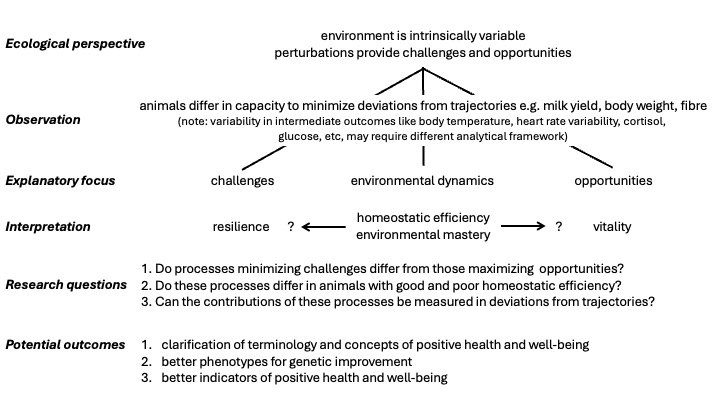
The dynamic stability of trajectories such as daily milk yield, body weight, egg weight, feed intake, and behavioural activity have been described in recent years as dynamic indicators of resilience (Berghof et al., 2019; Colditz & Hine, 2016; Friggens et al., 2017; Mancin et al., 2026; Scheffer et al., 2018). It is suggested here that in accord with the terminology of Hoskins and Cannon, these whole-animal outcomes can be understood to be measures of homeostatic efficiency. The products are an integrated outcome of regulatory processes occurring through multiple systems acting across a range of timescales. From this pluralist perspective, the efficiency with which system integrity is achieved provides a metric of success in maintaining dynamic balance with the environment. This interpretation is independent of whether we consider the underlying processes of organismal regulation to conform to Cannon (1929)’s concept of dynamic agencies maintaining homeostasis, the outdated model of set-point homeostasis, or newer models such as dynamic allostasis and teleonomic fulfilment. To this end, homeostatic (sensu Cannon), allostatic, and teleonomic efficiency may provide equivalent descriptors of environmental mastery, although a distinction between terms is outlined below. In common usage, the concept of resilience has a strong association with adversity. In accord with Hoskins’ and Cannon’s usage, day-to-day variability in trajectories such as milk yield, body weight, and feed intake may be better described as indicators of homeostatic efficiency rather than resilience. Homeostatic efficiency encompasses proficiency in navigating the opportunities of daily life as well as resilience in adversity (Figure 1).
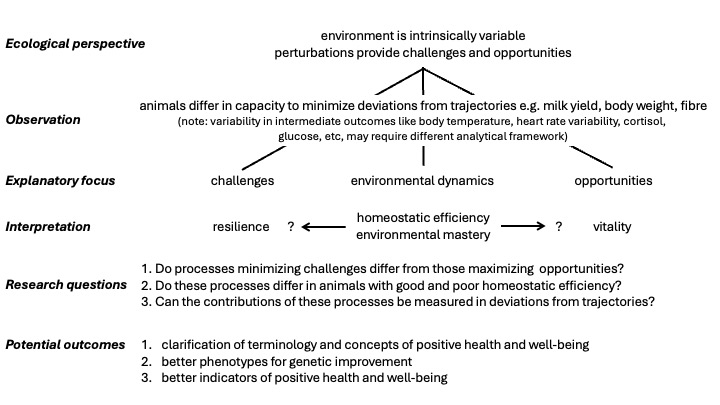
Figure 1 - Hoskins (1931)’s and Cannon (1935)’s concept of homeostatic efficiency encompassess resilience and vitality. An important research challenge is whether the influence of these two processes can be detected in deviations from trajectories of homeostatic outcomes like daily milk yield. Clarification would improve the description and measurement of positive health and well-being.
Factors influencing homeostatic efficiency
The efficiency with which regulatory processes maintain the animal in a homeostatic balance that is attuned to environmental dynamics can be influenced in positive and negative ways. Positive effects can occur through expansion of the repertoire of activities the animal can draw on to manage its environmental interactions and through synchronization of the expression of this repertoire with environmental dynamics. Expansion is the focus of studies on the role of environmental enrichments on the rate of physiological maturation and on acquisition of competences (Botreau et al., 2023; Špinka & Wemelsfelder, 2011). Expansion increases complexity in structures and pathways which provides a resource that broadens the animal’s capacity to accommodate environmental perturbations (Colditz et al., 2023). For example, metabolic flexibility (Rauw et al., 2025) can provide alternative pathways to an outcome such as milk yield or body growth. In the immune system, expansion of the repertoire via environmental experience occurs by the processes termed training in the innate system and learning in the adaptive system (Netea et al., 2020).
A second pathway to efficiency lies in synchronization of the expression of activities for example through anticipation of environmental dynamics. Learned anticipations of events such as the time of feeding mobilize behaviours (in lambs, Anderson et al., 2015) and activate reward pathways (in animals, Spruijt et al., 2001) which are coupled to anticipatory changes in metabolic activity that prepares the animal for a change in metabolic demands (in cattle, Boisclair et al., 1997). Learned anticipation reduces the potential negative impact of otherwise stressful events (in sheep, Greiveldinger et al., 2007) Synchronization of metabolic fluxes between organs (in pigs, Jang et al., 2019) can improve energetic efficiency (in primates, Dansereau et al., 2019; Xiong & Garfinkel, 2023). Synchronization of respiration with cardiac rhythm increases the concentration of oxygen in peripheral blood (in pigs, Mutch et al., 2007). The discharge of neurotransmitters from nerves is pulsatile and in a resting state varies between fibres within a nerve (Kenney & Ganta, 2014). Synchronization of the impulses leads to co-ordination of activity within and between target tissues (Barman & Kenney, 2007; Gilbey, 2007). Thus, synchronization enhances the efficient co-ordination of functions across multiple levels of activity.
Additional positive contributions to homeostatic efficiency can come from the social context of the animal and from the dynamics of activity in physiological and immune networks. The presence of conspecifics, especially familiar companions (Foris et al., 2021), and even familiar humans (Di Lucrezia et al., 2025) can strengthen the capacity of an individual to cope with environmental perturbations through a process termed social or emotional buffering (in animals, Wu, 2021). The dynamics with which a response progresses can also provide a positive dimension to organismal regulation. A detailed example here comes from the immune system. The response to an inflammatory stimulus or infection typically goes through an initial phase of rapid amplification as pro-inflammatory peptides (e.g. C5a, f-met-leu-phe), lipids (e.g. leukotriene B4, platelet activating factor) and cytokines (e.g. interleukins 1 and 8) are generated. Within hours to a few days the amplification phase can transition to a phase of resolution as the response progresses to an adaptive immune response dominated by lymphocyte functions. The termination of the inflammatory phase is facilitated by production of a family of pro-resolution mediators including lipids (lipoxins, resolvins, protectins, maresins), and peptides (annexins, interleukin 10) (Costa et al., 2024). Physiological and immune networks are linked in their roles for regulating resolution of inflammation by induction of pro-resolution annexins by endogenous corticosteroids as well as by the prior expression of pro-inflammatory signals by the immune system (Perretti & D’Acquisto, 2009). Elevated levels of expression of annexins is favourably associated with resilience to development of polymicrobial disease in pigs (Lim et al., 2023) and pneumonia in calves (Senthilkumaran et al., 2013). (Expression of many other genes was also associated with the resilience phenotype in Lim et al. (2023)’s study). The results suggest that the dynamics of resolution of inflammation and transition to an adaptive immune response influence the capacity of animals to manage some infectious diseases.
Negative effects on efficiency are described in many excellent reviews on stress in farm animal species (e.g. Wu et al., 2025). In addition, at a social level, the process termed social or emotional contagion can exacerbate the negative impact of environmental perturbations (in animals, Brandl et al., 2022; in cows, Nogues et al., 2023). At an individual level, the subjective experience described as fear decreases milk yield in cows (Hemsworth et al., 2000; Rushen et al., 1999) growth in pigs (Hemsworth & Barnett, 1991) and egg and body weights in chickens (de Haas et al., 2013). Fearfulness elevates activity in the autonomic nervous system and hypothalamic–pituitary–adrenal axis as well modifying slower-acting neuroendocrine pathways (Acharya et al., 2022). Endogenous adrenergic and corticosteroid messengers reduce anabolic activity in production tissues including mammary gland (Naik et al., 2014; Sibaja & Schmidt, 1975), muscle (Cafe et al., 2011), and wool follicles (Scobie & Hynd, 1995; Scobie et al., 1994) as well as modifying behaviours including feed intake (Cafe et al., 2011; Dennis, 2016). Notwithstanding the inhibitory effects of endogenous adrenergic activity, selective β adrenergic agonists are noted for their strong anabolic effects on muscle (Mersmann, 1998) and neutral or negative effects on milk production (McGuffey, 2017) and wool growth (Nash et al., 1994).
Studies on the bi-direction communication between the brain and immune systems in the 1980s led to the description of a neuroendocrine - immune gradient that influences somatic functions in farm animals (Elsasser, 1993; Fossum, 1998; Husband, 1995). Contributions of affective experience (Dantzer & Mormède, 1983; Düpjan & Dawkins, 2022) and the microbiome (Kraimi et al., 2019) to generation of the gradient are also well recognized. The tone of this interactome determines the balance between anabolic and catabolic activities (Colditz et al., 2023). As a consequence of circadian rhythms and shorter term changes linked to environmental perturbations, tone varies across the course of each day leading to patterns of incremental accretion in tissues such as milk, fibre, muscle, tooth, and bone (Neville, 1967). In hard tissues like bone these patterns can be evident as striations while in “soft” tissues like daily milk yield and daily feed intake they are evident in quantitative data. Studies on links between temperament (personality) and metabolism indicate that the longer term balancing point for tone of the interactome can differ between individuals (Careau et al., 2008; Colditz, 2021). The metabolic environment created by the interactome is an integrated product of the biological, psychological, and social process the animal utilizes in navigating daily life. The dynamic influence of these biopsychosocial effects on trajectories of accretion underlies the utility of daily patterns as indicators of homeostatic efficiency (Colditz et al., 2023).
The positive and negative influences of environmental, psychological and social factors on homeostatic efficiency reported above for animals are described in humans by the biopsychosocial model of health (Engel, 1977) and vitality (Logan et al., 2023), and by the nine hallmarks of positive health (López-Otín & Kroemer, 2021, 2024). This systems view was expressed a century earlier by Whipple (1916) who noted “health is … influenced by so many things that it is almost impossible to select one factor and consider its effect apart from all others” (p 195).
Costs of adaptation
Maintaining system integrity requires effort. In the early decades of the 20th Century, wear and tear provided a recurrent explanation for the degradation of integrity that occurs with stress, disease, and age. For example, in 1907, Abrahams suggested “the battles of life entail wounds and scars, injuries by external and internal noxae, chemical, physical and biological, gross and microscopic, any of which alone or in combination can contract the vital span. … [C]omplex living being[s] … eventually break, die … as the result of wear and tear. … [N]oxae, such as bacteria, find an easy prey in a body brought down by wear and tear. … Unwonted and excessive strain imposed upon any organ or tissue or cell of the body calls for its physiological reserve … this reserve enables an injured cell, if not damaged beyond a certain point, to recover; if the lesion goes beyond this point the power to recover is lost…” Adaptation, he suggested, could lead organs to function at altered levels that were nonetheless in a weakened state and vulnerable to “attack from another direction” leading to death from “exhaustion” (p 781, Abrahams, 1907). Abrahams’ words were perhaps sharpened by his own poor health - he died the following year with chronic kidney disease, aged 38 (Anon, 1908). Similarly, Cannon (1928) suggested that “the body … is constructed with generous margin for wear and tear and damage. … There will be stresses, perhaps prodigious stresses, which must be met” (p 596). Selye formalized Abrahams’ characterization of general defence as the General Adaptation Syndrome entailing three stages - alarm, resistance, and exhaustion (Selye, 1936). Selye described Abrahams’ physiological reserve as adaptation energy (Selye, 1938a) “... resistance of the organism to various damaging stimuli is dependent on its adaptability. This adaptability is conceived to depend upon adaptation energy of which the organism possesses only a limited amount, so that if it is used for adaptation to a certain stimulus, the resistance to other stimuli will necessarily decrease. We conclude that adaptation to any stimulus is always acquired at a cost, namely, at the cost of adaptation energy” (p 765, Selye, 1938b). Later he suggested that “the concept of ‘adaptation energy’ … was the most important outcome of stress research to date” (p 48, emphasis in original, Selye, 1952) and that “[s]tress is essentially the rate of all the wear and tear caused by life “ (p viii, Selye, 1956). Subsequently, Moberg proposed that “[p]athology … occurs only after the individual has entered a state of vulnerability, the prepathological state. … It indicates that if a stressor is of sufficient duration and/or magnitude, the resulting biological cost to the individual for maintaining homeostasis is risk to its mental and physical systems” (p 44, Moberg, 1985). In 1993, McEwen and Stellar described the accumulation of prepathological changes and the effects of wear and tear as allostatic load. “Chronic stress places a strain on physiologic systems that maintain homeostasis and leads to chronic wear and tear as well as change in the operating range of physiologic systems … the impact of wear and tear on a number of organs and tissues can predispose the organism to disease. We define this state of the organism as allostatic load” (p 2094, McEwen & Stellar, 1993).
Efforts to measure the extent of wear and tear and the costs of adaptation in health and welfare sciences initially focussed at the molecular level on allostatic load indexes based on hormonal and metabolic biomarkers (Seeman et al., 1997). With a conceptual heritage from the work of Schrödinger (1944) and Prigogine (1969), newer metrics assess entropy (disorder) in molecular biomarkers (Cummings et al., 2025) and in physical structures such as muscle cells (Hong et al., 2026). An alternative approach describes the wear and tear of stress and aging as a progressive accumulation of imperfections in structures and functions described as the deleteriome (Gladyshev, 2016). At the whole animal scale, the penalty of wear and tear can be assessed through tests of functional capacity to perform specific tasks (Colditz et al., 2024) described in human biomedicine as tests of frailty (Cosarderelioglu et al., 2025; Fried et al., 2021; Hamaker et al., 2023).
Homeostatic efficiency as a measure of the cost of adaptation
Allostatic adaptation seeks to attune the animal to current and anticipated environmental conditions. Homeostatic efficiency may have utility as an additional test of the system integrity attained through adaptation that, with appropriate contrasts, could provide an indication of the cost of adaption, prepathological change, allostatic load, environmental sensitivity, and the value of environmental enrichments, among others (Figure 2). For example, homeostatic efficiency could be used as a measure of allostatic efficiency in the following way. In a high-quality environment, a characteristic such as body weight, daily milk yield, immune responsiveness, acquisition of social competence, maintenance of pregnancy, and transition to lactation follows a preferred trajectory strongly governed by genetic and epigenetic determinants. Waddington (1957) and subsequently Bauman & Currie (1980) described this model of anticipatory dynamic regulation, homeorhesis – a process of flow that tunes physiological and behavioural parameters to support changing demands on the body. In lower quality environments, facultative adaptation tunes homeorhetic parameters to altered levels in anticipation of and reaction to diminished resources – the process of allostasis (Sterling & Eyer, 1988). Thus, homeorhesis prescribes the necessary changes for progression along the life course – a process of ontogenetic tuning - while allostasis makes facultative adjustments to better tune processes to current and newly anticipated conditions – a process of facultative adaptive tuning. Homeostasis, then, is the downstream outcome of organismal regulation within the constraints of homeorhetically and allostatically modulated parameters. A contrast of homeostatic efficiency between environments could provide an indication of allostatic efficiency – the efficiency with which allostatic processes can tune homeostasis in sub-optimal environmental conditions. A deficit in homeostatic efficiency in a lower quality environment would indicate a cost of adaptation. The cost lies in the lower quality of physiological regulation and the associated heightened risk of disease, reduced reproductive performance, reduced longevity and reduced contributions to the econiche. These values are relative – from the perspective of an individual with even poorer adaptation or experiencing an even lower quality environment the relative costs incurred by a better adapted individual would appear to be benefits to be gained by improving adaptation by moving from C to B in Figure 2. In this context, vitality describes the upside: the strength of reserves and the capacity of processes to master opportunities and threats in daily life to create and maintain order. Fragility describes the downside: the vulnerability of the same reserves and capacities in the same contexts to become more disordered. The example illustrates a distinction between homeostasis as an outcome of organismal regulation and allostasis as a process of anticipatory and reactive adaptation in sub-optimal conditions (Ramsay & Woods, 2014).
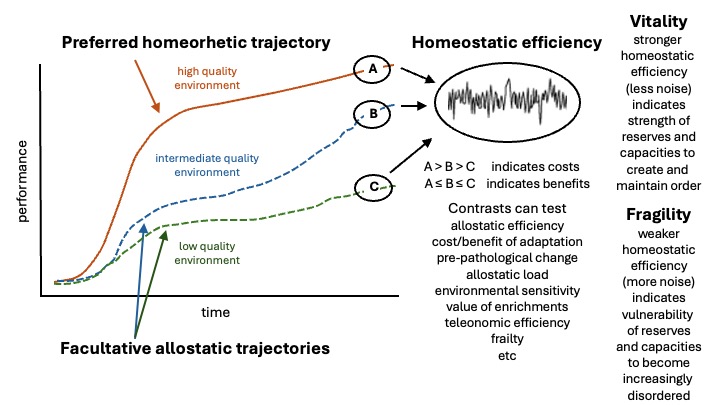
Figure 2 - Comparisons of homeostatic efficiency in different quality environments may provide a method for estimating allostatic efficiency. The gradation of homeostatic efficiency signified by A > B > C indicates that adaptation to a poorer environment incurs a cost to the efficiency of organismal regulation. Better efficiency (>) equates to less noise in the trajectory of the homeostatic outcome. A ≤ B ≤ C indicates the benefits of adaptation equal or outweigh costs. The homeorhetic (ontogenetic) trajectory is the preferred trajectory for a characteristic of the animal such as growth rate, acquisition of competence, and immune responsiveness (among many others) in a high-quality environment. The facultative allostatic trajectory is the trajectory expressed in lower quality environments. The transect through A B C is an example of the application of reaction norm methods to animal welfare science as proposed by Arndt et al. (2022) and Montalcini et al. (2025). A B C can also be a longitudinal contrast within an individual, testing, for example, a change in homeostatic efficiency following a developmental increase in competence or exposure to an enriched environment. Vitality describes the upside: the strength of reserves and capacities of processes to create and maintain order in the face of everyday environmental perturbations. Fragility describes the downside: the vulnerability of the same reserves and processes to become increasingly disordered in the face of the same everyday environmental perturbations.
The outputs of organismal regulation such as daily milk yield, growth, behaviours, body temperature, affect dynamics, and hard structures such as tooth and bone can differ in the time frame over which homeostatic conditions influence the dynamics of accretion. As a consequence, various products of organismal regulation provide an integrated summary of homeostatic efficiency over differing durations of the animal’s life (Colditz et al., 2023; Gormally & Romero, 2020) and may thereby enable assessment of costs of adaptation over differing intervals.
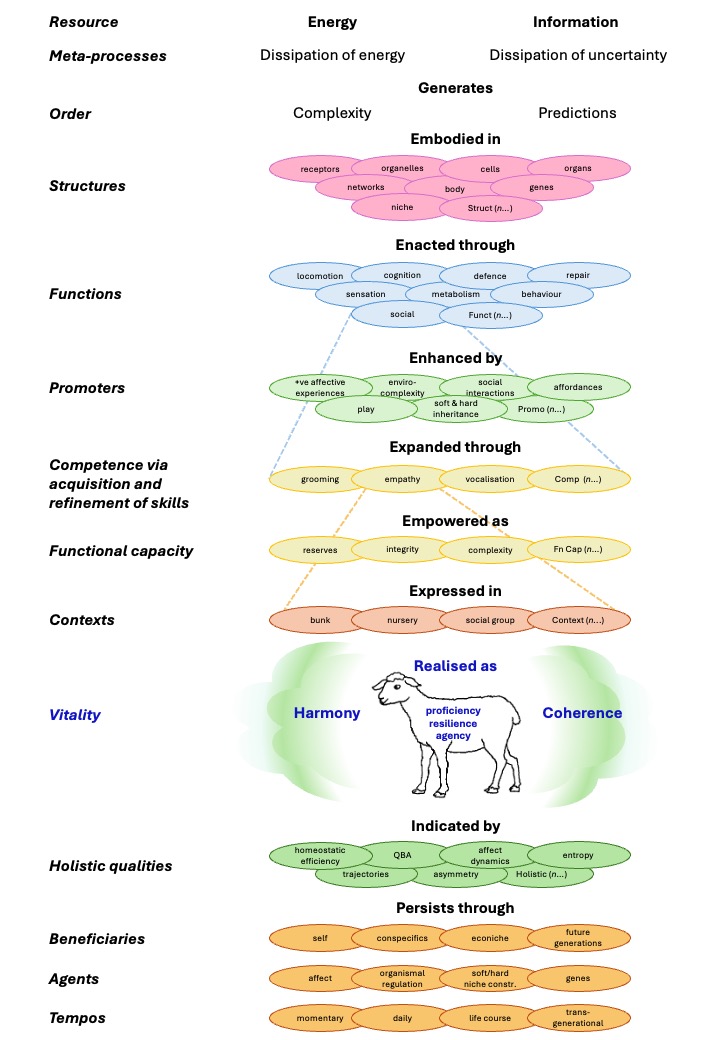
Figure 3 - Mastering the dynamics of energy and information through competence of biological functions enables vitality. The lack of clear boundaries between domains is illustrated by overlapping ellipses. The number of functions, promoters, skills, contexts and holistic indicators is open ended (n…). The goals of persistence are mediated by agents which act with tempos that range from moment to moment (affect) to transgenerational intervals (genes). +ve: positive, QBA: Qualitative Behavioural Assessment.
System efficiency is more than milk and action
The efficiency of maintaining system integrity entails more than the frugal conversion of materials into milk and information into action. It describes the efficiency with which the organism maintains competence and capacity to fulfil the activities necessary to be, say, “like a sheep” (Wilkins et al., 2026) and generate effectances to the benefit of others.
Efficiency declines as material and cognitive resources are diverted from sheep-ness activities (the animal’s telos, Rollin, 2012) towards stress responses, with a consequent decline in internal coherence of functions and external harmony of actions with environmental dynamics (Goodwin, 2001; Xiong & Garfinkel, 2023). The animal slips from a state of proactive mutualism with its surrounds towards reactive objecthood (Colditz, 2018). The diversion of metabolic and cognitive attention changes system dynamics in ways that provide additional holistic indicators of system integrity, as described next.
Indicators of system integrity
In accord with Prignone’s description of organisms as dissipative structures, the efficiency of capturing and distributing energy and information is enhanced by complexity within structures and processes (Goldberger et al., 2002; West, 2021). A prominent pattern of complexity is fractals. Fractal complexity in structures is seen in airways, blood and lymph vasculatures, and bone trabeculae among others. Fractal complexity within the expression of a variable over time is seen in heart rate variability, respiratory sinus arrhythmia, circadian trajectories of body temperature and cortisol, and some behavioural activities, with a decrease in complexity observed during stress and ageing (Alados et al., 1996; Cohen et al., 2022; Hahn et al., 1992; Hahn, 1999; Lipsitz, 2004; MacIntosh et al., 2011; Marıa et al., 2004). Increased variability in trajectories of “dynamic indicators of resilience” such as daily milk yield and daily feed intake represents a loss of temporal complexity (Scheffer et al., 2018).
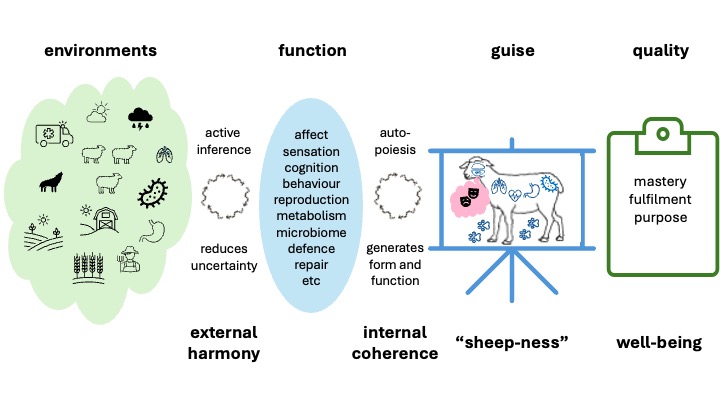
Figure 4 - Conditions and events in internal and external environments provide opportunities (affordances) for the animal to infer and act on information, energy and materials (through active inference). The flow of resources through functions including sensation, cognition, affect, and so on coalesces (by autopoiesis) in the guise of a species-, genotype- and individual- likeness. The qualitative success of these processes is realized as the dimensions of well-being described as mastery, fulfilment, and purpose as illustrated in more detail in Figure 5.
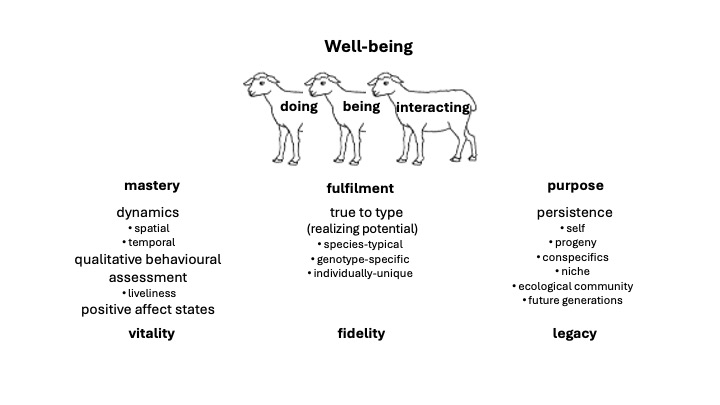
Figure 5 - The quality of actions depicted in Figure 4 influence well-being of the animal. Well-being can be characterized with action words (e.g. doing, being, interacting, Colditz, 2022; Colditz, 2023; Lawrence et al., 2019) or attributes (e.g. mastery, fulfilment, and purpose, Ryff et al., 2021; Williams, 2021). Vitality is evident through holistic indicators including dynamics, qualitative behavioural assessment, and prevalence of positive affective states - mastery of the environment through action (”doing”). Fulfilment of “sheep-ness” is embodied in the realization of potential through fidelity to characteristics of the species, genotype and individual - that is, by “being” a sheep. “Interacting” – especially social interactions - enable the generation of a legacy to benefit progeny, conspecifics, niche, ecological community and future generations. Boundaries between the attributes of well-being are somewhat arbitrary. For example, fulfilment of sheep-ness through acquisition of skills and competences improves environment mastery which faciliates persistence of the individual enabling the generation of effectances to the benefiting others. Mastery, fulfilment and purpose can be mapped to other descriptors of well-being including eudaimonia, hedonia, and social engagement (Appleby & Sandöe, 2002; Ryff et al., 2021; Williams, 2021).
More generally, the capacity to build order and resist disorder (entropy) in structures and functions including the microbiome (Mancin et al., 2026) provides a holistic measure of physiological integrity and its inverse physiological dysregulation (Cohen et al., 2025; Cummings et al., 2025; Gladyshev, 2016). Prepathological change and allostatic load are also examples of disorder. Other holistic indictors include: fluctuating asymmetry in bilateral structures of the body plan (Carvalho et al., 2026; Graham et al., 2010); behaviours embodying positive affective states (Keeling et al., 2021); and the whole-of-animal status embodied in demeanour and behaviour as assessed by qualitative behavioural assessment (QBA) (Wemelsfelder et al., 2001). Teleonomic efficiency may prove to be an additional indicator (Wilkins et al., 2026). After a long career at the forefront of analytical physiology and complex systems theory, Brian Goodwin drew inspiration from Francoise Wemelsfelder’s work on QBA to illustrate the need and potential for what he termed a “Science of Qualities” to describe holistic outcomes in animals and ecosystems (Goodwin, 1999; Goodwin, 2001). Further refinement of methods to assess vitality will complement progress made in recent years in operationalizing the holistic animal welfare concepts of “quality of life” (Reid et al., 2022; Vigors et al., 2021), “a life worth living” (Mellor, 2016; Webster, 2016; Yeates, 2011), “a good life” (Edgar et al., 2013; FAWC, 2009; Rowe & Mullan, 2022), “dynamic integrity” (Arndt et al., 2022; Arndt et al., 2024; Colditz et al., 2023; Colditz, 2023; Ohl & van der Staay, 2012; Verhoog, 2000), and “harmony” (Colditz, 2026; Hughes, 1976; Hurnik, 1988). Hoskins’ and Cannon’s concept of homeostatic efficiency should make an important contribution to this field.
Figure 3 illustrates semantic relationships between the terms and concepts described in the paper. Figure 4 provides a schematic representation of these relationships. Figure 5 provides a schema of how mastery, fulfilment of potential, and effectances relate to the quality of well-being.
Limitations and Conclusions
The importance of addressing vitality as a construct lies in the contribution this focus can make to understanding positive dimensions of function and well-being. Vitality is described here in general terms as a positive attribute that lies within the strength of reserves and the capacity of processes to create and maintain order as the animal navigates the challenges and opportunities of daily life. Hoskins and Cannon did not provide a detailed definition of vitality and equated it with homeostatic efficiency. In Cannon’s writing, efficiency was described as “the strength and endurance of stabilising factors of the organism, and … its ability to resist the operation of disturbing forces” (p 7, Cannon, 1935). Cannon proposed that experimental challenges such as low atmospheric oxygen, blood loss, and a glucose load could be used to measure efficiency. He suggested this approach would provide a quantitative basis for describing the influence of life experiences on vitality in “normal” humans and those experiencing life history transitions (e.g. puberty), old age, prolonged labour, training, fatigue, the demands of school, and disease. Present day health sciences echo Pearl (1928)’s insights on dynamics, and Abrahams (1907)’s, Cannon (1935)’s and Selye (1938a)’s emphasis on energy and strength of reserves when defining vitality (Chew et al., 2025). For example, Logan et al. (2023) suggest “vitality is a multifaceted, dynamic, and adaptive construct that can influence, and be influenced by, physical and psychological energy and stress. Higher vitality scores are indicative of mental well-being, better physical health over the life-course, and a reduced risk of various noncommunicable diseases” (p 3). In a recent scoping review of the literature, Chew et al. (2025) describe vitality as a core physiological reserve essential for sustaining resilience. It is evident that there is considerable overlap between the various terms used to describe positive aspects of functioning and well-being in animals (Rault et al., 2025). This overlap and potential duplication of concepts is likely to be exacerbated when precise definitions of one attribute such as vitality are developed in isolation from definitions of related concepts such as resilience, thriving, flourishing, vigour, physiological reserve, functional capacity, and positive health. A multidisciplinary collaborative approach would facilitate the development of biologically informed definitions of these closely related terms for operationalization in future animal research.
The ecological account of the animal-environment relationship highlights the importance of subjective experience in influencing organismal regulation, especially over short time frames. This draws attention to the importance of moving beyond a characterization of the environment solely in terms of objectively described episodic events to include unknown, unmeasured and perhaps unknowable influences on the animal, as noted by Mancin et al. (2026). Recent advances in functional neurology in non-human animals which describe the processes by which animals apprehend, experience affectively, act on, and remember their environment may provide an opportunity to better understand some of these unknowns (e.g. Healy et al., 2024).
Ample evidence indicates that environmental quality and positive experiences enhance biological functions (e.g. in pigs, Venegas et al., 2025) yet unravelling the functional basis for these positive effects together with methods for their objective measurement remains in its infancy. A challenge for analysis and interpretation of serial data such as daily milk yield as an outcome of homeostatic efficiency is to differentiate the positive influences of vitality from the restorative and adaptive mechanisms of resilience. Is this task even possible? Combining longitudinal assessments of affective state in cows by QBA (Craven et al., 2026) and behaviours (Keeling et al., 2021) with analysis of udder health (Ojo et al., 2026) and deviations in the trajectory of daily milk yield may help in this endeavour. Advances in describing and measuring positive functions should help inform the assessment of well-being.
Acknowledgements
Preprint version 3 of this article has been peer-reviewed and recommended by PCI Animal Science (https://doi.org/10.24072/pci.animsci.100495; Brito, 2026). The advice and suggestions of reviewers are gratefully acknowledged.
Funding
The author declares that he has received no specific funding for this study.
Conflict of interest disclosure
The author declares that he complies with the PCI rule of having no financial conflicts of interest in relation to the content of the article.
Data, scripts, code, and supplementary information availability
No data, scripts, code, or supplementary information are associated with this article