

 CC-BY 4.0
Introduction
Cerebrovascular diseases, including stroke, represent a major public health concern. In 2021, the global number of new stroke cases was estimated at approximately 12.2 million, making stroke the second leading cause of death and the third leading cause of disability worldwide (Feigin et al., 2022). Although acute stroke care has significantly improved in recent years, many survivors are left with persistent functional limitations, despite relatively good recovery of motor or cognitive abilities. According to available data, up to 50% of stroke survivors experience some form of chronic disability, affecting mobility, communication, cognitive functioning, or autonomy (Donkor, 2018). Furthermore, national hospital records indicate a substantial burden on healthcare systems, both in terms of the number of hospitalizations and the average length of stay (SPF Santé publique, 2025; The Health Foundation, 2023). In the context of rapid population aging and increasing prevalence of risk factors such as hypertension, obesity and diabetes, projections suggest a continued rise in stroke incidence over the coming decades. This trend poses growing challenges for prevention, acute care, and especially long-term rehabilitation (Feigin et al., 2021).
In addition to overt motor and cognitive sequelae, fatigue and pain are among the most frequently reported and disabling symptoms after stroke (Chari & Tunks, 2010; Cumming et al., 2016; Duncan et al., 2012; Harvey, 2010; Huang et al., 2024; Miller et al., 2013). These symptoms often persist in the long term and have been associated with higher rates of depressive symptoms, reduced participation, and lower adherence to rehabilitation programs (Naess et al., 2010). Many stroke survivors describe the paradox of being able to perform simple daily tasks from an objective standpoint, while nevertheless experiencing them as disproportionately effortful, despite having regained satisfactory objective functioning. This dissociation between objective capacity and subjective experience suggests that the sense of effort is not solely determined by measurable performance but is also shaped by internal, subjective mechanisms, which may include fatigue and pain.
The hypothesis that perception of effort may be influenced by the experience of both fatigue and pain remains underexplored in the context of stroke, despite being discussed across various disciplines, including (neuro)psychology (Carlier & Delevoye-Turrell, 2022), neurology (Thickbroom et al., 2006) and exercise sciences (Pageaux & Lepers, 2018). Notably, most evidence linking effort, fatigue, and pain stems from conceptual or theoretical frameworks (Lenaert et al., 2018; Van Damme et al., 2018) and remains largely untested in stroke populations. Yet this perspective is crucial to understanding why some stroke patients, despite being objectively capable of performing physical or cognitive tasks, perceive these tasks as excessively demanding (Goh et al., 2025). In the context of stroke, this dynamic may be particularly pronounced: we propose that residual pain, often underestimated (Broussy et al., 2019), increases the perceived burden of a task by intensifying perceived effort (Kuppuswamy, 2017). The individual, compelled to mobilize greater resources to complete otherwise simple activities, may enter a vicious cycle of mental and physical exhaustion. This contributes not only to the persistent fatigue frequently reported by patients but also to reduced engagement in activities, decreased autonomy, and potentially a decline in quality of life—factors that, over time, further fuel fatigue and pain (De Diego-Alonso et al., 2024; Fini et al., 2017). Therefore, this gap in the literature highlights the need for a more generalizable and clinically grounded approach that incorporates the interplay of these three symptoms into post-stroke rehabilitation to improve long-term therapeutic engagement and adherence.
This article adopts a theoretical framework centered on the patient’s perceived effort. Building on the fatigue model proposed by Kuppuswamy (2017), which conceptualizes post-stroke fatigue as a disorder of effort perception, we propose an expanded perspective: that effort perception may serve as a key interface between fatigue and pain—two frequently co-occurring but often separately studied symptoms. From this perspective, pain is not only an additional burden but also a potential amplifier of the patient’s perceived effort, intensifying the subjective difficulty of everyday tasks and worsening fatigue. Our idea fits within a broader mechanism in which fatigue increases perceived effort; elevated effort and pain, in turn, feed back to further increase fatigue; and pain may be amplified when fatigue is high. This framework will be examined and illustrated in a later section (see Figure 1).
While current rehabilitation models typically focus on objective performance measures (e.g. gait speed, grip strength, motor accuracy), they rarely consider whether the effort required to achieve these outcomes is sustainable—or perceived as excessive—by the patient. Yet, given that high perceived effort is a barrier to engagement in and adherence to physical and mental activities (Lorcery et al., 2024; Lovell et al., 2010), and thus to rehabilitation, such exacerbated perceived effort in stroke patients may progressively lead to disengagement from therapy and reduce long-term adherence. Additionally, the dissociation between the patient’s performance and their perceived effort is particularly problematic in post-stroke rehabilitation as two individuals with similar functional abilities may report very different subjective experiences, depending on internal states such as chronic fatigue, pain, mood, or beliefs about their own capacities. Despite its clinical relevance, effort perception in stroke remains underexplored—especially in the domain of cognitive rehabilitation, where even simple tasks can impose a substantial mental burden on patients with brain lesions. These issues call for a broader theoretical and clinical understanding of effort perception in post-stroke care. At present, there is a lack of clear clinical recommendations on how perceived effort should be integrated into post-stroke care management.
The aim of this opinion paper is to outline an ideal care pathway by integrating current knowledge on effort perception in stroke rehabilitation. To do so, we first present the theoretical foundations of effort perception and, drawing on research from neuroscience, psychology, and exercise sciences, review current knowledge and models of this perception, including their relevance for stroke rehabilitation. Second, we review empirical evidence on fatigue and pain after stroke. Third, we introduce and examine the hypothesis of a dynamic interaction between effort perception, fatigue, and pain, drawing from both stroke-specific and general population data. Finally, we propose clinical implications and future directions for assessment and intervention strategies with an ideal care pathway, in which subjective assessment represents the best way of measuring effort and should guide personalized and sustainable rehabilitation strategies.
As an opinion paper, this manuscript relies on a targeted, non-systematic selection of the literature to build and support our conceptual argument, rather than on a systematic or narrative review with a formal study selection process. The literature was built outward from foundational work on effort and fatigue (e.g. Marcora, 2009; Mangin & Pageaux, 2026; Read et al., 2026; Steele, 2020), reflecting the collaboration between our two research groups, which have complementary expertise on effort perception, fatigue, and stroke.
What is currently known about effort perception?
In this section, we will first define effort perception based on current literature. We will then review the main current methods to measure effort, and finally, we will examine the neurophysiological bases of effort perception through the lens of established theoretical models regarding its origin.
Definitions of effort and its perception
To date, there is no universally accepted definition of “effort” (Halperin & Vigotsky, 2024; Mangin & Pageaux, 2026; Massin, 2017; Steele, 2020). In particular, the distinction between objective effort and its subjective perception remains a matter of debate, both in terms of how to define it and whether such a distinction is relevant (see Steele, 2020, for a discussion).
First, as effort is perceived during physical and cognitive activities (Preston & Wegner, 2009), the experience of effort likely results from a dynamic interplay of multiple interacting resources—ranging from physiological substrates (e.g. motor unit recruitment, energy metabolism) to cognitive mechanisms (e.g. sustained attention, inhibitory control, working memory). This multidimensionality complicates the formulation of a precise, unified definition. Second, we currently lack both a comprehensive inventory of these underlying resources and standardized tools to reliably quantify their specific contributions to the subjective experience of effort (Mangin & Pageaux, 2026). In other words, we do not yet know which dimensions - physical, cognitive or affective - are most critical in shaping the experience of effort, nor how best to assess their involvement beyond currently available physiological or behavioral approximations (e.g. pupil dilation, heart rate variability). For example, when post-stroke patients voluntarily squeeze a handgrip in the context of motor rehabilitation, they will recruit physical resources such as the motor units supporting the muscle contraction or the ATP used to produce the force. Simultaneously, the task draws on cognitive dimensions such as sustained attention—to maintain focus—and inhibitory control—to resist the urge to disengage from the exercise. Yet the relative contribution of these different dimensions to the perception of effort remains largely unknown, as do the tools required to measure their influence with precision and reproducibility.
What is clear, however, is that effort cannot be perceived without active engagement in a task. In other words, effort is not perceived when an individual is passive, effort is perceived only when an individual voluntarily engages in a task or self-initiates an action (Mangin & Pageaux, 2026). Therefore, in the absence of a sufficiently developed theoretical and methodological framework to objectively measure all its aspects, we adopt here the subjective perspective of effort, in which effort perception can be defined “as the conscious experience of the intentional engagement of physical and cognitive resources to perform—or attempt to perform—a task.” (Mangin & Pageaux, 2026). It is worth noting that our definition follows a “dissociated” conception of effort, in which effort is treated as distinct from co-occurring exercise-related sensations such as fatigue, discomfort, or breathlessness (Bergevin et al., 2026; Mangin & Pageaux, 2026), rather than as their composite. Finally, throughout the manuscript, we use the terms “effort” and “exertion” interchangeably following common practice in the psychology and neuroscience literature (Burtscher et al., 2025), even though some authors have proposed distinguishing the two (e.g. Abbiss et al., 2015). The reader interested in more information about our theoretical approach is directed to Bergevin et al. (2026) and the section ‘Input from the sports sciences literature’ in Mangin & Pageaux (2026).
Measurements of effort perception
The perception of effort is most commonly assessed using self-report tools administered during motor or cognitive tasks, such as visual analog scales (VAS) (Price et al., 1983), numeric rating scales (NRS) (Lampropoulou & Nowicky, 2012), semantic Likert-type scales, or the Borg scales (E. Borg & Kaijser, 2006; G. Borg, 1982). In clinical contexts, these tools are simple, quick to administer, and particularly useful for adjusting exercises to individual tolerance—whether in physical rehabilitation or certain cognitive tasks (De La Garanderie et al., 2023; Villeneuve et al., 2026). In other cases, physiological indicators such as heart rate, commonly used to estimate objective effort, are also employed as indirect proxies for perceived effort during psychomotor tasks (Chen et al., 2002; De La Garanderie et al., 2023; Flairty & Scheadler, 2020; Villeneuve et al., 2026). These indicators are frequently used in clinical and rehabilitation settings to monitor effort levels and adjust physical exercise intensity (Chen et al., 2002). Nevertheless, physiological indicators (e.g. heart rate) should be interpreted as indirect proxies of the mobilization of physical or cognitive resources during task engagement, rather than a direct measure of perceived effort. Consequently, as with any proxy, this relationship is therefore imperfect, and changes in these indicators do not necessarily mirror the subtle variations in task demand, particularly at lower intensities (Villeneuve et al., 2026). In contrast, self-reported perceptions of effort have been shown to track such graded variations more consistently (De La Garanderie et al., 2023; Villeneuve et al., 2026). Additionally, this physiological–subjective alignment has been primarily validated in young healthy populations (E. Borg & Kaijser, 2006; G. Borg, 1982), and its generalizability to clinical groups such as stroke survivors remains uncertain due to altered interoceptive processing and greater inter-individual variability (De Doncker et al., 2020; Kuppuswamy, 2017; Sage et al., 2013). Stroke patients often report high perceived effort even during simple activities, suggesting a dissociation between objective physiological markers (e.g. heart rate, blood pressure) and perceived effort (De Doncker et al., 2020; Kuppuswamy, 2017). Furthermore, studies in stroke survivors and healthy individuals have shown that ratings of perceived effort do not always significantly correlate with physiological responses across a range of conditions, including walking, stair climbing, or eccentric exercises (Compagnat et al., 2018; Mater et al., 2024). In other words, some patients rate their effort as high even when facing a moderate-intensity exercise, and vice versa, likely due to large inter-individual variability in stroke survivors (Sage et al., 2013).
Neurophysiological bases of effort perception
Several authors have sought to understand the neurophysiological foundations of effort perception, and this, mainly in healthy populations, leading to various theoretical proposals regarding its origin. During physical exercise, it was initially proposed that effort perception may originate from the brain’s processing of afferent feedback. According to this view, the central nervous system integrates signals from muscle afferents, particularly type III and IV fibers involved in nociception (O’Connor & Cook, 1999), from the working muscles, as well as from the respiratory and cardiovascular systems, to generate the perception of effort (Hampson et al., 2001). However, this feedback-based theory of afferent-driven effort perception remains debated as reducing afferent input from type III and IV muscle fibers does not decrease perceived effort (Bergevin et al., 2023). Therefore, afferent signals from the working muscles are neither necessary nor sufficient to generate the subjective experience of effort (Marcora, 2009). Additional evidence reinforces this conclusion. First, stimulating the global pool of muscle afferents through electromyostimulation, in the absence of voluntary motor command and therefore engagement in the task, does not produce an illusion of effort (Pageaux et al., 2026). Second, observations in deafferented cardiac and lung patients show that they continue to perceive effort despite the near-absence of peripheral sensory feedback (Braith et al., 1992; Zhao et al., 2003). The reader interested in more details on the debate on afferent feedback theory is directed to the articles of Marcora (2009) and Bergevin et al. (2023).
Building on this, it has been suggested that effort perception primarily stems from central mechanisms, in which a copy of the motor command, called the corollary discharge or efference copy (Proske, 2005), issued by motor cortical areas involved in voluntary action, is transmitted to sensory and integrative brain regions (De Morree et al., 2012; McCloskey, 2011; McCloskey & Torda, 1975). The corollary discharge is classically defined as “the internal signals that arise from centrifugal motor commands and that influence perception” (Sperry, 1950). This predictive signal is thought to enable the brain to anticipate the sensory aspects of movement (e.g. the body position used in a voluntary muscle contraction) and to generate the perception of effort via its brain processing. While the corollary discharge model provides a plausible framework for explaining effort perception during engagement in physical tasks, it however remains limited in its ability to account for perceived effort during cognitive tasks, where motor command plays a less prominent role (Mangin & Pageaux, 2026). Nevertheless, recent work suggests that an analogue of corollary discharge may also support cognitive processes (Subramanian et al., 2019), thus opening perspectives for extending this model to integrate effort perception during cognitive tasks (see section 3.3 Current limitations of the corollary discharge model in Mangin & Pageaux, 2026).
In this context, the anterior cingulate cortex (ACC), along with the supplementary motor area (SMA), emerge as key structures in the perception of effort (Paus, 2001; Zénon et al., 2015). Beyond their established role in motor control—particularly in the preparation and execution of movement (Paus, 2001; Tanji & Shima, 1996)—the ACC is also involved in the integration of cognitive signals (such as decision-making and goal-directed behavior), emotional signals (e.g. emotion regulation), and interoceptive signals (Paus, 2001). The SMA, in turn, has been implicated not only in motor planning but also in aspects of cognitive control (Sjöberg et al., 2019). This functional convergence positions the ACC and SMA as an integrative hub in the genesis and modulation of effort perception. Notably, behavioral changes occurring due to fatigue have been associated with alterations in ACC functioning (Chen et al., 2020; Klaassen et al., 2016), which itself is associated with motivation to exert effort (Caruana et al., 2018; Müller & Apps, 2019). Beyond its involvement in motivation, the ACC also plays a role in monitoring the resources that need to be mobilized to perform an action, particularly in decision-making contexts (Shenhav et al., 2016). This function aligns with our definition of effort as “the intentional engagement of physical and cognitive resources to perform or attempt to perform a task” (Mangin & Pageaux, 2026).
In this light, any alteration in the motor command system, such as changes in cortical excitability—as observed following stroke (Kuppuswamy et al., 2015)—could also modulate effort perception. Indeed, some stroke patients show decreased cortical excitability within motor circuits, measured for example by altered responses to transcranial magnetic stimulation (De Doncker et al., 2021; Kuppuswamy et al., 2015). This hypoexcitability reflects central motor command inefficiency, which may not necessarily manifest as overt motor impairment, but can nonetheless lead to a disproportionate increase in perceived effort. The (pre)motor areas and ACC, receiving weak or poorly calibrated motor signals, may interpret even simple actions as more effortful to generate. This central disruption of motor and sensorimotor processing may thus contribute to the subjective experience of effort and fatigue, independently of actual motor performance.
Yet, motor system inefficiencies alone are unlikely to fully account for the altered effort perception in clinical populations. Although direct evidence of altered ACC or SMA activation during purely cognitive tasks in stroke is relatively sparse, several studies hint at dysfunction in these regions. For example, post-stroke cognitive impairment has been associated with reduced regional homogeneity in the ACC at rest (Peng et al., 2016), which corresponds to disrupted neural activity, along with disrupted functional connectivity of the ACC (Sagues et al., 2025).
Based on the theoretical position advanced in this paper, effort perception is, in many cases, shaped by the combined influence of multiple internal states—particularly fatigue and pain—which are both prevalent and often interrelated after stroke (Galligan et al., 2016; Nadarajah & Goh, 2015; Naess et al., 2006; Zhan et al., 2022). In this way, effort, fatigue, and pain can amplify the subjective cost of action, even when objective task demands remain constant. In what follows, we examine how fatigue and pain interact with effort perception and explore their potential combined effects on rehabilitation outcomes.
The Effects of Fatigue and Pain on Effort Perception
In this section, we will first define fatigue and the main fatigue models that have helped to better characterize effort. Then, we will focus on pain, and how this symptom may help better clarify the relationship between perceived effort, fatigue, and pain. Lastly, we will discuss the combined effects of fatigue and pain on effort perception.
From Fatigue Models to a General Theory of Effort in Rehabilitation
Fatigue is defined as a psychobiological phenomenon resulting from prolonged and sustained engagement in physical and cognitive exertion or illness (Behrens et al., 2023; Boksem & Tops, 2008; Kluger et al., 2013; Mangin & Pageaux, 2024; Pageaux & Lepers, 2016). Notably, post-stroke fatigue presents as a chronic condition, manifesting as a reduced motivation to engage in daily activities and an inability to fully recover after even moderate effort in physical and cognitive activities, compared to healthy individuals (Annoni et al., 2008; Finsterer & Mahjoub, 2014; Staub & Bogousslavsky, 2001a). As such, post-stroke fatigue has emerged as a relevant entry point for exploring the mechanisms underlying effort perception.
Fatigue can arise when a task becomes increasingly demanding. In such situations, individuals may show changes in behavior, such as reduced performance, as well as report a heightened perceived effort (Read et al., 2026). However, certain factors, such as motivational incentives (Meyniel & Pessiglione, 2014) or opportunities for rest (Gilsoul et al., 2022), can help counteract or delay the onset of fatigue. According to the motivational fatigue model proposed by Müller & Apps (2019), fatigue influences motivation by altering the way effort-related costs are weighed in cost-benefit evaluations. These evaluations are inherently subjective and shaped by how demanding a person perceives an action to be. When individuals experience fatigue, the subjective cost of effort tends to rise, making previously worthwhile actions seem less attractive. This shift leads to a reduction in motivation and, consequently, a decline in performance. Rest can help reduce fatigue to some extent, but high levels of sustained effort accelerate its accumulation, reinforcing the cycle of reduced engagement and performance.
Although the motivational fatigue model was developed in healthy populations, this model parallels several theories of pathological fatigue. Similar principles may apply, but with additional neurophysiological disruptions that distort the normal regulation of effort and motivation. Indeed, stroke-related fatigue has been associated with amplified perceived effort potentially due to impaired corollary discharge (Kuppuswamy, 2017), dysfunction in interoceptive predictions of internal states (Stephan et al., 2016), or basal ganglia disruptions or inflammation-induced dopaminergic deficits (Chaudhuri & Behan, 2004; Felger & Treadway, 2017). Thus, while the model of Müller & Apps (2019) emphasizes motivational and neural mechanisms rather than biological pathology per se, both motivational and biological fatigue theories cited above converge on a central idea: pathological fatigue alters how effort is perceived. Moreover, the motivational and biological theories should not be seen as opposite, but rather complementary. Notably, the framework of Pessiglione & Wiehler (2025) suggests that fatigue induced by prolonged and intense engagement in cognitive tasks and work arises from neurometabolic alterations that increase the cost of cognitive control. As a result, individuals become more likely to shift their subsequent decisions that require trade-offs between expected rewards and anticipated delays or effort.
One particularly influential model in the stroke population is the Sensory Attenuation Framework proposed by Kuppuswamy (2017), 2022). According to this model, chronic post-stroke fatigue may result from a deficit in the attenuation of sensory signals—including proprioceptive information (related to body position), but also exteroceptive (e.g. light, sound) and interoceptive signals (e.g. internal sensations like heartbeat) (Behrens et al., 2023). This failure to attenuate sensory input would lead to perceptual overload and, consequently, an increase in perceived effort when individuals are actively engaged in everyday tasks. This overload would be especially pronounced when individuals are exposed to tasks that place a high demand on attention or perceptual resources. For example, a recent study showed that trait fatigue (but not state fatigue) was associated with a reduced ability to filter visual distractors during a sustained cognitive task (Behrens et al., 2023; Kuppuswamy et al., 2025). The Sensory Attenuation Framework holds significant theoretical interest: by suggesting that perceived effort could be a direct consequence of amplified sensory input, it offers an explanatory framework for understanding why certain tasks may feel especially costly for patients—even when they are objectively simple (Goh et al., 2025). However, no clear biological substrates or mechanisms have been explicitly identified in this model.
Based on the contemporary models of effort and fatigue mentioned above, we propose that effort arises from a central mechanism in which the individual voluntarily mobilizes resources to engage in a task. In our framework, effort is conceived as a centrally generated process. Sensory inputs, although insufficient to produce effort on their own (Bergevin et al., 2023), play a modulatory role. They act as biological determinants that can indirectly alter effort, either by modifying motor regulation, by generating other sensations that interact with effort (e.g. pain or fatigue), or by altering the affective valence of the task, thereby increasing or decreasing effort (Mangin & Pageaux, 2026). Accordingly, the perception of effort emerges from the integrated contribution of both motor and cognitive components.
With this section, we aimed to demonstrate that understanding fatigue means refining our understanding of effort—and conversely, exploring the mechanisms of effort opens up new perspectives for addressing fatigue in both research and clinical practice.
A parallel line of reasoning can be drawn from another frequent post-stroke symptom: pain, whose theoretical models also offer valuable insights.
How Does Pain Increase Effort Perception?
While effort perception now occupies a central role in explanatory models of post-stroke fatigue, pain is still often treated merely as a contributing factor to fatigue—without fully recognizing its role in increasing perceived effort (English et al., 2024). Yet pain can serve as a direct source of both mental and physical overload, contributing to the chronification of fatigue by increasing the effort required to perform tasks (Van Damme et al., 2018).
Pain is defined as “an unpleasant sensory and emotional experience associated with, or resembling that associated with, actual or potential tissue damage” (Raja et al., 2020). It is therefore inherently subjective, shaped by cognitive, emotional and contextual factors. Among stroke patients, pain can take various forms—including musculoskeletal, joint, or neuropathic pain—the most emblematic being central post-stroke pain (Klit et al., 2009). Central post-stroke pain is characterized by both persistent discomfort and sensory disturbances, combining sensory loss and hypersensitivity in the somatosensory territories linked to brain regions affected by the stroke (Klit et al., 2009).
Nearly 40% of stroke survivors report persistent pain years after the event, and this pain appears to increase patients’ perceived effort in their everyday activities (Westerlind et al., 2020). Importantly, pain does not generate effort on its own, rather, it influences the perception of effort when the individual engages or intends to engage in a task. Much like fatigue, pain influences the anticipation of costs and motivational decision-making processes (Wiech & Tracey, 2013). In this way, pain can amplify perceived effort by disrupting motivational and attentional processes (Mangin et al., 2023; Silvestrini & Corradi-Dell’Acqua, 2023; Torta et al., 2017).
Moreover, pain can exert an inhibitory effect on motor command that can limit the recruitment and coordination of muscles involved in a given action (Bank et al., 2013). Notably, limb pain has been associated with reduced activity in the muscles involved during the contraction and a reduced corticospinal excitability (for a review, see Bank et al., 2013). In physical exercise contexts, it has also been shown that pain increases the cognitive demand needed to maintain a task, thereby reducing effort tolerance (Tesarz et al., 2012). For instance, individuals with chronic pain often show heightened vigilance toward effort, leading to premature disengagement from tasks deemed too costly—even when objective performance remains unaffected. In cognitive domains, some evidence suggests that pain interferes with executive functioning and attentional load, increasing the mental effort required (Berryman et al., 2014).
In summary, pain amplifies the patient’s perceived effort by affecting both motor and cognitive resources. Indeed, by increasing cognitive demands, pain disrupts motivational and attentional processes. By reducing muscle activation and corticospinal activity, it limits the physical capacity to perform actions.
How Fatigue and Pain Interact with Effort Perception?
The effects of both fatigue and pain on effort perception remain understudied, but some research suggests deleterious motivational interactions. Vogel et al. (2023) reported that among healthy participants, the co-occurrence of fatigue and pain significantly impaired performance during cognitive tasks. Their findings suggest that cognitive fatigue limits the availability of executive resources that would otherwise be allocated to pain regulation, thereby reducing the capacity to disengage attention from pain. Importantly, this effect was observed only when the cognitive task required high cognitive demands, indicating that fatigue does not directly amplify pain but rather modifies the allocation of effortful control to task engagement and pain modulation. In the theoretical framework of Van Damme et al. (2018), the authors propose that chronic pain, which is a commonly reported experience by some patients, simultaneously affects effort, pain and reward signals. Indeed, executive control is needed to attenuate pain experience (Legrain et al., 2009). However, this top-down process is costly in terms of resources, which leads to heightened effort perception. Moreover, as pain and effort are critical inputs to the cost–benefit evaluation of ongoing goal pursuit, by altering pain and effort, chronic pain biases the motivational system toward fatigue and goal disengagement, which leads to fatigue.
Complementing the perspective of Van Damme et al. (2018), Lenaert et al. (2018) proposed a reciprocal relationship between chronic pain and fatigue, suggesting that their effects are additive and collectively reduce effort tolerance thresholds. Even though the precise direction of the interactions between effort, pain, and fatigue remains debated, these theoretical frameworks suggest that in conditions like stroke—where fatigue and pain frequently coexist—their interaction could lead to a chronic overestimation of the effort required, with major implications for sustaining motivation and engagement in rehabilitation. Consequently, post-stroke pain should no longer be considered merely a comorbidity, but rather a central factor in the development and persistence of chronic fatigue, through its negative impact on effort perception.
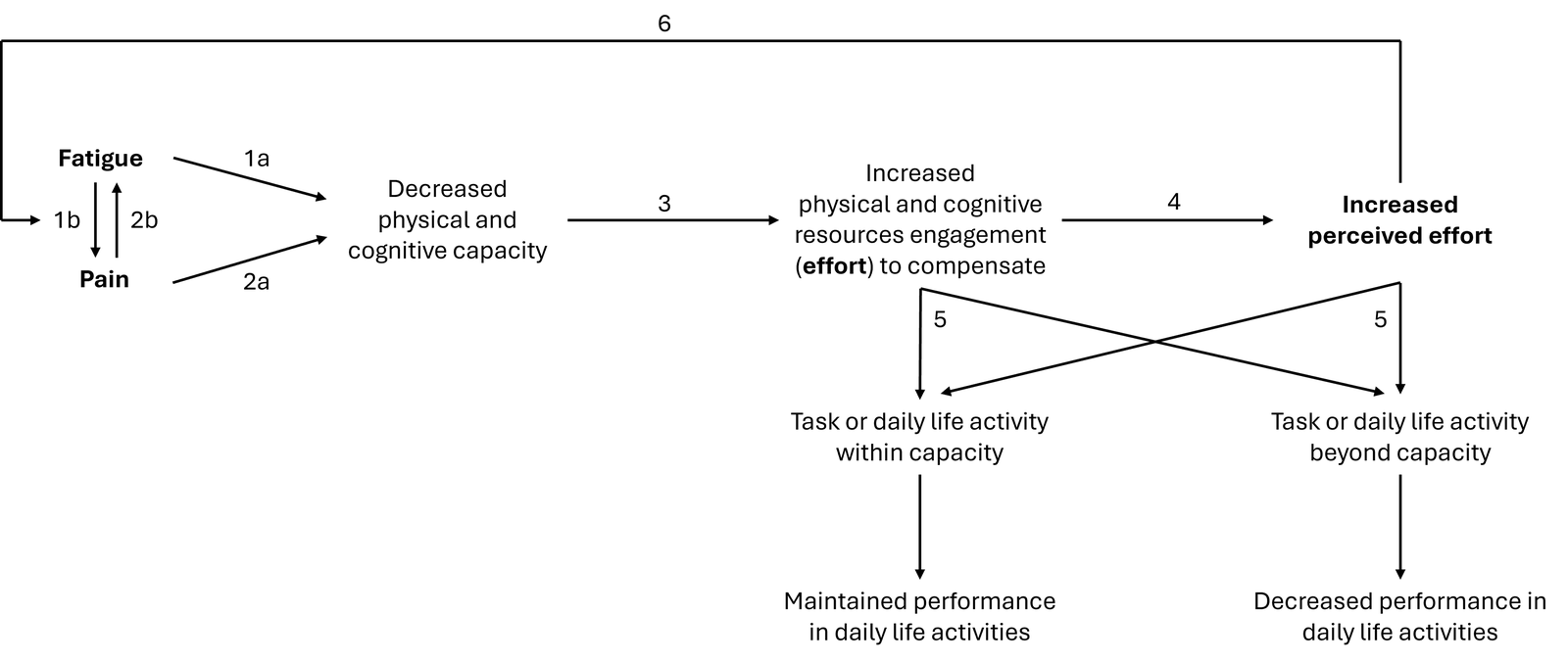
Therefore, and based on the previously described literature, we propose a feedback model of post-stroke functioning, which outlines a cyclical process in which fatigue and pain jointly alter physical and cognitive capacity, alter the experience of effort, and ultimately affect performance in daily activities (see Figure 1). This cycle, if left unaddressed, can become self-reinforcing and contribute to chronic fatigue. Below, we detail the main paths of this process.
In the model, post-stroke fatigue exerts two primary influences (Path 1 in Figure 1A). First, fatigue directly reduces physical and cognitive capacities (Path 1a in Figure 1A), limiting the resources available for action (Hockey, 2013). Second, growing evidence indicates that fatigue can exacerbate pain (Lenaert et al., 2018; Van Damme et al., 2018) (Path 1b in Figure 1A), thereby amplifying the overall burden of symptoms. In parallel to fatigue, pain contributes to the reduction of physical (Bryant et al., 2007) and cognitive (Moriarty et al., 2011) capacities (Path 2a in Figure 1A), while also increasing fatigue (Van Damme et al., 2018) (Path 2b in Figure 1A). Experimental work (Wiech & Tracey, 2013) suggests that pain competes for executive resources—particularly those involved in attentional control and inhibition—thereby diminishing the ability to maintain task-oriented performance.
Because fatigue and pain reduce the pool of available cognitive and physical resources, tasks that would normally fall within the individual’s capacity become more demanding. Therefore, following decreased physical and cognitive capacities due to fatigue or pain symptoms, patients must compensate and expend more resources to maintain functional performance in daily life (Hockey, 1997; Wang et al., 2016). In other words, reduced capacity necessitates increased objective effort, which corresponds to greater engagement of cognitive and physical resources in order to maintain the same performance level (Hockey, 1997; Wang et al., 2016) (Path 3 in Figure 1A). Indeed, research has shown that when individuals engage in a divided-attention task or a dual task, and resources are constrained, whether by a second task, mental fatigue, or pain, greater compensatory effort is required to maintain performance (Azouvi et al., 2004; Kahneman, 1973). Additionally, this increase in objective effort is accompanied by a heightened perception of effort (Path 4 in Figure 1A). Effort allocation or perception can lead to two distinct behavioral outcomes (Path 5 in Figure 1A). If the compensatory resources recruited or level of perceived effort are adequate, the task or daily life activity will remain within the patient’s functional capacity, and the performance will be maintained. If, however, these supplemental resources are insufficient or the level of perceived effort too high, the task will exceed their capacity, resulting in a decline in performance. In our model, the direction of this process is unidirectional: it is the engagement of resources itself that generates the perception of effort (Path 4 in Figure 1A), regardless of whether the resulting task or activity subsequently falls within or beyond capacity. The outcome of performance (Path 5 in Figure 1A) is therefore conceived as a consequence of this process, rather than a feedback input into perceived effort. We nonetheless acknowledge that a metacognitive appraisal1 of one’s performance and effort investment (e.g. succeeding at high effort cost versus failing despite high effort) could plausibly modulate how resource engagement translates into perceived effort. This process is however not represented in the model, as it lies outside the present scope, but represents a direction for future research.
Over time, a sustained increase in perceived effort in daily life feeds back into fatigue (Path 6 in Figure 1A). While the present hypotheses focus specifically on fatigue, this feedback mechanism is plausibly shared with pain (Path 6 in Figure 1A), given their well-documented bidirectional relationship (Paths 1b and 2b in Figure 1A; Lenaert et al., 2018; Van Damme et al., 2018). However, the pain-specific arm of this loop was not directly addressed here and is proposed as a direction for future research. Finally, because both pain and fatigue impose continuous demands on attentional and inhibitory control networks, capturing cognitive and physical resources and limiting their availability for concurrent activities, they increase the workload associated with everyday tasks. This load heightens perceived effort yet again, perpetuating the negative feedback loop of fatigue.
Building on this model, we propose that the role of post-stroke care management is to put in place strategies that can disrupt this vicious cycle, notably by acting specifically on effort perception (Figure 1B). By breaking the link between heightened effort perception and increased fatigue, post-stroke care can prevent chronic escalation of symptoms and promote more sustainable task engagement and daily life reintegration. This proposed clinical target constitutes the central hypothesis of the present manuscript rather than an established or empirically tested pathway of the model itself, and is therefore presented separately in Figure 1B.
As this manuscript is presented as an opinion paper, our feedback model of post-stroke functioning is conceptual in nature. While it is grounded in and consistent with existing theoretical and empirical literature on fatigue, pain, and effort perception, it has not itself been directly tested and should be understood as a heuristic framework intended to guide future research and clinical reasoning, rather than an established or validated causal model.
Clinical Perspectives: Implications for Post-Stroke Care Management
The clinical relevance of effort perception lies in its position at the interface of body, mind and experience, but also in its position in the triad linking effort, fatigue and pain. As previously described, findings underscore the idea that the experience of effort is not a direct readout of physiological demand, but a centrally integrated signal reflecting the resources voluntarily engaged in the task. We propose that by targeting the perception of effort, it may be possible to counteract, or at least limit, the vicious cycle linking effort, fatigue and pain (Figure 1B). Throughout the following sections, we refer to this model to illustrate how each step of care management intervenes on a specific node or transition of the cycle. Therefore, we call for a shift in clinical practice: from performance-based rehabilitation models toward approaches that integrate the patient’s perceived effort as a meaningful and actionable clinical lever. From this viewpoint, the main challenge for both clinicians and patients during rehabilitation is to find the right balance between accepting effort and preventing it from being either too excessive or avoided.
The following suggestions, though not exhaustive, offer practical strategies that clinicians can readily implement based on current literature. These recommendations accompany the patient’s clinical journey—from initial anamnesis, through rehabilitation or intervention, to long-term reintegration into daily life—and illustrate how assessing and addressing perceived effort can guide personalized care and support sustainable recovery (see Table 1 for summary). The proposed ideal care management approach follows a progression from highly specific, targeted interventions in the early post-stroke period, focusing on clearly defined physical or cognitive tasks, to more integrative strategies that combine physical, cognitive, and functional activities, which can be directly applied to everyday life.
Nevertheless, the steps proposed in our ideal care management are not intended to be followed in a strictly linear order. Rather, they should be applied iteratively and revisited as the patient’s condition and needs evolve. For instance, aspects of the initial assessment during early management may be readdressed during later care management processes. Additionally, no clear distinction is made between intervention and rehabilitation, or more broadly care management in the proposed care flow, as the boundaries between these domains can vary across disciplines and timeframes. Instead, each step should be individualized and tailored to the patient’s unique context.

Figure 1 - From fatigue and pain to increased perceived effort: a feedback model of post-stroke functioning. Panel A. Both fatigue and pain decrease physical and cognitive capacity (1a,2a). Fatigue increases pain (1b), pain increases fatigue (2b). The decrease in physical and cognitive capacity leads to an increase in physical and cognitive resources engagement (effort) to compensate (3). In turn, the engagement of these additional resources leads to increased effort perception (4). If the compensatory resources recruited or level of perceived effort are adequate, the task or daily life activity will fall within the patient’s capacity and performance will be maintained. If not, the task or daily life activity falls beyond the patient’s capacity, causing a decrease in performance (5). Over time, the constant increased perceived effort in daily life captures and limits cognitive and physical resources, progressively exhausting patients and increasing fatigue, reinforcing the negative feedback loop of fatigue (6). Panel B. By integrating effort perception into post-stroke care management, and aiming to minimize the perception of effort, the negative feedback loop can be disrupted.
Table 1 - Effort Perception in Stroke Care: Continuous Assessment & Adaptation
|
Time Period |
Aims |
Key Aspects |
Tools |
|---|---|---|---|
|
Step 1. Initial assessment and anamnesis |
Identifying pre-existing effort-related issues and influencing factors |
Psychological & medical history, personality traits |
|
|
Step 2. Early care management phase |
Determine the optimal effort intensity for task engagement |
Dynamic interplay between mobilization of physical & cognitive resources |
|
|
Step 3. Monitoring and adaptation during care management |
Ensure ongoing calibration of perceived effort, adjust rehabilitation goals |
Continuous evaluation of progress, adaptation of workload |
|
|
Step 4. Preparing for discharge and daily life reintegration |
Address anticipatory anxiety about effort and build confidence for activity resumption |
Patient education, gradual exposure to effort |
|
|
Step 5. Long-term follow-up |
Monitor evolution and changes in effort perception over time |
Changes in symptom burden, motivation, environmental factors |
|
|
If new barriers emerge (e.g. fatigue spike, pain increase, task avoidance), loop back to Step 1 for reassessment and re-adaptation |
|||
Note. FSMC, Fatigue Scale for Motor and Cognitive Functions (Penner et al., 2009); BPI, Brief Pain Inventory (Cleeland & Ryan, 1994); NFC, Need for Cognition Scale (Cacioppo & Petty, 1982); VAS, Visual Analogue Scales (Price et al., 1983); NASA-TLX, NASA Task Load Index (Hart, 2006); SMART, Specific, Measurable, Achievable, Relevant, Time-bound goal approach (Ogbeiwi, 2017); GAS, Goal Attainment Scaling (Hale, 2010; Jung et al., 2020); GMT, Goal Management Training (Levine et al., 2000).
Initial Assessment & Anamnesis
The first step in integrating effort perception into post-stroke rehabilitation should be initiated from initial assessment and anamnesis, within the first days following the event. A thorough anamnesis can help identify pre-existing factors that modulate or amplify the patient’s perceived effort, such as fatigue, pain, or cognitive overload, prior to the stroke. Consistent with our model (Figure 1), fatigue and pain are considered the entry points of the cycle (Paths 1a and 2a), and are symptoms reflecting key determinants of patient engagement, effort tolerance, and perseverance within therapeutic protocols. Yet, these symptoms remain under-addressed in most rehabilitation programs, despite their strong association with reduced self-efficacy and lower physical and cognitive activity levels (Goh & Stewart, 2019; Miller et al., 2013). This underestimation is particularly problematic because the presence of fatigue and pain can hinder successful community reintegration—one of the primary goals of post-stroke rehabilitation (Miller et al., 2013).
Several validated scales can assist in this process. For instance, the Fatigue Scale for Motor and Cognitive Functions (FSMC; Penner et al., 2009) for fatigue, the Brief Pain Inventory for pain (BPI; Cleeland & Ryan, 1994), the Need for Cognition Scale (NFC; Cacioppo & Petty, 1982) to assess the individual’s tendency to engage in effortful cognitive activities, and the Preference for and Tolerance of the Intensity of Exercise questionnaire for effort during physical activity (Ekkekakis et al., 2005), the Value of Physical Effort (VoPE; Bieleke et al., 2025) or the Physical Effort Scale (PES; Cheval et al., 2024) to evaluate how people generally value effort during physical activities. These baseline measures are essential to capture trait-like individual differences that may influence rehabilitation outcomes. For example, some individuals may generally experience higher levels of fatigue or perceive tasks as more effortful than others, independent of the stroke event. Moreover, some individuals preferentially value effort for physical activities rather than for mental activities, or vice versa (Wolff et al., 2024). Finally, a history of depression, anxiety, or other chronic medical conditions should be carefully considered during this stage to inform a more personalized rehabilitation approach as these antecedents can modulate fatigue and therefore effort perception (Staub & Bogousslavsky, 2001b). Although the management of these comorbidities remains an essential component of post-stroke care, current evidence is insufficient to conclude that interventions targeting these comorbidities consistently reduce post-stroke fatigue or perceived effort (for reviews, see Komber et al., 2024; Wu et al., 2015).
Early Care Management Phase
Once practitioners have gathered all relevant patient information through initial assessment and anamnesis, the rehabilitation phase can generally begin.
To date, there is no consensus on how to measure objective effort (i.e. the actual mobilization of resources). In the context of clinical practice, measures of fatigability, defined as an objective decline in performance over time during physical or cognitive tasks (Kluger et al., 2013), are often implicitly used as a proxy for effort. Yet this interpretation is misleading. Indeed, fatigability reflects performance change, but it does not allow for quantification of the resources voluntarily mobilized (i.e. effort) to maintain performance. In the presence of fatigue, task performance can often be maintained through an increase in effort, which will result in an increased perception of effort (Paths 3-5 in Figure 1). In such cases, an increase in resource mobilization can be seen in terms of compensatory strategies. Compensatory strategies (e.g. increased effort, taking more time to complete a task) reflect behavioral adjustments aimed at sustaining performance despite increased task demands (Nakagawa et al., 2013), and constitute the mechanisms by which patients can shift from beyond to within their functional capacity (Path 5 in Figure 1), but remain undetectable through performance-based measures alone. This underlines the necessity of assessing the perception of effort. In practical terms, over the course of care management, a decrease in perceived effort intensity for the same task may reflect improved efficiency and adaptation, providing a valuable complement to standard performance measures in evaluating functional recovery.
In patients who have experienced a minor stroke, the so-called “walking and talking patients”, this dissociation is particularly problematic (Mark, 2012; van Dijk & de Leeuw, 2012). Subtle cognitive impairments are common in this population but often go undetected by healthcare professionals during standard clinical assessments (Mark, 2012; Van Heugten & Wilson, 2021). One reason is that tasks administered are still within the patient’s capabilities: patients can perform them successfully, but only by mobilizing additional cognitive or physical resources to compensate for the stroke. As the use of compensatory resources can go undetected, it can further widen the gap between the effort invested by the patient and the recognition of that effort by the clinician, contributing to feelings of invalidation or frustration (Werner & Malterud, 2003). Therefore, effort cannot be inferred solely from observable performance. This underlines the necessity of conducting thorough and repeated anamnesis throughout the entire rehabilitation process, not just at the initial stage post-stroke, in order to adequately capture patient experience and evolving needs.
To address these issues, integrating self-report measures of perceived effort into the post-stroke care management process is essential. We recommend combining three complementary tools that operate on different temporal scales.
During task assessment, Category Ratio (CR) scales, such as the CR10 or CR100 (Borg, 1998), are well suited for in-task monitoring of effort perception during motor or cognitive exercises (see Table 2). More specifically, the CR10 ranges from 0 (nothing at all) to 10 (maximal), whereas the CR100 extends from 0 (nothing at all) to 100 (maximal), with higher values (>120) allowing patients to indicate an “absolute maximum”. These two formats have better psychometric properties (Borg & Kaijser, 2006) and are often more intuitive than the traditional Borg RPE 6-20 scale (Borg, 1998), which is linear and traditionally tied to heart-rate calibration during physical exercise. Notably, both the CR and 6-20 scales directly combine numerical anchors with descriptive labels, which allows the participants to orally provide their response during ongoing exercises as it corresponds to a single number. It should be noted that the Borg scales described above, in their traditional administration, instruct participants to rate perceived exertion as a composite of effort, muscular fatigue, breathlessness, and discomfort, rather than isolating effort from co-occurring exercise-related sensations as we define it (see the definition of effort we propose in section Definitions of effort and its perception). Clinicians wishing to track effort specifically, as opposed to the broader construct of perceived exertion, should therefore adapt the instructions accompanying the scale, explicitly asking patients to rate the intentional mobilization of resources independently of co-occurring sensations such as fatigue or discomfort. Without this adaptation, ratings obtained with the Borg scale may reflect a mixture of constructs and should be interpreted accordingly. The reader interested in more information about measurement of perception of effort is directed to Halperin & Emanuel (2020), Mangin & Pageaux (2026) and Bergevin et al. (2026).
In addition to CR scales, Visual Analogue Scales (VAS; Price et al., 1983) can also be administered in order to assess perception of effort. The VAS provides a rapid, intuitive indication of effort by marking a point on a continuum, for example from 0 (no effort at all) to 100 (maximum effort). Unlike CR scales, VAS are less susceptible to numerical recall bias because they do not rely on fixed categorical anchors. However, they must be administered retrospectively, during breaks or at the end of a task, as the participant needs to indicate a mark on the VAS line rather than verbally report a number. Both CR and VAS can also be used to assess other subjective experiences relevant to post-stroke care management, such as pain or fatigue.
In summary, these scales can be applied during the task or breaks in order to reflect the perceived mobilization of cognitive or physical resources engaged in the task. Notably, effort scales allow clinicians to both prescribe and monitor exercises by adjusting cognitive or physical demands of the task (De La Garanderie et al., 2023). More specifically, increasing the psychomotor or cognitive demands of upper-limb exercises leads to a proportional increase in perceived effort, confirming that effort ratings are sensitive to task intensity manipulations and can guide tailored progression in rehabilitation (De La Garanderie et al., 2023; Villeneuve et al., 2026). Before a task, however, these scales can be used to assess the individual’s anticipated effort investment, that is, the level of effort they believe they are willing or able to mobilize for the upcoming activity (Brown & Bray, 2019; Vidal et al., 2025). This anticipatory rating does not capture effort per se, but rather informs the clinician about the patient’s motivational readiness and their willingness to engage.
Additionally, the NASA Task Load Index (NASA-TLX; Hart, 2006) captures the patient’s overall perceived workload across physical, mental, and temporal dimensions after completing an activity. Unlike the VAS or Borg scales, it encourages reflection on the exercise as a whole, including aspects of frustration or expected performance, rather than focusing solely on the effort exerted. Therefore, it serves to identify cumulative demands (e.g. exercises that require both high levels of cognitive and physical resources), and potential sources of strain that may not be evident during the task (e.g. excessive time pressure).
Evidence from exercise sciences indicates that effort tolerance predicts not only perceived intensity but also the use of self-regulation strategies and the affective responses elicited during activity (Carlier & Delevoye-Turrell, 2022). By extension, in post-stroke rehabilitation, patients with lower effort tolerance may be more prone to experiencing therapeutic exercises as aversive or excessively demanding, which in turn can undermine motivation and adherence. In summary, using these measures of effort perception in a clinician-patient dyad supports a more personalized and adaptive care management process, enabling clinicians to calibrate interventions to the patient’s subjective tolerance, prevent overload, tailor cognitive and motor tasks, and promote sustained engagement in therapy.
Another important aspect is to promote an integrated approach to effort experienced during physical and cognitive activities. It is essential to recognize that everyday tasks or rehabilitation exercises performed are never purely cognitive or purely physical, including in stroke patients (Pendleton et al., 2016). Stroke-related deficits involve a heightened interdependence between these dimensions, increasing the physical and cognitive demands required to carry out an activity. According to our definition, effort perception corresponds to the conscious experience of the intentional engagement of physical and cognitive resources to perform or attempt to perform a task. From this perspective, stroke-related reductions in available resources (e.g. due to fatigue, attentional limitations, or motor inefficiency) will necessarily increase the amount of effort the patient must mobilize to reach the same level of performance. Therefore, this mechanism must be considered when designing care management programs, by adapting exercises to the patient’s ability to mobilize both cognitive and physical resources simultaneously.
Indeed, patients with motor impairments may struggle not only with physical tasks but also with activities that appear to be purely “cognitive” (e.g. those requiring attentional or executive resources), due to underlying physical constraints. For example, an upper limb motor impairment may interfere with the ability to maintain an appropriate posture for reading or to manipulate the pages of a book, thereby affecting reading fluency, concentration and information retention (Houwink et al., 2013). Conversely, high cognitive demands—such as planning a movement or focusing on a complex instruction—can increase the perception of effort during a physical task (Lin et al., 2021). This dynamic can create a vicious cycle, in which fatigue reduces cognitive capacity, and cognitive overload, in turn, amplifies fatigue (Paths 1-6 in Figure 1).
Table 2 - Self-report measures of perceived effort in post-stroke rehabilitation
|
Scale |
Primary Use |
Timing of Assessment |
Key Dimensions |
Clinical Strengths |
|---|---|---|---|---|
|
Visual Analogue Scale (VAS) |
Quick, intuitive rating of perceived effort |
During breaks or after exercise |
Single continuum (e.g. “no effort” to “maximal effort”) |
Fast to administer, highly sensitive to small changes, minimal cognitive load; allows comparison across sessions/patients |
|
Borg Rating of Perceived Exertion scales (RPE) |
Standardized quantification of effort |
During exercise |
Ordinal (6-20) or category ratio scale (0-10 or 0-100) anchored to descriptive effort levels |
Allows comparison across sessions/patients; widely validated in physical rehabilitation |
|
NASA Task Load Index (NASA-TLX) |
Multidimensional workload assessment |
After exercise |
Physical, mental, and temporal demands, performance, effort, frustration |
Captures cumulative demand and mental strain; identifies sources of overload |
Monitoring and Adaptation during Care Management
Having integrated the assessment of effort, fatigue, and pain into the early-phase routine of the post-stroke care management practice, the next step focuses on interpreting these scores in order to guide and adjust, if necessary, the recovery process.
Indeed, patients may exhibit distinct response profiles to effort exposure. Some underestimate their effort perception, while some others might tend to over-avoid effortful activities. The first profile may often reflect altered interoceptive awareness, which is common after brain injury (Dromer et al., 2021), and can lead to delayed exhaustion or sudden performance breakdowns once compensatory capacity is exceeded. Such patterns may become apparent through both objective scores and self-reported feelings gathered at different timepoints during a task (starting, during or after the task). For instance, a patient may score low on an effort scale at the start of a session, therefore pushing their limits, only to report sudden muscle heaviness or cognitive slowing midway through the session, reflecting a disproportionate perception of effort. Conversely, a second profile of patients may over-avoid effort, displaying excessive caution or fear. This phenomenon is sometimes described for cognitive activities as cogniphobia (Silverberg et al., 2017), and for physical activities as kinesiophobia (Knapik et al., 2011). In both response profiles, underestimation of effort or over-avoidance, effort allocation is not optimized.
The role of clinicians is therefore to identify these profiles based on both their scores and subjective experiences at multiple time points during tasks in order to adapt care management strategies. For example, patients who underestimate effort may benefit from more frequent monitoring of their perceived effort during the task, whereas patients who over-avoid effort may require reassurance to progressively engage in more challenging activities.
Another central objective of this step is to develop patients’ ability to identify their own indices of factors influencing perceived effort during physical and cognitive activities in everyday life, that is, to help them recognize when a given task or daily life activity is shifting from within to beyond their capacity (Path 5 in Figure 1). These mental and physical overload indices are various and task-specific: increased muscle tension, changes in breathing rhythm, irritability, cognitive slowing… The role of clinicians is therefore to guide this observation. The use of effort diaries, along with short feedback loops such as weekly meetings, can help detect these indices by promoting self-monitoring and self-awareness. More specifically, diaries have already been used in fatigue management and results showed that this tool is feasible and enhances self-management (Milzer et al., 2022). In practice, patients are asked to record daily, over a predetermined period (e.g. a week), their fatigue level using a Likert scale at multiple time points during the day (e.g. morning, afternoon, evening), along with relevant sleep metrics such as sleep quality, duration and presence of naps, as well as a list of both exhausting and positive activities. Therefore, this tool could be used to identify any factors modulating perceived effort and could also systematically record perceived effort associated with completed activities.
In summary, being able to identify these effortful situations and their associated modulators is a first step toward the patient’s autonomy, which will be more specifically addressed in the next step.
Preparing for Discharge and Daily Life Reintegration
As the main care management process, including any rehabilitation phases, comes to an end, practitioners must ensure that patients are equipped with strategies to manage effort effectively in their daily lives. Greater autonomy and self-efficacy reduce the risk of relapsing into passive or avoidant behavior due to perceived task overload (Lo et al., 2022). Indeed, as already mentioned, phenomena such as perceptions of effort, fatigue or pain are not merely physiological responses to sensory stimuli. They are also influenced by anticipation of future experiences. Among the factors influencing these predictions, apprehension about effort plays a key role. This anticipatory anxiety can undermine recovery, particularly in the transition from inpatient care to daily life.
From a motor perspective, apprehension toward exercise, which can take the form of kinesiophobia, is common after a stroke (Chen et al., 2024; Sütçü Uçmak & Kılınç, 2024; Wasiuk-Zowada et al., 2021). A survey of relatively young stroke patients (aged 18–55) found that 70% of men and 77% of women felt insufficiently informed about whether returning to physical activity post-stroke was safe, neither of how much they were allowed to exert themselves, and were therefore afraid of engaging in intense effort (Röding et al., 2009). This fear of effort during physical activities was associated with a perceived decline in both physical and cognitive capacities since the stroke (Röding et al., 2009). Once again, this demonstrates that inadequate effort perception can reduce self-efficacy (Alonso et al., 2021; Lo et al., 2022) as patients feel unable to fulfil anticipated demands. These findings highlight the clinical importance of therapeutic education on safe and progressive activity, not only to inform, but also to reduce effort-related anxiety and promote optimal engagement in meaningful physical activity without fear of harm.
Similarly, from a cognitive standpoint, stroke patients may experience a disconnect between their perceived effort during cognitive tasks, their subjective impressions of performance, and their actual test results. Notably, patients may report subjective cognitive complaints even when objective assessments reveal no clear deficits (Van Rijsbergen et al., 2014). This mismatch may reflect a heightened perception of effort, which could, in turn, give rise to negative anticipation of one’s cognitive abilities (reduced self-efficacy) or avoidance of cognitive activities (cogniphobia) (Silverberg et al., 2017).
Therefore, as apprehension toward exercises can take place in both physical and cognitive activities, clinical strategies to strengthen patients’ confidence in effort tolerance should address both the physical and cognitive domains. This can include: (1) graduated reconditioning programs that progressively expose patients to higher demands while monitoring perceived effort (Clark & White, 2005), (2) cognitive-behavioral interventions to reframe limiting beliefs about effort and capability (Kazantzis, 2024), (3) mindfulness-based approaches (e.g. Mindfulness-Based Stress Reduction, Mindfulness-Based Cognitive Therapy) to enhance present-moment awareness and reduce anticipatory anxiety (Hofmann & Gómez, 2017), or (4) environmental adjustments (e.g. optimizing lighting, reducing noise, ensuring ergonomic posture) to lower unnecessary sensory load and make effort feel more manageable (West et al., 2019). In summary, the main challenge for both clinicians and patients during rehabilitation is to strike the right balance between encouraging effort and avoiding situations where it becomes either excessive or entirely avoided.
By integrating these strategies into discharge planning, clinicians can provide patients with practical tools to gauge, manage, and trust their own effort tolerance. This proactive preparation not only helps reduce apprehension but also promotes sustained engagement during care management. Finally, and more importantly, these strategies support a smoother reintegration into daily life, where engagement in physical and cognitive activities inherently requires the mobilization of resources, and thus, effort.
Long-Term Follow-Up
The transition from structured rehabilitation to independent living marks a critical period in post-stroke recovery. Effort perception experienced during both physical and cognitive activities continues to evolve after discharge. Indeed, effort perception is influenced by fluctuations in fatigue, pain, mood and environmental demands (Behrens et al., 2023; Herzberg et al., 2025; Westerlind et al., 2020). Without adequate monitoring, late-onset difficulties such as increased perceived effort or avoidance of challenging tasks may go undetected, potentially undermining functional gains and reintegration into daily life. Therefore, the objective during a long-term follow-up is to ensure continuity of care by systematically monitoring changes in effort perception over the long term, enabling timely intervention if new barriers to activity emerge.
Follow-up consultations should explicitly address effort perception, using validated self-report tools and structured interviews (For details of the tools, see Step 1 Initial assessment & anamnesis). Interviews can offer valuable qualitative insights into how patients experience and manage effort in everyday activities. Questions such as “What tasks feel particularly demanding? What strategies do you use to complete them?” can help clinicians detect signs of disproportionate effort perception and identify maladaptive coping strategies. Beyond effort itself, clinicians should assess related experiences, such as pain, fatigue, mental load and general discomfort. Alongside interviews, several illustrative strategies that can be implemented to help patients monitor their perceived effort in both cognitive and physical activities in daily life have been identified.
Firstly, a goal-oriented framework ensures that objectives remain aligned with the patient’s evolving capacities (Ogbeiwi, 2017). Such frameworks can be understood as complementary strategies that help patients keep daily life activities within their functional capacity, thereby favoring maintained rather than decreased performance (Path 5 in Figure 1), while limiting excessive increases in perceived effort (Path 4 in Figure 1). One of the most common goal strategies for physical activity promotion is the SMART approach (Doran, 1981). It has been proposed that the SMART goals approach (Specific, Measurable, Achievable, Relevant, Time-bound) enables clinicians and patients to collaboratively establish a clear and realistic roadmap for gradual progress (Mohammadi-Ghayeghchi et al., 2024; Rehman et al., 2014). For example, a patient who is fatigued easily when walking may set the goal of walking 10 minutes in the park, three times per week, without exceeding a perceived effort of 12 (moderate) on the Borg RPE scale over a two-week period. Here, the goal is specific since it clearly defines the activity, its location and frequency, the level of effort can be easily quantified, while maintaining an achievable and relevant activity within a defined timeframe considering the patient’s status. Such an approach could help patients engage in physical activity while avoiding effort levels that are too intense and may trigger negative affective responses, which could ultimately compromise long-term engagement. Nevertheless, some limitations have recently emerged regarding this practice. Notably, SMART has been pointed out to not be a theory-based strategy, and its emphasis on achievable/realistic targets is not fully consistent with goal-setting theory, which instead recommends more vague and challenging learning goals for patients in early recovery (for a detailed review, see Swann et al., 2023, 2026). We therefore recommend that goal specificity and difficulty be adapted according to the patient’s ability and resources, alongside complementary strategies presented below.
Goal Management Training (GMT), initially developed for patients with executive function challenges, can help define strategies, organizing, and pursuing goals despite fatigue or distractibility, thus improving self-regulation in daily activities (Eslinger et al., 2013; Levine et al., 2000). More precisely, GMT helps to mitigate this heightened perception of effort by breaking tasks into smaller, manageable steps, reducing the cognitive load associated with planning and execution. For example, a patient who finds breakfast preparation exhausting may set a morning routine goal: “Organize breakfast preparation into three steps: (1) set the table, (2) prepare coffee, (3) serve toast”, using a checklist to stay on track and avoid mental overload. By externalizing the plan and providing clear action boundaries, the technique prevents mental overexertion, fosters a sense of control, and allows patients to better monitor and regulate their perceived effort throughout the activity (Levine et al., 2000). Additionally, the Time Pressure Management (TPM) technique, which focuses on recognizing situations in which time pressure can lead to significant overload or errors, can be integrated alongside GMT (Winkens et al., 2009). Here, the focus is on the temporal dimension of effort, with clinicians encouraging the patient to control the task tempo (i.e. time pressure). Once identified, the situation must be divided into subtasks which demand little or no time pressure in order to reduce the stress from time pressure during activities. The aim is therefore to slow down consciously, to integrate pauses, and to identify beforehand possible time bottlenecks.
Finally, while GMT and TPM are more process-oriented methods, which help manage effort in the moment while doing a task, Goal Attainment Scaling (GAS) is designed to track and evaluate the result of sustained effort over time (Hale, 2010; Jung et al., 2020). Here, the patient has to first set individualized targets and then to evaluate their achievement over time (Hale, 2010; Jung et al., 2020). More specifically, this tool allows progress to be quantified using a five-point scale in which the participant rates the goals previously set, ranging from “much less than expected” to “much better than expected”. It is important to note that when a patient successfully completes effortful activities, this should be followed by positive reinforcement. The aim is to underline their progress toward effort exposure. Positive conditioning toward effort is important and must be a key component of rehabilitation as it strengthens motivation and rebuilds confidence in the patient’s own capacities, both cognitive and physical.
Future Directions for Patient Care
The tools and clinical strategies provided in the present paper constitute a first, easy-to-implement foundation for integrating effort perception and its modulating factors such as fatigue and pain into post-stroke care management. In parallel, studies examining top-down modulation of perceived effort through altered states of consciousness, including hypnosis or meditation, may help clarify how effort perception can be influenced upstream of sensory processing.
Moreover, emerging tools for objective monitoring of daily activity, and, indirectly, of effort in the daily life, such as wearable accelerometers, connected watches, or smartphones, could allow clinicians to track sustained engagement in physical activities over the long term. Using these tools, clinicians could observe sudden or prolonged reductions in activity intensity metrics (e.g. daily steps, movement intensity), which may indicate diminished effort tolerance or avoidance behaviors, and could guide intervention accordingly.
Finally, the ideal care management framework proposed here could be extended beyond stroke to other clinical populations in which effort perception, fatigue, and pain interact to influence functional recovery, including traumatic brain injury, multiple sclerosis, or chronic fatigue syndrome. This broader perspective may help generalize strategies for assessing, supporting, and optimizing effort allocation in diverse rehabilitation contexts.
Conclusion
In this opinion paper, we aimed to demonstrate the importance of taking effort perception into account in post-stroke rehabilitation. We addressed important theoretical considerations on how effort perception is strongly influenced by internal states such as fatigue and pain, two symptoms frequently reported after stroke. Notably, based on recent evidence across different disciplines, we postulated that the experience of effort is not a direct readout of physiological demand, but a centrally integrated signal reflecting the cognitive and physical resources voluntarily engaged in a task. Finally, and based on the literature, we proposed a conceptual rather than empirically validated feedback model of post-stroke functioning. This model outlines a negative cycle in which fatigue and pain jointly alter physical and cognitive capacities, increase the post-stroke patient’s perceived effort, and ultimately affect performance in their daily life activities. We emphasized that if left unaddressed in post-stroke care, this negative cycle may become self-reinforcing and contribute to chronic fatigue. As a conceptual framework, it offers a useful starting point for both future research and clinical reflection on the role of effort perception in post-stroke care.
It is therefore essential to identify strategies not only to reduce patients’ perceived effort but also to modulate its anticipation, especially in post-stroke patients who frequently experience an exacerbated effort perception. In this context, explicitly accounting for the factors that shape anticipations—such as apprehension, past experiences, compensatory strategies, or internal representations of capacity—appears to be a promising avenue.
Drawing from motivational intensity theory (Brehm & Self, 1989; Richter et al., 2016) and recent frameworks linking effort perception and task engagement (Cheval & Boisgontier, 2021; Marcora, 2016), reducing the perception that effort is “too high” may enhance adherence to current activity, thereby improving overall quality of life and health outcomes. By adjusting patients’ perceived effort intensity, therapists can foster better adherence to rehabilitation programs and, in turn, improve long-term functional results. Ultimately, the challenge is to move from performance-centered rehabilitation toward experience-centered rehabilitation—one that fully integrates the patient’s subjectivity into therapeutic decision-making.
Acknowledgements
Preprint version 3 of this article has been peer-reviewed and recommended by Peer Community In Health and Movement Sciences (https://doi.org/10.24072/pci.healthmovsci.100407; Fessler, 2026). The authors acknowledge the use of a large language model (ChatGPT, OpenAI) for assistance with sentence rephrasing and language editing.
Funding
This work was supported by the Fonds de la Recherche Scientifique (F.R.S-FNRS), the University of Liège (ULiège), and the Fondation Léon Fredericq (FLF). M.C. is an F.R.S.-FNRS research fellow and F.C. is an F.R.S-FNRS research director. B.P. is supported by the Chercheur Boursier Junior 1 award from the Fonds de Recherche du Québec-Santé.
Conflict of interest disclosure
The authors declare that they comply with the PCI rule of having no financial conflicts of interest in relation to the content of the article.
Data, scripts, code, and supplementary information availability
Not applicable. This opinion paper does not rely on new data, scripts, code, or supplementary information.
-
↩︎
Metacognitive appraisal refers to the reflective, second-order evaluation of one's own performance and effort investment, building on classic monitoring/control frameworks of metacognition (Fleming & Dolan, 2012; Nelson & Narens, 1990).